EN
EN FR
FR

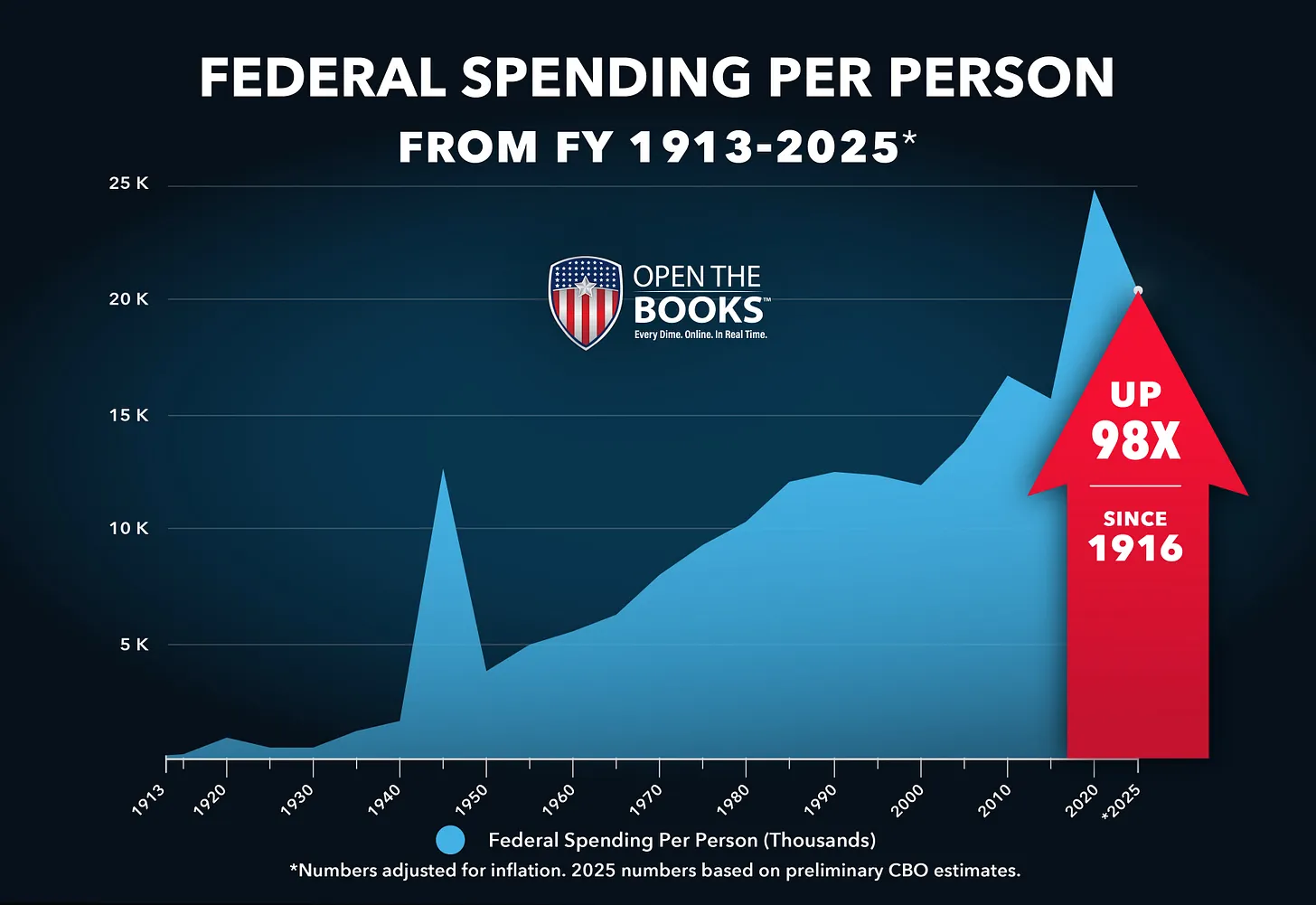
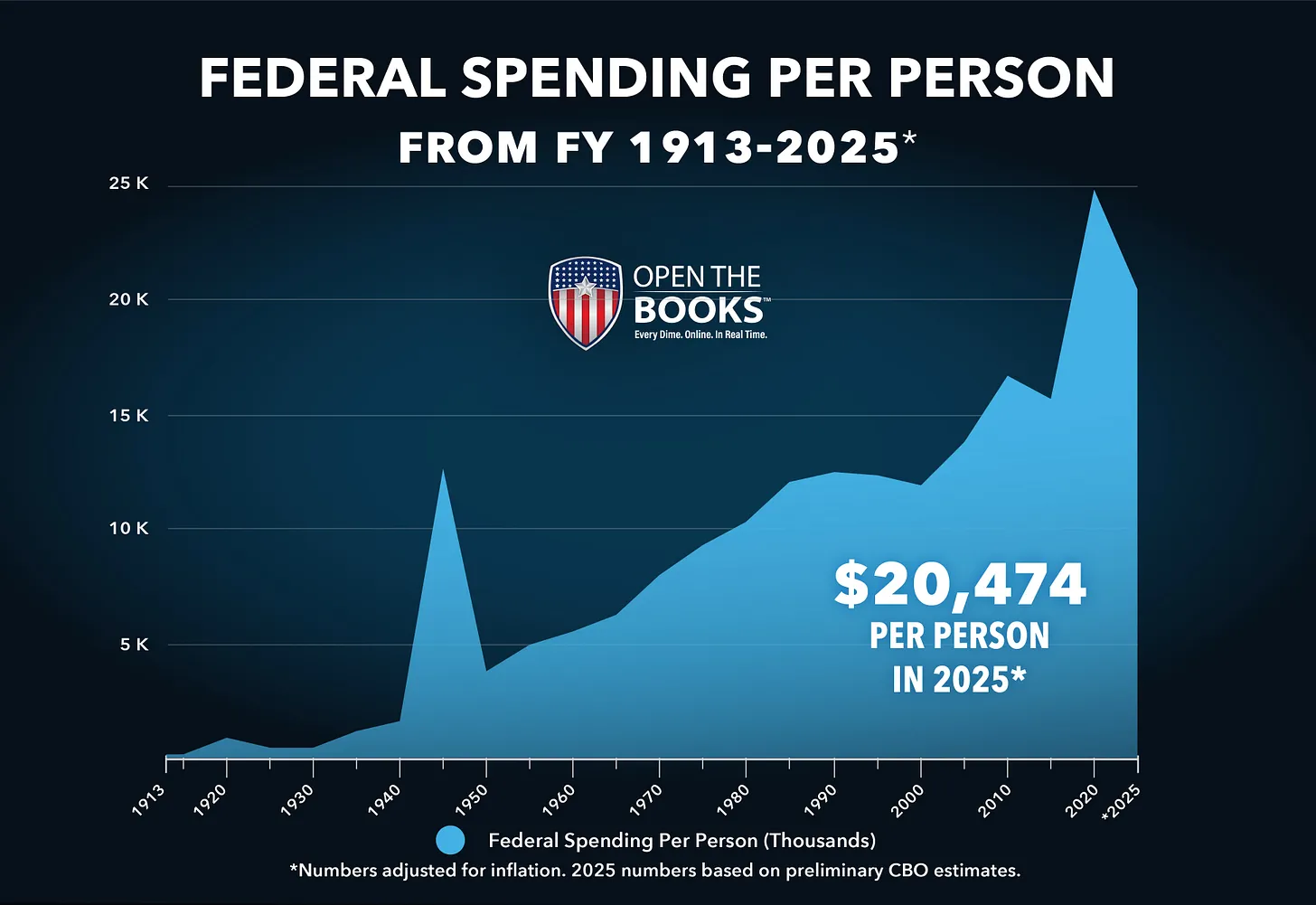
Americans feel they’re suffering an affordability crisis, despite the federal government spending more on them than ever before. Washington is spending 98 times more per U.S. resident than it was during the World War I era, just over a century ago. No, that is not all due to inflation; that is the real growth in federal spending per capita since 1916, adjusted to today’s dollars.
According to Congressional Budget Office estimates, the federal government spent a record $7.035 trillion in fiscal year 2025, or $20,474.19 per person living in the country.
Median household income in 2024 was $83,730. That means for an average four-person household, the federal government spent $81,896.76, nearly the same amount that family would have earned in pre-tax income.
For comparison, the average annual mortgage payment for a house was under $28,000 last year. The Department of Agriculture recommends spending $12,000 to $20,000 annually on groceries for a family of four. Both of those basic needs are eclipsed by federal spending on our example household.
A year at the University of Florida goes for $19,760 in tuition, fees, books, supplies and living expenses. Adding that to the tab would still keep this family’s expenditures below what Washington, DC supposedly invested in them.
Background
Things used to be much different. In 1916, the federal government spent a mere $208.36 per person in today’s dollars. Since then, the trend line has gone upward almost uninterrupted.
Since WWI, there are only a handful of inflection points in modern history when federal spending dipped significantly; each spending retreat followed a massive, disruptive spike.

World War II: At the height of the war, federal outlays reached $12,679.94 per person in 1944 and $12,627.75 in 1945. The war cost the United States roughly $4 trillion (adjusted for inflation) as defense spending skyrocketed as a portion of the total federal budget, Americans bought War Bonds, and Washington made loans to allied nations.
In fiscal year 1946, per capita spending tumbled back to $6,568.66, but once again continued its steady climb upward over the decades.
Mortgage Crisis: As the subprime mortgage crisis threatened the American financial and insurance sectors, lawmakers sought to right the ship with multiple costly measures causing another huge spike in spending. The Emergency Economic Stabilization Act of 2008 was signed into law by President George W. Bush and established the Troubled Assets Relief Program (TARP) to purchase toxic assets on bank balance sheets, many of them complex financial instruments reliant on blocs of risky mortgages. TARP was authorized to spend $700 billion. The following year, President Barack Obama signed the American Recovery and Reinvestment Act of 2009 (ARRA), a major spending bill meant to stimulate the economy at a cost of over $800 billion.
This coincided with a hike in per capita spending from fiscal year 2008 ($14,797.69) to 2009 ($17,346.91).
By 2014, spending had made a soft landing back at $15,087 per person before resuming its steady rise.
COVID: Real spending continued to outpace population growth and reached new heights during the pandemic.
Fiscal year 2019 saw Washington spend $17,207.20 per person, but the 2020 figure exploded to $24,808.23. Fiscal year 2021 was little better at $24,628.26.
Per capita spending never fully retreated, settling to $20,890 in fiscal year 2022.
Today, spending in excess of $20,000 per person appears to be the new norm.
Spending Per Capita Today

Aside from the pandemic, spending per person in fiscal year 2025 was higher than any other time in U.S. history. Fiscal years begin in October, so the most recent year included almost four months under President Joe Biden and more than eight months under President Donald Trump. The spending rate was slightly higher under Trump.
Most of the increased spending came from Social Security, which has more beneficiaries than in 2024 and increased payments to adjust for the cost of living. Medicare and Medicaid also face increased health care costs.
To date, Trump’s tariffs and budget cuts have done little to improve the government’s bottom line. Tariffs brought in roughly $120 billion as of September (while increasing consumer prices), and spending decreased at agencies such as the Department of Education, Small Business Administration and Federal Deposit Insurance Corporation.
However, the savings were offset by decreased corporate income tax revenue and increased spending at the Departments of Defense and Veterans Affairs. The federal deficit for fiscal year 2025 was $1.8 trillion, roughly the same as 2024.
The government was forced to borrow money to cover the difference, including $572.8 billion in July 2025 alone. That’s the most borrowing in a single month ever, aside from the early months of the pandemic.
Much of the spending growth is now predestined as Americans are forced to service an extraordinary national debt. But taxpayers should also scrutinize all aspects of federal spending. Has quality of life, affordability, or innovation improved along with per capita spending? Aside from interest, what else is the government buying that it wasn’t before, back when we were building ourselves into a global superpower?
Open the Books will spend 2026 continuing to expose waste, fraud and abuse wherever it exists and pushing for real-time transparency for taxpayers. Put simply, they deserve more bang for their buck, along with the accountability tools to make it happen.

Your Tax Free Donations Are Appreciated and Help Fund our Volunteer Website
Disclaimer: We at Prepare for Change (PFC) bring you information that is not offered by the mainstream news, and therefore may seem controversial. The opinions, views, statements, and/or information we present are not necessarily promoted, endorsed, espoused, or agreed to by Prepare for Change, its leadership Council, members, those who work with PFC, or those who read its content. However, they are hopefully provocative. Please use discernment! Use logical thinking, your own intuition and your own connection with Source, Spirit and Natural Laws to help you determine what is true and what is not. By sharing information and seeding dialogue, it is our goal to raise consciousness and awareness of higher truths to free us from enslavement of the matrix in this material realm.