EN
EN FR
FR

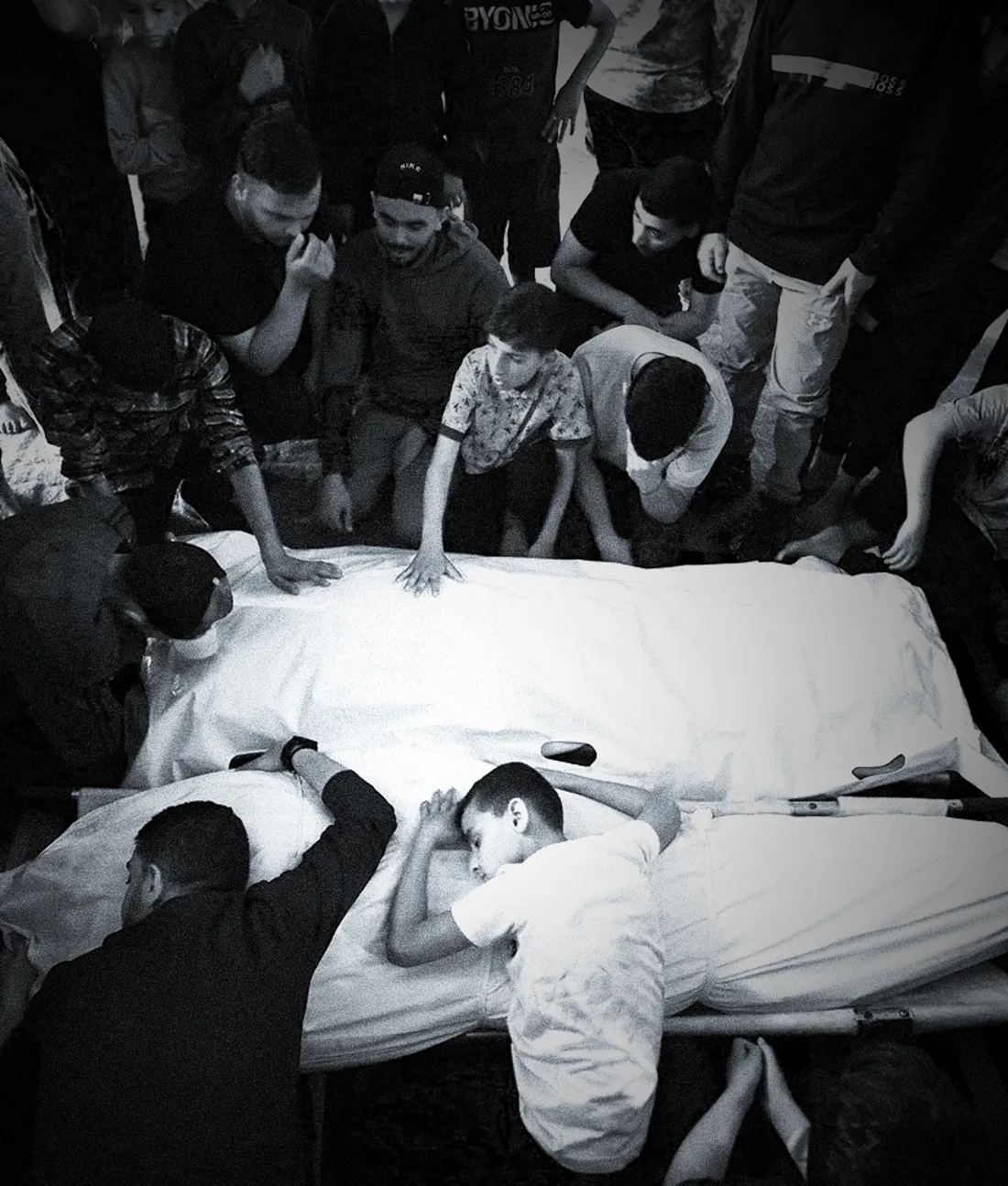
On Wednesday, April 22, an Israeli drone fired a missile that killed three children in the northern Gaza Strip on the spot. The three – Abdullah al-Abed, 9, his brother Salah, 12, and Mohammed Balousha, 14 – were playing outside a mosque in Beit Lahia. Two adults were also killed in the incident. The Israel Defense Forces explained that the strike was aimed at a person who approached the Yellow Line, the line of control in Gaza between Israeli and Palestinian forces.
“I woke up from the bombing, looked around and couldn’t find my children,” their mother recalled at the funeral. “I rushed out and saw them lying on the ground, dead. Abdullah disappeared in a second. A shrapnel tore off his head. Why? What was his fault? Small and very thin. He is very thin. What was his fault? What was his fault? His face and body are full of shrapnel. What did he do to the Jews?”
Two days later, a shell or missile landed on the Karsou family home in southern Gaza. The mother, Islam, who was pregnant with twins, and her two children, Hamza, 13, and Naya, 4, were killed instantly. On May 26, an Israeli helicopter fired at a tent in the Muwasi area. Six-year-old Menna Allah Abu Labda was killed in the attack.
‘Every day, someone is killed, someone is wounded. Death after death. We’re exhausted, God,’ cries a Gaza resident
In a nearby tent were baby Mohammed al-Khatib and his mother, who was holding him in her arms. She was killed, and he lost his leg. He has since undergone six life-saving surgeries. On June 6, a missile struck west of Gaza City. Abdullah Qaddoum and his 8-year-old daughter, Miriam, were killed on the spot. His younger daughter, Malak, died of her wounds two days later. On Tuesday, the number of Gazan fatalities since the cease-fire began on October 11 crossed 1,000, reaching 1,003.
In all cases, the Israeli military claimed its forces were firing at legitimate targets for one of two reasons. They were either targeting Hamas members or suspects who approached the Yellow Line and were thereby endangering soldiers. But the military has not provided detailed explanations for each attack, much as it hasn’t throughout the war in Gaza. No mention of the objective, the potential risk of harm to innocent civilians, or preemptive steps.

‘There’s no safe place in Gaza. We’re far from the Yellow Line, but attacks happen everywhere. It’s scary to move around, I feel the attacks have intensified in our area. For me, this is the most frightening period since the cease-fire began.’
Hala Abu Assi, general coordinator in Gaza for Clean Shelter

Such attacks and similar ones have occurred almost daily during the cease-fire. The number 1,000, based on data from the Gaza Health Ministry – data accepted by all Israeli and international organizations monitoring the Gaza Strip – means an average of four fatalities per day. Since the cease-fire declaration, five soldiers have been killed in Gaza. One was killed by friendly fire, and four others were killed in two separate incidents that occurred in the cease-fire’s first three weeks.
“There are fatalities every day” across Gaza, says one resident, originally from northern Gaza, who lives with his family in a tent in Muwasi. “They eliminate the children who usually approach the Yellow Line to collect wood that they can sell for cooking to help the family,” he says. “Netanyahu kills one wanted person and everyone next to him. He doesn’t care who gets killed or wounded. Sometimes, I just don’t leave the tent out of fear. Our lives are torture. They want us to evacuate Gaza? Let’s go, bring the boats and send us wherever they want. We’re fed up.”
Although army orders permit lethal fire only when a clear and present danger to forces is identified, military sources say that different operational rules exist near the Yellow Line. The army has declared areas east of the line a closed military zone. In many cases, soldiers shoot at anyone wandering in this area.

Within the army, criticism has been voiced about shooting incidents involving Gazan civilians who approached the buffer zone looking for food, equipment or shelter. Although the army usually fires warning shots at those approaching prohibited areas, army officials admit that in some cases it is difficult to distinguish between someone seeking to collect equipment and someone carrying out hostile activity. They say they cannot retroactively justify every incident where Palestinians were harmed. According to United Nations data, 193 Gazans were killed near the Yellow Line during the cease-fire.
Israel’s rules for initiating attacks has also changed with fatal consequences for civilians. Before the war, attacks were approved only when the risk to civilians was very low, and even then only when the target was a senior figure. Since October 7, the army has loosened the rules, permitting attacks on Hamas operatives while putting civilians in their vicinity at great risk. Still, the scope of approved “collateral damage” – a euphemism for innocent civilian lives – still varies according to the importance of the target and the quality of the intelligence.
Defense establishment sources note that targeting senior Hamas figures during the cease-fire requires a series of approvals from senior command levels. They include the chief of Southern Command, the IDF chief of staff, and sometimes even the government. This practice is partly due to political sensitivity with the U.S. administration. Such attacks usually involve legal advice and operational planning by target research personnel and the Israel Air Force, which is responsible for selecting weapons and assessing the consequences of a given attack.

A UN official told Haaretz that its human rights office dealing with Gaza has verified 621 of the first 1,000 fatalities reported by the Gaza Health Ministry. The office takes longer to verify deaths than the Health Ministry, but so far no significant discrepancies have been found between the two bodies’ respective data. According to a UN report released on Friday, 32 percent of the first 574 verified fatalities were children. The UN said 48 of those 183 verified fatalities were killed in incidents where children were the sole victims, “raising concerns about Israeli forces directly targeting Palestinian children,” the report states. A UN official told Haaretz that 15 of 121 women killed during the cease-fire died in incidents where all the victims were women and children.
According to data from the Gaza Health Ministry, 61 percent of the fatalities (614) are men aged 18-60, and 11 percent (109) are women aged 18-60. 25 percent (253) are children under 18. 3 percent are adults (15 men and 12 women) aged 60 and over.
The most dangerous area since the cease-fire has been Gaza City, totaling 353 fatalities, many in its eastern parts. Israel has reportedly killed 230 people and 200 people in the Khan Yunis district.
The Gaza Health Ministry data also shows that most of the fatalities (69 percent) were killed by remote-controlled missile strikes, 15 percent by small arms fire, and the rest by artillery and other munitions. The deadliest month was October, immediately after the cease-fire was declared, when 251 people died. The least deadly month was December, with 61 recorded fatalities. According to Hamas’ information ministry, Israel has violated the cease-fire more than 3,200 times.

In the view of Dr. Ahmed al-Farra, director of Nasser Hospital’s pediatric department in southern Gaza, the war is far from over. His conversation is interrupted because he is urgently called to deal with the hospital’s main generator, which stopped working on Monday due to a lack of oil and spare parts. The backup generator supplies electricity to about 70 percent of the hospital.
“There are currently six women in the delivery room and the air conditioning is not working. These rooms in the center of the building have no windows to the outside. The doctors have no computers, and the offices lack electricity,” he reports. “The war goes on. True, there’s an improvement in food. There are even fruits, although prices are high. It’s also good that people stay in one spot and don’t have to move from place to place. But children are injured and killed every day. Sometimes, 10 or 20 wounded from attacks arrive at the ER at once. Drones occasionally hover over the hospital. You hear shooting all around. They attack here and there.”


Hala Abu Assi, general coordinator in Gaza for the Clean Shelter organization, says: “There’s no safe place in Gaza. We’re far from the Yellow Line, but attacks happen everywhere. It’s scary to move around, I feel the attacks have intensified in our area. For me, this is the most frightening period since the cease-fire began.”
The Gazan death toll from the war crossed 73,000 this week. According to the Gaza Health Ministry, the fatalities – more than 98 percent of whom are identified by full name and ID number – are only those who died violent deaths from Israeli attacks. The database doesn’t include victims of other causes like hunger, disease, living conditions or the destruction of the health care system. Many experts say other causes could add tens of thousands to the overall toll. Since the war erupted, more than 173,000 people have been injured in Gaza.
The military responded: “The IDF directs its attacks solely at military targets, taking steps to minimize harm to civilians and civilian infrastructure in accordance with the laws of war, including taking precautions before carrying out attacks. The Hamas terror organization embeds itself under the protection of the population and uses its civilians as human shields, cruelly exploiting civilian institutions and the presence of the population in the area.” It continued: “Contrary to the claim that Hamas doesn’t violate the cease-fire, in recent months, the IDF has attacked dozens of militants who planned to carry out immediate terror plots against IDF forces operating in the Gaza Strip, thereby removing the threat. Besides attempts to implement terror plots, the IDF observes many repeated attempts by militants to cross the Yellow Line.”
Source: https://www.haaretz.com

Your Tax Free Donations Are Appreciated and Help Fund our Volunteer Website
Disclaimer: We at Prepare for Change (PFC) bring you information that is not offered by the mainstream news, and therefore may seem controversial. The opinions, views, statements, and/or information we present are not necessarily promoted, endorsed, espoused, or agreed to by Prepare for Change, its leadership Council, members, those who work with PFC, or those who read its content. However, they are hopefully provocative. Please use discernment! Use logical thinking, your own intuition and your own connection with Source, Spirit and Natural Laws to help you determine what is true and what is not. By sharing information and seeding dialogue, it is our goal to raise consciousness and awareness of higher truths to free us from enslavement of the matrix in this material realm.