EN
EN FR
FR

by Sayer Ji,
The new bill deletes the “classified” excuse, hands the unredacted record to victims and all fifty state attorneys general, and puts the Attorney General’s own name in the criminal penalties.

EFTA II is being covered as a lawsuit bill. Read the amendment language at the bottom of the text: it strikes the national-security classification exemption, dismantles the Department of Justice’s procedural shield-wall piece by piece, and attaches criminal liability to every redaction the government signs from here forward.
On the morning of July 15, Todd Blanche — the Acting Attorney General of the United States, serving since President Trump’s ouster of Pam Bondi in April and formally nominated in June — sat before the Senate Judiciary Committee for his confirmation hearing. He told the committee that “mistakes were made” in the release of the Jeffrey Epstein files, but that the disclosure was an exercise in unprecedented transparency.

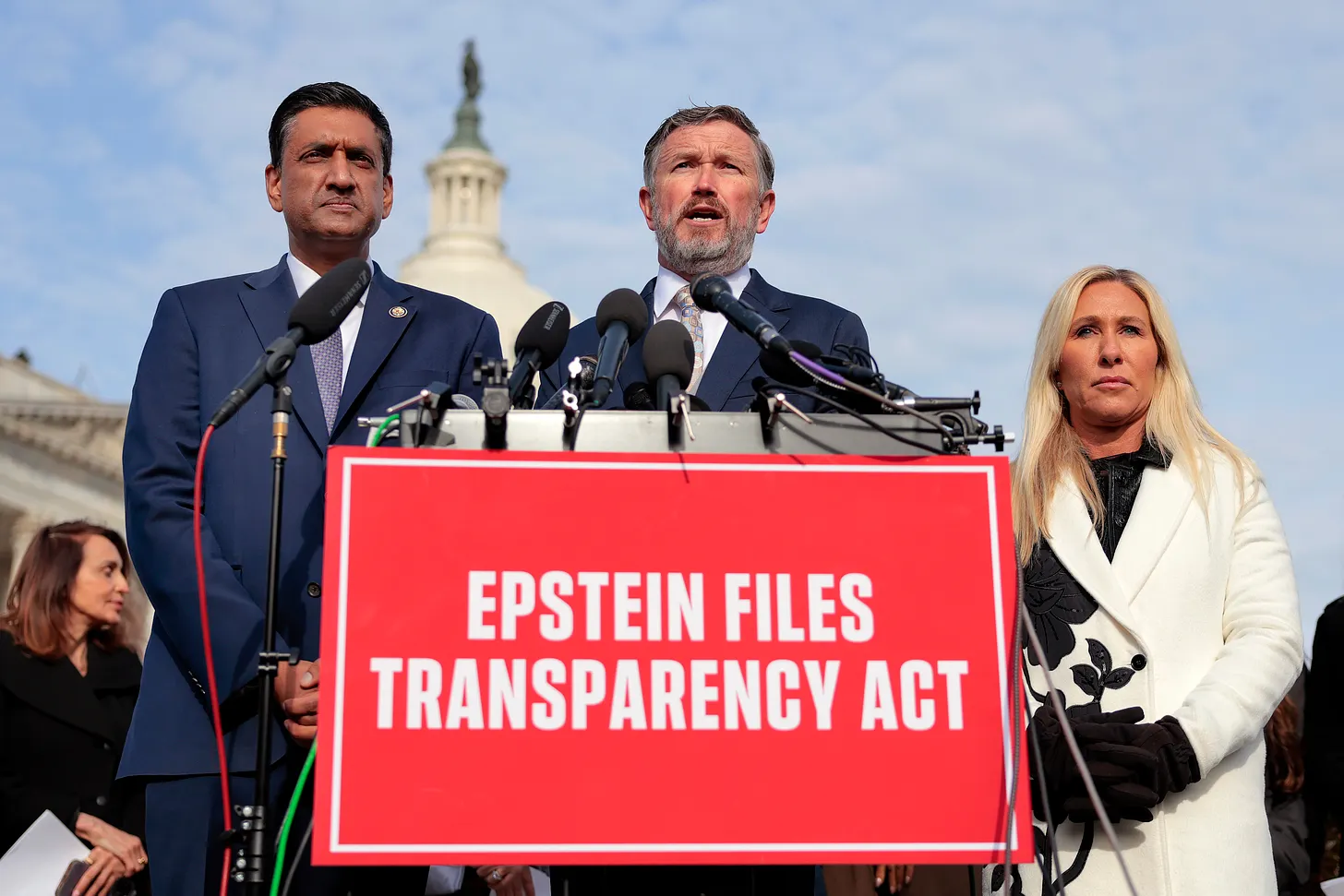
The same day, Rep. Thomas Massie (R-KY) introduced the Epstein Files Transparency Act II — H.R. 9694, per the sponsors’ announcement — co-led in the House by Reps. Ro Khanna (D-CA) and Teresa Leger Fernández (D-NM), with Sens. Jeff Merkley (D-OR) and Ben Ray Luján (D-NM) carrying the Senate version. If the House does not consider it within seven legislative days, a discharge petition will be circulated — the same procedural instrument that forced the original EFTA to the floor over leadership resistance last November.
The timing is not a coincidence. It is a message: the man testifying for the permanent job is the named defendant-in-waiting of the bill introduced that morning.
The coverage will tell you, accurately, that the bill lets state attorneys general and Epstein’s victims sue the Attorney General for withholding files. Massie states the Department “continues to unlawfully withhold over 3 million Epstein files”; Leger Fernández puts it at “as many as 3 million”. Those are the sponsors’ figures, and the imprecision is not sloppiness — it is the condition the bill exists to end. No one outside the Department knows the true count, because the Department’s own accounting has never stabilized. That story first.
I. Eight Months of Managed Disclosure
The Epstein Files Transparency Act became Public Law 119-38 on November 19, 2025, after passing the House 427–1 and the Senate by unanimous consent. It gave the Attorney General thirty days — until December 19, 2025 — to release all unclassified Epstein-related records. What followed is best told through the Department’s own numbers, which change every time they are written down. senate

The statutory deadline passed without the required release. On January 30, 2026, the Department published over three million pages and files, including more than 2,000 videos and 180,000 images — a release it branded, on its own website, the “Epstein Library.” The next day, House Judiciary Ranking Member Jamie Raskin wrote to then-Deputy Attorney General Blanche noting the arithmetic: the Department itself claimed to have identified over six million potentially responsive pages, had released roughly half — including over 200,000 pages redacted or withheld — and was nonetheless asserting full compliance with the Act.
The quality of the release matched the arithmetic. In a March 11 letter requesting a Government Accountability Office review, Senators documented the inversion at the heart of the Department’s redaction practice: records were published with email addresses and nude photographs in which publicly identified and non-public victims could be recognized — the one category the law most explicitly protects — while information identifying powerful business and political figures alleged to be co-conspirators or material witnesses was heavily redacted. The statute’s exemptions had been applied upside down: maximal exposure for the victims, maximal protection for the network.
Then came the takedowns. After publication, the Department removed thousands of records from its own website — not merely records that improperly identified victims, but records relating to allegations against President Trump and others — with no apparent explanation. Hold that fact; the bill’s drafters did.

By spring, the courts were involved. Journalist Katie Phang, represented by the Public Integrity Project, sued over the redactions — including the redaction of sender and recipient names in email exchanges with Epstein concerning a “torture video” and sexual activity with young women, including minors, and the redaction of potential co-defendants’ names from a draft criminal indictment. On June 26, U.S. District Judge Emmet Sullivan granted a preliminary injunction, finding that Blanche “has conceded that he is in violation” of the Act and ordering the Department to remove the specified redactions or show cause by July 2. Sullivan also ordered the Department to publish a log detailing all the redactions, and to hand over the underlying notes from the FBI’s interview with a woman who accused President Trump of assault.
The Department’s July 2 response is the single most clarifying document of the entire eight months. Hours before the deadline, Associate Attorney General Stanley Woodward asked the judge to delay by sixty days or to accept the Department’s reasons for withholding outright — and, disputing Sullivan’s concession finding, wrote: “Indeed, the Department has not knowingly violated, nor has it ever acknowledged violating, the EFTA as it continues working to comply with statutory requirements.” In the same filing, Blanche defended the withholding of millions of files — the Department now describing 3.5 million pages released and another 2.5 million withheld — and offered instead to share additional materials “in camera,” behind closed doors with a judge.
Track the ledger. December: nothing by the deadline. January: half of six million pages, declared full compliance. July: 3.5 million released, 2.5 million withheld, per the Department’s own court filing. July 15: the bill’s sponsors say three million still withheld. Four accountings in eight months, no two of which reconcile. When an institution cannot state a stable number for what it holds, the number is not the problem. Custody is. And custody is exactly what EFTA II transfers.
II. What the Law Actually Ordered
To see what the new bill does, you have to hold the original statute in your hands — not the summary of it, the text. Public Law 119-38 ordered the Attorney General to make publicly available, in searchable and downloadable format, all unclassified records across nine enumerated categories: everything relating to Epstein and Ghislaine Maxwell; flight logs and travel records for any aircraft, vessel, or vehicle; individuals — “including government officials” — named in connection with Epstein’s criminal activities, civil settlements, immunity or plea agreements; entities, “corporate, nonprofit, academic, or governmental,” with known or alleged ties to his trafficking or financial networks; all immunity deals, non-prosecution agreements, plea bargains, or sealed settlements; internal DOJ communications concerning decisions “to charge, not charge, investigate, or decline to investigate”; all communications and metadata concerning “the destruction, deletion, alteration, misplacement, or concealment” of Epstein-related evidence; and the complete documentation of his detention and death.
Congress then barred the motive it anticipated:
“No record shall be withheld, delayed, or redacted on the basis of embarrassment, reputational harm, or political sensitivity, including to any government official, public figure, or foreign dignitary.”
And it permitted exactly five withholdings — segregable portions of records that contain victims’ personally identifiable information; that contain child sexual abuse material; that “would jeopardize an active federal investigation or ongoing prosecution, provided that such withholding is narrowly tailored and temporary”; that depict images of death, physical abuse, or injury; or, at subparagraph (E):
“(E) contain information specifically authorized under criteria established by an Executive order to be kept secret in the interest of national defense or foreign policy and are in fact properly classified pursuant to such Executive order.”
Every redaction was to be accompanied by written justification published in the Federal Register and submitted to Congress. Classified covered information was to be declassified “to the maximum extent possible,” with an unclassified summary released for anything that could not be. And — read this one twice — the original act already contained a tripwire against the obvious evasion: “All decisions to classify any covered information after July 1, 2025 shall be published in the Federal Register and submitted to Congress,” with the date, the identity of the classifying authority, and an unclassified justification. The drafters anticipated, in November 2025, that the Department might respond to a disclosure mandate by classifying its way out of one.
One more provision, because its absence from the record is itself the record: Section 3 requires that within fifteen days “of completion of the release,” the Attorney General report to the Judiciary Committees every category released and withheld, a summary of redactions with legal basis, and “a list of all government officials and politically exposed persons named or referenced in the released materials, with no redactions permitted.” The clock on that report starts at completion. A release that is never complete is a report that is never due — and a list of politically exposed persons that never has to be written. Eight months in, the structure of the Department’s partial compliance is indistinguishable from a strategy for keeping that list unwritten.
III. Striking Subparagraph (E)
Now open H.R. 9694. Near the bottom, in language formatted to read like clerical housekeeping, sits this:
“Section 2(c)(1) of the Epstein Files Transparency Act (Public Law 119–38; 139 Stat. 657) is amended— (1) in subparagraph (C), by striking the semicolon at the end and inserting ‘; or’; (2) in subparagraph (D), by striking ‘; or’ and inserting a period; and (3) by striking subparagraph (E).”
The conjunction edits are cleanup. The operative words are five: by striking subparagraph (E). The victim-privacy exemption stays. The CSAM exemption stays. The active-investigation exemption stays, still bound to “narrowly tailored and temporary.” The death-imagery exemption stays. The classification exemption — the national-security shield — is deleted from the statute.
Precision matters here, because the strawman writes itself and the Department will write it in a brief. Striking (E) does not “release classified secrets.” Section 2(a)’s public-release mandate always ran to unclassified records; (E) was the authority to black-bar classified segregable portions within released records, silently. With (E) gone, that authority is gone, and the only remaining channel for classified material in the public record is the one the original act built at 2(c)(3): declassify to the maximum extent possible, and where genuinely impossible, publish an unclassified summary of what was withheld. No more silent bars. Every national-security withholding becomes a visible, described, justified event. And EFTA II confirms this reading in its own text — its classified-access provision states that nothing in it “shall be construed to authorize the public release of classified information except in accordance with section 2(c)(3).”
Why this exemption? The bill does not say, and I will not pretend the record says more than it does. What can be said as fact: of five exemptions, the drafters — who have spent eight months inside the compliance fight, closer to the withheld remainder than any member of the public — chose to delete exactly one, and it is the one whose invocations Congress cannot independently audit. A victim-privacy redaction can be tested against a name. An active-investigation redaction expires by its own terms. A classification redaction is a locked box marked trust us, held by a Department that missed its deadline, inverted its exemptions, and un-published records without explanation. Legislators do not draft surgical strikes against provisions no one is using. Where a bill cuts tells you where its authors believe the concealment lives. That is an inference — marked as one — but it is the inference the rest of the bill exists to underwrite, because the (E) strike does not travel alone.
IV. The Shield-Wall Comes Down
Around the strike, the bill dismantles the Department’s remaining procedural architecture with the specificity of drafters working from a casualty list.
The privileges. New language inserted directly after the no-embarrassment clause provides that the Attorney General “may not invoke any common law privilege, including the deliberative process privilege, attorney-client privilege, attorney work-product privilege, or law enforcement privilege” to withhold, delay, or redact covered material, except as expressly permitted under subsection (c) — the same subsection the bill simultaneously narrows. The original act barred the political motive for concealment. The sequel bars the legal instruments. The pairing on the page is the argument: Congress no longer distinguishes between the two.
Touhy. For seventy years, the Department’s standard answer to state and local demands for federal records has been its own housekeeping regulations at 28 C.F.R. §§ 16.21–16.29 — the Touhy regulations, which convert every state subpoena into a discretionary request the Department may simply decline. EFTA II provides that those regulations “shall not apply to any request for, or production of, records pursuant to this Act,” that “no federal agency may invoke such regulations as grounds to withhold, redact, delay, or condition the production of any record,” and that the Act’s mechanisms “shall constitute the exclusive procedural framework governing State law enforcement access to records covered by this Act.” The gate the Department has kept since Eisenhower is, for this corpus, removed from its hands.
Removal. The cause of action reaches any “unlawful withholding, redaction, delay, removal, concealment, failure to publish, failure to produce, or failure to justify.” Read the fourth word in that list against the March record: thousands of records taken down from the Department’s own website after publication, with no apparent explanation. Legislative drafting does not include the word “removal” by accident. The bill was written against the conduct, item by item. senate
In camera. And the tightest fit of all: on July 2, the Department’s answer to a federal injunction was an offer to show additional materials “in camera” — behind closed doors with a judge. Thirteen days later, the bill’s production provision arrives with this sentence: “Production under this subsection shall not be limited to in camera review, and no protective order may prohibit the requesting attorney general of a State, district attorney, or other authorized State officer from possessing or using the records as necessary for an investigation or judicial proceeding.” The precise accommodation the Department offered a court six days before introduction is foreclosed by name. This is not a transparency bill with an enforcement provision bolted on. It is a point-by-point answer to eight months of litigation conduct. Spokesman-Review
V. Who Gets to See Everything
Strip away the legal machinery and the bill does one simple thing: it ends the Justice Department’s monopoly on the file. Three groups of people get the whole record.
The victims. Any victim can demand her complete, unredacted file — everything the government has that names her, describes her, or documents what was done to her, including the FBI’s own internal interview reports. Not summaries. Not excerpts a lawyer selected. The file. If the Department stalls, she can sue in her home state, the court is required to move her case to the front of the line, and when she wins, the government pays her lawyers.
Every member of Congress. Any single senator or representative — no committee vote, no subpoena, no one’s permission — can send a written request and must be shown everything, unredacted, classified material included, within seven days. Five hundred and thirty-five people, each holding an individual key. The oldest excuse in Washington — nobody is allowed to see it — dies on contact.
All fifty state attorneys general. For a criminal investigation, a state prosecutor gets the complete file, classified portions included, reviewed in a secure room — and gets to keep it, copy it, and use it in court. The Attorney General of the United States is expressly forbidden from refusing “on the grounds that the material is classified.” He may request handling procedures. He may not say no.
And Congress built the courtroom door low on purpose. Under the bill, you’ve been harmed if the stonewalling damaged an investigation, blocked a victim’s statement, denied you information you were legally owed — or cost you a hundred dollars. One hundred dollars. After eight months of watching the Department argue that no one has standing to complain, Congress removed the argument.
One detail shows how closely the drafters were watching. On July 2, the Department’s best offer to a federal judge was to show additional materials “in camera” — behind closed doors, to the judge alone. Thirteen days later, this bill arrived with language forbidding exactly that arrangement as a ceiling: prosecutors get the records in hand, not a glimpse in chambers. Congress read the Department’s offer and wrote its refusal into law. Spokesman-Review
VI. Every Black Bar Must Explain Itself
Right now, the released files contain millions of black bars justified in bulk — vague, collective explanations covering oceans of ink. The new bill changes one word in the old law: where the statute said all redactions must be justified, it now says each redaction. Every single black bar gets its own written explanation, published publicly and sent to Congress.
Here is why that one word is a revolution. Every explanation can now be checked. A member of Congress or a state attorney general can lift the bar, read what’s underneath, and compare it to what the government claimed. And an official whose explanation is false faces prosecution under the same federal laws used against people who lie to FBI agents or shred evidence — with the bill naming who’s on the hook, all the way to the top: “including the Attorney General of the United States and the Director of the Federal Bureau of Investigation.”
The redactions stop being a wall. They become a ledger — a public, signed, criminally enforceable record of exactly what the government decided you couldn’t see, entry by entry, with a name attached to every entry.
And the Department has already told us it sees this coming. In its July 2 court filing, it did not say it hasn’t violated the transparency law. It said: “the Department has not knowingly violated, nor has it ever acknowledged violating, the EFTA”. Read that adverb again. Knowingly. That is not a denial. That is a defense — drafted in advance, by careful lawyers, for a prosecution that doesn’t exist yet. Congress noticed the wordsmithing too: the bill punishes explanations that are misleading, not just false. The technically-true dodge is being written out of the game before it’s played.
VII. The Redactions Change Sides
For eight months, every black bar protected the government. This bill reverses the polarity.
Under the new law, if the Department blacked out your name in these files as a victim, that black bar is itself official recognition that you are one — and that recognition is what unlocks everything: your right to your complete unredacted file, and your right to sue when they stall. The government cannot hide a woman’s name without simultaneously handing her the key to the room.
Sit with that design for a moment. Every black bar the government drew to keep someone invisible now creates a person with the legal right to look behind it. The instrument of concealment becomes the instrument of discovery. Whoever drafted that clause understands this record the way its closest readers do: in these files, what the government hides is the most precise map of what it fears.
One flaw should be fixed before passage: the bill gives this right to living victims and says nothing about the families of victims who did not survive to use it. Given how many did not, that silence is not small.
VIII. Not One Man. A Network. In Law.
For seven years, the official story has had a convenient ending: Epstein is dead, Maxwell is in prison, case closed. This bill writes the opposite into federal law. It defines the “criminal network” to include everyone who “participated in, assisted, facilitated, funded, concealed, profited from, obstructed investigation of, or otherwise enabled” the abuse — and extends the list of crimes to money laundering, bribery, extortion, and racketeering.
Read those verbs slowly. Funded. Concealed. Profited. Obstructed. The money men. The fixers. The ones who made investigations disappear. None of them ever appeared on a flight log, and all of them are now inside the definition. Congress is no longer describing a dead predator. It is describing a living system — and giving that system a legal name, so that the next prosecutor doesn’t have to argue about what the case is. The law now says what the documents have said all along.
IX. New Mexico Is the Live Wire
Every provision above has a beneficiary already standing at the door, and his story is the whole story in miniature.
In 2019, New Mexico opened an investigation into Zorro Ranch — the sprawling property Epstein owned south of Santa Fe, where survivors say young women were brought and abused. Federal prosecutors in New York asked the state to stand down so the federal case could proceed. The state complied. The federal case ended weeks later in a Manhattan jail cell. And then: six years of nothing.

This February, after reading the files Congress forced out, New Mexico’s Attorney General Raúl Torrez reopened the case — saying the previously sealed FBI files warranted further examination — and this time state investigators searched the ranch itself. Then his office hit the same wall as everyone else. By his count, the federal files contain roughly 13,000 references to Zorro Ranch — most of it blacked out. His office made six requests for the records, starting February 13. More than 130 days passed with the files still locked away, while he warned of what delay costs a criminal case: witnesses scatter, memories fade, evidence degrades. And the office now telling New Mexico the records are tangled up in “the protective orders that are in place”? The same New York office that asked the state to stand down in 2019.
Here is why this front matters more than any other. A state prosecution is the one door Washington cannot lock. No federal plea deal, no federal immunity agreement, no decision made by any Attorney General in D.C. protects anyone from charges brought by a state. New Mexico answers to its own laws and its own people. This bill hands its prosecutors the complete, unredacted file — classified portions included — and forbids the federal government from burying it in a judge’s chambers or under a protective order. The federal government has shown us, across nineteen years and two smothered state investigations, what it does with exclusive custody of this case. If EFTA II becomes law, the exclusivity ends — and the reckoning starts in Santa Fe County.
X. The Clock
The Department will fight this. It will argue that only the President controls classified secrets, that individual members of Congress can’t sue the executive, and it will seek years of appeals. Let it. One independent journalist already sued under the existing law — and won. A federal judge found the Department “has conceded that he is in violation” of the Act and ordered black bars lifted. This bill doesn’t invent enforcement. It takes what one plaintiff proved possible and multiplies it by every victim, every state, and every member of Congress in America.
Now the clock. If the House doesn’t act within seven legislative days, a discharge petition circulates — the same tool that forced the original bill to the floor over leadership’s objections last fall. That bill passed 427 to 1. Every member who cast that vote is about to be asked whether they meant it. A vote for EFTA II is a vote to delete the national-security exemption from the Epstein files law, to open the complete file to themselves and to all fifty states, and to make lying about a redaction a crime with the Attorney General’s name in the statute. A vote against it is an argument that the last eight months — the missed deadline, the victims exposed while the powerful were protected, the records quietly deleted, the numbers that never add up the same way twice, the injunction, the stall — have earned the Department another season of trust.
So watch the next seven days closely. Watch who reads the bill before opposing it. And watch, above all, who understands exactly what subparagraph (E) was — the classified-information shield — and fights to keep it anyway. Because here is what eight months inside the released half of this record has taught me: the files we already have document a twenty-year financial architecture — the funders, the offshore structures, the institutions that turned proximity to Epstein into capital — which I have been mapping, document by document, Bates number by Bates number, in my ongoing 30-part investigation, beginning with Part I: The Epstein Files Illuminate a 20-Year Architecture Behind Pandemics as a Business Model. That is what the government released. EFTA II is the fight over what it still holds. In this record, as from the beginning, the architecture of concealment is the confession — and the confession is not finished.

Sources:
- H.R. 9694, Epstein Files Transparency Act II, introduced text as posted by the sponsor: https://massie.house.gov/UploadedFiles/EFTA_II.pdf
- Epstein Files Transparency Act, Public Law 119–38, 139 Stat. 656 (Nov. 19, 2025), enrolled text: https://www.govinfo.gov/content/pkg/PLAW-119publ38/html/PLAW-119publ38.htm
- Press release, Offices of Sen. Merkley et al., July 15, 2026: https://www.merkley.senate.gov/massie-khanna-leger-fernandez-merkley-lujan-introduce-the-epstein-files-transparency-act-ii/
- Ranking Member Raskin letter announcement, House Judiciary Committee Democrats, Jan. 31, 2026: https://democrats-judiciary.house.gov/media-center/press-releases/ranking-member-raskin-requests-review-of-unredacted-epstein-files-in-doj-s-possession
- Senators’ GAO review request letter, Mar. 11, 2026: https://www.merkley.senate.gov/wp-content/uploads/GAO-Epstein-Files-Redactions-Review-Letter.pdf
- ABC News, June 27, 2026 (Sullivan injunction): https://abcnews.com/Politics/judge-orders-doj-turn-unredacted-epstein-files/story?id=134228532
- ABC News, July 2, 2026 (DOJ response): https://abcnews.com/Politics/doj-declines-turn-additional-epstein-files-redactions/story?id=134430675
- The Spokesman-Review, July 2, 2026 (Blanche filing; 3.5M/2.5M figures): https://www.spokesman.com/stories/2026/jul/02/doj-defends-decision-to-withhold-millions-of-epste/
- CNN, July 9, 2026 (Torrez letter): https://www.cnn.com/2026/07/09/politics/epstein-new-mexico-raul-torrez-letter-blanche
- Source New Mexico, July 2026 (Torrez letter text): https://sourcenm.com/briefs/new-mexico-ag-torrez-says-feds-impeding-criminal-epstein-investigation/
- KOB 4, July 2026 (13,000 Zorro Ranch references): https://www.kob.com/new-mexico/4-investigates-ag-torrez-turns-attention-to-blanche-over-epstein-files/
- Al Jazeera, July 9, 2026 (2019 Balderas suspension): https://www.aljazeera.com/news/2026/7/9/new-mexico-accuses-us-justice-department-of-impeding-epstein-investigation
- CBS News, July 15, 2026 (Blanche confirmation hearing): https://www.cbsnews.com/live-updates/todd-blanche-confirmation-hearing-senate-attorney-general/

Your Tax Free Donations Are Appreciated and Help Fund our Volunteer Website
Disclaimer: We at Prepare for Change (PFC) bring you information that is not offered by the mainstream news, and therefore may seem controversial. The opinions, views, statements, and/or information we present are not necessarily promoted, endorsed, espoused, or agreed to by Prepare for Change, its leadership Council, members, those who work with PFC, or those who read its content. However, they are hopefully provocative. Please use discernment! Use logical thinking, your own intuition and your own connection with Source, Spirit and Natural Laws to help you determine what is true and what is not. By sharing information and seeding dialogue, it is our goal to raise consciousness and awareness of higher truths to free us from enslavement of the matrix in this material realm.