EN
EN FR
FR

by Shaiel Ben-Ephraim,
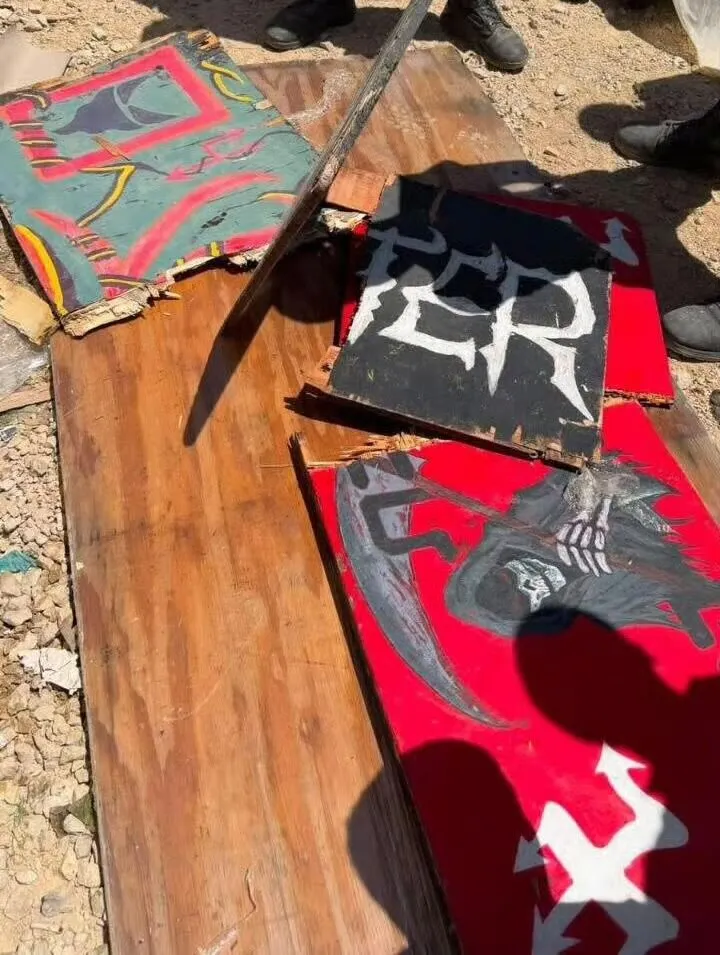
There was a massive mutiny in Sde Teiman as soldiers rebelled against the removal of satanic symbols related to their hazing practices. Here is what this tells us about the IDF and Israeli society.
A large number of IDF soldiers in the infamous Sde Teiman camp, known for torturing detainees, stormed out of the base today, and many refused to return. Why? Were they protesting torture? As if. They were protesting that signs signaling their sadistic hazing rituals, carrying seemingly satanic imagery, had been torn down. That led to the largest act of insubordination in recent IDF history.

Here is what this means.
A Tradition of Cruelty and Sadism
This isn’t new. Back in August 2018, a fresh recruit to the Maglan commando unit, named Ili Hayut, jumped out of a Humvee and was never the same. It was just ten days into his service at Maglan. At the end of the camouflage training, the commanders announced the traditional ritual: gather thorn branches and place them in a massive pile and then jump onto them from a vehicle. He broke a vertebra in his neck and was left paralyzed.
This tradition is not in the training manuals or in any brochure. But it is part of the IDF way of life.
He broke a vertebra in his neck and was left paralyzed. As he writhed in pain, his comrades did not believe him, picked him up and sat him upright. The pain was unimaginable. He remembers waiting after that in agony for an evacuation that did not come. He later recalled: “I understood they were probably hesitant to call an evacuation because they’re worried about themselves. Afraid of what would happen to them.”
The hospital was just seventeen minutes away. But it took two hours and ten minutes. They dropped him off the stretcher. He had to ask the ambulance crew to turn on the siren.
The jump was filmed. When his parents asked for the commander’s phone, the segment was gone. A laboratory told the family it had been deleted in a way that could not be recovered.
What about the investigation? There wasn’t one for a year and a half, until the Military Police opened the investigation. In March 2021 the Military Advocate General closed the case with no criminal charges. Because of course it did. Officers received reprimands and had their promotions delayed by a year or two.
The Maglan commander spoke to Ili at his bedside. He told him, it was “a tradition of many years in the unit. And a tradition that is, let’s put it this way, idiotic.” That is one way to put it.
A commission was formed to look into it and its head promised Hayut he would investigate how widespread the practice was in other units. Of course, nothing happened. Hayut, said:
“I wasn’t surprised that it wasn’t done, because the cover-up culture was here from the start. I only want to prevent the next case.”
Other Nightmarish Cases
2012. In Givati’s Tzabar Battalion veterans convened pazam trials, seniority trials, where they sentenced juniors to twenty or sixty seconds of beating. Video showed a soldier with his eyes covered being kicked on the floor by his company-mates while others giggled in the background. A victim described being beaten “with wooden sticks and broom handles until they broke,” leaving marks “red, purple and swollen.” The plea negotiations aimed at a total sentence of less than two months…
2012, again. In Kfir’s Nahshon Battalion, Sahar Mizrahi touched the pazam stick, a rod only the two senior intakes were permitted to handle. Ten soldiers jammed the door shut with a chair, and beat him; each time he collapsed, they lifted him up and beat him again. Broken ribs, a ruptured spleen. Nine were convicted and sentenced to fifty-eight days’ detention, less seven days of holiday clemency, and demoted to private.
His mother said:
“This isn’t a punishment — they got a summer camp. It’s a shame and a disgrace. They’ll go out on leave over the holidays, and my son will go on lying at home, incapacitated.”
2024–25. In the Arrow air-defence array, veterans ran pazam trials in which they appointed themselves judges over junior soldiers. Seven were arrested. The suspicions at arrest included aggravated rape and acts of sodomy. Several told investigators the acts had been done by mutual consent and “as a joke.” Yes, the rape was treated as a joke. The lead defendant got sixty days and kept a clean record.
May 2026. The Times of Israel, which is the only outlet anywhere to report this case, described four veterans of the Panther Battalion beating a younger soldier at an informal ritual in which older troops present juniors with their personal gear. He was punched in the ribs and struck in the back with a weapon attachment: punctured lung, broken rib, internal bleeding. Surgery, days in intensive care, and he “is not expected to return to combat duty.” Four were indicted.
The problem isn’t so much that this happened. It is that the army is fine with it. The army prison is notoriously lax and sometimes even enjoyable. Records were often kept untarnished. Life for the perpetrators went on as if nothing happened, while the victims remained traumatized or even paralyzed.
Every army does this
I have been a vocal critic of the IDF and, I believe, with good reason. But armies are generally ugly places where male violence is enshrined and hazing is part of the normal procedure. True, it is generally less extreme now than it was in the past. But I doubt you will find a military without hazing.
In the Russian army it is a massive and awful phenomenon. The Russians have a word for it, dedovshchina: “rule of the grandfathers.” The Canadian Airborne Regiment was disbanded in 1995 after a videotape of its initiation rites came out, showing a Black soldier led around on a leash with “I love the KKK” written on his back.
But the IDF case matters. This event didn’t take place in a vacuum. It took place in a base that has become the most infamous military torture and murder camp of recent history. Sde Teiman. A place of which nightmares are made. And it gives us a window into the minds of the people serving there. The results are horrific.
The signs
Sde Teiman, an army base and prison in Israel, has been at the epicenter of the IDF’s crisis of morality and humanity. That includes, most famously, the cases of torture, murder, and rape. But it had also become the center of a horrific culture of hazing.
On the thirtieth of July, 2026, the commander of the Tzabar Battalion decided to do something about it. He walked through his companies’ quarters at Sde Teiman and started taking down signs.
The signs he took down were utterly horrifying. Some were the normal stuff. But among them were “wooden signs of Satan, the Angel of Death and others.” One of the wrecked signs carried a hellish motif and the words “Kingdom of Devils.” A soldier told Walla that one of the commanders used a five-kilogram sledgehammer on one of the emblems. It was filmed.
The soldiers were outraged that their culture of harassment, violence and hazing had been disturbed. They walked off the base, leaving their weapons behind, chanting an obscenity about their officers. How many is genuinely contested: Ynet, Mako and Haaretz said dozens; Israel Hayom and Channel 14 said more than a hundred; Kan said more than two hundred; Walla’s headline said hundreds.
It was not only privates. Israel Hayom recorded one of the commanders addressing the men as they went:
“Everyone here knows the consequences of what he is about to do. We are going together now, as a battalion. I am proud of every single person here for what he is doing right now. There are new soldiers here who do not know what the consequences are, but none of that matters. Being absent without leave, going to prison, none of that matters.”
The battalion commander then wrote to their parents. It is the most valuable document in the story, because he is not a critic of the army:
Any of you who knew seniority games of “juniors and veterans” from your own military service knows how serious the incident is, and how many soldiers are harmed by it through violence and humiliation. Therefore, I decided to break wooden signs of Satan, the Angel of Death and others — signs that represent exactly these things.
He added that he had removed the rest but kept a few, “out of an understanding of their sentimental value,” and stated flatly: “There is no connection whatsoever between the signs and the battalion’s fallen or memorial corners, contrary to what has been claimed in some of the media.” That last clause is aimed at Kan, which had reported the destruction of a memorial corner, and at the soldiers’ own claim that plaques for men killed in Lebanon went under the hammer with the rest. The dispute is unresolved.
What the fighters told their parents, as Walla reported it:
“What broke the fighters were the videos. Seeing their symbols being destroyed. And with a hammer, no less. It was a humiliation.”
That word. It is the same one the commander used for what the signs did to the younger soldiers.
Three things that are not ordinary
It has been done before, and it did not produce this. In June 2013, after a hazing scandal in Golani’s 12th Battalion, the brigade abolished the veterans’ symbols. Ynet reported at the time that veteran-status markers “such as flags and pazam sticks” were cancelled and the veterans’ club opened to everyone; Mako’s account is fuller — soldiers were told to take a five-kilo hammer to the company statues, flags bearing the names of company veterans were taken, painted signs removed, company songs banned. The soldiers were furious. They said publicly that the command had “erased a tradition of generations who fought and sacrificed themselves for the country.”
They complained to reporters. Thirteen years later, the same order led to a walkout. That shows that the importance of this culture has grown. Significantly.
The imagery. There is a stupid version of this argument. Nobody at Sde Teiman was worshipping the devil. Not literally anyway. This is closer to a skull on a biker jacket than to a black mass. But notice what the concession costs. Infantry unit art is usually a lion, a fist, a wolf. Somebody in Tzabar decided the truer emblem of what the veterans were to eighteen-year-olds was the Angel of Death, hung on the wall, in wood, where everyone could see it. Nobody in the ensuing argument disputed what the signs were for. The dispute was over whether a battalion commander had the right to take them down.
The Torture Camp. Sde Teiman is a long-standing army base in the Negev. From October 2023 it also held Palestinians captured in Gaza, first in an emptied tank hangar and then in further hangars converted into pens, alongside a field hospital and a separate Shin Bet interrogation compound. Soldiers who served there described four main pens of fifty to a hundred men each and a smaller one for minors. By late May 2024 some four thousand Gazans had passed through.
The State of Israel told its own High Court that all new detainees at Sde Teiman are “handcuffed and blindfolded all day long,” in exceptional cases with ankle restraints too, “for the first four days of their detention.” A doctor working at the facility wrote to the Attorney General and the defence and health ministers: “Just this week, two prisoners had their legs amputated due to handcuff injuries, which unfortunately is a routine event.” And: “This makes all of us — the medical teams and you, those in charge of us in the health and defense ministries, complicit in the violation of Israeli law.”
Physicians for Human Rights–Israel documented ninety-four Palestinian deaths in Israeli custody between October 2023 and August 2025, and four more in the month before publication. Twenty-nine of the ninety-four were at Sde Teiman, more than at any other single facility in the dataset.
There are credible reports of rape used systematically against detainees. Of deaths caused due to beatings. Sde Teiman is hell on earth. Just the place for the Angel of Death.
What the silence tells you
I checked every Israeli outlet that covered the walkout — Ynet in both languages, Walla, Mako, Maariv, Kan, Channel 14, the Jerusalem Post, Times of Israel, Israel Hayom, and Haaretz in Hebrew. Not one connected the story to the detention facility, the detainees, or the case that had collapsed four and a half months earlier.
The single trace of that history anywhere in the coverage was accidental. The Jerusalem Post illustrated its report with a file photograph, and the agency caption beneath it still read: “Demonstrates protest against the detention of Israeli reserve soldiers suspected of assaulting a Hamas terrorist, at the Sde Teiman military base near Beersheba, July 29, 2024.”
I am not claiming these soldiers tortured anyone. There is no specific record of that, though it is quite possible that occurred too. I could find no record placing Givati, or any conscript infantry brigade, on guard duty at the detention compound.
Here is what I do have. Asa Kasher, who wrote the IDF’s Code of Ethics, published an analysis in the Institute for National Security Studies’ journal in August 2024, written in direct response to Sde Teiman. Collective abuse, he wrote, “did not appear from nothing, without other phenomena of similar kinds preceding it, which led to the bottom of the slippery slope.” He described the “cancerous character of the negligence” that permits it, and then this:
“It is impossible to limit it to marginal components of the working system. Perhaps it appears first at the margins, but from there it spreads, naturally and continuously, toward the central components of the system as well.”
That is not me. That is the man who wrote the rules.
The IDF has been loud and clear on how it feels about torture, whether it involves Palestinian detainees or fresh conscripts. It simply doesn’t care. Violence against a comrade is worth fifty-eight days, or a delayed promotion, or nothing at all. Torture against Palestinians is meaningless. The charges were dropped on the few soldiers accused of torture.
Look, every army has hazing. Not every army has pictures of the Angel of Death put up in a torture camp and performs mutiny if it is taken back. Why does the Angel of Death mean so much to the IDF? Because the IDF is, for all intents and purposes, an actual angel of death. Bringing death and destruction to Gaza, Lebanon, and the West Bank daily. It loves its symbol.
Source: https://shaielbenephraim.substack.com

Your Tax Free Donations Are Appreciated and Help Fund our Volunteer Website
Disclaimer: We at Prepare for Change (PFC) bring you information that is not offered by the mainstream news, and therefore may seem controversial. The opinions, views, statements, and/or information we present are not necessarily promoted, endorsed, espoused, or agreed to by Prepare for Change, its leadership Council, members, those who work with PFC, or those who read its content. However, they are hopefully provocative. Please use discernment! Use logical thinking, your own intuition and your own connection with Source, Spirit and Natural Laws to help you determine what is true and what is not. By sharing information and seeding dialogue, it is our goal to raise consciousness and awareness of higher truths to free us from enslavement of the matrix in this material realm.