EN
 FR


Scour the planet for the worst of the worst….give them everything free…and tell them they are gods children….a god who murders children…and let them loose…did we miss something?
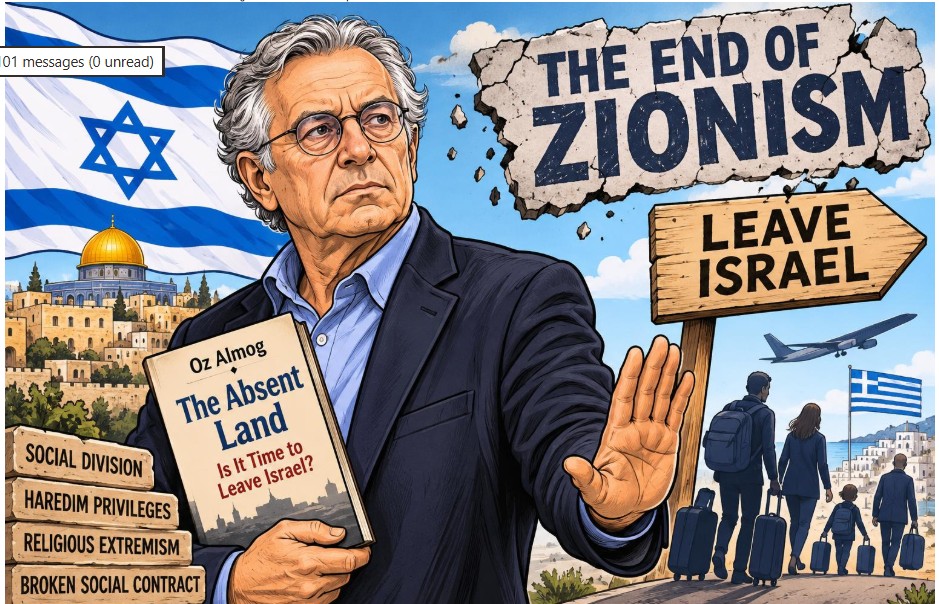
Hawza News Agency – Israeli sociologist Oz Almog has declared “the end of Zionism” and Israel’s arrival at “the point of no return,” calling on liberals to leave the country in his new book, “Absent Land: Is It Time to Leave Israel?”.
Hawzah News Agency – Israeli sociologist Professor Oz Almog believes that Israel has reached a point where it is difficult to return to its former path, declaring “the end of Zionism.” He called for people to leave Israel.

Almog, a professor of sociology at the University of Haifa and a leading researcher on Israeli society, has spent decades studying Israeli identity and its transformations. He has published books, research papers, and lectures addressing lifestyles, values, beliefs, and social changes in Israel. He is the son of former Israeli Navy Commander Rear Admiral Zeev Almog and children’s literature scholar Dr. Gaula Almog.
Oz Almog warned that a change of government would not address the profound transformations occurring in Israeli society, marked by the rise of religious and nationalist movements and the erosion of the social contract. In his new book, “The Absent Land: Is It Time to Leave Israel?”, the scholar of Israeli society goes so far as to recommend leaving Israel, arguing that remaining there could mean abandoning personal values and the future of one’s children.
In a stance reflecting the extent of frustration within sectors of the Israeli academic and liberal elite, Almog called on liberal Israelis to seriously consider leaving Israel, arguing that Israel has reached a “point of no return,” and that the chances of restoring its “path of enlightenment and pluralism” are extremely limited, even if the government changes.
In an interview with the Hebrew website “Walla” from Greece, coinciding with the release of his new book “A Land That Is Absent: Is It Time to Leave Israel?”, Almog, 66, said that his answer to the question posed in the book’s title is “yes,” explaining that his recommendation does not stem from his belief that there is another ideal place, but rather from the accumulation of political, social, and security transformations that Israel has witnessed in recent years.
Almog says that the last four years have been a difficult journey for him of reviewing positions and abandoning previous perceptions about Israeli society, stressing that the reasons for his disappointment are not limited to the current government or what he calls the “coup against the regime,” nor to the October 7, 2023 attack and the war that followed it, but are related to what these events revealed about profound transformations in the structure of Israeli society.
In a direct criticism of Prime Minister Benjamin Netanyahu, Almog said that the latter did not invent the weaknesses and divisions existing in society, such as feelings of deprivation, jealousy, religious and national extremism, and the decline of commonalities, but that they existed before he came to power, noting that he realized the possibility of exploiting them politically and worked to nurture them and turn them into tools of governance.
Almog accused Netanyahu of stoking fears, reviving old grievances, and turning frustration into hatred, as well as justifying abuses and convincing broad sectors that loyalty to the political camp is more important than truth, law, and morality.
While noting that Netanyahu may be on his way out of office after the elections, Almog stressed that the problem goes beyond the person of the prime minister, saying that Netanyahu has relied on social and cultural currents that have strengthened their influence over the years, adding: “The government can be changed, but changing society is much more difficult.”
He illustrated this with the example of someone waiting for a bus that never arrives, year after year, election after election, bad government after crisis, war after war, and yet another promise of change, until one day he stops waiting for the bus and decides to continue on foot. This is a metaphor he uses to explain his shift from waiting for Israel to reform to believing he must leave it.
Being labeled a traitor: Survival might mean abandoning oneself.
Almog opposes the view that leaving Israel is a form of treason, and believes that describing those who leave as traitors is, in his words, a way to exert emotional pressure on them and keep them inside Israel.
He says the paradox in the current circumstances is that survival may require a person to “betray something far more important, namely himself,” calling for a revival of the idea of the “Wandering Jew” and the individual’s right to choose the place that provides him with a better and safer life.
In the conclusion of his book, he bases his argument on the notion that Jewish identity does not impose a permanent attachment to a particular land, and that Israelis have the right to choose a different life outside the country, citing the Prophet Abraham by saying that “Abraham, our father, himself did not remain in his house.”
Through this argument, Almog attempts to break one of the established taboos in Zionist discourse, which views leaving the country as abandoning the “national project,” presenting emigration as a legitimate moral and personal choice, not evidence of weak belonging.
The social contract with the Haredim and the national-religious movement has broken down.
Almog places at the heart of his analysis what he considers a breakdown of the social contract between sectors of Israeli society, particularly the relationship with two groups he sees as among the most prominent centers of political and social influence: the Haredi community and the messianic Zionist religious movement.
Regarding the Haredi community, Almog criticizes what he calls the “scholarship society,” arguing that a socio-economic model based on isolation, dependence on government support, non-military service, and the use of political influence to obtain privileges, constitutes a burden on the rest of society.
He says that this model is based on taxes paid by working Israelis and on what is provided by individuals in sectors performing military service, referring to what he sees as an imbalance in the distribution of burdens, rights and duties among segments of society.
As for the religious Zionist movement, Almog believes that it has witnessed what he described as a “dangerous transformation” that has led to a change in the nature of the original Zionist project, as it has moved, according to his analysis, from a project aimed at building a state and providing a sovereign haven for Jews to an orientation that focuses on land, settlements and hills, and is accompanied by violence and catastrophic religious salvation visions.
This shift is seen as reflecting a transition from a Zionism that focused on building the state and its institutions to movements that place religious and messianic considerations above civil and political considerations.
Between these two currents, Almog believes that the secular and liberal middle class finds itself besieged, a class which he describes as the backbone of the economy, the army, and scientific and professional institutions.
He notes that this segment includes, in his estimation, about 400,000 people working in the advanced technology sector, scientists, doctors and military leaders, who bear a significant portion of the burdens of the economy and military service.
He says that the signs of emigration are not limited to loud announcements or final departure decisions, but appear in gradual steps taken by some Israelis, such as obtaining foreign passports, opening bank accounts abroad, looking for schools for their children, and inquiring about property prices in Greece and Portugal, or about healthcare systems in Cyprus.
Almog describes these steps as an attempt to retain the “option” to leave without making a final decision at the moment, adding that the word “option” allows one to leave the country without actually leaving it yet.
The sociologist links this trend to what he sees as a breakdown in the social contract with the ultra-Orthodox community, saying that doctors, engineers, and workers in the high-tech sector may feel that their money and military sacrifices are being used to support a political system that is incompatible with their values and funds groups that, as he describes it, do not perform the same obligations.
He warns that the exit of this productive segment, even gradually, could deprive the state of one of its economic, military and scientific pillars, and push it towards a crisis that is difficult to contain.
Almog cites Jerusalem as an example of the consequences that may result from the decline and emigration of the productive class, as he believes that it has lost a portion of its population capable of supporting its economy, and has become a poor city dependent on government budgets and rescue programs.
This example is used to warn of what might happen across Israel if the phenomenon of silent emigration among skilled workers in vital sectors expands, considering that the departure of this group will leave no room for the emergence of “another Israel” capable of saving the state from its crisis.
According to his vision, the question facing liberal Israelis is no longer whether leaving Israel constitutes treason, but rather whether staying in it has become, in light of the current transformations, an abandonment of oneself and the future of one’s children.
Almog admits that writing a book calling on Israelis to leave Israel was not something he imagined he would ever do.
He said in the book: “In my worst nightmares, I never imagined that I would one day write a book recommending that Israelis leave. And here is the book.” He added that his position did not stem from his belief that he had found an ideal alternative place, but rather from an accumulation of factors that led him to what he described as an unavoidable conclusion.
The book consists of 123 pages divided into 15 chapters, each with a one-word title, and deals with different aspects of social, cultural and political transformations in Israel.
Among these chapters is one entitled “Ugly,” in which he discusses what he sees as the spread of crude and violent culture in society, citing entertainment and reality programs, and what he describes as the decline in the level of discourse in the street and the Knesset.
In another chapter entitled “Hamsa”, he discusses what he considers a decline in traditional rational and secular thinking, in contrast to the spread of superstitious beliefs, amulets, and practices related to luck and spirituality.
As for the chapter on “the clan,” it deals with what he describes as the failure of the integration of Arab society in Israel, the growing influence of criminal organizations, and the decline of political partnership.
From participating in the Kaplan protests to declaring the protest a failure
Almog’s position is not limited to criticizing the government or the policies it follows, but extends to his assessment of the course of the Israeli protests against what is known as the “judicial coup” or “coup against the regime,” in which he participated during the past years in the Kaplan area.
When asked whether the protests had failed, he answered in the affirmative, arguing that Israel had reached a point where it was difficult to return to the previous course.
He described the state as “quasi-fascist,” using another expression in which he spoke of “the growing attack from Judea on Israel,” referring to what he sees as the expansion of religious and nationalist hardliners at the expense of the state’s civil character.
Nevertheless, Almog does not say that changing course is completely impossible, but he believes that the chances of Israel regaining what he calls the “path of enlightenment” are very low, adding: “It is not impossible, but the probability is very low.”
He asserts that a change of government, even if it were to happen, would not be enough to address the roots of the crisis, because, in his view, it is linked to social and cultural transformations that have accumulated over the years.
Almog’s recommendation to leave Israel has a personal aspect, as he himself is preparing to move to Greece after reaching the age of 66 and retiring, having spent the last few years moving between Tel Aviv and Athens.
In his interview with Walla from Greece, he said that the decision to leave was causing him great pain.
Despite his attachment to Greece and his declaration that he has fallen in love with the country, he does not necessarily expect to find in it an alternative homeland in the fullest sense, saying: “I am destined to remain without roots,” adding that he will continue to feel uprooted until the end of his life.
Almog says that the natural course for any retiree is to stay in the place where he grew up and lived his life, but he believes that his desire to leave stems from the fact that the Israeli reality has changed in a way that has made staying there different than it was before, adding that Israel “has changed its face.”
He describes it as a painful personal and professional transformation, after having spent his life studying Israeli society and interpreting its identity.
He acknowledges that the book also represents a professional and personal shock, as it ends his academic career at a time when he feels that the society he spent decades studying is moving away from the values he embraced.
Almog points out that his criticism of Zionism is not new, as he had previously addressed what he described as “naive Zionism” in a book published in 2004, considering it to be in decline, but he says that he did not expect things to reach the point they have reached today.
In response to a question about whether his book was an attempt to justify his personal decision to leave, or an invitation for others to follow him, Almog rejected this interpretation, saying that he was not asking anyone to make the same decision, and that everyone should decide according to their own convictions and circumstances.
He explained that his goal was to analyze the reality and make a recommendation to liberals to consider leaving for multiple reasons, foremost among them what he described as value-based reasons, adding that his personal decision to move to Greece was also a “value-based choice.”
He said that, in his view, Israel has become a country where he and others who share his values cannot identify with the values of a large part of its population, expressing his belief that the situation will not improve.
Almog adds that he is still in the process of adjusting to retirement and moving to live outside of Israel, and that he has to get used to the idea of living away from his country.
At the end of the interview, he acknowledged that the book might anger readers, and that some might call it treason, but he said that his sense of responsibility drove him to publish his ideas, adding: “I have no choice. All my life I have worked from the assumption that I have a message, and that message is to tell the truth. I am telling the truth.”
*Source: Rai Al-Youm [email protected]

Your Tax Free Donations Are Appreciated and Help Fund our Volunteer Website
Disclaimer: We at Prepare for Change (PFC) bring you information that is not offered by the mainstream news, and therefore may seem controversial. The opinions, views, statements, and/or information we present are not necessarily promoted, endorsed, espoused, or agreed to by Prepare for Change, its leadership Council, members, those who work with PFC, or those who read its content. However, they are hopefully provocative. Please use discernment! Use logical thinking, your own intuition and your own connection with Source, Spirit and Natural Laws to help you determine what is true and what is not. By sharing information and seeding dialogue, it is our goal to raise consciousness and awareness of higher truths to free us from enslavement of the matrix in this material realm.