EN
EN FR
FR

By Wyatt Reed,
If Trump Cares About Drug Trafficking, Why Is He Pardoning a Convicted Drug Trafficker?
By pardoning former Honduran leader Juan Orlando Hernandez, Trump will be directly helping out one of the most powerful, corrupt, and prolific convicted drug traffickers in central America.
Donald Trump is threatening to destroy the Honduran economy unless the country elects the oligarch-run National Party. Now, he’s even pardoned the last party member to rule the country, who was convicted in 2024 of smuggling hundreds of tons of drugs into the US.
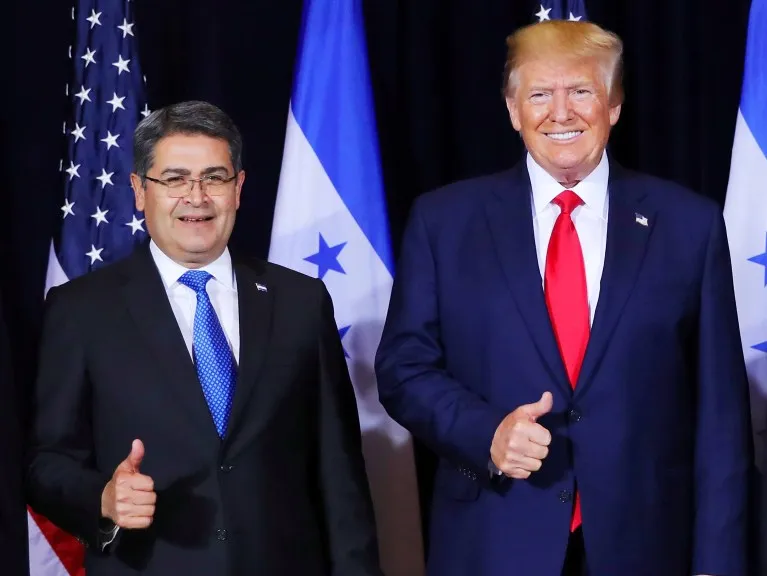
On November 28, US President Donald Trump Trump declared he will be pardoning former Honduran President Juan Orlando Hernandez, who was sentenced to 45 years in a New York prison in 2024 for his role in helping smuggle 400 tons of cocaine into the US in a drug-running scheme linked to the Sinaloa cartel. Hernandez, Trump wrote, had been “treated very harshly and unfairly.”
While Hernandez was President of Honduras, he initiated contracts worth over half a million dollars with Republican lobbying firm BGR Group, after his brother, Tony, was sentenced to life in prison for cocaine smuggling. In the time since, BGR has donated tens of thousands of dollars to the campaign of Marco Rubio, the Cuban American former senator who now serves as Trump’s Secretary of State.
As The Grayzone reported, the US Department of Justice indictment of Hernandez contained explicit and often shocking details of his role in transforming his country into the Western hemisphere’s premier narco-state. The US-backed president “wielded incredible influence and partnered with some of the most notorious narcotics traffickers in Honduras, allowing them to flourish under their control,” a DOJ prosecutor stated.

Speaking to a Honduran outlet the day after the pardon was announced, Hernandez’s longtime pastor credited the decision to the fact that “Donald Trump was and is a friend of Juan Orlando.”
The Honduran government has noted that despite being pardoned for crimes against the US, the investigation into his crimes in Honduras remains open, and he will likely be required to turn himself in upon his return to the country.
Trump’s announcement came in a statement demanding that Honduran voters elect his preferred candidate, threatening to economically sabotage the country if Tito Asfura – leader of the narco-friendly National Party that Hernandez controlled before his conviction – does not emerge victorious Sunday.
“If Tito Asfura wins for President of Honduras… we will be very supportive. If he doesn’t win, the United States will not be throwing good money after bad,” Trump wrote on his Truth social media platform. Trump deployed the same strategy in Argentina’s October 2025 midterm elections, successfully strong-arming voters there into backing the party of the country’s mentally unstable president, Javier Milei.
The message came just two days after Trump first publicly meddled in the Honduran election with a statement urging voters in the Central American to cast their ballots for Asfursa, who he called “the only real friend of Freedom in Honduras.” In that post, the US President railed against the other two candidates: the ruling Libre Party’s Rixi Moncada – “who says Fidel Castro is her idol,” Trump claimed – and “borderline Communist” Liberal party candidate Salvador Nasralla.
“Normally, the smart people of Honduras, would reject [Moncada], and elect Tito Asfura, but the Communists are trying to trick the people by running a third Candidate, Salvador Nasralla,” Trump claimed, insisting that “Nasralla is no friend of Freedom” and is merely “pretending to be an anti-Communist only for the purposes of splitting Asfura’s vote.”
With his brazen interventions, Trump appeared to concede that the initial US plot to control the outcome of the vote had failed.
Leaked recordings expose initial coup plot
Before Trump’s threat to nuke the Honduran economy unless voters elected the National Party’s Asfura, Washington seemingly planned to sow chaos in the election by manipulating the preliminary vote count in favor of Nasralla. In doing so, it would generate widespread skepticism of the result, and demand a new vote.
But the ruling Libre party foiled the plot by releasing a series of recordingscontaining evidence that the right-wing, US-backed opposition was planning to launch an electoral coup.
In the audio files, voices strongly resembling the National Party’s electoral Councilor Cossette López and top National Party Congressmember Tomás Zambrano can be heard discussing plans to delay the transmission of vote counts in order to generate widespread perceptions of fraud, and provoke a national crisis by falsely presenting Salvador Nasralla as the initial favorite. The speakers suggest they can manipulate the vote by ensuring a friendly contractor was selected to transport ballots on election day.
The recordings, which also feature an unnamed man presenting himself as a military officer, show the trio describing a plan in which NGOs, international electoral observers, and the US Embassy conspire to declare a Libre victory illegitimate, and see the party removed from power. The plot is framed as being carried out with US government assistance, with Lopez seemingly encouraging her colleagues to “use the tools that the people at the Embassy gave us.”
Some of the plans mentioned in the recordings appear to already be in motion, including a call by the voice matching Zambrano’s to “sow doubt in the electoral process” in the run-up to the vote. Elsewhere, Lopez appears to call for all friendly media coverage “to be focused on the fact that there’s going to be fraud” in order to generate “suspicion among the people that there’s going to be fraud, or that the elections won’t be recognized” from abroad.
“We’re going to say that they’re going to manipulate a CNE advisor so that the results favor and an electoral crisis is created,” the voice matching Lopez’s continues. This exact scenario played out in the weeks following the release of the audio files, when the Attorney General of Honduras opened an investigation into Lopez due to her comments, and calls grew for Lopez to be removed from her CNE post.
After the US-friendly NGOs declare the vote illegitimate, “the idea is that the government of the United States” steps in and agrees the vote should be nullified – “that would be the nail in the coffin,” the voice adds. And “what I am clear about is that the military is with us,” she states.
Once the audio files revealing the electoral coup plot were publicized, the US puppetmasters of the Honduran right-wing scrambled to control the narrative, seeking to flip the script by baselessly accusing Libre of seeking to steal the election through dirty tricks. But this cynical tactic has apparently expended its utility, prompting Trump to enter the fray with an explicit threat to devastate the Honduran economy unless it elected the National Party.
Once Stolen, Twice Shy
Known for its corruption and financing by drug lords including Mexico’s Joaquín “El Chapo” Guzmán, the National Party first came to power thanks to a US-backed coup in 2009. It maintained its grip on government thanks to blatant election rigging in order to fraudulently seize the presidency of Honduras.
In 2017, Juan Orlando Hernandez declared himself the president following a bizarre incident in which he went from losing handily to emerging with a sizable lead after a mysterious blackout at the country’s main voting tallying center. The Trump administration rushed to recognize the results, cementing the party’s grip on power for the next four years.
Despite Hernandez’s incarceration in 2024, the dirty tricks appear to have continued. This election cycle, Honduran outlet Contracorriente identified a vast “digital network that disguises political propaganda as local news to attack the ruling [Libre] party in Honduras,” which it referred to as the Nahual Network. The outlet suggested on November 28 that the network was likely operated by Fernando Cerimedo, an Argentinian advisor of National Party candidate Asfura, noting that “Cerimedo’s history aligns with several patterns observed in the “Nahual network”: the use of fake accounts, manipulated amplification of content, armies of trolls, and the fabrication of narratives designed to erode trust in democratic institutions.”
For his part, Nasralla has expressed no objections to the plans voiced in the audio recordings leaked this October. Instead, the Liberal Party candidate sought to reinforce the narrative that Libre is to blame for any electoral chaos. In early November, the former TV and beauty pageant host declaredthat if Libre were to attempt to engage in election fraud, the US would have no choice but to draw its naval assets away from the coast of Venezuela and threaten to invade Honduras – and suggested that Hondurans should “avoid” this possibility by voting for him.
Yet just a few weeks later, he was unceremoniously dumped on social media by Donald Trump, who warned Hondurans not to be “tricked again” by the “borderline communist.”
It was an abrupt turnaround for Nasralla, who had been invited by a prominent right-wing legislator from Florida to a congressional hearing in Washington the previous week which was seemingly designed to advance the electoral plot.
As a result, with just 10 days left before a tightly-contested election, Nasralla was not in his country’s capital of Tegucigalpa, where the other two main parties’ leaders were busy holding last-minute rallies. Instead, he was nearly 2,000 miles away on Capitol Hill, appearing before a US congressional committee aimed at delegitimizing his top opponent, Rixi Moncada, the proposed successor to Honduras’ current democratic socialist President, Xiomara Castro.
The hearing, which was presented as a preemptive effort to warn Castro and Moncada against attempting to steal the election, was chaired by Rep. María Elvira Salazar, a Cuban American former broadcast personality from South Florida best known for her on-air regime change tirades. From her perch on the committee, Salazar railed against Xiomara Castro, Moncada, and their social democratic Libre Party, accusing them of attempting to “impose communism” on Honduras.
Salazar continued by waxing nostalgic about the Obama-backed 2009 coup d’etat which overthrew the current president’s husband, Manuel Zelaya, before demanding to know whether the Honduran military could intervene to “stop” the Castro government from “trying to rig the elections.” She recalled that she was in Honduras working “as a journalist” when Honduran soldiers “pulled [Zelaya] out of his bed… in the middle of the night in PJs, and put him on a plane to Costa Rica, because Mel Zelaya wanted to implement communism in Honduras.”
“Now 16 years after, his wife is doing this job.”
Salazar’s commentary was filled with contradictions, vacillating between opposition to foreign interference in the upcoming elections while openly dictating to Honduran voters that they “not elect a communist.” But in Tegucigalpa, her performance was seen as a malign act of meddling.
“We condemn her interference,” Moncada shot back, concluding that Salazar “should respect Honduras and respect the Honduran people.”
Throughout the session, Salazar teed up seemingly-scripted answers from a number of regime change operatives, including Trump’s first-term appointee as ambassador to the Organization of American States (OAS), Carlos Trujillo – who was exposed mid-hearing as a well-paid lobbyist whose Honduran clients strongly oppose the current government.

Among Trujillo’s clients were a large bank whose founding president led the National Party for years, and the so-called Prospera charter city, a self-proclaimed “startup zone with regulation and tax autonomy” established under the National Party, which hosts a variety of “human augmentation” tech companies on Honduran land with no oversight, much to the chagrin of the current government.
During his testimony, Trujillo lashed out at Castro, accusing her of such horrible crimes as having “repeatedly expressed an affinity for totalitarian regimes” like “Venezuela, Cuba, and Nicaragua,” her “decision to eliminate and sever all diplomatic ties with Taiwan and establish and recognize the Communist Party… of China,” and having “failed to seat the Israeli ambassador… for over a year and a half.”
Other alleged misdeeds of Castro’s government included threatening to cancel an extradition agreement and kick US troops out of the military bases they’ve operated in Honduras since the ‘80s, when they were set up to wage a dirty war against Nicaragua’s Sandinista government to the south.
Though he neglected to mention his friendly meeting with Hernandez in 2018, Trujillo was quick to credit himself and Salazar for liberating Hondurans from the yoke of a hypothetical Honduran dictatorship led by Hernandez’s former victims.
“Sometimes it’s difficult to recognize when you’re sitting in the seats that you’re sitting [in], the importance of the words you say, and how important they are in-country – in Honduras,” Trujillo gushed. “And how it gives hope to the Honduran people – the amount of people you see sitting here behind us – who really, their hope on saving their democracy is kind of vested in a hearing like this.”
Responding later that day, Rixi Moncada described the visitors seated behind the speaker differently, characterizing them as the very elites who conspired with the US in 2009 to remove Zelaya from power in the first place. “There are people there who participated directly in the coup and are getting away with it,” she stated, adding that those on-hand for the hearing in Washington were “surely from the 25 economic groups and 10 families in this country that monopolize the financial sector.”
Off-shoring the consequences
In the days since, Trump-aligned figures have continued to ratchet up tensions with the government of Honduras, setting the stage for a potential stand-off between the democratic will of Hondurans and Washington. The outcome could reverberate across the hemisphere, potentially triggering a renewed wave of migration to the north and violence at home.
During the OAS session on November 25, the ambassador of Javier Milei’s Argentina unleashed an unhinged regime change rant, describing the interrogation-style hearing as a measure of “preventative diplomacy” aimed at ensuring Hondurans didn’t follow in the example of Cuba and Venezuela. He was joined by US Deputy Secretary of State Christopher Landau, who argued that Honduras was experiencing an electoral “crisis” before calling on member states to pressure the Honduran government to adhere to American instructions when carrying out its elections.
Landau concluded imperiously: “I urge you to use your collective voice to warn officials in Honduras of the consequences of meddling in the process or interfering with the results” of the upcoming elections.

Your Tax Free Donations Are Appreciated and Help Fund our Volunteer Website
Disclaimer: We at Prepare for Change (PFC) bring you information that is not offered by the mainstream news, and therefore may seem controversial. The opinions, views, statements, and/or information we present are not necessarily promoted, endorsed, espoused, or agreed to by Prepare for Change, its leadership Council, members, those who work with PFC, or those who read its content. However, they are hopefully provocative. Please use discernment! Use logical thinking, your own intuition and your own connection with Source, Spirit and Natural Laws to help you determine what is true and what is not. By sharing information and seeding dialogue, it is our goal to raise consciousness and awareness of higher truths to free us from enslavement of the matrix in this material realm.