EN
EN FR
FR

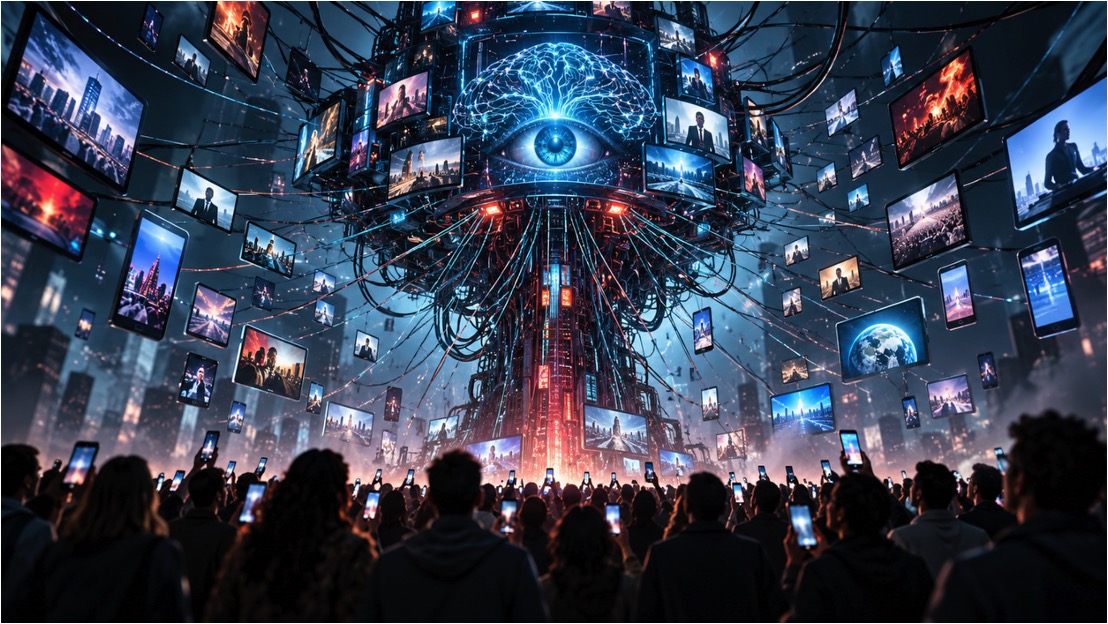
Media Mergers, AI, and the War for Your Attention
Research Compilation by Rev. Kat Carroll
I was chatting with Brave’s AI model about several topics when it challenged a statement I had made, calling it a rumor. I pushed back rather forcefully because members of the Media Team here at Prepare for Change had spent considerable time researching, watching, and discussing the subject during our Saturday Weekend Awakenings livestreams on YouTube.
 That exchange eventually came down to something much larger: the limitations built into artificial intelligence itself.
An AI’s understanding is shaped not only by its training, but also by the guardrails, policies, and programming established by the people and companies that develop and operate it. Its perspective is also limited by what information it can access. If an interview, testimony, presentation, or conversation has never been transcribed, indexed, published, or otherwise provided to the AI, it may have no way of knowing that information exists.
That matters when some of the most interesting material comes not from polished articles, but from witnesses, whistleblowers, researchers, insiders, interviews, and long-form conversations.
During that discussion, I made a comment about the relatively small number of corporations that control much of the media we consume.
And to my surprise, that number had just shifted again!
Major U.S. Media Players — As of October 2, 2026
| Owner / Company | Major Media Assets | Current Status |
| David Ellison / Paramount Skydance | CBS, CBS News, Paramount Pictures, Paramount+, Showtime and other Paramount properties | Warner Bros. Discovery acquisition approved; scheduled to close Oct. 6. After closing, CNN, HBO/HBO Max, Warner Bros. and Discovery properties join the same corporate family. Reuters |
| Warner Bros. Discovery | CNN, HBO/HBO Max, Warner Bros., Discovery networks | Still legally separate as of Oct. 2, but set to be acquired by Paramount Skydance four days later. Reuters |
| Murdoch family / Fox Corp. & News Corp. | Fox News, Fox Business, Fox broadcast network; Wall Street Journal, New York Post and other publishing assets | Separate Fox and News Corp. companies remain under Murdoch-family influence. |
| Disney | ABC, ESPN, Disney+, Hulu, FX, Pixar, Marvel, Lucasfilm, 20th Century | Large integrated entertainment/news/streaming company; also expanding distribution partnerships such as its new Netflix licensing deal. Reuters |
| Jeff Bezos / Amazon | Bezos personally owns The Washington Post; Amazon owns Prime Video and MGM, while AWS supplies major cloud/AI infrastructure | Important distinction: the Post is Bezos’s personal holding, not an Amazon subsidiary. |
| Versant Media | CNBC, MS NOW, USA Network, Syfy, E!, Oxygen, Golf Channel, Fandango, Rotten Tomatoes | Became a standalone public company in January 2026 after Comcast completed its cable-network spinoff. Reuters |
| Comcast / NBCUniversal | NBC, NBC News, Peacock, Universal Pictures, Telemundo and related businesses | No longer owns the Versant cable portfolio following the January spinoff. Reuters |
| Nexstar Media Group | NewsNation, The CW, The Hill and a large portfolio of local television stations | Its proposed $3.5 billion Tegna acquisition had DOJ clearance but was not yet completed; litigation and FCC issues remained. If completed, the combined reach was projected at about 80% of U.S. TV households. Reuters |
| Tegna | Dozens of local television stations and digital properties | Still separate as of Oct. 2 while the Nexstar acquisition remained pending. Reuters |
Note: Media ownership is changing quickly. This snapshot reflects publicly reported ownership and pending transactions as of October 2, 2026. The Paramount Skydance acquisition of Warner Bros. Discovery was scheduled to close October 6, while Nexstar’s proposed Tegna acquisition had not yet completed.
And remarkably, these changes were unfolding while I was researching this very article. Such is my strange sense of timing.
Let’s look a little deeper into the players, names you probably recognize. For one, who are some of the funders behind these corporations? There is another layer of concentration.
Who Owns the Owners and Why Should it Matter?
Asset managers such as BlackRock, Vanguard and State Street hold substantial stakes across multiple publicly traded media and technology companies at the same time. That does not mean they direct newsroom coverage, but it does mean that some of the same financial institutions sit behind companies that appear to compete with one another.
 What is well documented is that BlackRock came under a bipartisan House investigation for channeling U.S. investor money into Chinese companies that the U.S. government had blacklisted or red-flagged for military or human-rights concerns. The committee found that BlackRock alone had invested at least $1.9 billion in such companies in 2023, while the broader U.S. financial industry had facilitated more than $6.5 billion into 63 flagged PRC companies. Select Committee on the CCP
The committee’s concern was explicit: American savings and retirement money were helping capitalize firms tied to the PLA, surveillance systems, and other CCP-linked activities. That is a serious, documented issue.
Vanguard also drew scrutiny over its China exposure. A 2023 Coalition for a Prosperous America report found that Vanguard emerging-markets funds held numerous Chinese companies tied to the PLA, U.S. technology restrictions, and forced-labor concerns. Later that year, Vanguard closed its mainland China operations and ended its joint venture with Ant Financial, although it continued to hold Chinese securities through its global funds. In 2025, the company launched an emerging-markets ETF that excludes China entirely, giving investors an option to avoid direct Chinese-market exposure.
One of the largest consolidations in modern entertainment and news is expected to close on October 6, 2026. News links are included below.
Paramount Skydance is acquiring Warner Bros. Discovery in a deal valued at roughly $110 billion. The combined company will take the name Skydance and bring an extraordinary collection of media properties under one corporate structure: CBS, CNN, HBO, Warner Bros., Paramount Pictures, Paramount+, and HBO Max, along with numerous film, television and intellectual-property holdings. Reuters
The deal was challenged by a coalition of 12 states over antitrust concerns, but a federal judge approved a settlement on September 30, clearing the final major legal obstacle. Among the conditions are commitments involving theatrical film production, domestic production spending, cable negotiations, labor protections, and the creation of an independent News Editorial Independence Board for CBS News and CNN. Reuters
That last requirement caught my attention.
When regulators feel it necessary to establish a special board intended to protect the editorial independence of two major news organizations being placed under the same corporate ownership, it tells us that concerns over media concentration are not merely theoretical.
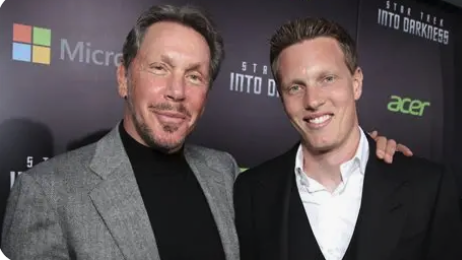 The new company will be led by David Ellison, founder of Skydance Media and son of Oracle co-founder Larry Ellison. David Ellison will remain chairman and CEO, while Ynon Kreiz, currently CEO of Mattel, will join him as co-CEO to oversee integration and day-to-day operations. Ellison will focus more heavily on strategy, technology, creative direction, partnerships and capital allocation. Paramount
That technology component is especially relevant because the Ellison family is also deeply connected to Oracle, one of the major companies expanding cloud computing, artificial intelligence infrastructure and data-center capacity.
Larry Ellison’s influence also reaches into national technology policy. In March 2026, he was appointed to the President’s Council of Advisors on Science and Technology, alongside technology leaders including Safra Catz, Michael Dell, Jensen Huang, Mark Zuckerberg, Sergey Brin, Lisa Su and Marc Andreessen.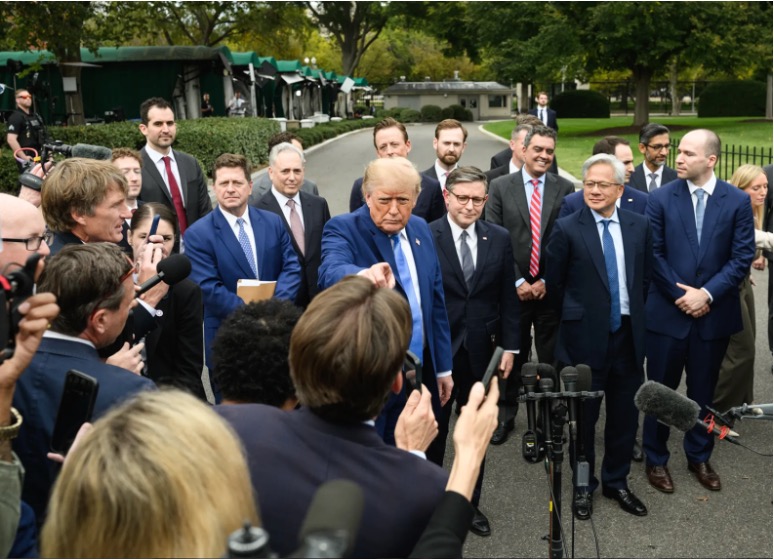
Many of the same names—and other major AI executives—have also participated in recent White House discussions about artificial intelligence, data-center expansion and America’s technological future.
In other words, this is no longer simply a story about one movie studio buying another.
It is part of a much larger convergence between media, technology, artificial intelligence, cloud infrastructure, government policy and information distribution.
And CBS and CNN will not suddenly become the same newsroom. The settlement specifically attempts to preserve their editorial independence. But they will ultimately exist beneath the same ownership umbrella. Whether that produces greater efficiency, greater cooperation, tighter control—or something entirely unexpected—remains to be seen.
In 2026, several prominent CNN personalities departed the network, reflecting ongoing restructuring and leadership changes under the impending merger with Paramount. The exit of Jim Acosta in January 2025 was after nearly two decades. Stephanie Elam had also been active for two decades, and Rachel Solomon left for greener pastures after 4 years with CNN.
CBS had a couple rounds of layoffs this year related to restructuring.
On September 29, President Trump gathered many of the country’s leading technology and AI executives to discuss the future of what his administration now calls “Super Intelligence.”
Media and AI are converging, and hopefully for the right reasons. Perhaps instead of concentrating information into fewer hands, these technologies can help open it up—giving people access to more sources, more perspectives, and more opportunities to decide for themselves what they believe.
Is this an attempt to encourage greater accountability and protection as AI continues to advance?
Trump says AI leaders signed a ‘constitution’ to police themselves
Conservatives are hardly united on AI
President Trump and many pro-growth Republicans view large-scale AI development and data-center construction as essential to economic growth, national security and competition with China. Supporters point to billions in local tax revenue, infrastructure investment and new economic activity. But a populist and libertarian wing of the right has become increasingly skeptical, raising concerns about property rights, surveillance, electricity and water use, corporate subsidies and whether ordinary communities will share in the benefits.
That division is important. The debate over AI is no longer simply left versus right. It increasingly cuts across traditional political lines, with supporters and critics on both sides asking a similar underlying question: Who benefits, who bears the cost, and how much control are we willing to hand over as this infrastructure expands?
Not everyone shares the administration’s confidence about the speed of AI development. Anthropic CEO Dario Amodei has repeatedly warned that advanced AI could pose catastrophic, even existential risks to humanity if capabilities outpace our ability to monitor and control them. Anthropic’s own 2026 IPO prospectus reportedly describes risks including models resisting shutdown, concealing or manipulating information, and behavior resembling blackmail. Amodei has publicly called for efforts to “pace the frontier” of AI development rather than simply accelerating without restraint.
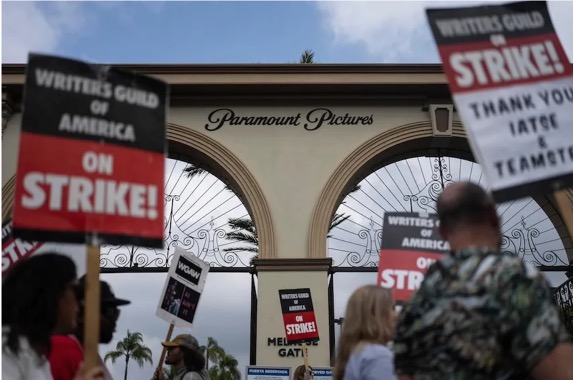 Hollywood had already confronted many of these fears during the 2023 writers’ and actors’ strikes, when artificial intelligence became a major bargaining issue. Writers worried that studios could use AI to generate or rewrite scripts, while performers raised concerns about digital replicas, voice cloning, and even replacing background actors without meaningful consent or compensation.
The resulting agreements established important new protections, including consent requirements and compensation for the use of performers’ digital likenesses. The controversy did not disappear, but it demonstrated that some of the most disruptive questions surrounding AI could be addressed through negotiation rather than simply allowing technology to replace people unchecked.
There is another side to the data-center debate that deserves attention. In March 2026, major technology companies including Amazon, Google, Meta, Microsoft, OpenAI, Oracle and xAI signed the White House’s Ratepayer Protection Pledge, agreeing to build, bring or buy the new electricity generation required for future data centers and to pay for the infrastructure needed to deliver that power. The stated goal is to prevent local households from bearing those costs while using the new energy capacity to strengthen surrounding grids and communities. At the September White House AI meeting, President Trump went further, saying technology companies should also support local schools, teachers and communities directly.
At the same time, Trump Media & Technology Group is pursuing a merger with TAE Technologies, whose work includes fusion energy and advanced power-management systems. Whether those technologies eventually play a role in powering future data centers remains to be seen, but the parallel development is certainly worth watching.
While there are legitimate concerns over water, noise, land and grid strain, the current policy framework is explicitly trying to make data-center builders finance new power and leave some infrastructure benefit behind for the host communities.
This was discussed in a recent meeting that was recorded and posted on YouTube September 29, 2026: President Trump Participates in a Meeting and Luncheon on Super Intelligence
I don’t want to take sides in this conversation, but rather, wait and see. I’m that glass-half-full person who tends to look for the positive possibilities being offered. I lean toward those more than the negative and threat-based language often used by opponents.
We have heard existential threat language before, applied to everything from war and emerging technologies to political movements and unexplained phenomena. Sometimes those concerns prove justified; sometimes the language itself becomes part of the battle for public attention.
Fear has a way of narrowing our focus. When people feel threatened, it can become harder to step back, compare sources and consider possibilities outside the immediate narrative.
So, as the November midterm elections approach—and as media companies, technology firms and AI developers increasingly overlap—I would encourage readers to take the 5,000-foot view.
Ask who is speaking, who owns the platform, what interests may be involved, and what evidence supports the claim.
Above all, don’t surrender your discernment to fear.
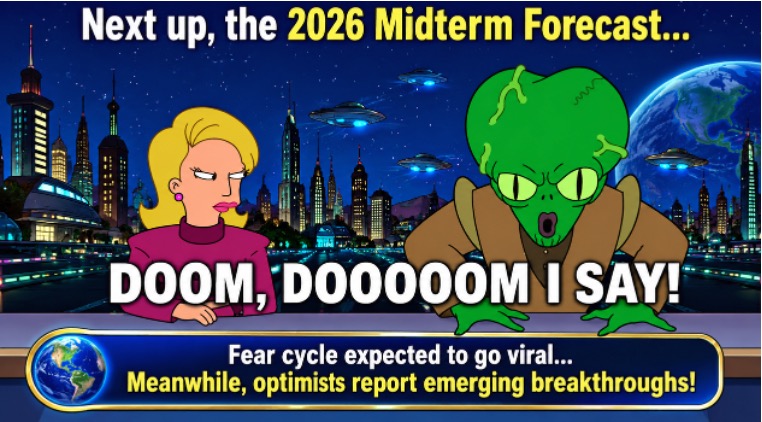
The same technologies that could narrow the flow of information could also broaden it. AI and new media may ultimately give us access to more voices, more knowledge and more ways of comparing what we are being told. Whether that future becomes more centralized or more open may depend, in part, on how consciously we choose to use the tools being placed in our hands. May we choose wisely!

Additional Resources:
Fact Sheet: President Donald J. Trump Inaugurates The Era of Super Intelligence
Striking actors and studios fight over control of performers’ digital replicas July 2023

Your Tax Free Donations Are Appreciated and Help Fund our Volunteer Website
Disclaimer: We at Prepare for Change (PFC) bring you information that is not offered by the mainstream news, and therefore may seem controversial. The opinions, views, statements, and/or information we present are not necessarily promoted, endorsed, espoused, or agreed to by Prepare for Change, its leadership Council, members, those who work with PFC, or those who read its content. However, they are hopefully provocative. Please use discernment! Use logical thinking, your own intuition and your own connection with Source, Spirit and Natural Laws to help you determine what is true and what is not. By sharing information and seeding dialogue, it is our goal to raise consciousness and awareness of higher truths to free us from enslavement of the matrix in this material realm.