EN
EN FR
FR

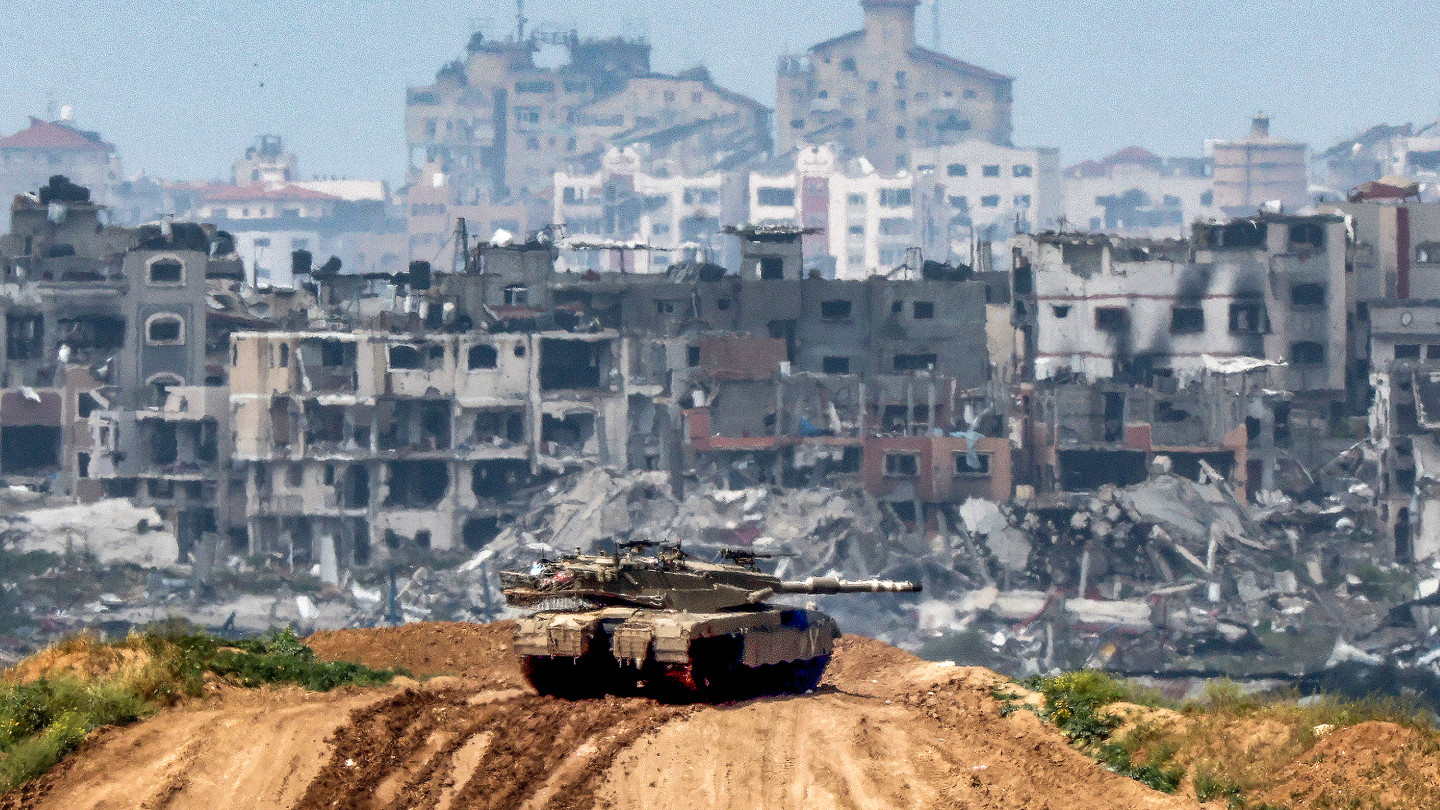
Gallant and Davidi casually joked about flattening Gaza to rebuild Jewish-only settlements on its ruins. “I would also like to build in Beit Hanoun (in Gaza), but I will settle for Sderot,” said Davidi. Gallant replied, “In order to build in Beit Hanoun, you first need to flatten the area there.”
A month earlier, Israel’s Minister of Settlements Orit Strook said explicitly, “I don’t know how many years it will take…returning to Gaza will take a lot of sacrifices. Gaza is part of the land of Israel, and we will return to it one day.”
Strook was reiterating what the deputy head of Israel’s Knesset, Limor Son-Har Melech, said the same day. “Our task now is to return to the settlements in Gush Katif and rebuild them,” he said, in reference to Israeli settlements in Gaza that were evacuated in 2005.
Israel’s finance minister and de facto ruler of the occupied Palestinian territory, Bezalel Smotrich, had also promised on the eve of the Netanyahu government’s formation in December 2022 that Israel would “return” to rebuild Jewish settlements in Gaza.
Three years into Israel’s war, these statements now sound like prophetic declarations of intent.
Beit Hanoun was levelled to the ground during the war, just as Gallant said. Earlier this year, Limor Son-Har Melech led a group of settlers deep inside Gaza, planting trees to mark the first step towards rebuilding settlements in the enclave. He bragged: “Gaza will be Jewish, because only in this way will we ensure victory.”
Israel Katz, meanwhile, Israel’s new defence minister, has formally announced intentions to start building settlements in Gaza.
That is why Israel’s military rabbi Amichai Friedman described the month of October 2023 as “the happiest month of my life”. He added, “We’re finally realising who we are. All of this land is ours. The entire land, including Gaza and Lebanon. Gush Katif is tiny compared to what we will get with God’s help to achieve… We will destroy everyone.”
An ambition decades in the making
Seven months before 7 October, Israel’s former defence minister and right-wing politician Moshe Yaalon sounded the alarm that Israel’s “Jewish supremacist” ministers, whose beliefs, he said, reflected “Mein Kampf in reverse”, wanted to provoke “the final war” of “Gog and Magog.”
Yaalon warned that Smotrich and Ben-Gvir would try to provoke Palestinians, through massacres, for instance, to use any Palestinian retaliation as a pretext for the ‘final battle‘.
As soon as Itamar Ben-Gvir became Israel’s security minister, he rushed, as Yaalon anticipated, to abuse Palestinian prisoners to ignite that war. Some of his first decisions were to ban pita bread for detainees, reduce their shower time to two minutes per day, overcrowd their cells, and let a Palestinian hunger striker, Khader Adnan, die in solitary confinement.
The cruelty meted out to Palestinian detainees is thought to have served as one of the core justifications, and strategic drivers, for Hamas leader Yahya Sinwar to launch the 7 October attacks on Israel.

But even without Hamas’s attack, the concept of ‘transfer’, or ethnic cleansing, has long been embedded in official Israeli policymaking.
“You shall continue to live like dogs, and whoever wishes may leave… It’s possible that in five years, there will be 200,000 fewer people, and that’s an enormous thing,” said Israel’s then defence minister Moshe Dayan shortly after the 1967 war.
The “live like dogs or leave” dichotomy was reiterated in 2017 by Smotrich in a manifesto Israeli pundits themselves described as “genocidal.” Smotrich gave Palestinians three options: submit to living as inferior subhumans, leave the land, or resist and get killed.
Israel has used this policy in Gaza since the 1948 Nakba. Even before it captured Gaza officially in 1967, the Israeli government sought to push for mass migration from the enclave through intimidation, bribery, periodic massacres, and destruction of vital infrastructure.
After Gaza fell under Israeli occupation, Israel used more force, coercion, destruction, intimidation, and bribery to empty Gaza.
When Israel imposed a blockade on Gaza in 2006, economic warfare and starvation were systematically imposed, punctuated by periodic “high-tech killing sprees” to inflict the maximum destruction possible in order to make the enclave uninhabitable and force its people out.
Before 7 October, about 10% of Gaza’s population (205,000 people) had already emigrated from the Strip since the blockade started. Half of that significant figure were people who left in the five years that preceded Hamas’s attack.
A senior Israeli official even bragged in 2019 that Tel Aviv was “actively pushing Palestinian emigration from Gaza.” The official said Israel was reaching out to Western and Middle Eastern countries to encourage accepting Gazan migrants and even offered to cover the costs of travel.
Israel’s focus on displacing Gaza’s population stems in part from the fact that the overwhelming majority of the Strip’s population are refugees displaced from villages in what is now Israel, leading it to view the population as a persistent potential source of insurgency.
Israel’s then defence minister Moshe Dayan said in 1956, “Why should we blame [Palestinians in Gaza] for their burning hatred for us? For eight years they have been dwelling in Gaza’s refugee camps, as before their eyes we have transformed the land and the villages in which they and their forefathers had dwelled into our own property.”

7 October gave Israel its opening
The 7 October attacks provided a powerful accelerant for Israel’s longstanding displacement of Palestinians in Gaza.
Almost immediately, Netanyahu called on Gazans to leave, while his government ordered the mass evacuation of northern Gaza. The assault also revived an older Israeli conception of the conflict as an unfinished war of national survival, with Netanyahu later explicitly invoking the 1948 War of Independence, or Nakba.
In the first days of Israel’s response, Tel Aviv, with US help, rushed to pressure neighbouring Arab countries to transfer the entire population of Gaza into the Sinai desert under the pretext of “temporary relocation until Hamas is defeated.”
When those countries refused, Israel pushed most of Gaza’s population towards Rafah at the Egyptian border in the hope of pushing them to cross into Sinai on their own. When that failed, Israel invaded Rafah and devastated the city, only to propose sending Palestinians back towards the area again – this time into a so-called “humanitarian city” that Israel’s own former prime minister Ehud Olmert described as a concentration camp.
Even after Israel signed President Donald Trump’s 20-point plan for a ceasefire – which included Hamas’s disarmament, the withdrawal of Israeli troops, and reconstruction – Israel promptly reneged on its commitments and continued to push for building the Rafah ‘humanitarian city’.
The push to empty, and resettle, Gaza
Since the ceasefire began, Israel’s Defence Minister, Israel Katz, has repeatedly emphasised that Tel Aviv’s long-term goal in Gaza remains its total ethnic cleansing.
“There is no real solution for Gaza in the end without this migration… I think there is no other solution for everyone’s good,” he said in September, despite Hamas agreeing to lay down its arms. Katz added that Israel remains “organised and prepared to get [Gazans] out – by sea, by air, by every way possible.”
Israel’s Security Minister Ben-Gvir presented a concrete plan in September for the ethnic cleansing of 1.86 million Palestinians in Gaza over the next 7 years, called “disengagement 710.”
Through this scheme, Israel would expel 250,000 Gazans in the first year, 1.11 million by the third year, and the entire population by 2034. During the genocide, more than 100,000 Palestinians have already left Gaza.
That is why, even in the “new Rafah” camp, Israel made clear it would not allow any permanent construction with concrete, but rather would only give the caged population temporary and portable shipping containers to live in, making clear those camps are a mere transit towards expulsion.

The Israeli defence minister made clear that all Israel now needs to “finish the job” in Gaza is a pretext. “When it becomes clear that Hamas is not fulfilling its commitment. Then we will get a green light to advance militarily, territorially, and in other areas as well,” he said.
The same applies to the West Bank, where Katz revealed on Tuesday that the Israeli army has been instructed to plan for a scenario of war with the Palestinian Authority (PA). Despite the PA being Israel’s peace partner and security subcontractor, Katz made clear that Israel is ready to replicate its ‘Gaza model’ in the West Bank.
Any war on the PA “would be short and forceful and would include the use of ground and air forces and special means, the elimination and expulsion of senior officials, the destruction of weapons, and the large-scale evacuation of residents and destruction of terror infrastructure inside the cities and in all refugee camps,” Katz said, referencing the Gaza and Lebanon “models”.
Katz’s threat to the PA is not limited to an Israeli retaliation against violent Palestinian attacks on settlers or soldiers. A “war scenario” would also be unleashed if Palestinians organise a popular uprising.
“There will not be an Intifada lasting years, as there was in the past, but rather a short and forceful war with a clear decision and a change in the reality,” he emphasised.
A political consensus on Palestinian subjugation
The upcoming Israeli election is one of the most heated and competitive in the country’s history. But the one thing that unites the Israeli ruling coalition with most opposition parties is the subjugation of Palestinians.
In 2024, the Israeli Knesset saw an unprecedented moment of bipartisanship in rejecting Palestinian statehood and self-determination. In February of that year, 99 Israeli members of Knesset from both the opposition and ruling coalition voted in favour of a resolution rejecting international recognition of Palestinian statehood. Only nine members opposed the resolution, all of whom were from Palestinian parties.
In June, another resolution passed with only the same nine members opposing it. This time, the resolution rejected Palestinian statehood in absolute terms, even if such statehood comes through negotiations and diplomacy.
In this election cycle, Israel’s former prime minister and opposition leader Naftali Bennet is campaigning on calling the Trump plan for Gaza “unworkable” and opposing the plan’s promise of returning the Palestinian Authority to the enclave.
Israel’s former defence minister Avigdor Lieberman is similarly campaigning on dismantling the PA and resuming military operations in Gaza. Israel’s former war minister and likely the next prime minister Gadi Eisenkot attacked the roadmap for decommissioning Hamas’s weapons in return for the Israeli military’s withdrawal and called it a “capitulation” to Trump “without achieving the war’s objectives.”The 7 October attacks did not create this Israeli mainstream consensus. At most, it provided the cover of war to make it more flagrant and explicit.
Israel’s stated long-term goal in Gaza and the West Bank is the natural culmination of a settler-colonial project that was created on the premise of grabbing the “maximum land with a minimal number of Arabs.”
Palestinians have for decades been pushed by Israel into ever-shrinking confines with two options left to them: submission or departure.
The only substantial debate about this endgame in Israel’s election is about the pace and packaging of that expulsion and subjugation.
Muhammad Shehada is a Palestinian writer and analyst from Gaza and the EU Affairs Manager at Euro-Med Human Rights Monitor
Follow him on Twitter: @muhammadshehad2
Edited by Charlie Hoyle

Your Tax Free Donations Are Appreciated and Help Fund our Volunteer Website
Disclaimer: We at Prepare for Change (PFC) bring you information that is not offered by the mainstream news, and therefore may seem controversial. The opinions, views, statements, and/or information we present are not necessarily promoted, endorsed, espoused, or agreed to by Prepare for Change, its leadership Council, members, those who work with PFC, or those who read its content. However, they are hopefully provocative. Please use discernment! Use logical thinking, your own intuition and your own connection with Source, Spirit and Natural Laws to help you determine what is true and what is not. By sharing information and seeding dialogue, it is our goal to raise consciousness and awareness of higher truths to free us from enslavement of the matrix in this material realm.