EN
 FR


Nicolas Hulscher, MPH,
An eight-year-old boy experienced complete regression of Burkitt’s lymphoma without cancer treatment. A separate study later identified a link between childhood measles and reduced cancer mortality.
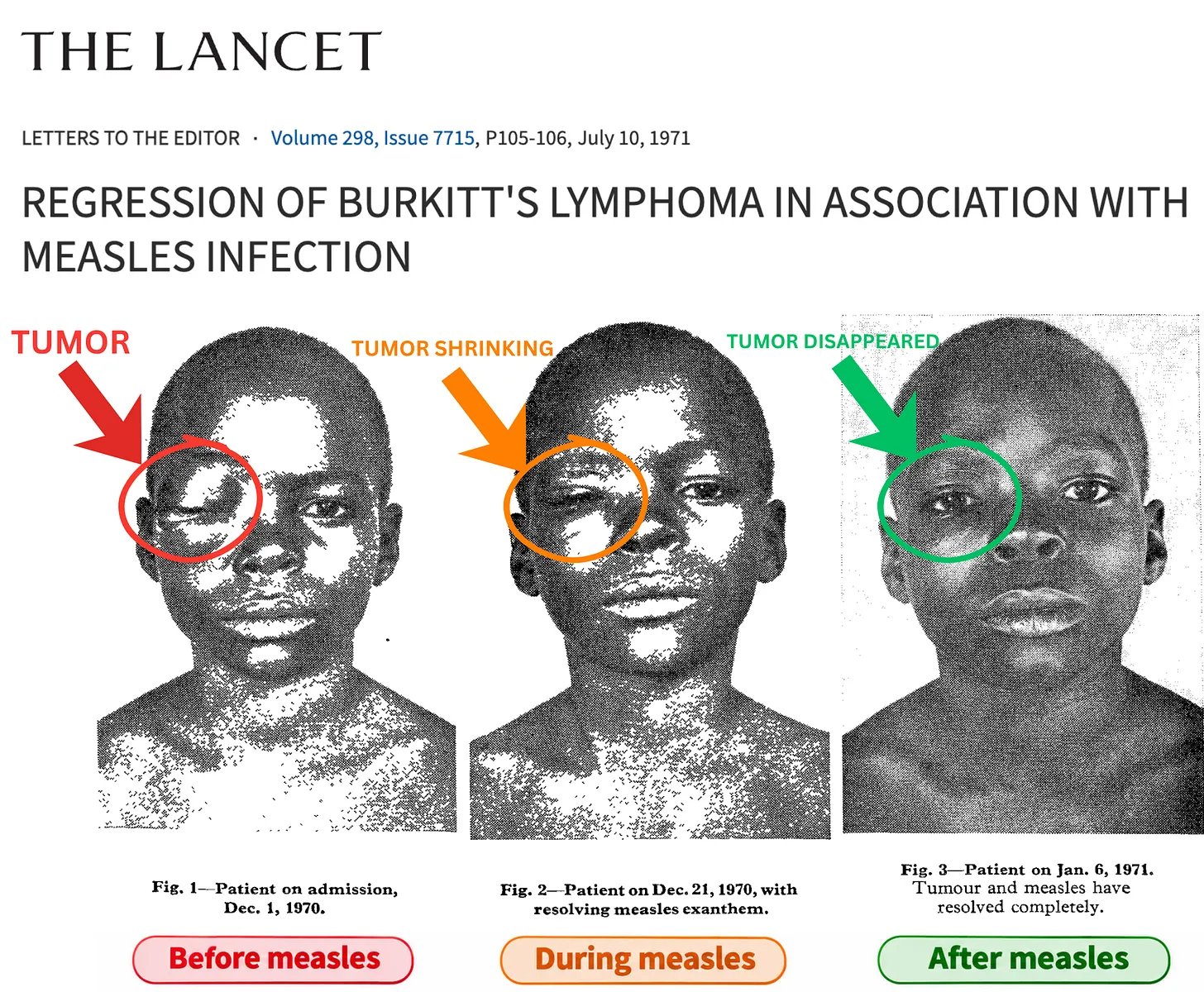
In a remarkable 1971 case report published in The Lancet, researchers documented the complete regression of biopsy-confirmed Burkitt’s lymphoma, a highly aggressive form of blood cancer, in an eight-year-old boy shortly following natural measles infection.
The child was admitted to Mulago Hospital in Uganda on December 1, 1970, with a massive tumor behind his right eye. The cancer had caused severe swelling, protrusion of the eye, loss of vision, and an inability to move the affected eye. A biopsy performed on December 3 confirmed Burkitt’s lymphoma.
On December 13, the boy developed a measles rash. Remarkably, physicians first observed the tumor shrinking on that very same day.
Over the following two weeks, both the measles rash and the tumor completely disappeared, despite the child receiving no anticancer treatment.
At four-month follow-up, he remained in complete remission.

The potential relationship between natural measles infection and cancer has also been investigated in epidemiological research.
A 2013 prospective cohort study published in the European Journal of Epidemiology examined 1,060 individuals born in Newcastle-upon-Tyne, England, in 1947, before widespread measles vaccination.
They found that individuals who experienced measles during childhood had a 51% lower risk of cancer mortality between ages 15 and 60, compared with those without a recorded history of measles (HR 0.49; 95% CI 0.24–0.98).

The researchers proposed that certain childhood infections might influence long-term immune surveillance, potentially through immune responses that recognize antigens shared by infectious agents and cancer cells.
Several mechanisms have been proposed across the literature:
- Viral infection of tumor cells: Measles virus may infect susceptible malignant cells and contribute to tumor regression.
- Immune recognition: Viral antigens expressed by infected cancer cells could make those cells targets for immune-mediated destruction.
- Enhanced immune surveillance: Immune responses generated during infection could potentially recognize similar antigens expressed by malignant cells.

These findings remain preliminary. Nevertheless, these observations are quite remarkable, and most people are completely unaware that such reports and studies even exist.
Epidemiologist and Foundation Administrator, McCullough Foundation
www.mcculloughfnd.org

Your Tax Free Donations Are Appreciated and Help Fund our Volunteer Website
Disclaimer: We at Prepare for Change (PFC) bring you information that is not offered by the mainstream news, and therefore may seem controversial. The opinions, views, statements, and/or information we present are not necessarily promoted, endorsed, espoused, or agreed to by Prepare for Change, its leadership Council, members, those who work with PFC, or those who read its content. However, they are hopefully provocative. Please use discernment! Use logical thinking, your own intuition and your own connection with Source, Spirit and Natural Laws to help you determine what is true and what is not. By sharing information and seeding dialogue, it is our goal to raise consciousness and awareness of higher truths to free us from enslavement of the matrix in this material realm.