EN
 FR


By Jacob Magid,
Trump envoy says Israel could emerge from Oct. 7 more secure and integrated in region if it shifts Gaza approach, which has seen it block Board of Peace from testing Hamas disarmament pledge.
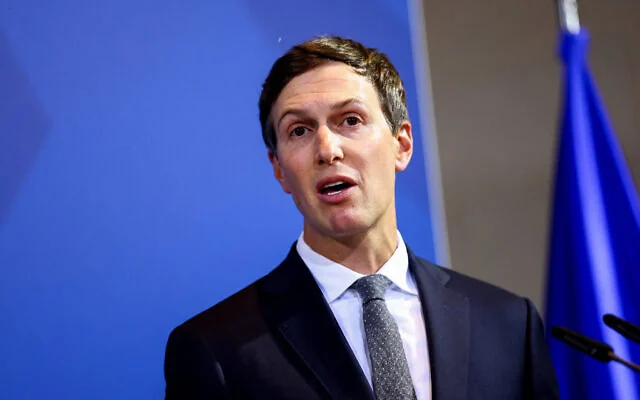
US special envoy Jared Kushner has warned that Israel is heading toward “global-pariah status,” but that it could emerge from the Hamas-sparked Gaza war more secure and integrated in the region if it decides to shift its approach toward the Strip.
“I feel like the fork in the road is Israel could rise from the tragedy of October 7, [and] be much more secure and much more integrated into the world, or they can go on the current trajectory, which is to trend toward global-pariah status,” Kushner told New York Magazine in an interview published Monday.
While such warnings have been voiced by senior Democrats in the US and even former security chiefs in Israel over the latter’s conduct toward the Palestinians, such rhetoric from a senior Republican official is far less common.
The blunt message came amid increased frustration in the Trump administration with Prime Minister Benjamin Netanyahu, who has blocked the US-controlled Board of Peace from advancing its plan to rebuild Gaza. Kushner is one of the main architects of the Board of Peace, which was established in January.
Hamas in July agreed to the board’s disarmament roadmap, which envisions the terror group gradually handing over its weapons as Israel withdraws from the Strip. Netanyahu has rejected the framework, arguing that Hamas must completely disarm before Israeli troops conduct any withdrawals.
Accordingly, Netanyahu has blocked the board from operationalizing the governing and security agencies that are supposed to replace Hamas in Gaza, effectively keeping the terror group in control of half the enclave.
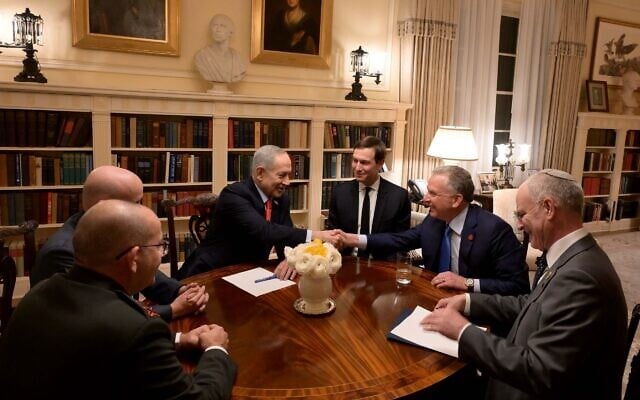
The Board of Peace held off on exerting more pressure on Israel in the lead-up to the October 27 election, believing that Netanyahu was unlikely to take steps that would expose him to criticism of being soft on Hamas.
But the election did not produce conclusive results, and efforts to form a new coalition could take several more months. Netanyahu remains the caretaker prime minister, and his approach toward Gaza has not shifted.
Against that backdrop, the board has begun intensifying its public messaging against Israel, with senior adviser Josh Gruenbaum giving several interviews over the weekend in which he argued that Israeli intransigence is blocking the US-controlled panel from even testing Hamas’s commitment to hand over its weapons, and warned that if progress is not made soon, the board will have no choice but to hand its mandate overseeing postwar Gaza reconstruction back to the UN.
Gruenbaum’s interview was shared on X by Republican Senator Dave McCormick, as Republican frustration with Netanyahu appeared to extend from the White House to the legislative branch.
“As chair of Senate Foreign Relations’s Middle East subcommittee, I agree with President Trump and the Board of Peace on this—the time for action is now. Hamas must disarm, and Israel must fulfill its commitments. Failure to act risks squandering a historic opportunity and international buy-in,” McCormick wrote.
Seeking new support, Board of Peace envoy meets Russian FM
Meanwhile, the board is seeking new sources of political support and funding, as less than two percent of the $17 billion in pledges have been met.
Board of Peace senior envoy Nickolay Mladenov traveled to Moscow, where he met on Monday with Russian Foreign Minister Sergey Lavrov.
While Russia is increasingly despised by much of the West over its war in Ukraine, Mladenov wrote on X after the meeting that the country “has an important role to play in supporting this process [due to its status]… as a permanent member of the UN Security Council.”
Turning a ceasefire into lasting peace is slow, difficult and fragile work. There are no shortcuts, and the people of Gaza need tangible progress, not more promises.
Today in Moscow, I met Foreign Minister Sergey Lavrov to discuss the work of the @BoardOfPeace. Three priorities… pic.twitter.com/CoV16Wh06J
— Nickolay E. MLADENOV (@nmladenov) November 23, 2026
“Three priorities framed our discussion,” he wrote. “(1) The ceasefire must hold, and all parties must honor their commitments. (2) Palestinian governance in Gaza must be credible, accountable and connected to a wider political horizon. (3) Security and recovery must advance together, because neither can be sustained without the other.”
The Times of Israel first revealed Mladenov’s travel plans last week.
Israeli and Palestinian officials said the Board of Peace envoy will also travel to Japan, which is seen as another potential major donor to the board, given its previous funding of humanitarian projects in Gaza.
Neither Russia nor China is among the 28 countries whose leaders are members of Trump’s Board of Peace.
Last week, the top Democrat on the House Oversight Committee penned a letter to Kushner, warning of potential congressional investigations into conflicts of interest arising from his financial interests and his diplomatic work involving conflicts in Iran, Ukraine and Gaza on behalf of the administration.

While stepping back from his involvement in day-to-day operations, Kushner has maintained involvement and financial interests in his private-equity firm Affinity Partners since officially joining Trump’s second administration in February.
The New York Magazine profile of Kushner examined the potential conflicts of interest arising from his business dealings with Gulf monarchies and Israeli companies, suggesting that his diplomatic role and financial interests have become increasingly intertwined.
The article revealed that at Kushner’s investment firm office, a map of Trump’s failed 2020 Israeli-Palestinian peace plan hangs on the wall, with an inscription in Sharpie by Trump reading, “JARED, GREAT JOB.”
Kushner denies that his business interests have influenced his diplomatic work, arguing that his financial independence allows him to pursue diplomacy without needing compensation from the government.
In 1935, Rabbi Max Shorenstein left Denmark to pursue his lifelong dream: building a zoo in Tel Aviv and teaching children to love animals. The Tel Aviv Zoo became one of the city’s greatest attractions, but envy, greed, and corruption drove Shorenstein from the paradise he created.
The film ‘There Are No Lions in Tel Aviv’ is available to screen November 19-26 for members of our reader support group, The Times of Israel Community. Join the Community todayto support our work and watch our DocuNation series of outstanding Israeli documentary films.
Source: https://www.timesofisrael.com

Your Tax Free Donations Are Appreciated and Help Fund our Volunteer Website
Disclaimer: We at Prepare for Change (PFC) bring you information that is not offered by the mainstream news, and therefore may seem controversial. The opinions, views, statements, and/or information we present are not necessarily promoted, endorsed, espoused, or agreed to by Prepare for Change, its leadership Council, members, those who work with PFC, or those who read its content. However, they are hopefully provocative. Please use discernment! Use logical thinking, your own intuition and your own connection with Source, Spirit and Natural Laws to help you determine what is true and what is not. By sharing information and seeding dialogue, it is our goal to raise consciousness and awareness of higher truths to free us from enslavement of the matrix in this material realm.