EN
 FR


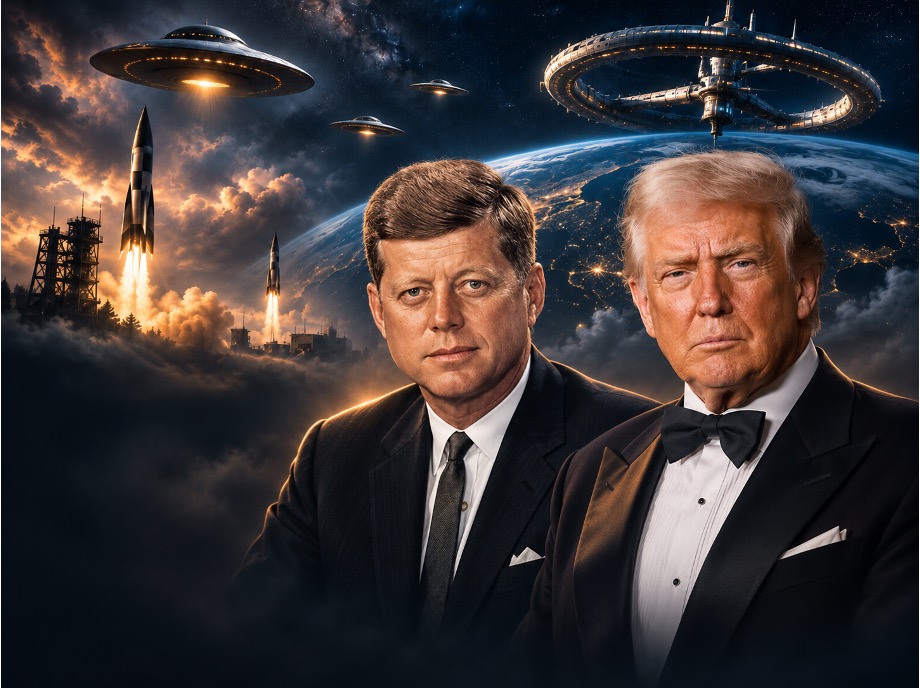
JFK Remembered: Where Humanity Could Have Been and May Be Going
Rev. Kat Carroll | November 22, 2026
(About a 9 minute read)
Sixty-three years later, the assassination of John F. Kennedy still raises questions about government secrecy, intelligence operations, and the direction America might have taken had he lived.
I was that kid, not by the side of the road (a reference to the book by Juan O’Savin), but sitting in front of the television about a month before my sixth birthday. Even at that young age, I sensed that something much bigger had happened than simply a man being shot.
The question isn’t merely who killed Kennedy. It’s whether his plans for space exploration, international cooperation, and access to classified technology threatened powerful interests, particularly those within the aerospace industry.
What might our world look like today if Kennedy’s vision of peace, shared scientific discoveries, and exploration of space had been allowed to flourish?
And could we finally be approaching another opportunity to realize that vision?
What Did Kennedy Know?
On September 20, 1963, President Kennedy proposed something extraordinary before the United Nations: that America and the Soviet Union consider joining forces in the exploration of the Moon.
Then, on November 12, just ten days before his assassination, he signed National Security Action Memorandum 271, directing NASA to develop proposals for cooperation with the Soviet Union, including lunar exploration.
Rather than continuing a costly competition between two nuclear superpowers, Kennedy was exploring the possibility of cooperation.
But who might have opposed sharing some of America’s most closely guarded technological secrets with the Russians?
I discussed that in this article: Who Won WWII and Who Inherited Future Technology?
One of those scientists was Wernher von Braun, who would become instrumental in America’s journey to the Moon despite his earlier involvement in Nazi Germany’s rocket program.
But as scientific discoveries moved into classified military projects and the hands of private corporations, how much control did elected officials really have over their development?
And how much did Kennedy know?
The Kennedy Brothers and Colonel Corso
Colonel Philip J. Corso, a former Army intelligence officer and author of The Day After Roswell, described the military’s handling of what he maintained was recovered extraterrestrial technology.
In a 1997 interview, Corso recalled discussing UFOs with Attorney General Robert F. Kennedy and indicated that information he shared with Bobby also reached President Kennedy.
Corso’s account raises an interesting question: Were the Kennedy brothers becoming aware that certain decisions concerning advanced technology were being made outside their direct control?
Researcher Daniel Liszt, better known as Dark Journalist, has spent years examining connections among intelligence officials, aerospace corporations, Operation Paperclip, Antarctica, and people surrounding Kennedy’s assassination.
Among the intriguing personalities are physicist Lloyd Berkner, who participated in Admiral Richard E. Byrd’s Antarctic expeditions and became involved in early government UFO investigations, and D. Harold Byrd, an aerospace investor who owned the Texas School Book Depository building and was related to the famous Antarctic explorer.
The family ties, institutional relationships, and classified research programs form a remarkable historical trail.
Why do so many roads seem to lead through intelligence agencies, aerospace corporations, and Antarctica?
We’ve seen how the public sometimes learns about secret government activities decades after the events themselves. Operation Paperclip and MKUltra are two examples of programs whose histories became clearer through later investigations and disclosures.
For those who enjoy exploring the historical breadcrumbs and discovering who was who in the zoo, I encourage you to watch Dark Journalist’s extensive presentation: Dark Journalist X-246: JFK The UFO File Assassination NASA Final Evidence
There are enough fascinating personalities and connections to fill several books. But for today, I’d rather return to Kennedy’s vision and what humanity might have accomplished had he lived.
From Kennedy’s Vision to a New Opportunity for Peace
On May 25, 1961, President John F. Kennedy stood before Congress and issued an extraordinary challenge:
“I believe that this nation should commit itself to achieving the goal before this decade is out of landing a man on the Moon and returning him safely to the Earth.”
He continued:
“No single space project in this period will be more impressive to mankind or more important for the long-range exploration of space. And none will be so difficult or expensive to accomplish.”
Kennedy understood the enormous technological difficulties, expense, and determination this undertaking would require. But he also recognized its importance to humanity’s long-range exploration of space.
On July 20, 1969, Apollo 11 fulfilled his ambition.
Sadly, Kennedy never lived to witness that achievement.
Kennedy reinforced that determination in his famous September 12, 1962, address at Rice University in Houston, Texas:
“We choose to go to the moon in this decade and do the other things, not because they are easy, but because they are hard.”
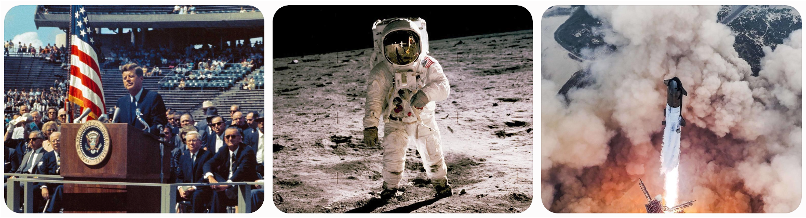
I was eleven years old when Apollo 11 landed on the Moon in July 1969. According to NASA, between 1969 and 1972, Americans successfully landed on the lunar surface six times, with twelve astronauts walking on another world.
And yet, more than half a century later, we’re still working toward returning humans to the Moon. But reaching the Moon was only the beginning.
Kennedy was right. Space exploration isn’t easy and we’ve lost some people along the way.
- Apollo 1 (1967): Tragedy struck on the launch pad at Cape Kennedy during a preflight test for Apollo 204 (AS-204). The mission was to be the first crewed flight of Apollo, and was scheduled to launch Feb. 21, 1967. Astronauts Virgil Grissom, Edward White and Roger Chaffee lost their lives when a fire swept through the command module.
- Space Shuttle Columbia (2003): The shuttle Columbia disintegrated during reentry, killing all seven astronauts. Damage to the left wing from insulating foam during launch allowed superheated gases to penetrate the structure.
But advances in aerospace technology, reusable rockets, robotics, and spacecraft design are opening possibilities that earlier generations could scarcely have imagined. It’s also making it much safer.
E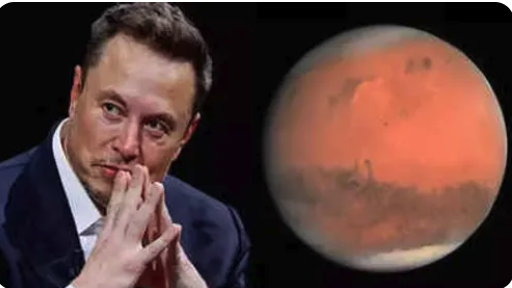 lon Musk and SpaceX are already looking beyond the Moon toward Mars. Musk has described ambitious plans to use Starship to transport equipment, robots, and eventually human explorers to the red planet.
His original timelines may have been optimistic, particularly as SpaceX continues developing the technology needed for increasingly complex missions. But perhaps that is part of the challenge Kennedy understood so well.
Mars may take a little longer than Musk originally hoped. But reaching the Moon was only the beginning of humanity’s journey into space.
Great achievements require vision, determination, and the willingness to attempt what once seemed impossible.
More than six decades later, President Donald Trump has introduced initiatives to return Americans to the lunar surface, develop a permanent lunar presence, expand commercial space activity, and educate future generations of space pioneers.
The Artemis Accords, introduced in 2020 during Trump’s first administration, established international principles for peaceful civilian exploration of the Moon, Mars, and beyond. By November 2026, 78 nations had signed.
On December 18, 2025, Trump signed Executive Order 14369, Ensuring American Space Superiority, outlining plans for a return to the Moon by 2028, progress toward a permanent lunar outpost, and expanded commercial and technological development.
On August 28, 2026, he established a commission to develop plans for a United States Space Academy, intended to prepare future scientists, engineers, astronauts, and civilian and military space professionals.
And on November 3, 2026, he issued The American Declaration of Freedom in Space, describing outer space as a frontier for human exploration, development, and settlement.
These initiatives also emphasize military security and American leadership, raising familiar questions about competition, technology, and control.
Are we witnessing the continuation of Kennedy’s vision in a new era?
Humanity may be developing the technologies to explore beyond Earth, but can we find ways to cooperate rather than compete?
A Historic Meeting of Three Superpowers
Just three days before the anniversary of Kennedy’s assassination, another remarkable event took place.
On November 19, 2026, President Trump met with Russian President Vladimir Putin and Chinese President Xi Jinping in Shenzhen, China, for an unprecedented summit involving the leaders of three major nuclear powers.
Together, they issued a Declaration toward Peace, calling for dialogue to reduce nuclear risks and prevent nuclear proliferation.
The declaration did not mention space exploration, nor did it resolve the serious conflicts between these nations. But it established a public commitment to discussing matters that affect the future of humanity.
What else might have been discussed behind closed doors?
Could international cooperation in space eventually become another area of common interest as humanity prepares for a more permanent presence beyond Earth?
Kennedy imagined cooperation with America’s greatest Cold War rival in 1963. Now, sixty-three years later, leaders of three powerful nations have met to discuss reducing nuclear dangers.
Could this be another opportunity to pursue the kind of peaceful cooperation Kennedy once envisioned?
Strange Echoes Across Time
As I followed these historical threads, another layer of mystery began to emerge.
Some of the strangest coincidences appear not in government documents, but in old artwork, literature, and curious numerical connections.
Consider Charles Dellschau, a Prussian-American artist whose extraordinary illustrations depicted unconventional flying machines called aeros. His notebooks describe a mysterious group known as the Sonora Aero Club, supposedly experimenting with aircraft in California during the 1850s, long before conventional powered flight became a reality.
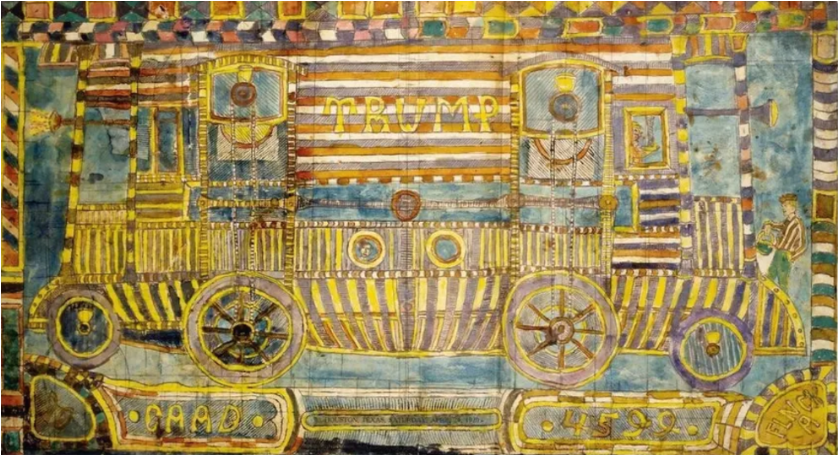 Among Dellschau’s illustrations is an unusual airship bearing the word TRUMP, accompanied by the number 45.
Then there is Ingersoll Lockwood, an American author whose nineteenth-century works include The Travels and Adventures of Little Baron Trump (1890), Baron Trump’s Marvellous Underground Journey (1893), and 1900; or, The Last President (1896).
 These books experienced renewed interest following Donald Trump’s 2016 election because of their curious similarities in names and certain political themes.
Are these merely coincidences? Maybe.
But what if history isn’t always as linear as we assume? Could some people, technologies, or hidden circles have glimpsed possibilities long before the rest of the world caught up?
Even the dates invite curiosity.
1945: World War II ended, the atomic age began, and the recruitment of German scientific expertise expanded.
1947: The Roswell incident occurred, the National Security Act established the CIA, and America’s modern intelligence and national-security structure took shape.
The 45th and 47th presidencies—in case that connection didn’t jump out at you!!
1963: Kennedy was assassinated, leaving questions about intelligence activities, secrecy, and his unfinished plans.
And today marks the 63rd anniversary of his assassination.
2017–2021: America’s 45th president, Donald Trump, established the United States Space Force in 2019.
2025–2029: Trump returned as the 47th president, with renewed interest in releasing classified government information and expanding America’s presence in space.
I’ve also heard speculation since Trump’s first term that he might be the last president under our current system of government, giving Lockwood’s century-old title an especially curious resonance.
I don’t offer these connections as proof of prophecy or time travel. But they certainly invite us to consider possibilities beyond our ordinary understanding of history.
Perhaps they’re nothing more than extraordinary coincidences. Or perhaps they remind us that we still have much to discover about our world and its history.
And here’s another question: What if a new age requires a new way of governing?
Returning Power to the People
During his inaugural address on January 20, 1961, President John F. Kennedy challenged Americans with words that would resonate for generations: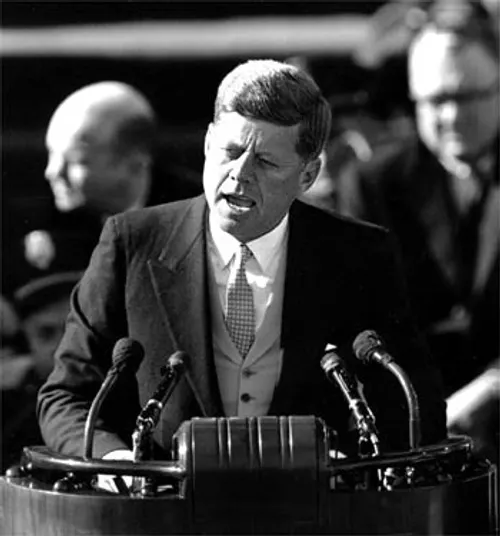
“Ask not what your country can do for you—ask what you can do for your country.”
Fifty-six years later, during his own inaugural address on January 20, 2017, President Donald Trump made another declaration:
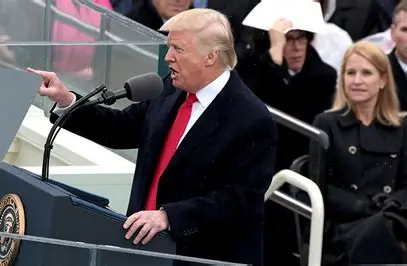
“We are transferring power from Washington, D.C. and giving it back to you, the American People.”
Two presidents, separated by more than half a century, each calling attention to the relationship between the American people and their government.
Kennedy encouraged Americans to accept responsibility for their country’s future. Trump promised to restore political power to the citizens the government was created to serve.
But what would that mean in practice?
Can the people truly shape their nation’s future without transparency, accountability, and access to knowledge that may have been withheld for generations… decades?
And if humanity is preparing to establish a presence beyond Earth, shouldn’t ordinary people have a meaningful voice in deciding how that future unfolds?
Perhaps the most important connection between these two inaugural addresses is the reminder that a nation’s future does not belong exclusively to presidents, politicians, intelligence agencies, or powerful corporations.
It belongs to the people who will inherit it.
An Unfinished Vision?
John F. Kennedy challenged humanity to think beyond war, fear, and the narrow limits of the Cold War.
He called America to the Moon, but he also imagined a future in which cooperation could become more powerful than conflict.
That vision was never fully realized during his lifetime.
Now, decades later, President Trump appears to be pursuing some of those same ambitions in a very different era, through renewed attention to disclosure, expanded space exploration, and diplomatic efforts involving some of the world’s most powerful nations.
Is Trump simply advancing American power, or could some of these initiatives also help reopen a path Kennedy once tried to establish?
A path toward peace, technological breakthroughs, and humanity’s greater future among the stars?
Perhaps the greatest tribute we can offer John F. Kennedy is not simply to remember the day we lost him, but to rediscover the future he believed humanity could create.
And perhaps that future isn’t lost after all.

Resources
- JFK Presidential Library — The Space Program
- Dark Journalist X-246: JFK The UFO File Assassination NASA Final Evidence
- The Day After Roswell — Colonel Philip J. Corso
- BBC — Trump, Putin and Xi’s Declaration toward Peace
- Calling in UFOs for Peace or for Technology? — Prepare for Change
- Who Won WWII and Who Inherited Future Technology? — Prepare for Change

Your Tax Free Donations Are Appreciated and Help Fund our Volunteer Website
Disclaimer: We at Prepare for Change (PFC) bring you information that is not offered by the mainstream news, and therefore may seem controversial. The opinions, views, statements, and/or information we present are not necessarily promoted, endorsed, espoused, or agreed to by Prepare for Change, its leadership Council, members, those who work with PFC, or those who read its content. However, they are hopefully provocative. Please use discernment! Use logical thinking, your own intuition and your own connection with Source, Spirit and Natural Laws to help you determine what is true and what is not. By sharing information and seeding dialogue, it is our goal to raise consciousness and awareness of higher truths to free us from enslavement of the matrix in this material realm.