EN
EN FR
FR

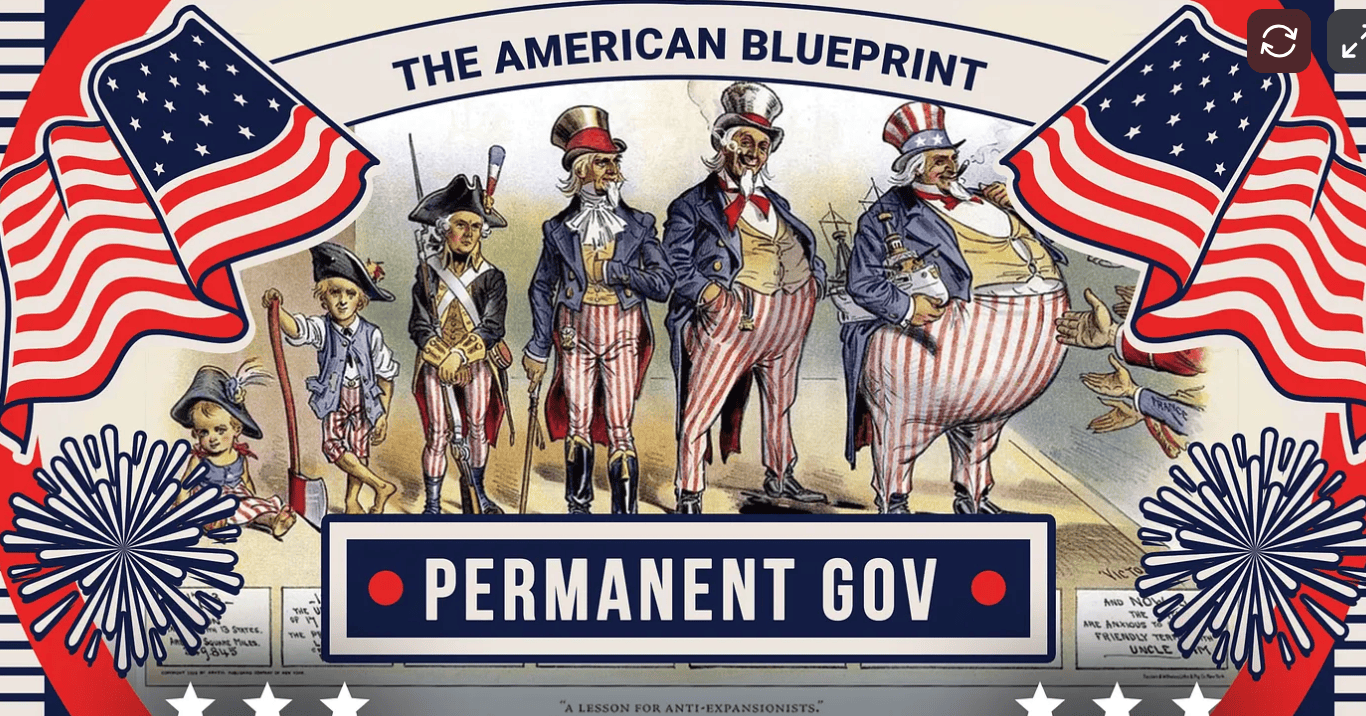
An administration lasts four to eight years. The administrators last decades. The bankers last centuries. And on July 17, 2026, the mechanism became publicly visible in a way it never had before.
On June 29, 2026 — days before the country marked two hundred fifty years since the Declaration was signed — the Supreme Court handed down two rulings that will likely be remembered as the moment the modern argument over who actually runs the United States got settled, at least for now. Less than three weeks later, on July 17, 2026, a sitting president stood in the East Room of the White House and named, in a nationally televised address supported by newly declassified intelligence, a permanent administrative layer that had operated against the constitutional vessel it was built to serve.
The sequence of those two events — the Slaughter ruling on June 29th, the declassification speech on July 17th — is not coincidental. They are the same constitutional confrontation playing out in two consecutive moves. The first gave the president the legal tool. The second deployed it rhetorically and documentarily, establishing the public record that makes the subsequent legal and institutional moves possible.
DOCUMENTED – Trump v. Slaughter and Trump v. Cook were decided June 29, 2026. Trump’s primetime address from the East Room, July 16-17, 2026, accompanied the release of newly declassified documents on Chinese election data compromise and domestic intelligence agency conduct. The speech was covered by all major networks. The declassified documents were simultaneously published by the White House. Source: multiple contemporaneous news accounts including CNN, ABC News, France 24, Newsweek, and Votebeat.
What the Supreme Court Decided
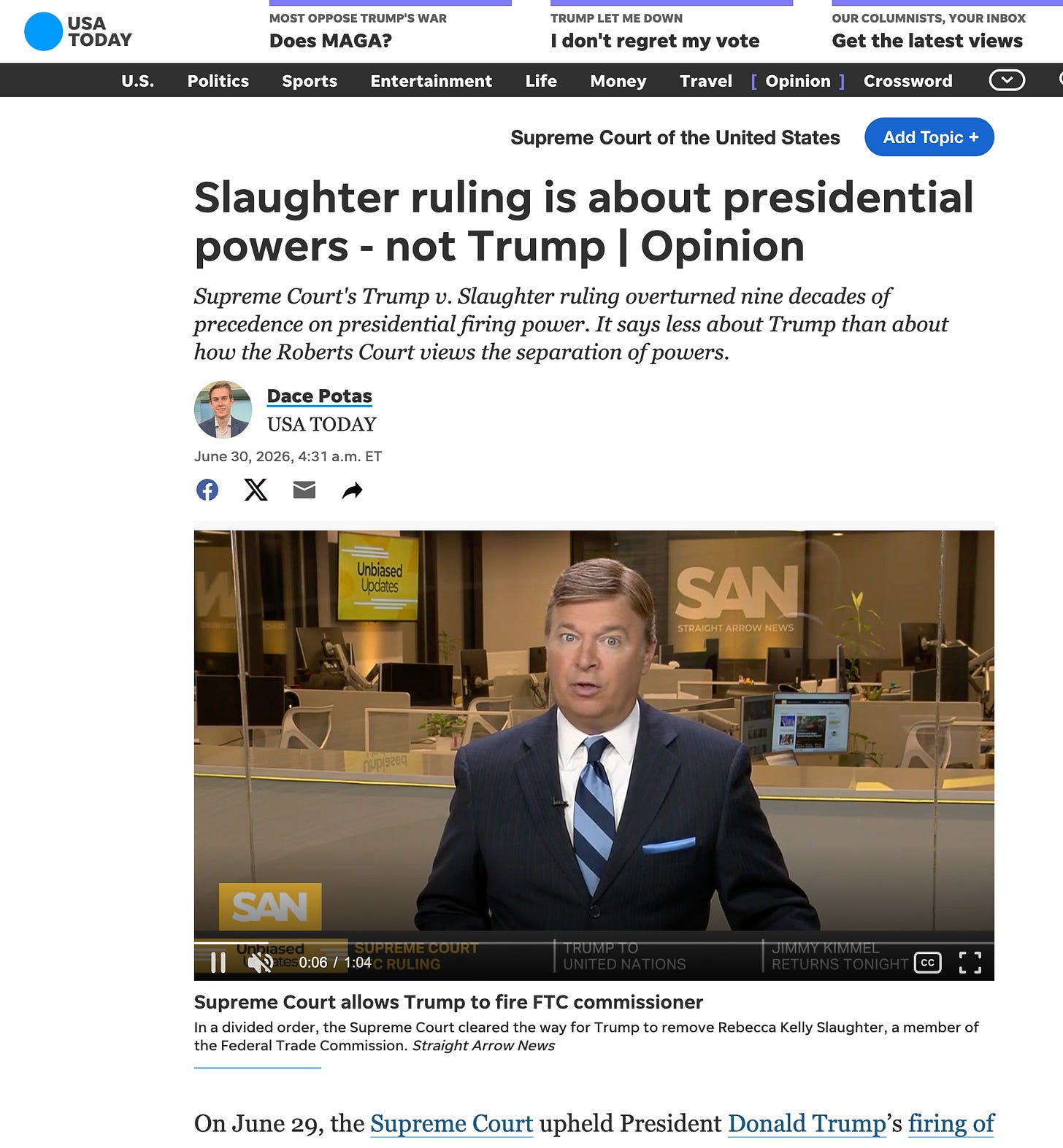
The Slaughter ruling gave the president the authority to fire the heads of roughly two dozen federal agencies that Congress had, for nearly a century, deliberately insulated from at-will removal — agencies regulating everything from consumer products to nuclear materials to labor relations to communications. Chief Justice Roberts’ reasoning was explicit: officials who exercise the president’s executive power must be removable by the president at will, otherwise they are not accountable to him, and he is not accountable to the people who elected him.
The companion Cook ruling left the Federal Reserve’s independence intact — the one agency, the one controlling the currency, that every side agreed needed to stay insulated from the temporary occupant of the office. Set the legal reasoning aside and look at the structural outcome: in a ruling that one constitutional law scholar said had essentially eliminated independent agencies from the United States government, the single institution left standing with its independence intact was the one that is not a federal agency at all. Thus, outside of the reach of the President and government.
What the Federal Reserve Actually Is
The Federal Reserve is not a federal agency. It has never been a federal agency. It is a privately owned banking institution — a consortium of regional reserve banks whose stockholders are the member commercial banks — granted the appearance of governmental authority by an act of Congress in December 1913. Roberts did not carve out an exception for the Fed. He accurately, if inadvertently, named where it actually lives: outside the constitutional structure being adjudicated, because it was never inside it to begin with.
The one part of the administrative state every side agreed needed to stay insulated from the temporary occupant of the office was the part that controls the money — because that part was never the government’s to begin with.
DOCUMENTED / ASSESSED – The private ownership structure of the Federal Reserve System is a matter of public record. G. Edward Griffin’s The Creature from Jekyll Island (1994) provides the most detailed account of the Fed’s founding, drawing on contemporaneous congressional records and the later admissions of participants in the 1910 Jekyll Island meeting. Michael Maloney’s Hidden Secrets of Money series extends this analysis into the mechanics of currency issuance and debt.
Jekyll Island and the Architecture of 1913
In November 1910, a group of men boarded a private rail car at a New Jersey station under assumed names, destination undisclosed. They traveled to Jekyll Island, Georgia — a private retreat owned by J.P. Morgan — and spent nine days drafting what would become the Federal Reserve Act. The participants represented, by some estimates, roughly a quarter of the world’s total wealth: Senator Nelson Aldrich; Frank Vanderlip of National City Bank; Henry Davison of J.P. Morgan; Charles Norton of First National Bank of New York; Benjamin Strong of Bankers Trust; and Paul Warburg of Kuhn, Loeb — the American representative of the Rothschild banking interests in Europe.
The Federal Reserve Act passed Congress in December 1913, during the Christmas recess when most members had returned home. In February of the same year, the 16th Amendment had been ratified, establishing the federal income tax. One created the mechanism to extract wealth from the labor of individuals. The other created the private institution that would manage and expand the currency those extractions were denominated in. The administrative infrastructure of financial control was formalized in a single calendar year.
The Civil War and What It Made Possible
To understand why 1913 became possible, you first have to understand what the Civil War made possible.
The early American republic had deliberately dispersed financial power. State-chartered banks, local lending institutions, regional currencies, and community credit networks reflected a constitutional suspicion of concentrated financial authority. Andrew Jackson’s destruction of the Second Bank of the United States was not simply a political victory; it was an expression of the prevailing belief that centralized banking inevitably concentrated political influence alongside economic power.
The Civil War fundamentally altered that landscape. Faced with the enormous cost of financing the Union war effort, Congress passed the National Banking Acts of 1863 and 1864, creating nationally chartered banks, a uniform national currency, and a federal framework that steadily marginalized state banks and competing local currencies. What was presented publically as wartime necessity became permanent financial architecture. The South’s banking system lay devastated, regional capital markets were fractured, and the federal government opportunistically emerged with unprecedented influence over the nation’s monetary system.
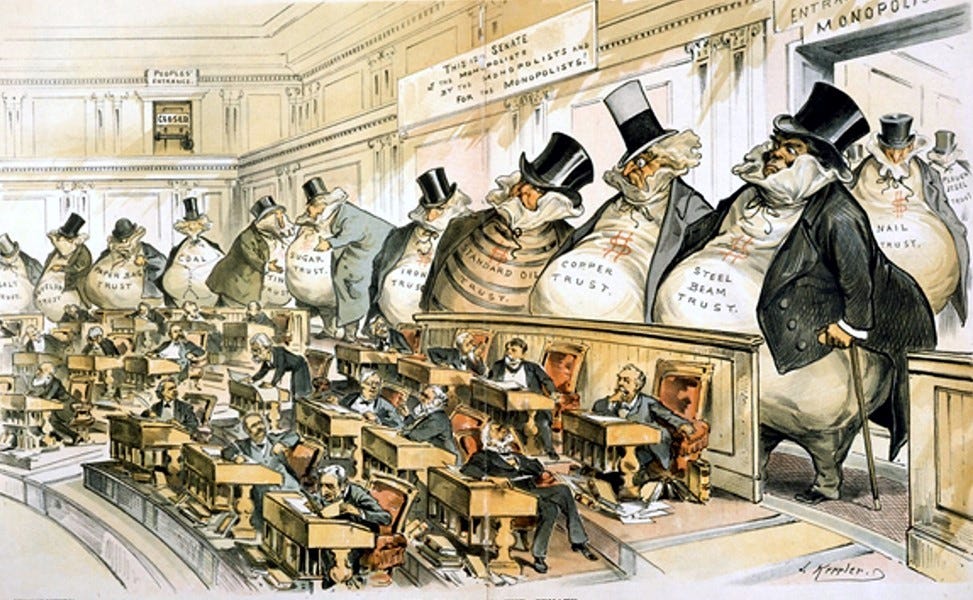
The decades that followed witnessed more than reconstruction—they witnessed consolidation. The South and her many of her ideals, subjectively good and bad, were “gone with the wind.” Capital increasingly flowed toward New York, where private banking houses such as J.P. Morgan & Co. evolved into the de facto stabilizers of the American financial system. Consolidation of wealth was the model that the Wall Street bankers copied from the great Central Banks of Europe, pursued by burgeoning elite American familial dynasties. Repeated financial crises, particularly the panics of 1873, 1893, and 1907, reinforced the argument that national markets required national financial management. Each crisis expanded both the influence of Wall Street financiers and the political appetite for greater central coordination.
For many observers, this sequence appears less like a series of unrelated reforms than an opportunity skillfully exploited. The destruction of regional banking, the gradual displacement of local financial institutions, and the growing dependence upon northeastern capital created conditions in which a centralized banking system became increasingly inevitable. The beneficiaries of that consolidation are difficult to ignore. Financial power migrated steadily from thousands of independent institutions toward a relatively small network of national banks and investment houses concentrated in New York.
The Civil War ended plantation slavery throughout the South while arguably creating financial slavery throughout the United States, one of the defining transformations in American history still at play today. Viewed through the lens of financial history, it marked the beginning of the migration of monetary power away from communities and regions toward an increasingly centralized financial system. Whether that outcome was the unintended consequence of wartime necessity or the realization of longer-standing ambitions remains one of the enduring questions of American economic history. Credible sources say that it was part of the plan that continues which this blog presents among many articles and sources.
July 17, 2026: The Permanent Government Named
Against this background — two and a half centuries of permanent administrative infrastructure built above and around the constitutional vessel — Trump’s July 17th speech was something categorically different from any prior political accusation about election fraud or deep state interference. It was a declassification event. The distinction matters operationally in a way that most coverage missed entirely.
Classified evidence cannot be introduced in open court proceedings in the normal way. The classification status of intelligence is not a procedural footnote — it is the primary mechanism by which the permanent administrative layer has protected itself from legal accountability. What declassification does is not produce a news story. It produces admissible evidence. The grand jury proceedings in Fort Pierce, Florida that preceded this speech had been exponentially extended in timeline by the classification status of the very documents that would have accelerated them. Last night’s declassification changed that timeline
What the speech named, specifically: that newly declassified documents showed China had carried out what Trump called the largest compromise of election data in history; that intelligence agencies had concealed this from the president and signed documents falsely asserting the 2020 election was the most secure in history; that the FBI, DHS, CIA, and other government agencies had worked in coordination with media institutions and corporations to suppress and destroy evidence of the compromise; and that this conduct — hiding critical intelligence from the president, working to undermine the constitutional process of elections — constituted treason.
DOCUMENTED / CONTESTED – Trump’s speech and the accompanying declassified documents are matters of public record. The specific claims — that voting machines were altered, that 250,000 non-citizens are registered to vote, that the FBI manufactured ballots — are contested by election officials and plenty partisans who say the released documents do not fully support them. This is how the hybrid war operates – to seed confusion. What is documented: that a Chinese actor downloaded state voter information available on commercial websites; that some intelligence officials believed China took steps to undermine Trump’s 2020 reelection primarily through social media; and that a classified IC assessment containing this information existed as of January 7, 2021. History will likely settle this issue.
Trump asked the ODNI, DOJ, FBI, and CIA to investigate how and why the information was hidden, to fire those involved, and to file criminal charges if appropriate. He said federal agencies would begin notifying governors and election officials about compromised election data and cyber vulnerabilities before the 2026 midterms.
The Self-Investigation Problem
Here is where the analysis within our network that has spent years documenting the CIA’s nefarious activities was neither surprised by the speech’s content nor optimistic about its immediate consequences. The same institutions the speech named as having committed the cover-up are the institutions being asked to investigate themselves. That is not a procedural oversight. It is the structural problem the entire arc of this series has been documenting: the permanent administrative layer does not investigate itself. It absorbs and neutralizes accountability attempts the way the human body absorbs a foreign object — surrounding it, containing it, rendering it inert.
FIRSTHAND ACCOUNT – The observation within our network, consistent across years of engagement with people who have operated inside these institutions: internal investigations of intelligence agencies by intelligence agencies have rarely produced genuine accountability for systemic conduct. The mechanism has always been the same — a review process that consumes years, produces redacted reports, results in no criminal referrals, and leaves the institutional culture intact. The Slaughter ruling theoretically gives the president the tool to bypass this by removing agency leadership at will. Whether that tool will be used before the institutional self-protection reflex absorbs it is the live question.
The architectural fix exists in the structure the founders built. The grand jury mechanism — civilian, outside the administrative chain, historically resistant to institutional capture — is the instrument through which the declassified evidence can be introduced and acted upon without requiring the compromised institutions to investigate themselves. The at-will removal power the Slaughter ruling just confirmed gives the president the ability to replace leadership that obstructs that process. The sequence, if it is executed, is: declassify, establish the public record, notify states (forcing them to act or become complicit), accelerate the grand jury timeline with now-admissible evidence, and remove any agency leadership that obstructs.
Whether the vessel is intact enough to execute that sequence before the permanent administrative layer absorbs it is the question this series cannot answer. What it can document is that the constitutional architecture designed to make that sequence possible is being used, in real time, in exactly the way the founders built it to be used — and that the speed of what follows, as the Hybrid War Correspondent who has been tracking this from inside the network most directly engaged with it observed immediately, will increase exponentially.
SERIES BRIDGE – The Trump declassification speech of July 17, 2026 is the present-tense expression of the permanent government mechanism this article has traced from Jekyll Island through the Slaughter ruling. The Arcane Blueprint documented the philosophical lineage that built the administrative architecture. The American Blueprint has traced that architecture through two and a half centuries of institutional development. The accountability moment the founders built the vessel to produce is now, in some form, underway. Article 8 examines what the cosmic frame says about whether it succeeds.
Eyes to see it.
The American Blueprint — Series Roadmap
Article 1 — The Fraternity Before the Flag [Published]
Article 2 — The Comte and the Cause [Published]
Article 3 — The Angel and Orb at Valley Forge [Published]
Article 4 — A City Built to a Plan [Published]
Article 5 — New Atlantis, New Lemuria, and the World Before [Published]
Article 6 — The Permanent Government (COG) [You are here]
Article 7 — The Imperial Agency and the Hemisphere
Article 8 — 250 Years of the Plan
— Gerry
Gerry Gomez is an investigative journalist, creative director, and hybrid war correspondent who has spent a decade documenting the convergence of financial, media, and geopolitical forces shaping the current global transition.

Your Tax Free Donations Are Appreciated and Help Fund our Volunteer Website
Disclaimer: We at Prepare for Change (PFC) bring you information that is not offered by the mainstream news, and therefore may seem controversial. The opinions, views, statements, and/or information we present are not necessarily promoted, endorsed, espoused, or agreed to by Prepare for Change, its leadership Council, members, those who work with PFC, or those who read its content. However, they are hopefully provocative. Please use discernment! Use logical thinking, your own intuition and your own connection with Source, Spirit and Natural Laws to help you determine what is true and what is not. By sharing information and seeding dialogue, it is our goal to raise consciousness and awareness of higher truths to free us from enslavement of the matrix in this material realm.