EN
 FR


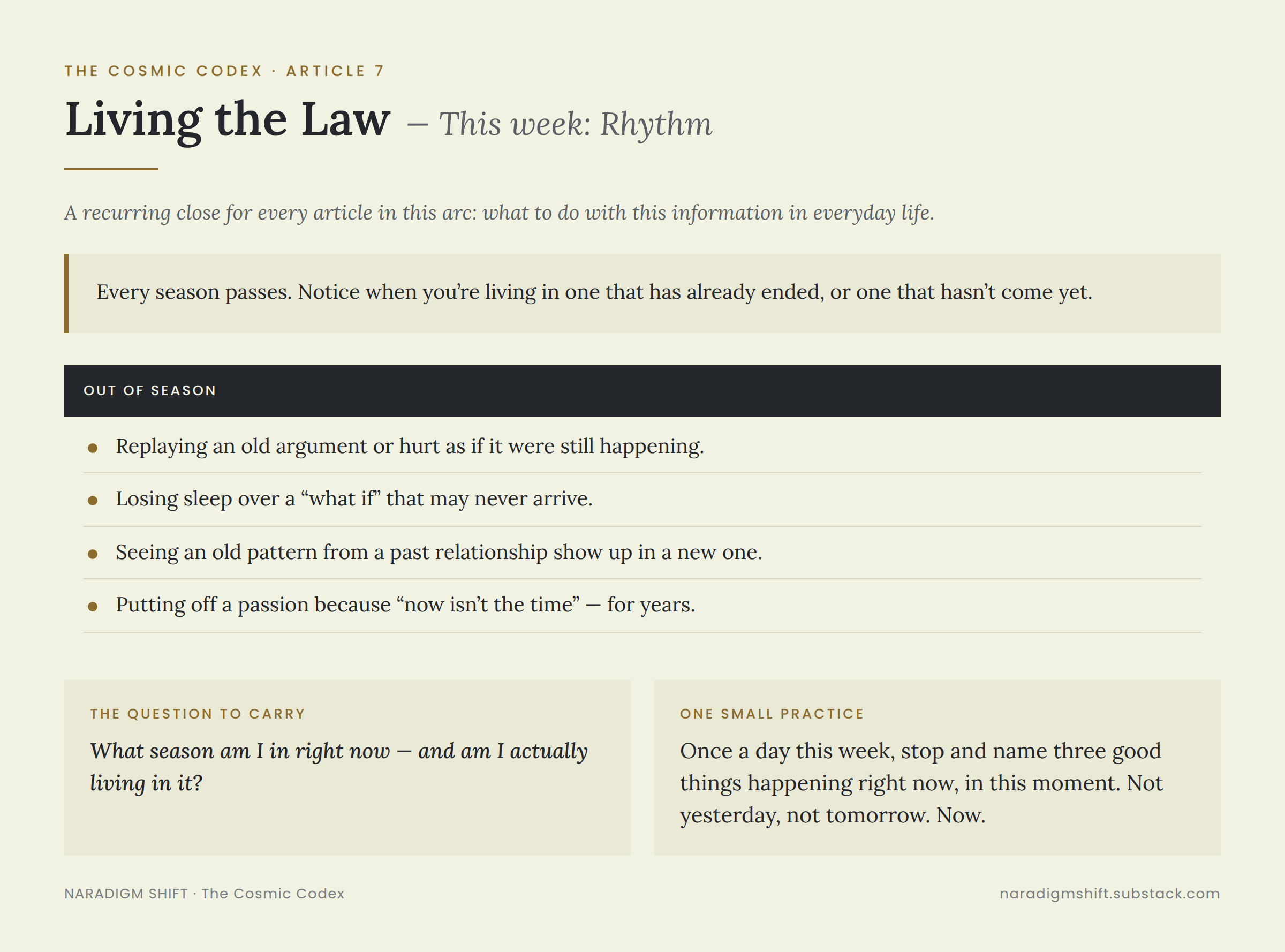
Everything moves in cycles, and nothing stays in one form forever. The trick is learning to live in the season you’re actually in.
[Documented] One of the oldest statements of this law is in the Bible. The third chapter of Ecclesiastes opens: “To every thing there is a season, and a time to every purpose under the heaven.” It goes on to pair opposites — a time to be born and a time to die, a time to weep and a time to laugh, a time to break down and a time to build up. In 1965, the Byrds turned those verses into a number one hit, “Turn! Turn! Turn!,” adapted by the folk singer Pete Seeger. A generation that was living through enormous change sang along to a three-thousand-year-old teaching on change itself. A new Age, the Age of Aquarius, was beginning with a sing-a-long.
That passage is a living lesson in two laws at once. Every pairing in it — day and night, joy and sorrow, war and peace — is polarity, the subject of Article 6. And the fact that each one has its time, and gives way to the next, is the Law of Rhythm.
This article takes up Rhythm and its partner, the Law of Perpetual Transmutation. Together they describe both the timing of change and the nature of it. And they offer something every reader can use today: a way to stop fighting the season you are in.
The Pendulum
Rhythm is the easiest law to see, because we live inside it every moment. Breath in, breath out. Heartbeat. Waking and sleeping. Tides rising and falling twice a day. Spring, summer, autumn, winter.
[Documented] The Kybalion (1908) describes Rhythm as a pendulum: “the measure of the swing to the right is the measure of the swing to the left.” Everything that rises will fall back, and everything that falls will rise again. Moods swing. Markets swing. Civilizations swing.
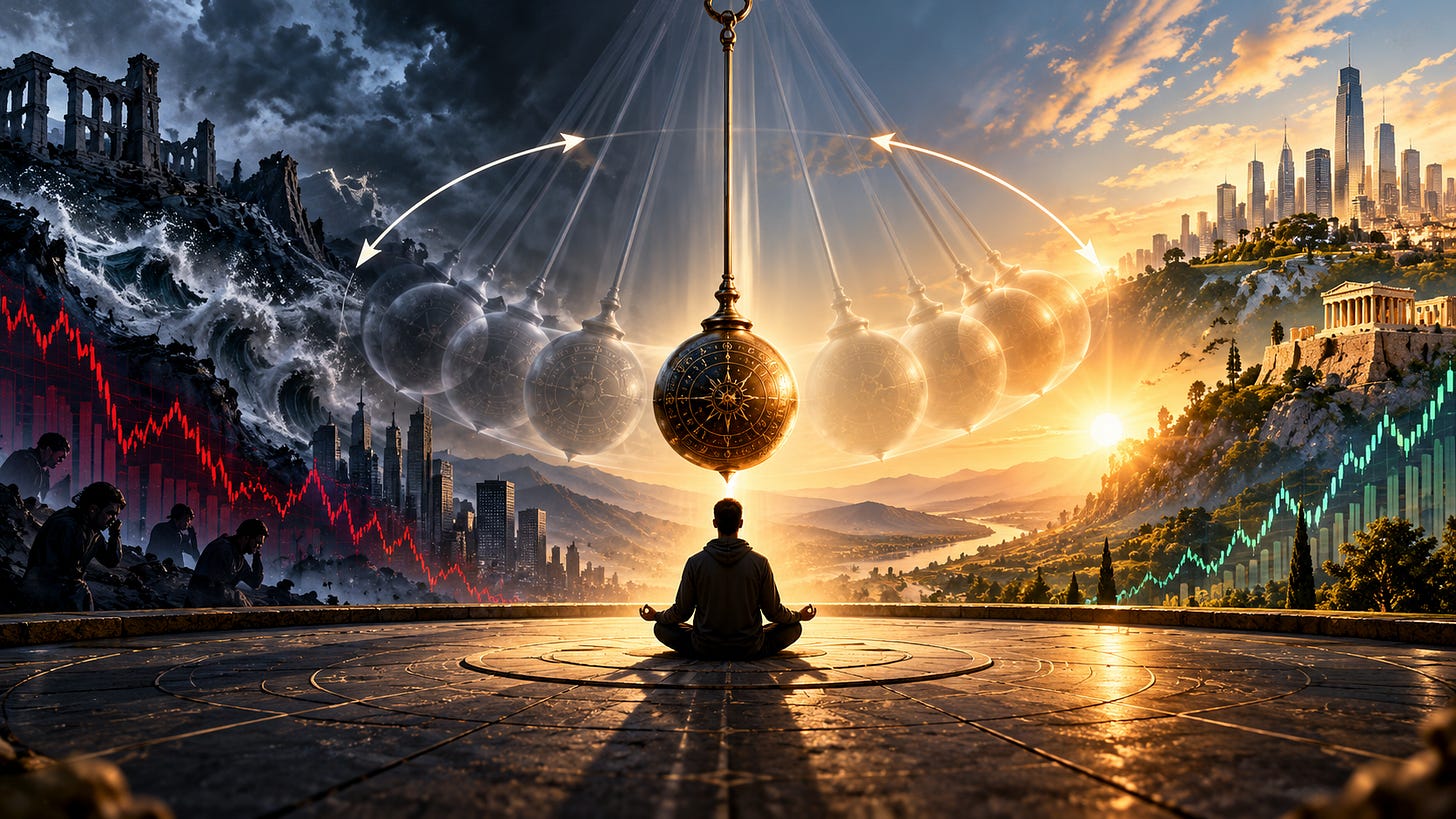
But the same text offers something more useful than a description. It teaches what it calls neutralization: the practice of not being thrown by the swing. [Oral Tradition] The idea is that you cannot stop the pendulum, but you can choose where you stand in relation to it. A person who knows that a low mood will pass, and that a high one will settle, is less likely to make permanent decisions in a temporary state. They feel the swing without being carried away by it.
[Assessed] That is the practical gift of this law. It does not ask you to escape the cycles. It asks you to recognize them, so they stop surprising you.
The Great Cycles
If rhythm governs a breath and a season, the traditions say it also governs ages.
[Documented] Human cultures have tracked very long cycles for thousands of years. Plato wrote of a “Great Year,” the span after which the heavens return to their starting positions; later writers linked it to the precession of the equinoxes, the roughly 25,800-year wobble of Earth’s axis described in Article 2. Hindu tradition describes four great ages, or yugas, descending from a golden age of truth to the Kali Yuga, an age of conflict that tradition dates from 3102 BCE. The Maya Long Count calendar completed its thirteenth b’ak’tun cycle on December 21, 2012 — a date widely misread as a prophecy of the world’s end, when to the Maya it marked the turning of a cycle.
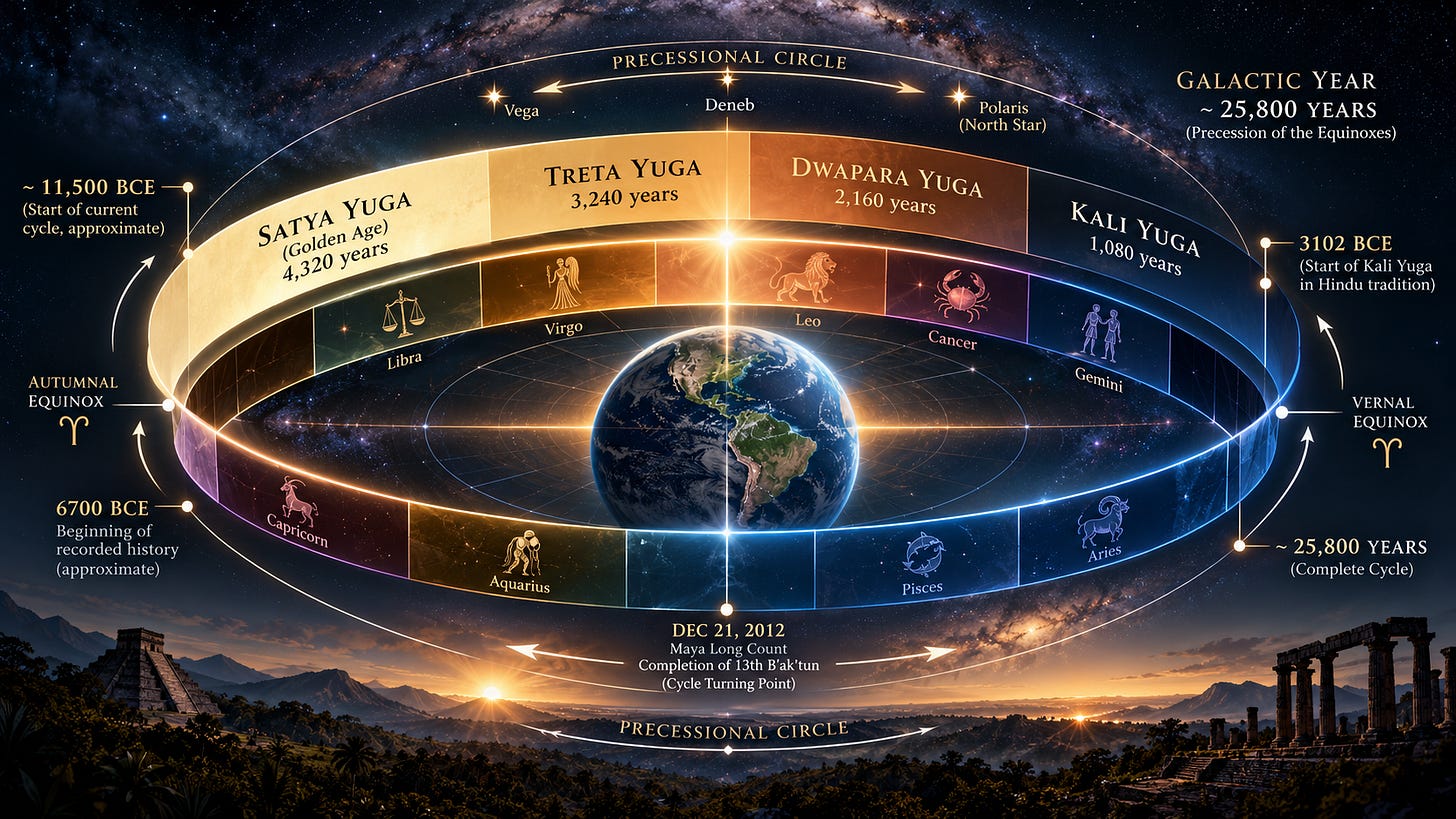
[Oral Tradition] The Ra material, as Article 2 described, speaks of three minor cycles of about 25,000 years each, with humanity now at the end of the third. Different traditions, different numbers, one shared intuition: history moves in great seasons, and we are living through a change of season now.
[Assessed] As always, it is worth keeping the measurement and the meaning separate. The cycles of the sky are documented. The spiritual significance given to them is interpretation. But the fact that so many cultures, independently, arrived at the idea of great ages turning is itself worth noticing.
From Pisces to Aquarius
The most familiar version of this great turning is the shift from the Age of Pisces to the Age of Aquarius.
[Documented] The astrological ages follow the precession: roughly every two thousand years, the constellation behind the Sun at the spring equinox slowly changes. Astrologers widely disagree about exactly when the Age of Aquarius begins — estimates span several centuries — but most agree we are at or near the threshold. It is also worth noting that early Christians used the fish, the ichthys, as their symbol, and the Piscean age broadly overlaps the Christian era.
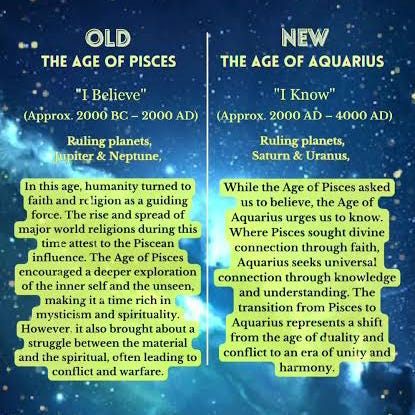
[Oral Tradition] In this tradition, the Piscean age was an age of faith and belief: truth handed down from above, through priests, kings, and institutions, and accepted on trust. The Aquarian age is described as an age of knowledge and shared understanding: truth reached directly, by individuals connected in networks rather than ranked in hierarchies.
There was a time for the old age, and there is a time for the coming one. New things will happen in Aquarius. But the transition is also a time to look back and examine what we have already experienced — to keep what served us, release what bound us, and carry the lessons forward. [Assessed] That is exactly what this arc has been doing: taking the old teachings about universal law out of the hands of gatekeepers and putting them where anyone can read and test them.
The Only Season You Can Live In
Here is where the great cycles come home. Ages turn over thousands of years. But a human being only ever lives in one moment: this one. The present. AKA, the gift.
Things change. Things come and go. And the Law of Rhythm carries a quiet warning about where we put our attention.
If you live in the past, you stay anchored to what already happened, often to a previous hurt or trauma. You replay it, sometimes in your head, sometimes in your body and emotions, over and over. [Documented] Psychologists call this rumination, and research has linked it to depression and anxiety. It holds you back from growth, because you are reliving one season instead of moving into the next.
If you live in the future, you may spend your days stressing over things that have not happened and may never happen. Article 3 gave this a name: FEAR, False Evidence Appearing Real. Worry about tomorrow is one of its favorite forms.
If you live in the now, you can see what is actually in front of you — and appreciate the good things happening right now. [Documented] Teachers across traditions have pointed here, from Buddhist mindfulness practice to Eckhart Tolle’s The Power of Now (1997). [Assessed] The present is not just a pleasant place to rest. It is the only solid ground there is — the base you move out from. Every season you will ever live through arrives as a present moment.
A Time for Each
I was talking with a friend recently, and our conversation turned out to be this law in miniature.
A few years ago, a long marriage of his came to an end. Afterward, he spent a long stretch in a job he didn’t love, working to settle the costs of starting over. Now he is in a new relationship — and he is noticing some of the same habits and expectations from his old one starting to surface again. At the same time, he is a creative person, and he feels a strong pull toward his art: the thing he set aside during the hard years.
He was trying to weigh the two. On one side, the desire for companionship. On the other, the call to follow his passion.
What I told him was that the relationship is not an obstacle to growth. It is an opportunity for it. Old patterns resurfacing is not failure. [Oral Tradition] It is the rhythm of the school described in Articles 5 and 6: a lesson that was not fully learned the first time comes back around, giving you another chance to meet it differently. And the creative pull is not selfishness. Following a genuine passion is part of becoming who you are meant to be.
[Assessed] The answer is not to choose one forever. It is to recognize that there is a time for each, and to learn how to balance them. Some seasons are for building a life with another person. Some are for building the work only you can make. Most of life asks us to hold both — and to notice which one the present moment is asking for right now.
Nothing Is Lost, Only Changed
If Rhythm is the timing of change, the Law of Perpetual Transmutation is its nature. Energy is always moving from one form to another. Nothing stays stuck forever.
[Documented] Physics states a version of this as the conservation of energy: energy cannot be created or destroyed, only converted from one form into another. The medieval alchemists pursued a more poetic version, the transmutation of lead into gold. [Assessed] Whatever they believed about metals, the image has lasted because it describes something true about people: the heaviest experiences in a life can, with work, become its most valuable.
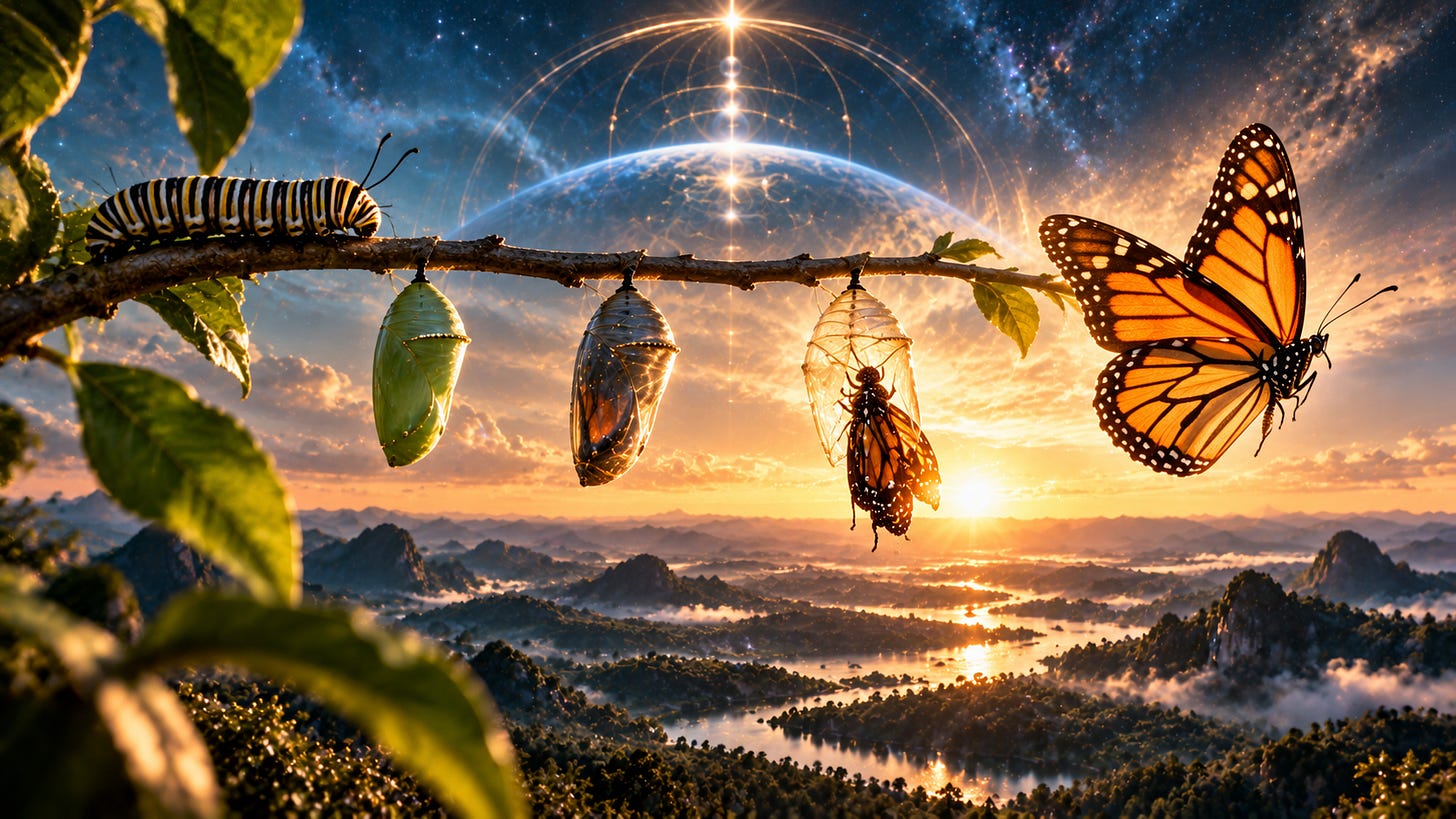
The most striking picture of transmutation comes from nature. [Documented] When a caterpillar enters its chrysalis, much of its body breaks down. Clusters of cells called imaginal discs, which were present in the caterpillar all along, then build the adult structures — wings, legs, eyes. The butterfly was not added from outside. It was carried inside the caterpillar the whole time, waiting for its season.
[Assessed] That is a precise image for where humanity is said to be now. The old form is breaking down, and from the outside it can look like collapse. But in this tradition’s reading, what is happening is not destruction. It is transmutation. The new form was carried within us all along.
A Lifetime in Twenty-Five Minutes
Science fiction has given us two of the most memorable pictures of these laws.
[Documented] In Star Trek: The Next Generation’s “The Inner Light” (1992), an alien probe scans Captain Picard, and he collapses on the bridge. In his mind, he wakes as a man named Kamin on a planet called Kataan. He lives an entire life there. He marries, raises children, learns to play the flute, grows old. And he watches, over decades, as his world slowly dies: Kataan’s sun is failing, and its people know there is nothing they can do. At the end, Picard learns the truth. The people of Kataan launched the probe as their final act, so that someone, somewhere, would remember them. On the Enterprise, only twenty-five minutes have passed. Picard is left holding the flute.
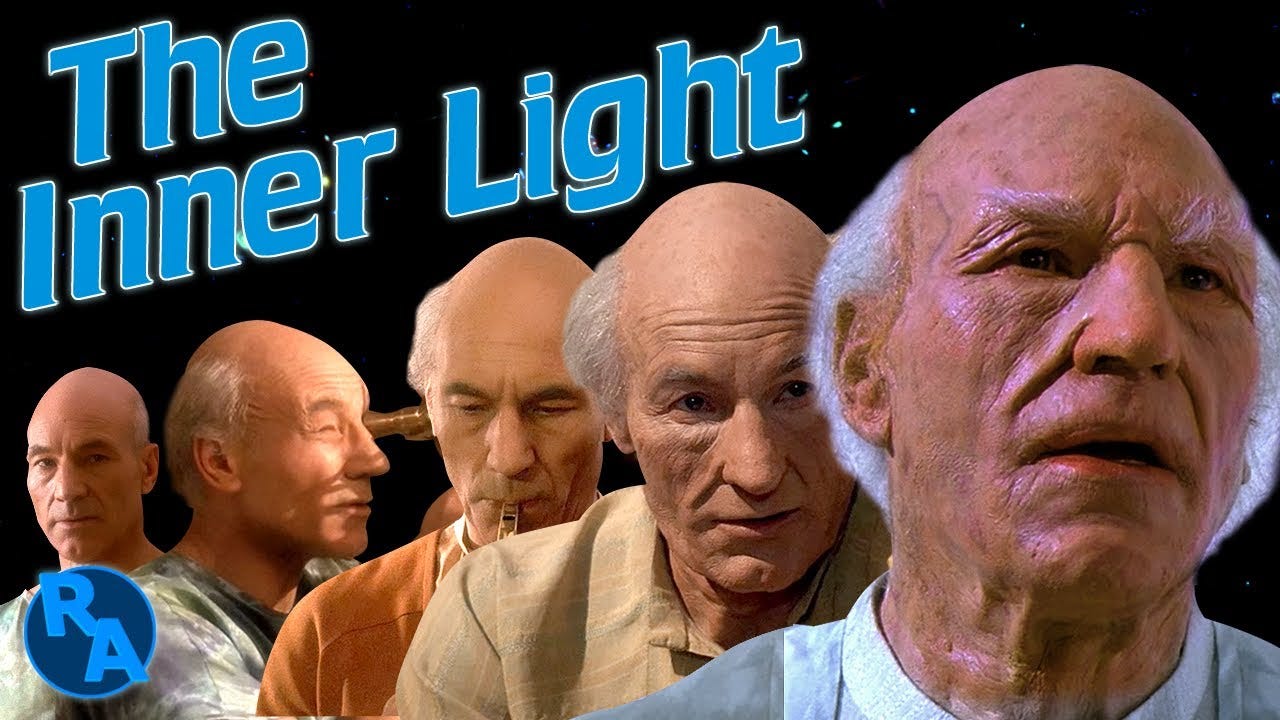
[Assessed] That episode is Rhythm and Transmutation in one story. A whole civilization reaches the end of its season. Its form cannot be saved. But what it was — its love, its music, its way of life — is transmuted into memory and carried forward into a new life. Nothing truly essential is lost. It drastically changes form.
[Documented] The rebooted Battlestar Galactica (2004–2009) built its entire mythology on the opposite edge of the same law. Its refrain, repeated across the series, is “All of this has happened before, and all of it will happen again.” Humans and machines fall into the same cycle of creation, rebellion, and destruction, generation after generation. [Assessed] The show’s great question is whether the cycle can ever be broken — which is exactly the question this tradition asks about humanity now. Rhythm says the seasons will turn. Free will says we choose what we become when they do.
Riding the Waves
Anyone who has followed disclosure, or the transition this publication has covered for years, knows the pattern. A wave of hope: a breakthrough, a hearing, a whistleblower, a sense that everything is about to change. Then a setback: delay, denial, silence, disappointment. Then hope again.
[Assessed] Rhythm explains why. Large changes rarely move in straight lines. They move in waves, each one reaching a little further up the shore than the last before pulling back. “It’s always darkest before the dawn” is not a cliché in this light. It is a description of how cycles actually turn.
That understanding is its own form of protection, which brings us back to the question this arc keeps asking: how does humanity hold its ground as contact with non-human intelligence becomes part of life?

A person who does not understand rhythm is easy to whiplash. Every hopeful headline lifts them too high. Every setback drops them into despair. Swinging between those poles is exhausting, and as Article 4 described, an exhausted person is exactly the kind of person who never calls for help and is easiest to approach in the dark. A person who understands rhythm, by contrast, can feel the swings without being thrown by them. They stay present. They stay steady. And steadiness is a high frequency.
Transmutation adds the second half. We do not have to destroy the darkness to move beyond it. We only have to change it — to take fear, grief, and old wounds and turn them, like the alchemists’ lead, into something of value. That is not the stance of a frightened species waiting to be rescued. It is the stance of a sovereign one.
A Time to Every Purpose
The great ages turn over thousands of years. A marriage ends; a new love begins. A caterpillar dissolves and becomes something with wings. A dying world sends its memory across the stars. At every scale, the same two laws are at work: everything has its season, and nothing that truly matters is ever lost — only changed.
We are said to be living through one of the largest changes of season in human history, the turning from one great age to the next. It will not move in a straight line. There will be waves of hope and waves of setback. The way through is not to cling to the old season or rush ahead to the new one. It is to live fully in the present, appreciate what is good in it, learn what it is here to teach, and trust that the next season will come in its time.
To every thing, there is a season. Including this one. I have to remind myself of this lesson and have trust in it. Enjoy the now. It won’t come again.
Next in the series: The Missing Half — the Law of Gender, masculine and feminine energy, and the restoration of balance.
Whatever the question, love is the answer. You have to believe it to see it.
Sources
• Ecclesiastes 3:1–8 (King James Version)
• The Byrds, “Turn! Turn! Turn!,” adapted by Pete Seeger, Columbia Records, 1965
• The Kybalion, Three Initiates, 1908
• Plato, Timaeus
• Eckhart Tolle, The Power of Now, 1997
• Star Trek: The Next Generation, “The Inner Light,” 1992
• Battlestar Galactica, Sci Fi Channel, 2004–2009
• The Ra material (The Law of One), L/L Research sessions, 1981–84
• Naradigm Shift: The Cosmic Codex, Articles 1–6
— Gerry
Gerry Gomez is an investigative journalist, creative director, and hybrid war correspondent who has spent a decade documenting the convergence of financial, media, and geopolitical forces shaping the current global transition.
From Naradigm Shift on Substack with Gerry Gomez

Your Tax Free Donations Are Appreciated and Help Fund our Volunteer Website
Disclaimer: We at Prepare for Change (PFC) bring you information that is not offered by the mainstream news, and therefore may seem controversial. The opinions, views, statements, and/or information we present are not necessarily promoted, endorsed, espoused, or agreed to by Prepare for Change, its leadership Council, members, those who work with PFC, or those who read its content. However, they are hopefully provocative. Please use discernment! Use logical thinking, your own intuition and your own connection with Source, Spirit and Natural Laws to help you determine what is true and what is not. By sharing information and seeding dialogue, it is our goal to raise consciousness and awareness of higher truths to free us from enslavement of the matrix in this material realm.