EN
EN FR
FR

Filed by Qassam Muaddi
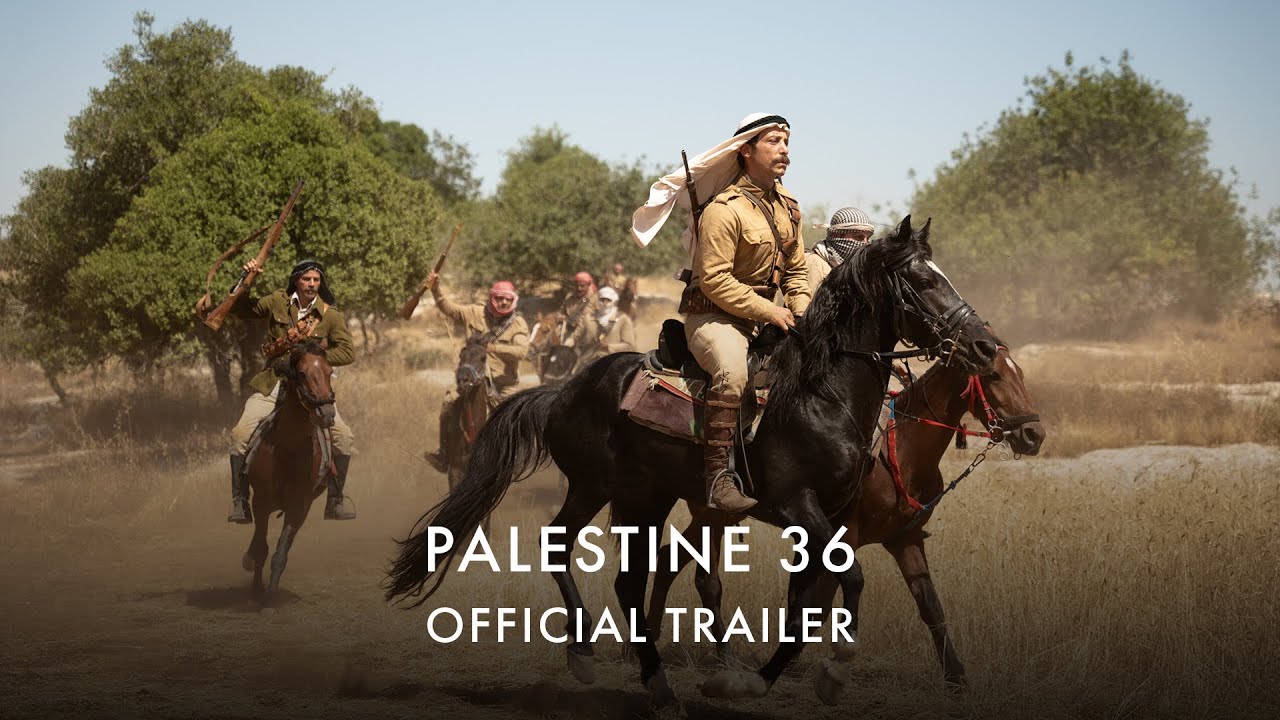
Last week, I took my parents to Ramallah City Hall’s theater to watch a movie, Palestinian director Annemarie Jacir’s widely anticipated “Palestine 36.” Covering the 1936-1939 revolution in Palestine, I thought I was going to a screen adaptation of events I was already familiar with, so I didn’t expect to learn anything new. I was wrong.
The film sheds light on Palestine’s social and political context during the Palestinian revolt against British colonial rule through the stories of several characters, depicting life in a Palestinian village through the lives of a peasant family, particularly its children. It also shows the reality of Palestinian workers and the political paralysis of Palestinian elites and their complicated relations with the British authorities.
But at the center of it all, the film follows a young, passionate Palestinian journalist who is trying to make sense of the rapidly evolving events in her country. She tries to explain these changes to her society and the world, almost screaming into deaf ears.
That particular character reminded me of a Spanish pop song about the Spanish Civil War, which took place in the exact same years as Palestine’s revolution — from 1936 to 1939. One of the song’s lines says:
“Bombshells that steal the sleep, whistled in those night
The earth breaks in two, and the world looks away …”
“Palestine 36” does show how Palestine’s land was broken in two — the gap between the plight of Palestinians and the colonial mindset of the British; the gap between the reality of the Palestinian popular classes, who endure poverty, loss of land, and brutal collective punishment at the hands of the British, and the Palestinian elites lost in their political disputes and calculations of profits and losses from land rents.
But those details weren’t new to me. Palestinians my age know about the brutality of the British from our elders who lived through it — and because the Israeli occupation inherited their methods. We also read about the divisions of the Palestinian national movement at the time, and we can see how our current leaders inherited their incapacity to lead. Even the Zionist colonization of Palestinian lands, under the facilitation and protection of the British authorities, is a well-worn story for many of my generation.
But something about the film struck me. It was the atmosphere of anxiety, terror, and despair of a people watching their world being torn apart at an accelerated rate, and the frustration of not being able to give voice to it. Yet I myself wouldn’t have caught it in the same film had it been made five years ago.
That morning, I travelled to Ramallah, as I do every day. But before that, I went through half an hour of anxiety, hoping that the checkpoint at the exit of my village would have opened before I got there, to avoid wasting an hour or more of my time. I then learned that settlers had attacked a village not very far from mine, and I hoped, as I read through the news, that nobody was hurt — while pushing to the back of my head the possibility that my own village could be next.
Later during the day, I spent an hour calling minibus drivers from my area to make sure that the roads were clear and that my parents could arrive in time for the film. My parents were already on their way when I learned that the same checkpoint closed again. I held my stomach, hoping the Israeli soldiers at the checkpoint wouldn’t stop the minibus carrying my elderly parents and subject them to a humiliating experience or send them back.
I was trying to give my parents a day out as a way of making them feel that things were “normal.” Then, watching scenes of Palestinian villagers from 80 years ago calculating the time required to go back and forth between their village and the city — and the risks associated with the journey — the continuity between past and present was more than a little unsettling.
The part that terrified me most was the journalist. She couldn’t have known at the time that the revolution would be crushed, or that an apocalyptic event, the Nakba, would follow it over a decade later. The only thing she knew was that what she did — investigating, understanding, writing — had a purpose. She seemed frustrated at the Palestinian elites, who tried to reason with the British to protect Palestinians. She denounced their inability to unite, yet retained a certain naivete, attempting to force clarity onto the chaos of political rhetoric. And the tragedy of it all is that it was fruitless. We know this because Palestinian newspapers had been warning against the Zionist project since the 1920s, and they defended the cause of the Palestinian people in the revolutionary years of 1936-1939, even in the face of a divided leadership. It didn’t do anything to halt the colonial process that erased half of Palestine’s villages and towns off the map.
“That wasn’t 1936,” I thought as I left the theater, while my parents tried to figure out whether we’d be able to go back home at such a late hour. “This was my village today. It is Ramallah right now.” Then I felt my heart sink as the next thought hit me: the difference is that today, we all know what that process was building up to. And that passionate, young, naive journalist? That’s me, trying to explain it all to a world with full access to what is happening, yet remains intentionally deaf.
The realization of this historical cycle would probably come too late for Palestinians in Gaza, where the new cycle of the Nakba has already destroyed their homes and communities. But something in this cycle seems broken.
“Palestine 36” is the first adaptation of the 1936 revolution to the big screen for international audiences, and many around the world are just beginning to learn about that episode of Palestine’s history. It also took decades for the Nakba’s reality to be recognized. But that is not the case now.
The genocide in Gaza was livestreamed, and for the first time in history, there will be no need to spend years digging up evidence of genocide. Humanity at large didn’t just let it happen either. On the contrary, it was the fact that massive protests did not stop for two years, and that they began to influence political discourse and policies in many countries, that forced the US to impose a ceasefire in Gaza. This international awareness might also be a reason why Palestinians in Gaza haven’t yet been replaced by settlements, as happened in 1948. But journalism is journalism, then and now, so what is the difference?
I don’t believe it is the internet or social media. These are only the means that allowed for the real difference to come into play: an international audience that actually cares and wants to know. A humanity that bears the trauma of past atrocities, from Hiroshima to Vietnam, and from Guernica to Iraq, is tired of the same brutality repeating itself. This is probably something a Palestinian journalist in the 1930s couldn’t count on, or even dream of. The hope, perhaps foolish, is that this time it will be different. This time, even if “the earth breaks in two,” not everybody in the world will “look away.”
Source:https://mondoweiss.net

Your Tax Free Donations Are Appreciated and Help Fund our Volunteer Website
Disclaimer: We at Prepare for Change (PFC) bring you information that is not offered by the mainstream news, and therefore may seem controversial. The opinions, views, statements, and/or information we present are not necessarily promoted, endorsed, espoused, or agreed to by Prepare for Change, its leadership Council, members, those who work with PFC, or those who read its content. However, they are hopefully provocative. Please use discernment! Use logical thinking, your own intuition and your own connection with Source, Spirit and Natural Laws to help you determine what is true and what is not. By sharing information and seeding dialogue, it is our goal to raise consciousness and awareness of higher truths to free us from enslavement of the matrix in this material realm.