EN
EN FR
FR


In an era where information moves faster than verification, the very foundations of meaningful discourse are crumbling beneath us. On our latest Critical Perspectives, my co-host Vanessa and I find ourselves returning, episode after episode, to the same disquieting observation: what passes for journalism and analysis today is often little more than digital confetti—sensationalist headlines, viral posts stripped of context seeking only the most clicks, with this relentless tide of clickbait designed to provoke reaction, rather than understanding. We are drowning in endless chatter but starved of truth. And this isn’t merely an annoyance for us—it is a strategic dismantling of our collective ability to perceive reality, ultimately detrimental to progress, leaving us vulnerable to narratives crafted by power. Our latest dialogue ventured into this murky landscape, as we dissect how this phenomenon distorts our view of everything from high-stakes geopolitics to the exposed rot within our own institutions.
A prime example of this distortion is theunabated, simplified framing of global conflict as a cinematic showdown between a “bad” West and “good” alternative powers like Russia and China. This week, social media was set ablaze with triumphant claims of a new, game-changing trilateral “defense pact” between Russia, China, and Iran. As Vanessa detailed, a closer examination revealed this was not new at all, but a repackaging of existing agreements—agreements that notably lack a mutual defense clause. In truth, Iran and Russia solidified their long-term alliance with a 20-year Comprehensive Strategic Partnership Treaty, signed in January 2025 and now in force. The agreement is designed to strengthen economic, political and defense cooperation while countering the impact of Western sanctions. Separately, Iran’s 25-year cooperation pact with China — first signed in 2021 — continues to guide expanded engagement across trade, infrastructure and energy integration.
But this critical nuance was lost in the celebratory retweets. Why does this matter? Because it creates a dangerous, passive hope in a foreign savior, blinding us to the complex, often transactional realities of international relations. It prevents us from asking hard questions: Why did Iran itself reportedly resist a mutual defense clause? What are the historical tensions, like Russia’s past capitulation to U.S. pressure to withhold promised S-300 systems from Iran, that inform today’s cautious partnerships? This isn’t about pessimism; it’s about precision. Wishing for a superhero narrative does not make it so, and building analysis on those wishes is a recipe for profound disillusionment and strategic failure.
Esptein, Chomsky, & the Problem with U.S.-Centric Intellectuals
This pattern of mirage extends to the domestic sphere, where the long-awaited release of more Epstein files, has unfolded not as a cathartic reckoning, but as a masterclass in controlled narrative. For years, those of us in independent media pointing to Epstein’s Mossad ties and the grotesque criminality of the powerful were dismissed as conspiracy theorists—here’s Truthwire’s (formerly the Convo Couch) post from nearly 7 years ago titled, The Epstein Family Tree: Connections to Mossad. Now, the controlled “revelations” are meted out in a curated drip-feed, heavily redacted and interspersed with dumb distractions that reveal a whole lot of nothing. The goal is clear: provide the spectacle of exposure, with a controlled narrative, without the substance of accountability. We won’t get justice for the victims because the criminals will never be revealed, arrested, or end up in prison—they’re simply too powerful hence the redacted names.
The most poignant symbol of this moral collapse is the continued defense of figures like the MIT, intellectual hero of the mostly Jew-ish, mostly upper class, “Brooklyn Left,” Noam Chomsky, whose correspondence with the convicted pedophile and sex-trafficker reveals a steadfast, post-conviction friendship, as well as his committed defense of his character, despite knowledge of his activities. More so, Chomsky’s wife had a relationship with Jeffrey and both accepted favors from him, including a $1400/night hotel.
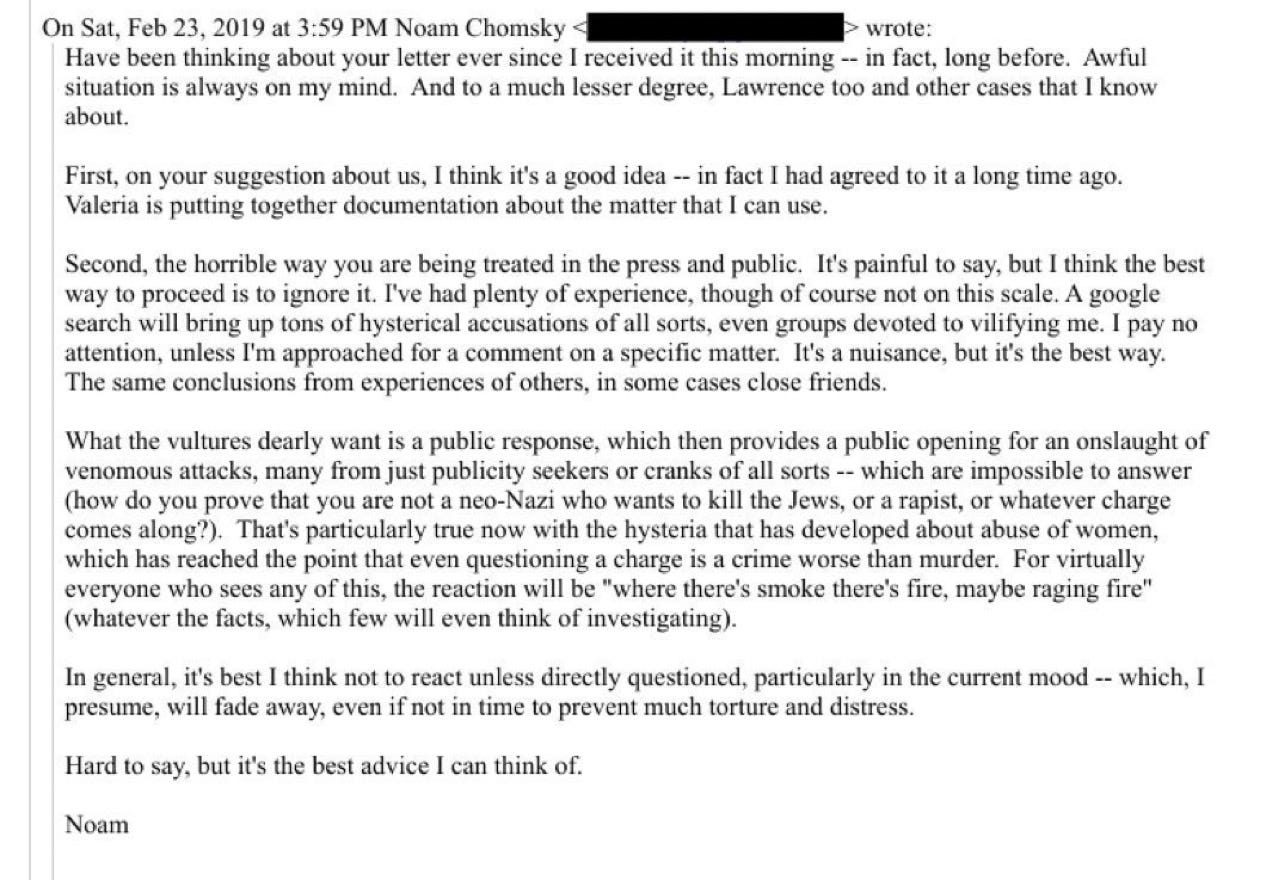
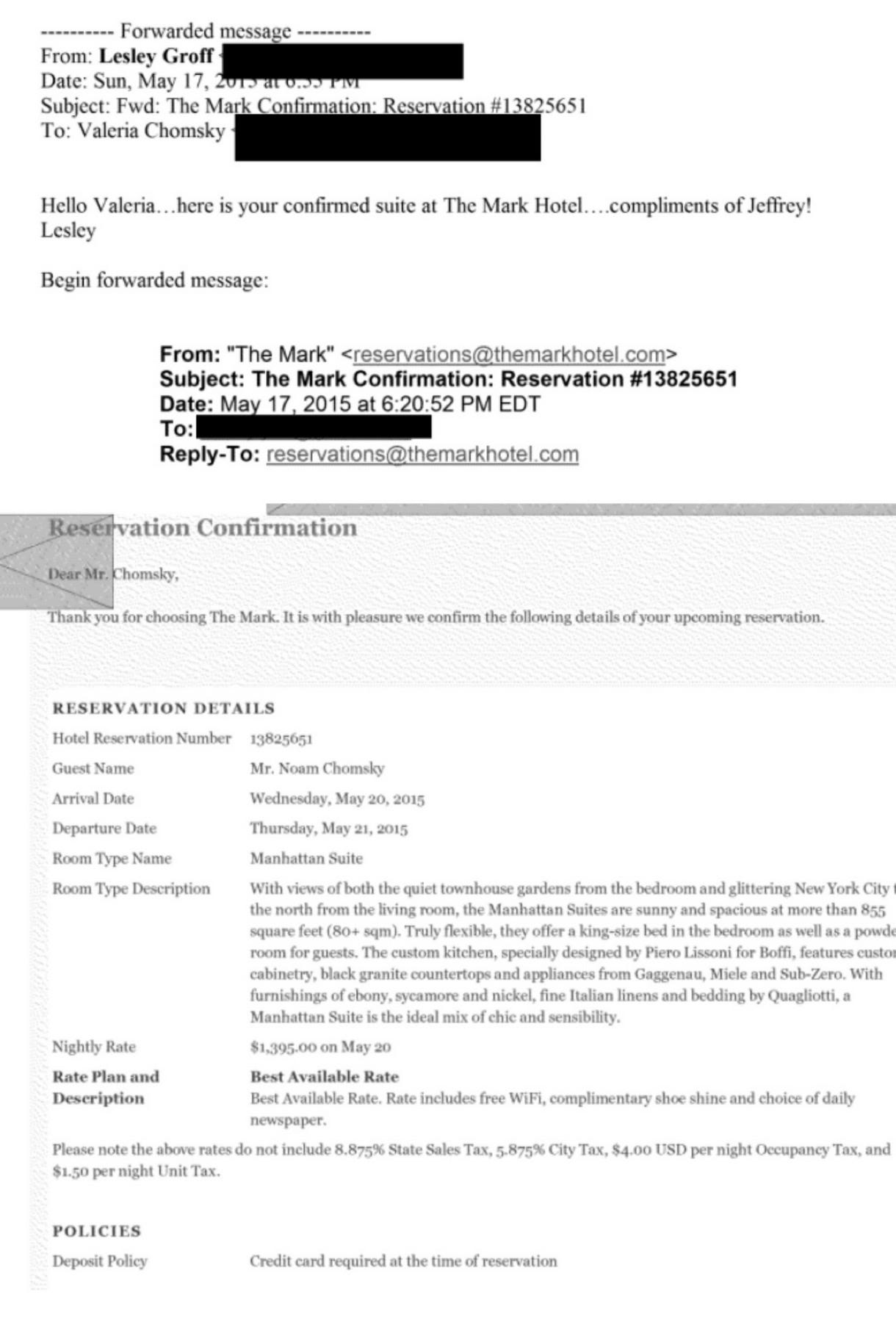
This is not a minor misstep; it is a catastrophic failure of moral judgment that his dem-soc liberal apologists willingly overlook. It lays bare a hypocritical, U.S.-centric idolatry where intellectual reputation is placed above the suffering of children, minors, sex-trafficking victims, and victims of rape and murder. As we argued, this selective outrage reveals an anti-imperialist movement that is often more performance than principle, unwilling to apply consistent scrutiny to its own icons.
Further, while Noam Chomsky is widely recognized as a preeminent scholar in linguistics, often called the “father of modern linguistics,” and his book Manufacturing Consent, co-authored with Edward S. Herman, is a foundational text in critical media studies, his fans also argue that he’s been one of the most prominent and persistent critics of U.S. foreign policy and corporate power. In reality, outside of his U.S.-centric liberal circle, he’s not trusted in the realm of anti-imperialist leaders nor considered any sort of revolutionary advocate against foreign intervention.
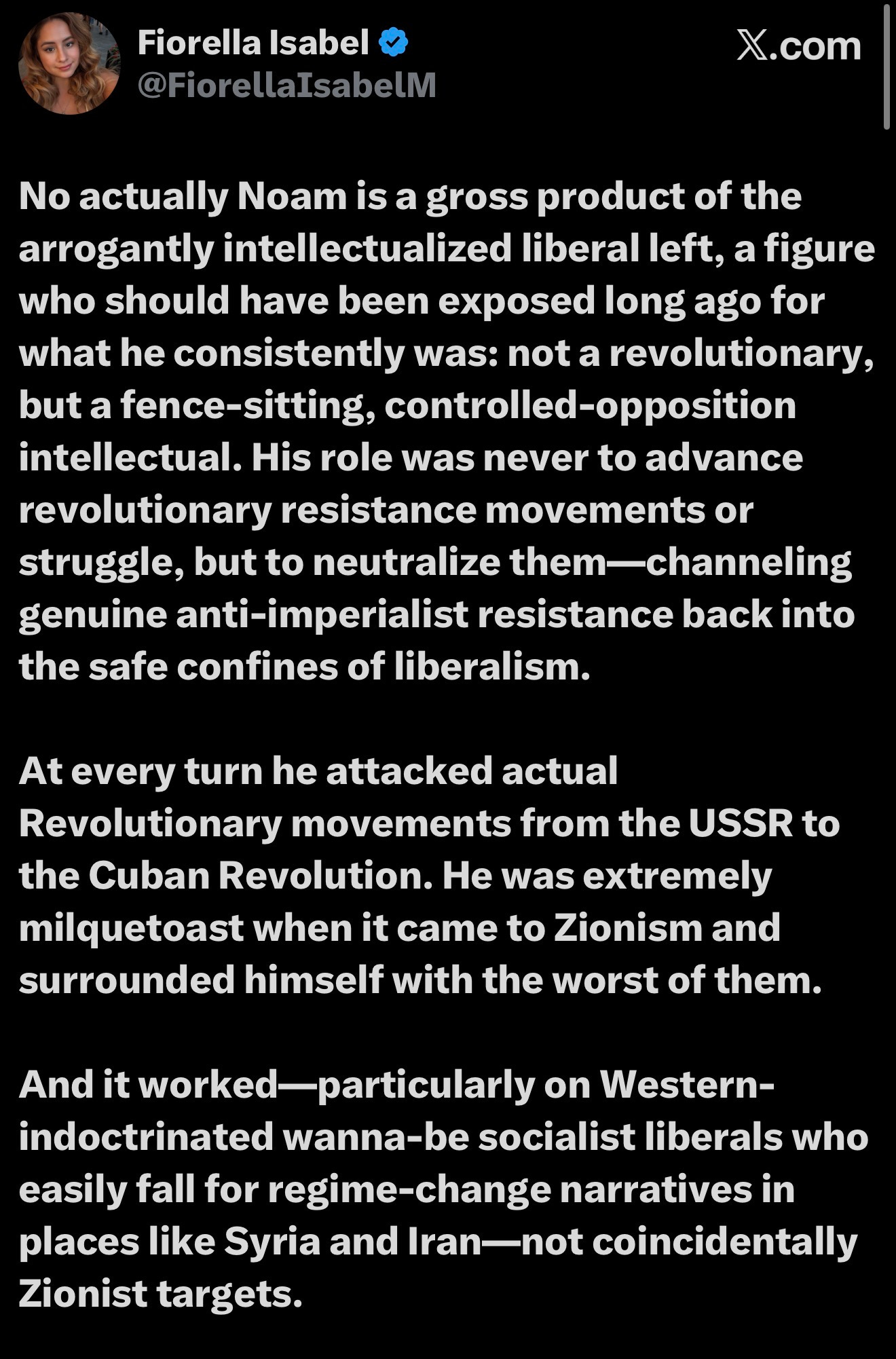
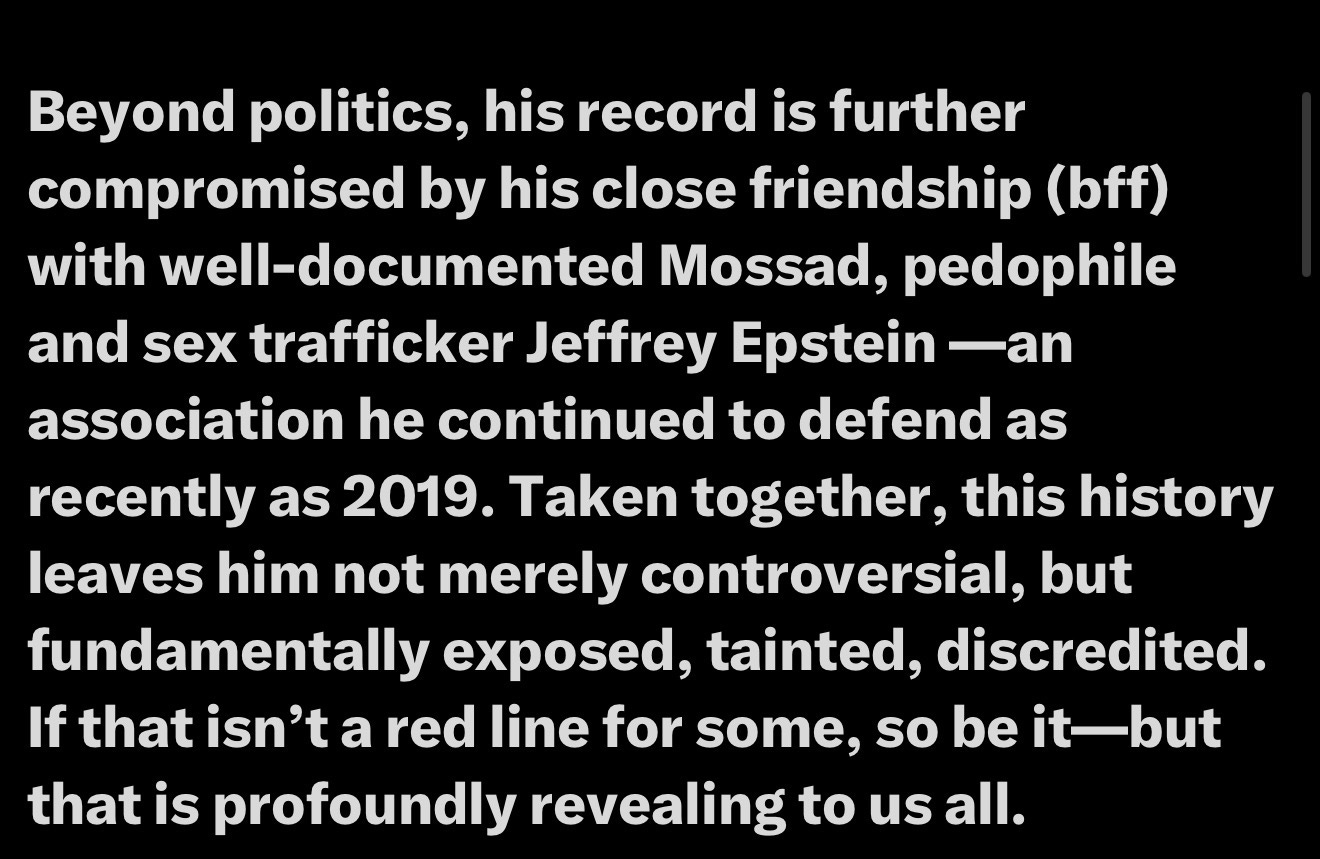
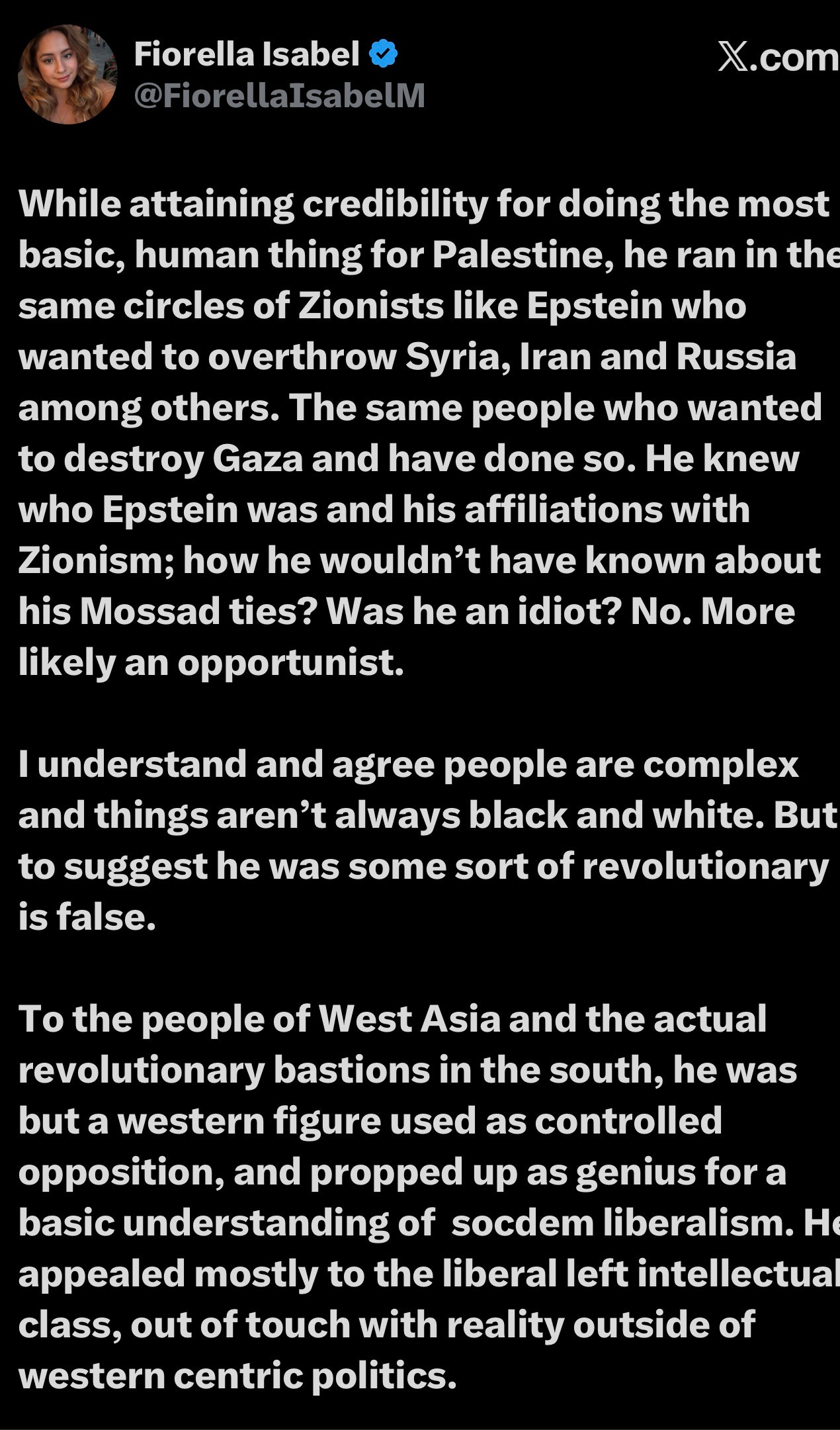
While Chomsky provides a basic critique of Western power structures, his underlying framework serves to disarm genuine socialist and revolutionary movements. His disdain and attack on historical socialist experiments, particularly the Soviet Union, Cuba, Venezuela are obvious contradictions. Critics like historian Michael Parenti contend that Chomsky’s analysis of communism dismisses its material achievements and historical context, treating it as morally equivalent to fascism, thereby serving to uphold the legitimacy of the intelligence, Washington-led, status quo by discrediting any alternative. Chomsky to anyone paying attention has been used as controlled opposition, a gatekeeper of the permissible left. His “work” from a Pentagon-funded office at MIT, hailed by The New York Times and legacy media, has been to train the Western left to reflexively reject and disavow its own historical victories, leaving it unable to build a cohesive political force.
Many cite his defense of Palestine and Hezbollah, when he was invited and welcomes to speak, but in actuality, he did not believe in the BDS movement and surrounded himself with Zionists, including of course Epstein. After a high-profile 2006 visit to Lebanon where he met with leaders of Hezbollah and Hamas, he was reportedly banned from re-entering the country as Vanessa stated. The ban was likely imposed because figures within the Lebanese Axis of Resistance, recognized him not as a genuine ally, but as an intellectual whose analysis ultimately served to legitimize Western narratives and undermine revolutionary solidarity, making him, an unreliable or even counterproductive figure.
Regarding the 2011 NATO intervention in Libya, Chomsky supported the doctrine of the “Responsibility to Protect” and characterized Muammar Gaddafi as a brutal dictator whose removal was a “noble” goal, despite the intervention’s catastrophic outcome and its basis in now-discredited claims.
A Convergence of Manipulated Narratives
Our conversation then turned to the chilling convergence of these manipulated narratives with active, real-world aggression. We discuss the precarious position of Iran, a nation facing not only the threat of military escalation but also an insidious economic and diplomatic war of attrition. Vanessa provided crucial insight into how even Iran’s economic relationships with Russia and China, often touted as salvific, are leveraged from a position of asymmetric power, with resources bought at discounts enforced by U.S. sanctions. The high-stakes calculus in Tehran—where the statements of the presidential administration and the Revolutionary Guards often reflect different tempos or outright conflict—is reduced online to simplistic disappointment or unfounded accusations of capitulation. This ignores the devastating reality: a full-scale conflict would not only risk regional annihilation but also open the door to the final destruction of the Axis of Resistance, with catastrophic consequences for West Asia and beyond. The digital discourse, with its cycles of alarmism and deflation, actively obscures the terrifying stakes at play.
We also traced how this cycle of distraction and false hope is being used to soften targets for neoliberal co-option. From Venezuela to Cuba, we are witnessing a playbook of economic strangulation followed by offers of “negotiation.” As I noted, history shows that U.S. negotiations are almost never honest; they are traps designed to facilitate concession and control, and not a single State has benefited from this. The recent maneuvering around Venezuela’s oil and Cuba’s crippling shortages, accompanied by vacuous statements of “unwavering solidarity” from other powers like China andRussia, that translate into little actionable support, paints a dark picture. It suggests a move toward a normalized world of spheres of influence, where the powerful negotiate over the sovereignty of nations, while the promise of a “multipolar world” risks merely swapping one master for several. The passionate online hope that China or Russia will send warships to defend Cuban sovereignty is, as Vanessa bluntly put it, a beautiful dream but an extremely unlikely one. This desperate hope is itself a symptom of the powerlessness that clickbait narratives both exploit and reinforce.
Ultimately, in our discussion we call for intellectual integrity and courageous clarity in an age designed to produce their opposites. The proliferation of AI-generated commentary, compromised accounts, and the platform algorithms that reward sensationalism are not glitches; they are features of a system that benefits from a confused, divided, and emotionally exhausted public. To fight this, we must commit to the unglamorous work of due diligence: seeking primary sources, embracing nuanced realities over satisfying fables, and applying consistent moral scrutiny regardless of political tribe. The truth is not always found in the headlines that make you cheer, but often in the complex, sobering analysis that follows. It is there, in that disciplined space beyond the clickbait, that we can begin to build a perspective—and a resistance—that is truly critical.
From https://fiorellaisabel.substack.com

Your Tax Free Donations Are Appreciated and Help Fund our Volunteer Website
Disclaimer: We at Prepare for Change (PFC) bring you information that is not offered by the mainstream news, and therefore may seem controversial. The opinions, views, statements, and/or information we present are not necessarily promoted, endorsed, espoused, or agreed to by Prepare for Change, its leadership Council, members, those who work with PFC, or those who read its content. However, they are hopefully provocative. Please use discernment! Use logical thinking, your own intuition and your own connection with Source, Spirit and Natural Laws to help you determine what is true and what is not. By sharing information and seeding dialogue, it is our goal to raise consciousness and awareness of higher truths to free us from enslavement of the matrix in this material realm.