EN
 FR


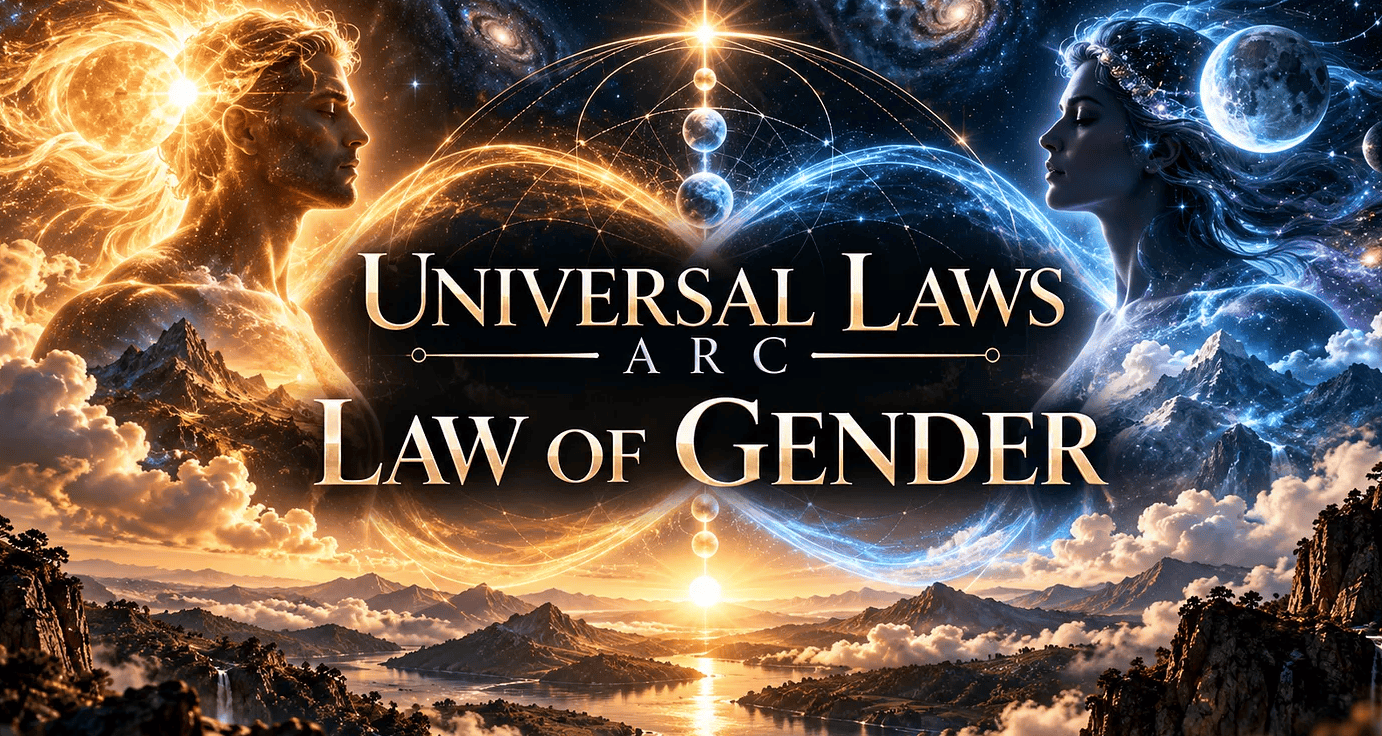
For thousands of years, one half of the creative force has run the world while the other half was pushed aside. Contact may be the moment we finally need both.
In the film Arrival (2016), based on Ted Chiang’s novella “Story of Your Life,” twelve enormous alien vessels appear without warning at sites around the world. They do nothing. They simply hover. Every major government responds the way governments know how: it brings in the military, surrounds the ships with soldiers, and prepares for war.
But the United States also brings in someone unusual: Dr. Louise Banks, a linguist. Her job is not to fight the visitors or to frighten them. It is to listen to them. Slowly, patiently, she begins to learn their language. And as the world’s armies grow more afraid and edge closer to attacking, the outcome of first contact comes to depend not on who has the most firepower, but on who is willing to understand.
That film is the best picture we have of the law this article takes up: the Law of Gender, the teaching that everything carries a masculine and a feminine principle, and that creation requires both. It also makes a case that runs through this whole arc. At the turn of an age, and at the threshold of contact, the receptive approach may matter far more than the military one.

What the Law Says — and What It Doesn’t
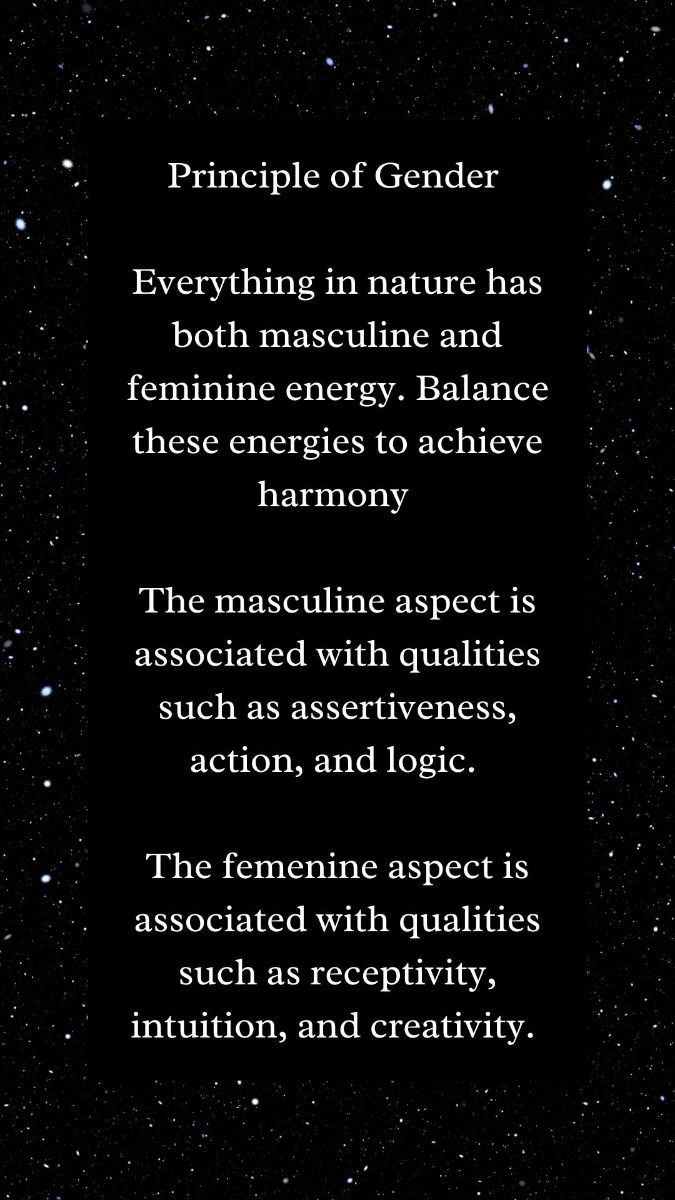
The Kybalion (1908) states the Principle of Gender plainly: “Gender is in everything; everything has its Masculine and Feminine Principles.” The masculine principle is directive and projecting: will, action, structure, the force that pushes outward. The feminine principle is receptive and generative: intuition, nurture, the womb in which something new is formed. Neither creates alone. A seed needs soil. An idea needs both the inspiration that receives it and the will that carries it out.
It is worth being clear about what this law is not. The Kybalion itself insists that the principle is not the same as physical sex. Nor, in this tradition, is it about gender identity. It describes two energies, and every person carries both. A man can be deeply intuitive and nurturing. A woman can be fiercely decisive and driven. Health, in this tradition, is not one energy winning. It is the two working together.
The Taoist yin-yang symbol, which Article 2 used to describe oneness, is the classic image of this law. Yin is the feminine principle and yang the masculine, each curling into the other, each carrying a seed of its opposite. Polarity, the subject of Article 6, is the tension between them. Gender is what that tension creates.
Half a World
If creation needs both principles, a civilization that runs on only one will eventually break. This tradition reads much of recorded history as exactly that: the masculine principle cut off from its partner. Will without intuition becomes domination. Structure without nurture becomes hierarchy. Action without receptivity becomes conquest. Article 1 put it simply in its table of the twelve laws: a civilization out of balance is easier to steer.
The suppression of the feminine is not only a spiritual claim. Much of it is on the record.
The European witch trials, spanning roughly the fifteenth through eighteenth centuries, executed an estimated 40,000 to 60,000 people. The large majority were women — often healers, midwives, and women who lived outside the control of a husband or the church.

In a sermon in the year 591, Pope Gregory I merged Mary Magdalene with an unnamed sinful woman from the Gospel of Luke, and for more than a thousand years she was remembered in Western Christianity as a repentant prostitute. Nothing in the Gospels says so. The Church quietly dropped that label in its 1969 calendar revision, and in 2016 Pope Francis raised her day to a full feast, honoring her as the “apostle of the apostles.” Texts outside the Bible go further: the Gospel of Mary, which surfaced in Egypt in 1896, presents her as a disciple who received teachings the others did not, and the Gospel of Philip, found at Nag Hammadi in 1945, calls her Jesus’s companion.
Whatever one believes about those texts, the pattern is clear. A woman who stood at the center of the story was pushed to its margins and reframed as a sinner. In this tradition’s reading, that is the feminine principle itself, demoted for two thousand years.
The Restoration
Article 7 described the turning from the Age of Pisces to the Age of Aquarius as a move from hierarchies to networks, and from truth handed down to truth reached directly. Many in this community describe that same shift as the return of the feminine principle. Cooperation instead of command. Intuition alongside analysis. Care for the whole instead of conquest of the parts.
It is important to say what that does not mean. It is not women replacing men, or one half of humanity winning over the other. A world run only on the feminine principle would be as unbalanced as one run only on the masculine — all reception and no action, all feeling and no follow-through. The restoration is not a reversal. It is a rebalancing, inside institutions and inside every individual person.
That is why this article is called The Missing Half. For a very long time, humanity has been trying to build a future with only half of its creative power. The shift now underway, in this tradition’s view, is the other half coming back.

Stand Down
If the masculine principle out of balance looks like anything on this planet, it looks like an arsenal. And the contact literature returns to that point again and again.
The community this publication serves is well aware of the warnings attributed to major contact incidents. They share a striking common thread: stand down, demilitarize, and do not use nuclear weapons.
The alleged Greada Treaty is said to have been struck in 1954 between the Eisenhower administration and a group of non-human visitors. The best-known account comes from Milton William Cooper’s 1991 book Behold a Pale Horse, which also describes an earlier offer from a human-looking group: help with humanity’s spiritual development, on the condition that it give up its nuclear weapons. In Cooper’s telling, that offer was refused. No documentary evidence for the treaty has surfaced, and it should be read as a claim, not a record.
On November 26, 1977, the audio of a Southern Television news broadcast in southern England was hijacked for several minutes. A voice identifying itself as “Vrillon,” a representative of the “Ashtar Galactic Command,” urged humanity to abandon its weapons of evil and learn to live in peace. The broadcast interruption is a matter of record. Who was behind it has never been established; authorities at the time treated it as a hoax.
Former U.S. Air Force officers, including Robert Salas, have publicly testified that nuclear missiles went offline at Malmstrom Air Force Base in Montana in 1967 while unidentified objects were reported overhead. Researcher Robert Hastings collected dozens of similar accounts in UFOs and Nukes (2008). These are first-person testimonies, not official findings.
Channeled sources like the Ra material and Bashar carry the same broad theme: that fear and force are the wrong frequency for meeting what is coming, and that love and openness are the right one.
None of these accounts is proof on its own, and each sits at a different tier. But taken together, they point the same way. If contact is a test, the masculine-only answer — meet the unknown with weapons — may be exactly the wrong one.
“But We Need to Defend Ourselves”
That is always the comeback, and it is a fair one. If we stand down, what happens if the visitors are hostile? Doesn’t a responsible species need a way to protect itself?
Arrival answers that question better than any argument could.
Midway through the film, the visitors communicate a phrase that the military translates as “offer weapon.” Panic spreads. Several nations break off cooperation and prepare to strike. Louise argues that the word could just as easily mean tool — that the visitors’ language does not divide the world the way ours does. She turns out to be right. What the visitors are offering is their language itself, a way of perceiving time that will change humanity, and they are offering it because, three thousand years from now, they will need humanity’s help. At the climax, a Chinese general is minutes from launching an attack. Louise reaches him not with force but with understanding: words that only he could know, learned through the very gift the visitors brought. He stands down.
The film’s point is not that defense is wrong. It is that the military reading of an unknown situation can be catastrophically wrong, and that only patient, receptive understanding revealed what was actually happening. The masculine principle wanted to protect. The feminine principle made protection unnecessary.
This is my opinion, but I think it applies directly to us. If humanity understood universal laws better, we would be in a far better position to assess any contact for what it is — to know whether we are facing a threat, a test, or a gift, before we reach for a weapon. The masculine principle still has a place in that: the will to set boundaries, to say a clear no, to stand our ground as Article 4 described. But a boundary held with understanding is very different from a weapon pointed in fear.
Will that be enough? We’ll only know when we know. But a species that meets the unknown with understanding first gives itself far more options than one that meets it with force.
Both Halves of Discernment
Article 6 offered a set of signs for telling light from its imitation. The Law of Gender explains what it takes to actually use them.
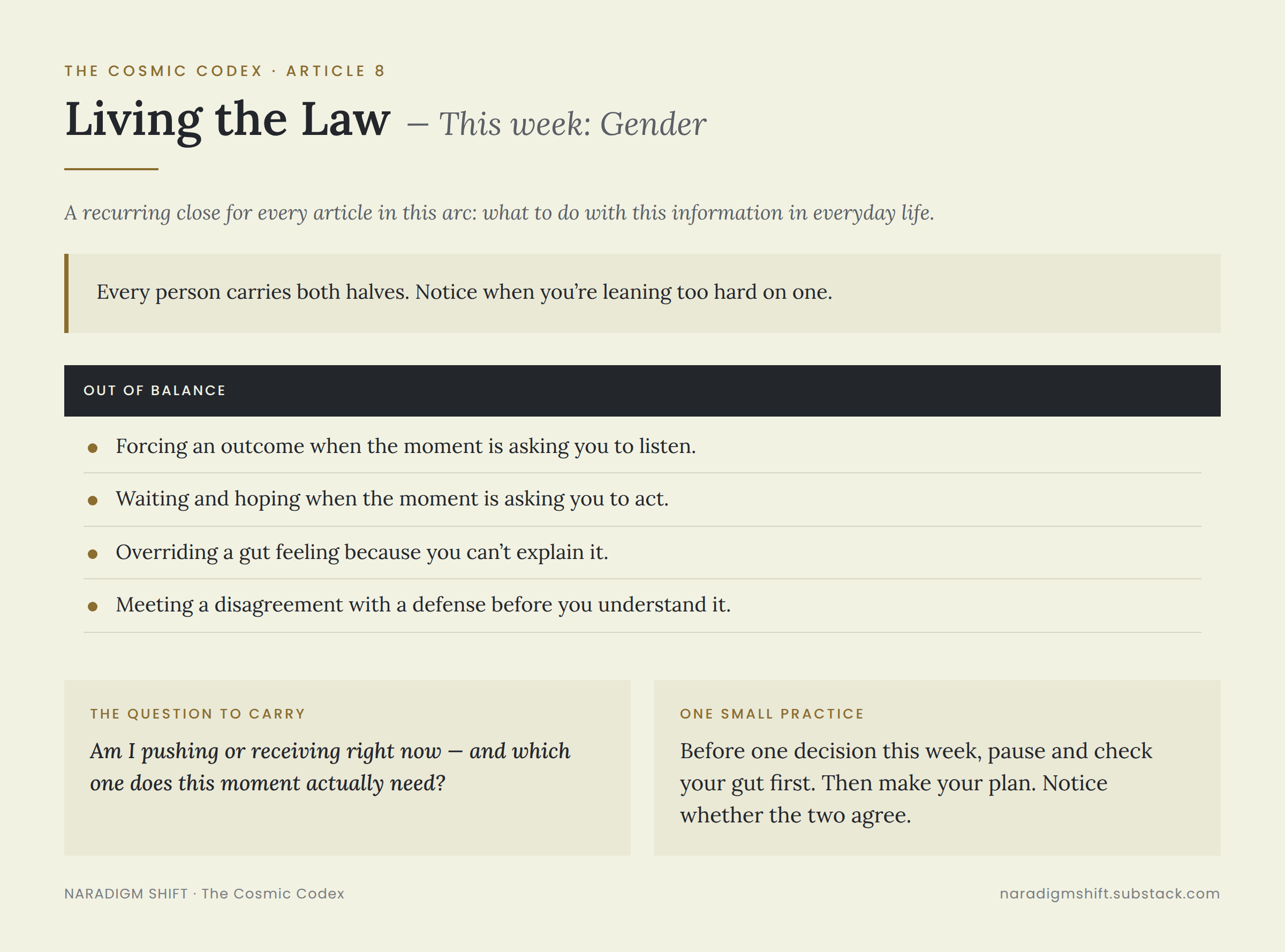
The feminine half is perception. Intuition is the felt sense that something is off, or that something is right, often before the mind can explain why. In contact, it is the quiet inner response to a being or a message: calmer or more afraid, more free or more managed. A civilization that has trained itself to dismiss intuition as unscientific has disarmed one of its most important senses.
The masculine half is action. Perception alone is not enough. Once you sense that something is wrong, you need the will to act on it: to set a boundary, to withdraw consent, to say no and mean it. Article 4 showed how silence becomes consent. The masculine principle is what breaks the silence.
Intuition without will notices the danger and does nothing. Will without intuition charges ahead without knowing what it is facing. Put together, they form the complete skill this arc has been building toward: sense clearly, then act clearly. That is not a military doctrine. It is a sovereign one.
The Other Half Comes Home
At the end of Arrival, the world does not win by being stronger. It wins by understanding. One person, willing to listen when everyone else was arming, changed what first contact meant for an entire species.
That is the promise of the Law of Gender at this turning of the age. For thousands of years, humanity has tried to meet every challenge with only half of its creative power: will without intuition, strength without receptivity, force without understanding. The results are written across our history, and across our arsenals. The other half is coming home now — in institutions, in culture, and in each of us.
When contact comes, we will need both halves. The feminine to perceive what we are truly facing. The masculine to act on what we perceive. Neither alone will be enough. Together, they are exactly what a sovereign species looks like.
Next in the series: Balance and Creation — the two sets of laws described by the network, and how they map onto the twelve.
Whatever the question, love is the answer. You have to believe it to see it.
Sources
• Arrival, Paramount Pictures, 2016; based on Ted Chiang, “Story of Your Life,” 1998
• The Kybalion, Three Initiates, 1908
• Pope Gregory I, Homily 33, 591
• Roman Catholic General Calendar revision, 1969; Congregation for Divine Worship, decree on the Feast of St. Mary Magdalene, 2016
• The Gospel of Mary (Berlin Codex); The Gospel of Philip (Nag Hammadi Library)
• Milton William Cooper, Behold a Pale Horse, 1991
• Southern Television broadcast interruption, November 26, 1977
• Robert Hastings, UFOs and Nukes, 2008
• The Ra material (The Law of One), L/L Research sessions, 1981–84
• Naradigm Shift: The Cosmic Codex, Articles 1–7
— Gerry
Gerry Gomez is an investigative journalist, creative director, and hybrid war correspondent who has spent a decade documenting the convergence of financial, media, and geopolitical forces shaping the current global transition.
The opinions expressed in this post and NaradigmShift blog are my own. My opinions are based on my expertise as a communications, marketing professional, propaganda analyst, and researcher. I’ve also been able to review historic assets, statements and testimony of many intel insiders, royals, whistle-blowers, along with speaking with contacts within the occult, secret societies, agents of light and dark. I’ve researched and reviewed articles and original source materials, press-releases, and FOIA documents. As a council member of the global network Prepare for Change, I’ve been privy to some deep level sources and intel which inform my unique perspective. We are all able to research as one law of Galactic Codex is the right to have access to all knowledge. Seek and ye shall find.

Your Tax Free Donations Are Appreciated and Help Fund our Volunteer Website
Disclaimer: We at Prepare for Change (PFC) bring you information that is not offered by the mainstream news, and therefore may seem controversial. The opinions, views, statements, and/or information we present are not necessarily promoted, endorsed, espoused, or agreed to by Prepare for Change, its leadership Council, members, those who work with PFC, or those who read its content. However, they are hopefully provocative. Please use discernment! Use logical thinking, your own intuition and your own connection with Source, Spirit and Natural Laws to help you determine what is true and what is not. By sharing information and seeding dialogue, it is our goal to raise consciousness and awareness of higher truths to free us from enslavement of the matrix in this material realm.