EN
EN FR
FR

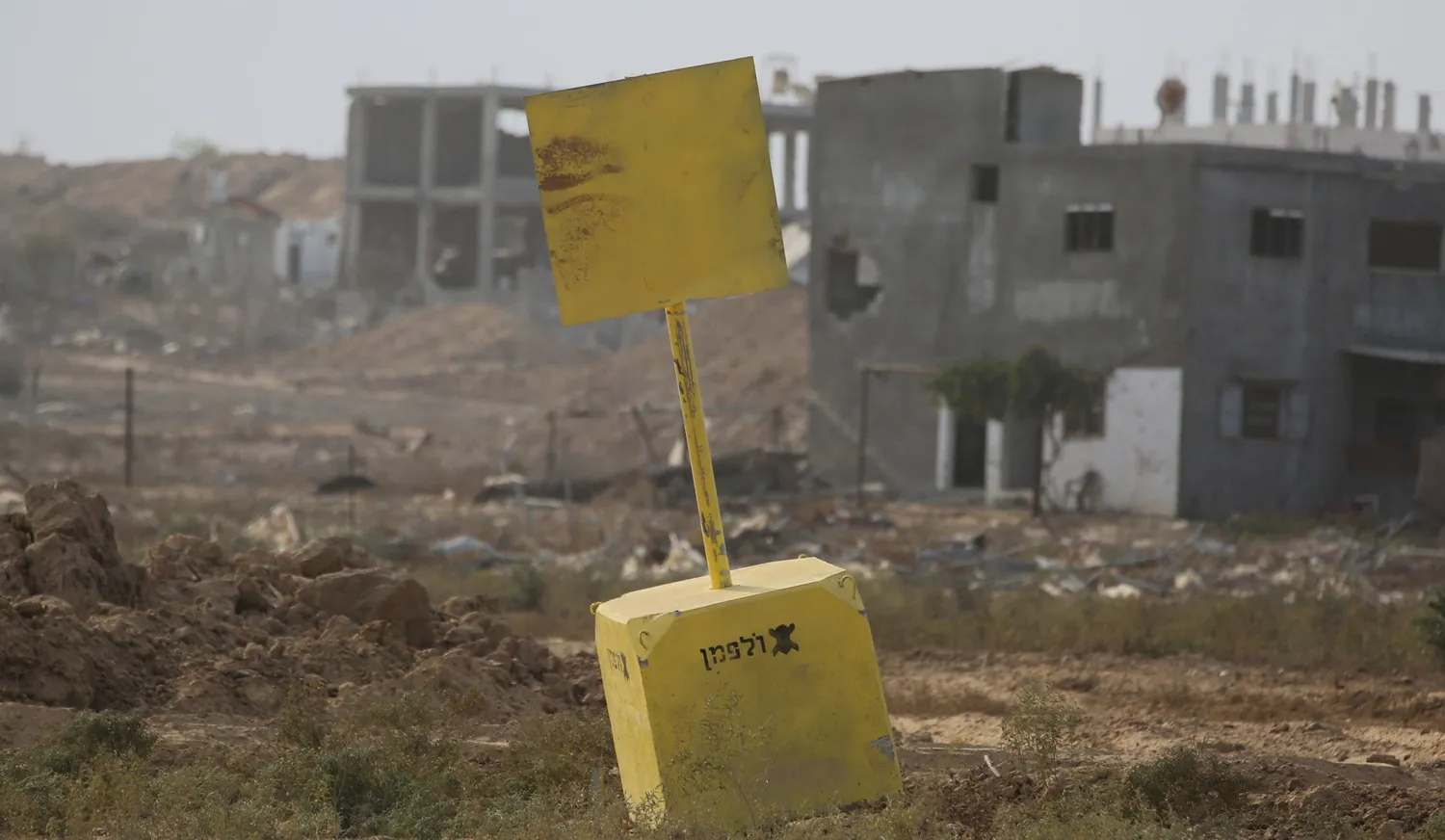
Fadi Abu Assi, 10, and his brother Jumaa, 12, died not far from their temporary home in the town of Bani Suheila in the southern Gaza Strip. It happened last week in an open area that was once used for agriculture, where children used to chase goats or simply play. Now the area is called the Yellow Line, and the Israel Defense Forces applies a “shoot first, ask questions later” policy there.
Fadi and Jumaa entered the area to collect firewood and were spotted by Israeli forces. A drone dispatched into the air killed them on the spot.
The IDF spokesperson confirmed the details: “Forces from the Kfir Brigade identified two suspects who crossed the Yellow Line, carried out suspicious activities on the ground, and approached the forces in a way that posed an immediate threat to them. The Air Force, guided by the forces on the ground, eliminated the suspects in order to remove the threat.”

The incident underscores the fact that the Yellow Line – which marks the boundary of the area still controlled by Israeli forces in Gaza – is a real line separating life and death, even if it is not clearly visible on the ground. In a sense, the lethal boundary is imaginary. Its rules of deployment are arbitrary; it has no clear checkpoints. Sometimes it is marked by concrete blocks or metal pipes stuck in the ground, and sometimes there is no physical marking at all.
For the hundreds of thousands whose homes lie in the space between the line and their previous place of residence or work, the vague boundary determines who will live and who will die.
According to Gaza’s Health Ministry, since the announcement of the cease-fire, 356 people have been killed in the Strip as a result of air or artillery strikes. Dozens of them were killed when they approached the Yellow Line, to which the IDF withdrew under the cease-fire.
Muhammad Abu Assi, the uncle of Fadi and Jumaa, struggled to contain his emotions: “They’re just children. What did they do? They don’t have rockets or bombs. They just went to collect wood.”
An activist with a local rescue organization told Haaretz that in some places, the route of the Yellow Line is relatively clear. In other areas – especially around the eastern villages – the land is open and abandoned, and residents do not know where they are allowed to walk and where a hidden rifle is aimed at them.
Imad, a resident who came to the eastern area to collect items from a damaged house, said: “It’s an imaginary line, but it cuts our lives. People go there because they still have homes, even if they’re partially destroyed. Some try to save a mattress, a blanket, a few clothes. Others look for firewood because the area was once agricultural. People do what they need to to survive, and Israel sees every such person as a threat.”
He emphasizes that these are civilians: “Anyone who thinks there are still gunmen trying to cross from side to side is lying. Hamas members know very well they have no business there. Everyone who approaches today is a civilian, period. Looking for food or wood or something they can sell. The army knows this, and therefore the shooting is not security enforcement but punishment.”
A resident named Abu Ahmad describes the deep confusion surrounding the line’s very existence: “Most people don’t even know where it runs. Some families don’t know whether their home is inside or outside. People just want to see if anything is left. And then shooting? It’s murder in cold blood. Israel can identify every person in the area. If the two children who were killed were a threat, they would have known it. But they are trying to create a reality in which anyone who approaches – dies. He is taking his fate into his own hands.”
He says it doesn’t end with gunfire. “Ultimately, there is a policy here. They don’t want people to return – not to a house and not to a tent. The goal is to squeeze the population into smaller and smaller areas. It’s an internal displacement within Gaza.”
Farming in a divided field
Approaching the Yellow Line in the Strip has become routine. Many do so to check whether their home still exists. Others collect from their destroyed homes anything that can serve as a tent or shelter, such as plastic sheeting or fabric. Ahead of winter, the list has expanded to include pieces of wood for heating – essentially anything that can burn. “Wood and diesel are expensive today, if they even exist,” a refugee from Khan Yunis living in the Mawasi area told Haaretz. “So many are now looking for anything that can warm them.”

Alongside those searching for lost belongings and heating materials, others roam the Yellow-Line area for different purposes – such as to find metal to sell, stealing abandoned property, and attempting to take anything others left behind.
Gaza residents have entered the winter season, and those west of the Yellow Line are beginning to realize they are on their own. They struggle to find housing solutions and resources to survive daily life, as well as anything that might restore their ability to buy food or rebuild some economic base in the future. Often, the “resourcefulness” they display encounters boundaries that are unclear – and deadly.

A farmer from Gaza told Non-Post (a relatively new Arabic-language media outlet) that after the cease-fire he returned to his farmland east of Khan Yunis and found that most of it was beyond the Yellow Line. He began cultivating the only field that remained on the western side.
“If we don’t plant something on our land, I won’t have anything to eat or to feed others,” he said. He built makeshift greenhouses from the plastic that covered aid pallets and from wood and water pipes he found among the ruins of homes. With the sound of an Israeli drone overhead, he told how he planted and sowed arugula and sorrel.
Many residents of the Strip are willing to risk their lives to retrieve something of their means or property. Khaled al-Raqab from Khan Yunis told the Wafa agency that before the war, he and his partners bought and sold used iron. After the cease-fire, al-Raqab and his partners returned to the plant in Bani Suheila and began extracting every piece of iron they could find in the rubble to recycle the raw material and sell iron rods cheaply to those needing them to build tents and shelters from the rain. In the northern Strip, residents have begun extracting clay from the ground – in areas still under fire – to use as building material.

Ibrahim Abu Khater, an elderly man from Bani Suheila, was interviewed by Al-Jazeera from the ruins of his home: “I am afraid that the blast of ongoing shelling east of the Yellow Line will bring down what’s left of my house on me during the night.” According to Al-Jazeera, in Bani Suheila there are nearly daily reports of people killed by IDF fire.
The unclear boundaries of the Yellow Line claim victims throughout the Gaza Strip. According to reports by Palestinian media, on Monday night, several families came under heavy IDF fire in the Tuffah neighborhood of Gaza City, near the Strip’s main north-south highway – Salah al-Din – close to the Yellow Line. The civil defense organization announced that with UN assistance, it managed to rescue five people wounded from the incident. Footage showed the organization’s ambulance stuck several hundred meters from the scene.
And there are also those who prefer to stay where they feel safe and not return to their homes near the Yellow Line. Muhammad Zaqout, a displaced person from northern Gaza City, told an Arab human-rights organization in England about such an attempt that failed. “I wanted to help a family living in tents in Deir al-Balah survive the winter, but all the children’s winter clothes are under the rubble and I haven’t managed to retrieve anything.”
“In the absence of any horizon for a permanent arrangement or for the start of reconstruction, we are entering a dark period,” says a former official in Hamas’ welfare ministry. “It looks like chaos that no one really wants to end, and so the Yellow Line becomes a separation line and approaching it means death. But even those who cross that line do not find life there, so it is not a line that separates between life and death, but a line that separates between two parts of a Strip that experienced disaster.”
The IDF did not provide a response.
Source: https://www.haaretz.com

Your Tax Free Donations Are Appreciated and Help Fund our Volunteer Website
Disclaimer: We at Prepare for Change (PFC) bring you information that is not offered by the mainstream news, and therefore may seem controversial. The opinions, views, statements, and/or information we present are not necessarily promoted, endorsed, espoused, or agreed to by Prepare for Change, its leadership Council, members, those who work with PFC, or those who read its content. However, they are hopefully provocative. Please use discernment! Use logical thinking, your own intuition and your own connection with Source, Spirit and Natural Laws to help you determine what is true and what is not. By sharing information and seeding dialogue, it is our goal to raise consciousness and awareness of higher truths to free us from enslavement of the matrix in this material realm.