 EN
EN FR
FR

by Mike Shedlock,
A Cato study analyzes how immigrants affected total US government debt.

Please consider the Cato study, Immigrants Reduced Deficits by $14.5 Trillion Since 1994
Today, the Cato Institute published “Immigrants’ Recent Effects on Government Budgets: 1994–2023,” a study on the fiscal effects of immigrants—legal and illegal—that builds upon the National Academies of Sciences, Engineering, and Medicine (NASEM) fiscal effects model. The paper, which I coauthored with Michael Howard and Julián Salazar, is the first to analyze three decades of federal, state, and local government budgets to determine how immigrants affected the total US government debt and deficit.
In this paper, we wanted to accomplish two main things:
1) Provide the first-ever assessment of the total net fiscal effect of all immigrants from 1994 to 2023, rather than a one-year snapshot or forward-looking projection like many other studies. We wanted a sufficiently long period to assess claims like those by White House Deputy Chief of Staff Stephen Miller, asserting that immigrants have already sucked us dry.
2) Provide the clearest explanation for the mechanisms driving the fiscal effects of immigration on government budgets.
Immigrants Have Reduced the Deficit Every Year
Every year since 1994, when data collection began, immigrants have paid more in taxes than they received in benefits from the federal, state, and local governments. The fiscal benefits have continued to rise, reaching their highest level ever in 2023.
The fiscal surplus from all immigrants from 1994 to 2023 was $14.5 trillion, compared with a deficit of $48 trillion without immigrants. That means that immigrants cut deficits by nearly a third in real terms over the last three decades.
Immigrants Pay More Taxes, Receive Fewer Benefits
Immigrants pay more in taxes than the average person. This is counterintuitive because they have lower hourly wages, but because they work at much higher rates (the blue line), they end up with higher per capita incomes (the gray line) and pay more in taxes than their share of the population predicts (the dotted line). Thus, immigrants have been better at generating revenue for the government than the average person.
Are their tax revenues overwhelmed by the costs they impose? Here’s everything the federal, state, and local governments spent money on over the last 30 years in per capita dollar amounts. Immigrants did not create significantly higher costs for any items and saved the government enormously in two areas: old-age benefits and education costs.
Immigrants cost less as retirees: First, the savings on old-age benefits are not because immigrants are significantly less likely to retire. Instead, it is because they are far less likely to receive a government pension, since they were less likely to have government jobs and thus less likely to receive expensive government pensions. The main reason, though, is that they were simply barred from applying for Social Security and Medicare because they either arrived too late in life to earn the necessary qualifying work history, or they are here illegally or in a temporary status and ineligible for that reason.
Immigrants cost schools less: Immigrants arrive in the United States at the average age of about 25, meaning that the United States gets workers without having to pay to educate them. Even though they are more costly when in school—due to bilingual education needs—they are much less costly overall because they are so much less likely to be in school. The result is that immigrants cost the US education system about half as much as the US-born population.
Immigrants aren’t big welfare users. The savings on education aren’t lost in the welfare state. Immigrants are much more likely to be in poverty but use roughly an average amount of what we call “needs-based” assistance. That includes traditional welfare, food assistance, Medicaid, refundable tax credits, and unemployment insurance. The entire reason for this disconnect between poverty rates and welfare use rates is that many immigrants are here illegally and so are ineligible to apply for welfare in most states. This conclusion, that immigrants use welfare at the same rate as the US-born population, matches the Trump administration’s conclusion in 2018.
Concluding Thoughts
For years, nativists in Congress and the administration have wrongly claimed that immigrants are behind the growth in debt and that the US immigration system allows foreigners to take advantage of Americans’ generosity. Our data completely repudiates this view. Immigrants are subsidizing the US government.
The best way to balance the budget is to reduce spending—particularly on wealthy retirees—but rather than hinder our efforts to control deficits, immigrants are helping.
The Study
Immigrants’ Recent Effects on Government Budgets: 1994–2023
This paper updates a model of these effects first developed by the National Academies of Sciences, Engineering, and Medicine (NASEM) to shed light on how immigrants, both legal and illegal, and their children affect government budgets. This analysis is the first to estimate the cumulative fiscal effect of immigrants on federal, state, and local budgets over 30 years.
The government first began gathering detailed information on benefits use by citizenship status in 1994. The data show:
- For each year from 1994 to 2023, the US immigrant population generated more in taxes than they received in benefits from all levels of government.
- Over that period, immigrants created a cumulative fiscal surplus of $14.5 trillion in real 2024 US dollars, including $3.9 trillion in savings on interest on the debt.
- Without immigrants, US government public debt at all levels would be at least 205 percent of gross domestic product (GDP)—nearly twice its 2023 level.
These results, which do not account for any of immigration’s indirect, tax-revenue-boosting effects on economic growth, represent the lower bound of the positive fiscal effects. Even by this conservative analysis, immigrants may have already prevented a fiscal crisis.
The NASEM–Cato model shows the following:
- Every year from 1994 to 2023, immigrants have paid more in taxes than they received in benefits.
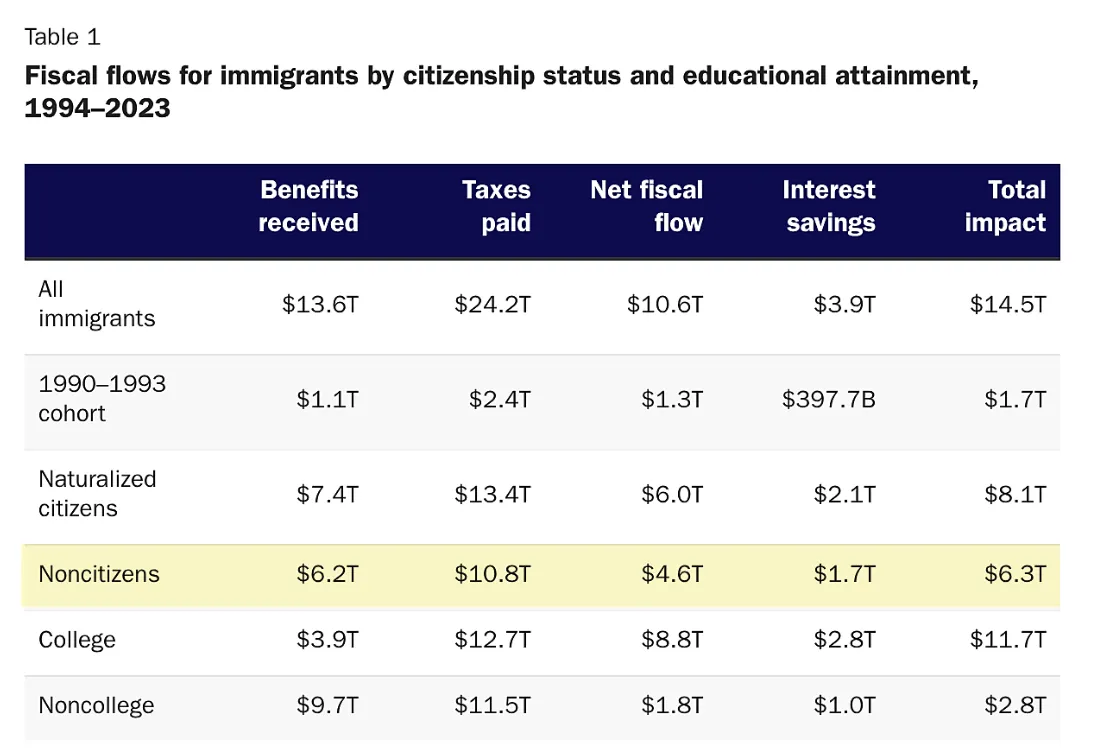
- Immigrants generated nearly $10.6 trillion more in federal, state, and local taxes than they induced in total government spending.
- Accounting for savings on interest payments on the national debt, immigrants saved $14.5 trillion in debt over this 30-year period.
- Immigrants cut US budget deficits by about a third from 1994 to 2023, and fiscal savings grew to $878 billion in 2023 (Figure 1).
- Noncitizens accounted for $6.3 trillion of the $14.5 trillion debt savings.
- College graduate immigrants accounted for $11.7 trillion in savings, while non–college graduates accounted for $2.8 trillion.
- The cohort of immigrants entering from 1990 to 1993, just before data collection began in 1994, was fiscally positive $1.7 trillion, and was still positive after 30 years in 2022–2023 (Table 1). [lead chart]
- Even including the second generation (see Box 1 for definitions), who are mostly still children who will become taxpayers soon, the fiscal effect of immigration was positive every year.
- Immigrants in all categories of educational attainment, including high school dropouts, lowered the ratio of deficit to gross domestic product (GDP) during the 30-year period.
- Without the contributions of immigrants, public debt at all levels would already be above 200 percent of US GDP—nearly twice the 2023 level and a threshold some analysts believe would trigger a debt crisis.
Our results represent the lowest possible fiscal surplus that immigrants provide to US government budgets. This is because the NASEM–Cato model is a static accounting model that does not include indirect economic effects of immigration, such as improving the productivity of US workers.9 For instance, the Congressional Budget Office (CBO) estimates that one-third of the fiscal surplus from the surge of immigration from 2021 to 2024 came from indirect economic effects,10 but none of these revenues can be attributed to immigrants in the NASEM–Cato model, as we are only tracing accounting payments to and from immigrants, not modeling the entire economy. The model also does not account for how accruing less debt would have reduced interest rates on debt, enhancing the savings on interest payments.11
Cato Figure 1 Immigrants

Box 1
Immigrant definitions
Immigrants/first generation: Foreign-born persons, including legal and illegal noncitizens and naturalized citizens. This category excludes those born abroad to American citizens, who are granted citizenship at birth.
Noncitizens: Immigrants without US citizenship, including legal and illegal immigrants.
Second generation: US-born persons with at least one first-generation parent.
Third-plus generation: US-born persons (including those born in US outlying areas such as Puerto Rico and Guam) of two US-born parents as well as those born abroad to American citizens and who are granted citizenship at birth.
Why Immigrants Were Fiscally Positive
The US government spends more than it receives in taxes and other revenue, so many people believe that deporting a person with average characteristics would improve the deficit. They reason that, with fewer US residents, there would be a commensurate decrease in government spending and thus a lower deficit.
However, a significant portion of government spending consists of items that do not causally increase or decrease with population. For instance, the US military, nuclear arsenal, and NASA spaceflight would remain the same regardless of whether the US population grew or shrank by a million people. In this analysis, we call these items “pure public goods” and refer to all other spending as “benefits.” Pure public goods are mainly national defense and interest payments on debt accrued before the immigrants arrived. As we explain in more detail in the Appendix, immigrants may benefit from this spending, but they do not require the government to spend more on these items. Indeed, immigrants may even decrease these costs for the US-born by lowering interest rates and decreasing military recruitment costs. And they certainly ease the fiscal load on the US-born, because immigrant taxpayers help shoulder the fiscal burden of these expenditures.
There is much more to the study with detailed analysis and charts.
Here is a second link to the White Paper Immigrants’ Recent Effects on Government Budgets: 1994–2023.
I do not doubt the study one bit. Those wearing MAGA hats probably did not get this far.
Could We Do Better?
Certainly. I do not advocate an open borders free-for-all.
We need better vetting of criminals and we don’t need an uncontrolled flood of people.
But without a doubt, construction, agricultural, hotel, meat packers, and many trades would have labor shortages without immigrants.
Deporting people who have been here in the US productively, for many years in morally and economically idiotic.
The racist Gestapo is rounding up people by looks and putting them illegally in unsafe conditions. Those with valid papers, even US citizens are caught in the snare.
24 people have died in ICE concentration camps in fiscal year 2025. There’s 14 so far in fiscal year 2026.
Food, medical supplies, and sanitary conditions are lacking.
What’s going on is sickening, morally and economically, but if you are a racist you cheer it.
Source: https://mishtalk.com

Your Tax Free Donations Are Appreciated and Help Fund our Volunteer Website
Disclaimer: We at Prepare for Change (PFC) bring you information that is not offered by the mainstream news, and therefore may seem controversial. The opinions, views, statements, and/or information we present are not necessarily promoted, endorsed, espoused, or agreed to by Prepare for Change, its leadership Council, members, those who work with PFC, or those who read its content. However, they are hopefully provocative. Please use discernment! Use logical thinking, your own intuition and your own connection with Source, Spirit and Natural Laws to help you determine what is true and what is not. By sharing information and seeding dialogue, it is our goal to raise consciousness and awareness of higher truths to free us from enslavement of the matrix in this material realm.

























There is no way that I am going to believe that having millions of uncouth and generally repulsive third-world foreign invaders, many of them vicious criminals, in the United States is going to pay more than than it costs. I know that throwing them out, buying them out, and keeping them out is costing billions, but I want it to keep happening until it is complete.