EN
EN FR
FR

Perception and Reality: Is It All as Bad as It Seems?
Rev. Kat Carroll
(About a 16 min read)
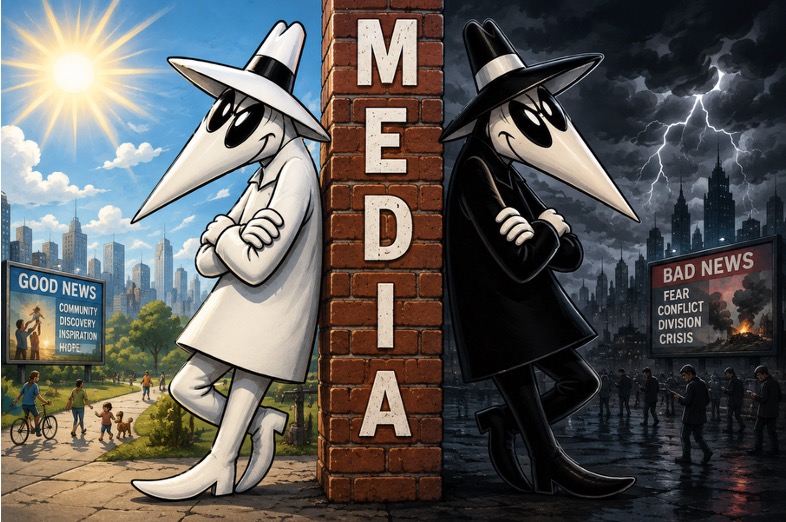
Turn on the television. Open a news app. Look at the breaking-news alerts arriving on your phone.
War. Political conflict. Economic uncertainty. Crime. Natural disasters. Disease. Another celebrity has died. Countries threatening each other. Another reason to worry about tomorrow.
After enough exposure, it is easy to arrive at a troubling conclusion: The world is falling apart.
But is it? Or are we seeing only a carefully selected portion of reality?
That’s not the same thing as suggesting that wars aren’t happening, people aren’t suffering, or economic concerns aren’t real. They are. A family struggling to pay the mortgage or put food on the table doesn’t need to be constantly reminded.
But there is another question worth asking: How much of our perception of the world is being shaped by what we repeatedly choose—or are encouraged—to look at?
What Are We Being Shown?
Think about the news you’ve encountered lately. How much of it concerned death, war, political division, crime, financial instability or catastrophe?
Now think for a moment about the other things happening during those same 24 hours. People got married and babies were born. Scientists made discoveries and doctors helped patients recover. Volunteers fed people they had never met, as we’ve witnessed following hurricanes and other disasters.
We saw neighbors helping neighbors, animals being rescued during catastrophes. Technology helped someone walk again, see, hear or communicate. Someone quietly “paid it forward” by covering a stranger’s grocery bill or cup of coffee.
Those things are reality too. But how often do they become the banner headline instead of being relegated to page seven—or later?
Positive stories certainly exist. The interesting thing is that we often have to dig for them, while fear and conflict are delivered directly as breaking news.
That imbalance matters.
A study involving people in 17 countries found that, on average, participants showed greater physiological arousal and attentiveness to negative news than positive news. In other words, bad news really does grab us, and news organizations competing for our attention operate within that reality.
Or, as my mother used to say: If it bleeds, it leads.
You can read that research here: Cross-national evidence of a negativity bias in psychophysiological reactions to news.
But those same researchers also found considerable individual variation and cautioned news producers against assuming an audience for positive news doesn’t exist. It does! You and I are likely some of those people.
So, what if we—and the media—have created a feedback loop based on what they produce, and what we chose to watch?
Negative stories attract attention. Attention creates ratings, clicks and engagement. Engagement teaches editors and algorithms what keeps us watching. More negative material is presented, we consume it and react to it, and sometimes we go looking for even more.
Can you see the feedback loop developing?
Meanwhile, the quieter evidence that humanity may not be doing quite as badly as the headlines suggest receives far less attention.
When the Picture Becomes Reality
This is where things become more important than simply criticizing the evening news.
If we are continually shown humanity at its worst, eventually we may begin believing that humanity’s worst behavior is humanity’s normal behavior.
But from my own experience, and from what I’m seeing in many places on social media, I think our perception of reality is changing. Increasingly, people seem to be saying, “Enough.”
The Reuters Institute’s 2026 Digital News Report found that 42 percent of respondents across the markets studied say they sometimes or often actively avoid the news. That figure was only 29 percent in 2017. Overall interest in news has also declined substantially since the pandemic.
I have friends telling me they’re putting their televisions in storage. We just got rid of one ourselves.
I don’t think we’re necessarily becoming apathetic. I think many of us are just exhausted—and tired of waiting for something positive to happen to humanity.
There’s a big difference between being informed and being immersed. In humanity’s case, perhaps we’re simply tired of drowning in a tide of negative news.
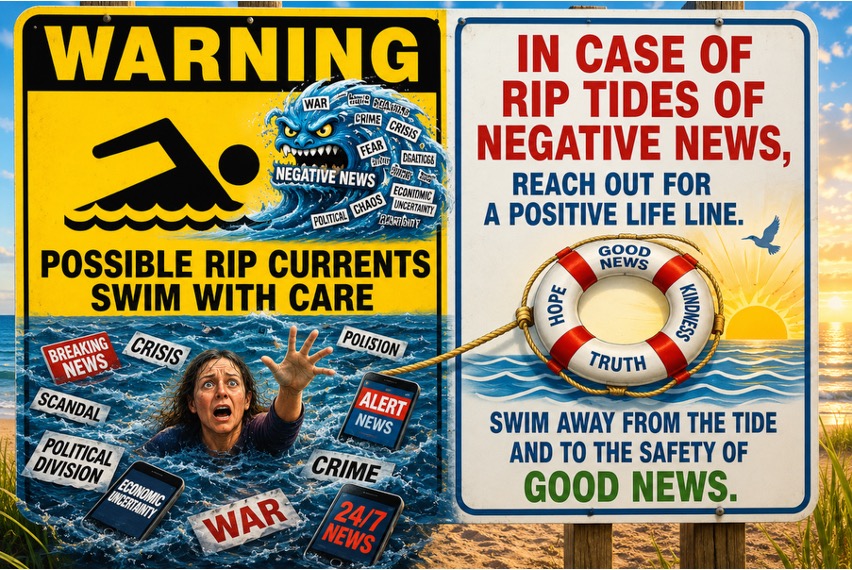
We don’t need hours of bombing footage to understand that wars are taking place. We can follow an election without spending every evening angry at people who vote differently. We can acknowledge suffering without allowing suffering to become our entire perception of humanity. And we can turn off the television without turning our backs on the world.
Doomscrolling and the Fear Loop
There is now a word for something many of us have caught ourselves doing: doomscrolling.
One disturbing story leads to another. We want more information, perhaps because knowing more gives us some sense of control. Instead, we frequently find another frightening story—and another, and another.
Research following major traumatic events has demonstrated something particularly interesting: distress can cause people to consume more trauma-related media, while greater exposure can contribute to still more distress.
There’s our feedback loop:
Fear → attention to threatening information → more threatening information → greater fear.
A three-year longitudinal study following the Boston Marathon bombing and later the Pulse nightclub massacre found evidence for precisely this cycle. Trauma-related media exposure predicted later post-traumatic stress symptoms; those symptoms predicted worry about future events, which in turn predicted increased media consumption and acute stress following another tragedy.
Research into doomscrolling itself has similarly found associations with reduced mental well-being, mindfulness and secondary traumatic stress.
We may believe we’re simply “keeping informed,” but our nervous system may be having a very different experience.
Your Body Is Watching Too
The conscious mind knows the difference between sitting safely on a sofa watching an explosion and actually standing near one. But our stress-response systems can nevertheless react to vivid and repeated representations of threat.
Heart rate changes. Stress hormones are released. The body prepares itself to respond: fear, fight, flight or freeze.
That response is enormously useful when danger is standing in front of us. It’s considerably less useful when the “danger” is being continuously delivered through a screen from thousands of miles away.
And the stress doesn’t necessarily disappear when we turn off the TV or our devices. stress can interfere with sleep, cognition, emotional regulation and physical well-being. Poor sleep can then make stress more difficult to regulate as is shared in this article from Psychology today: The Fearful Brain
Another feedback loop appears:
Stress → poorer sleep → reduced resilience → greater stress reactivity → more difficulty sleeping.
All the while, our ability to focus, think clearly and make decisions can suffer from prolonged exposure to distressing news.
 Now consider someone already struggling with genuine problems:
Will I be able to pay the mortgage?
Can we afford groceries?
Will I have enough gas to get to work so I can make the car payment and mortgage?
Is my job secure?
No wonder so many people seem to be having nervous breakdowns!
Those aren’t imaginary concerns. But what happens when those personal stresses are surrounded morning, noon and night by images of war, financial collapse, political hatred, crime and catastrophe? How does anyone remain hopeful under a constant stream of reasons to be afraid?
For those trying to raise their consciousness, become more compassionate, find spiritual balance, or simply become calmer human beings, there is an obvious problem:
How can you lift yourself up when the information environment continually weighs you down?
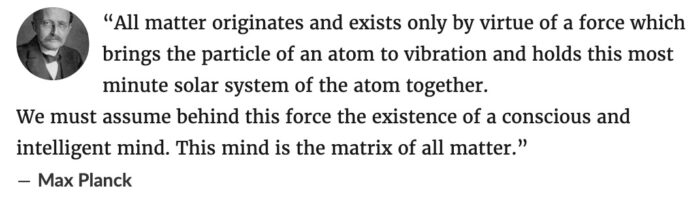
In 1927, Max Plank, a German theoretical physicist said, “The mind is the matrix of all matter”. Gregg Braden interpreted that as, the reality we are experiencing is a consequence of our consciousness. I would add that it’s a consequence of what we choose to watch and believe.
Let’s Feed the Other Wolf
Many readers will recognize the familiar story of two wolves fighting: one represents fear, anger, resentment and despair; the other represents compassion, hope, love and peace.
Which one wins? The one we feed.
Our attention is food. Every click is food. Every hour spent watching outrage is food. Every frightening story we repost without checking is food.
And algorithms notice what we feed upon.
They don’t necessarily know whether we clicked because something inspired or horrified us. They know that we clicked, watched, commented and shared.
So perhaps changing our information environment begins with changing our participation in it—not by denying reality, but by expanding it.
Seek out new discoveries and good-news stories. Share stories about rescues and feeding the hungry. Congratulate newlyweds. Support people doing something constructive. Spend time with people who make you laugh.
Most importantly, connect with others. Put down the phone or turn off the computer. Go outside. Help somebody, even if it’s only with a smile, a compliment or holding a door open.
And occasionally ask, what kind of news am I consuming?
Change the Picture
This morning I spoke with a friend who was deeply concerned about the state of the world, particularly financial uncertainty.
This isn’t someone unfamiliar with meditation. Quite the opposite. He is an experienced energy healer who has guided many other people into deeply relaxed states. But even experienced healers sometimes need reminding that if you want to stop focusing on the negative, you need to replace the picture.
I couldn’t very well say, “Don’t think about the bombings in Iran.”
What picture immediately appeared in your mind when you read that sentence?
Exactly!
So I gave him another one.
Imagine standing in a beautiful grassy field. Behind you is a peaceful forest. Ahead is a perfectly clear lake reflecting magnificent snow-capped mountains beneath the light of a full moon. Nothing is required of you. There is nowhere you need to go. For a moment, simply be there.
His financial concerns didn’t disappear. The world’s conflicts didn’t suddenly end. But for a moment, the picture changed.
And with it, so did his emotional state and the feelings associated with his concerns.
After all, it’s all about changing your focus.
Try it yourself. Close your eyes for sixty seconds and create somewhere beautiful. It doesn’t have to be my lake; create your own private getaway in your imagination. Perhaps yours is an ocean beach, a mountain cabin, a garden, a childhood home, a forest or somewhere beneath an enormous field of stars.
Give it detail. What can you see? What can you hear? What does the air feel like?
Then notice how you feel.
That isn’t escaping reality. It’s demonstrating how profoundly attention influences our experience of reality.
Now imagine thousands—or millions—of people doing this at the same time.
Could mass meditation literally change external events through a field of consciousness? There are people and organizations exploring precisely that possibility, and I’ve shared many articles about Global Consciousness projects.
What happens when thousands of people become less reactive? What happens when frightened people become calmer and communicate differently with their families, neighbors and coworkers? What happens when people stop sharing every piece of outrage placed before them? What happens when attention moves away from fear and toward compassion, gratitude, creativity and service?
Maybe changing ourselves changes how we interact with everyone around us—and eventually, around the world.
Ready to Feed the Other Wolf?
As if on cue, a worldwide experiment is beginning right now.
The Heart Coherence Collaborative has launched its free 21-Day Heart Coherence Challenge, running from August 28 through September 17, 2026.
For 21 consecutive days, participants are invited to practice heart coherence through guided meditations intended to cultivate greater peace, gratitude, compassion, emotional resilience and connection. Some practices take only a few minutes, and thousands of people around the world are participating together.
The challenge includes daily guided meditations along with presentations and practices from teachers including Gregg Braden, Dawson Church, Jonathan and Andi Goldman and many others.
But you don’t need to know anything about heart coherence to participate. You don’t have to meditate perfectly or change your entire life.
Just change the picture for a few minutes each day.
For the next 21 days, consider conducting your own experiment. Spend less time doomscrolling. Turn down the noise and notice what you’re feeding your mind—and how it makes you feel. Become conscious of which stories receive your attention. Look deliberately for evidence of kindness. Practice gratitude. Imagine something beautiful. Do something kind for someone else.
And each day, spend a few minutes cultivating the positive emotional state you would rather contribute to the world. Share your love and light.
Then notice what changes over the next few weeks. Does your sleep improve—or the quality of your dreams? Are you more patient and less reactive? Are you noticing things you previously overlooked? Does the world seem quite as frightening when you’re no longer spending hours each day consuming its most frightening moments?
The challenge is free and entirely online:
 21-Day Heart Coherence Challenge
https://www.heartcoherencecollaborative.com/challenge
The organizers are also sharing daily meditations and events through their YouTube channel and Heart Coherence Collaborative community.
Perhaps this is a small experiment in something much larger. Heart Brain Cohesion, the Maharishi Effect, shifting Global Consciousness via mass meditation.
We have spent years asking why the media shows us so much darkness. Maybe it is time to ask ourselves an equally important question:
Why do we keep watching it?
Being informed is a choice. So is being immersed. And so is deciding that fear will no longer be the focus of our attention.
The world certainly has problems. There is suffering that deserves our attention and injustice that requires action. Looking for good does not mean pretending darkness doesn’t exist.
It means refusing to let darkness become our entire definition of reality.
 And so, perhaps the world isn’t as bad as it seems. Perhaps we’re finally learning to look at the rest of the picture and see a greater reality.
And perhaps, one person at a time, we can begin feeding the other wolf.
The one that makes you smile!

Resources:
Cross-national evidence of a negativity bias in psychophysiological reactions to news
Reuters Institute’s 2026 Digital News Report
Meditation and Prayer to Heal the World
Click the quote for the full article about his quote.

Your Tax Free Donations Are Appreciated and Help Fund our Volunteer Website
Disclaimer: We at Prepare for Change (PFC) bring you information that is not offered by the mainstream news, and therefore may seem controversial. The opinions, views, statements, and/or information we present are not necessarily promoted, endorsed, espoused, or agreed to by Prepare for Change, its leadership Council, members, those who work with PFC, or those who read its content. However, they are hopefully provocative. Please use discernment! Use logical thinking, your own intuition and your own connection with Source, Spirit and Natural Laws to help you determine what is true and what is not. By sharing information and seeding dialogue, it is our goal to raise consciousness and awareness of higher truths to free us from enslavement of the matrix in this material realm.