EN
EN FR
FR

Sovereignty and the Wolf You Feed
Are Your Thoughts Your Own?
Rev. Kat Carroll
(About a 3 minute read)
There has been quite a lot of talk about sovereignty in social media this past year. People seem to be waking up to the fact that they may have outsourced much of their thinking for generations. In very early days, we outsourced to the local shaman, healer, priest, governor or king/queen.
In the 20th and 21st centuries, we still outsourced to religious leaders from a church, but added spiritists, channelers, and social media influencers (some good, some bad).
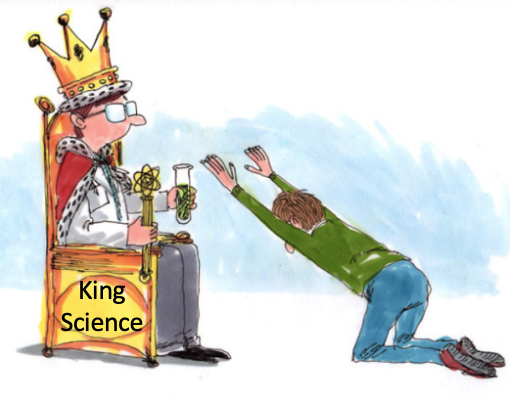 But during COVID, many people found themselves taking direction from unelected public-health officials and advisers whose recommendations influenced school closures, business restrictions, masking, vaccination policies, and everyday behavior. Our choices were being taken from us.
We learned rather quickly that those decisions were not necessarily good for the public, education, and business. Not every state or community accepted COVID-era mandates without resistance. Florida took a notably different approach from many states, while organized groups in places such as Oregon challenged vaccine and workplace mandates through public advocacy and the courts. In several cases across the country, courts ultimately imposed limits on federal mandates or governments later withdrew them.
Not as many stood up to the new policies as should have, and I must ask why? Perhaps it’s something we grew up with because at birth, we are totally dependent on those who raise us up to a certain age. Some have problems breaking away while others revel in the new freedom of adulthood.
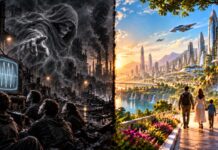
About sovereignty…. In rewatching the brilliant and fictional mind-bending film Tomorrowland we learn that there is a secret utopian community that exists in an alternate dimension. People who helped Plus Ultra (Latin for further beyond) include a secret group of inventors and optimists—including Nikola Tesla, Thomas Edison, Gustave Eiffel, and Jules Verne. And they were some of the best dreamers of their time.
 I know it’s only fiction, but what if there really are secret societies who have figured out how to open portals, teleport to other locations, and create massive robots to build beautiful cities and futuristic technologies?
One of the basic tenets of the movie is that the world is pretty messed up and there are those who want to change it. They don’t give up trying. This allegory was used early in the film:
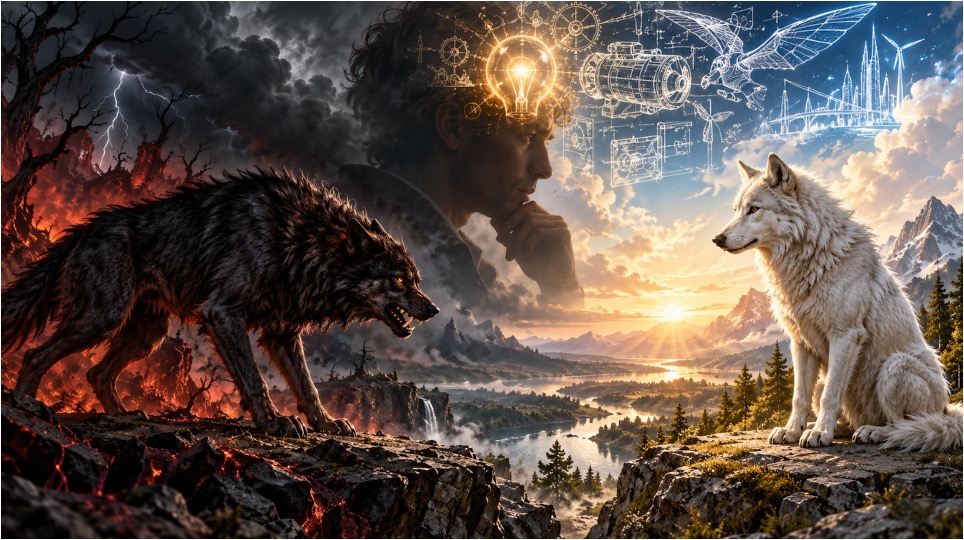
“There are two wolves and they are always fighting. One is darkness and despair. The other is light and hope. Which wolf wins? The one you feed.”
The two-wolves story isn’t really about optimism versus pessimism in a simplistic sense. It’s about attention. Which story do we repeatedly feed with our time, emotion, imagination, and belief?
Is it the news about wars, high prices of food, gas, water, electricity and taxes, or do you look for positive information like new inventions, advances in medicine, sustainable farming techniques?
Perhaps we haven’t lost our creativity so much as outsourced large portions of it. How many now defer to AI to help write their articles or do their research? How many defer to the entertainment industry to tell us what to imagine. Advertising tells us what to desire. News tells us what deserves our attention and what to believe. All the while algorithms decide what we’re likely to see next.
It’s not without a price. Algorithms also show the people behind them what products to promote to you with the hopes you’ll buy them.
Experts and institutions can become substitutes for doing our own investigation. And now AI can even think, write, draw, plan, and create alongside us—or, if we choose, instead of us.
None of those things is inherently destructive. The distinction is whether we use tools to expand our agency or gradually surrender it.
Have we forgotten how to dream our own future because we’ve become accustomed to having someone else dream it for us? And what if their version of reality is less than positive?
In Tomorrowland, Casey wasn’t powerful because she knew how to fix the problems, she didn’t. She was powerful because she refused to accept that a catastrophe was inevitable. She retained her sense of curiosity and hope when others were resigned to what they imagined was their fate… the end of the world.
Something else that stood out to me was Casey’s faith that things could be changed. It reminded me of a verse from scripture in which Jesus told a centurion, “Go; it shall be done for you as you have believed.” — Matthew 8:13
The centurion had asked that his servant be healed. In some ways, it echoes what many today call manifestation: the idea that belief, thought, feeling, and intention all play a role in shaping outcomes, or future probabilities.
Changing Future Outcomes
In one scene, a device designed to monitor changes in tachyons—hypothetical particles that travel faster than light—began to flicker as its predicted probability of catastrophe dropped. The device could view the past and predict the future. In the movie Tomorrowland, the Monitor typically displayed a 100% certainty that a worldwide catastrophe was imminent. However, when Casey Newton refused to accept this pessimistic vision, the machine’s prediction level flickered and dropped, demonstrating that her optimism and refusal to give in to despair could alter the projected outcome.
I was talking about those early creators and inventors who dared to dream. What would the world be like without people like Leonardo da Vinci? Simply by observing nature, mechanics, and the human body, he imagined machines that would not become practical realities for centuries.
Among his remarkable designs were an aerial screw resembling the concept of a helicopter, an ornithopter modeled on the flight of birds, an armored fighting vehicle, a multi-barreled weapon, a self-propelled cart, and even a mechanical knight and animals capable of movement.
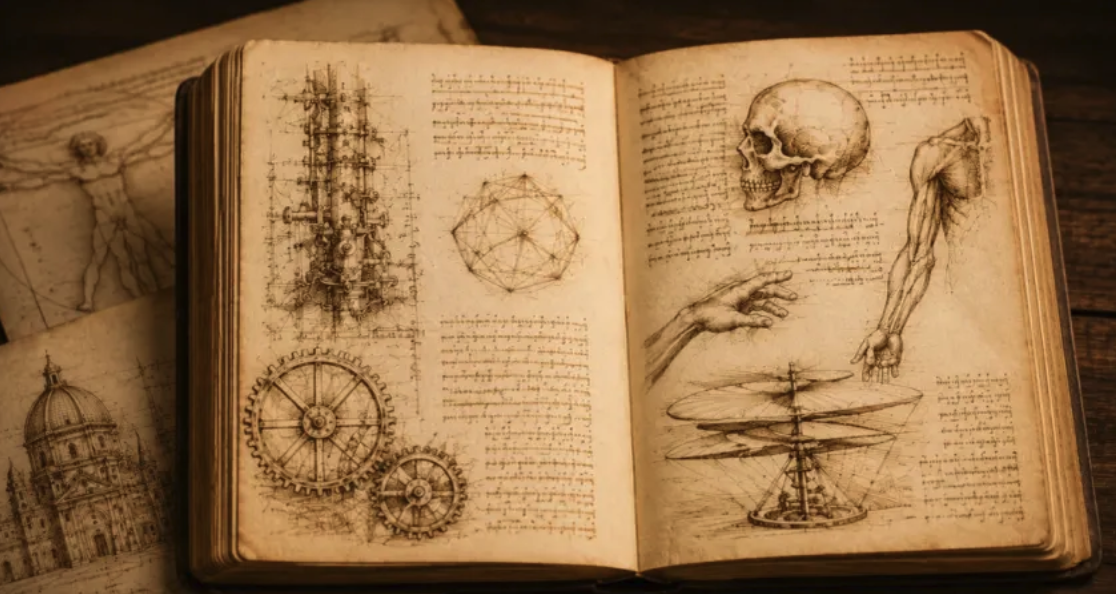
Many could not be built successfully with the limited materials available in his lifetime, but that didn’t diminish his achievements. His ideas grew from observation, experimentation, and his vivid imagination.
The mind is a powerful thing. It can create or destroy, find ecstasy or despair. What matters is the thoughts and imagination we provide as fuel to create the world we wish to live in—not the dreams others choose for us.
Never outsource your dreams nor limit yourself to the ideas of others.


Your Tax Free Donations Are Appreciated and Help Fund our Volunteer Website
Disclaimer: We at Prepare for Change (PFC) bring you information that is not offered by the mainstream news, and therefore may seem controversial. The opinions, views, statements, and/or information we present are not necessarily promoted, endorsed, espoused, or agreed to by Prepare for Change, its leadership Council, members, those who work with PFC, or those who read its content. However, they are hopefully provocative. Please use discernment! Use logical thinking, your own intuition and your own connection with Source, Spirit and Natural Laws to help you determine what is true and what is not. By sharing information and seeding dialogue, it is our goal to raise consciousness and awareness of higher truths to free us from enslavement of the matrix in this material realm.