 EN
EN FR
FR


Land, Air, Energy, and Rights in a Constitutional Republic
Written by Arturo
This article is part of an ongoing examination of technology, infrastructure, and constitutional governance.
Introduction
AI data centers are often described as invisible engines of innovation. In reality, they are among the most resource-intensive industrial facilities operating today. Beyond electricity prices, these installations reshape land use, strain air and water systems, and raise serious constitutional questions. This article examines AI data centers through four lenses: land and earth, air, energy and health, and constitutional limits within the framework of a constitutional republic.
Land and Earth: Permanent Industrial Footprints
AI data centers require massive concrete foundations, substations, and transmission corridors. These facilities are not temporary. Once constructed, they remove land from agricultural, residential, or ecological use for decades.
Concrete production is a significant source of carbon emissions, while the conversion of permeable land increases heat retention and runoff. Communities hosting data centers experience a lasting transformation of their physical environment, often without proportional local benefit.
Water Use and Thermal Stress
Most large AI data centers depend on water-intensive cooling systems. These facilities can consume millions of gallons of water daily, drawing from local aquifers and watersheds.
Water used for cooling is frequently discharged at elevated temperatures, contributing to thermal stress in nearby ecosystems. In regions already facing drought or water scarcity, data center cooling competes directly with residential and agricultural needs.
Air: Energy Demand and Industrial Emissions
Grid Load and Power Generation
AI data centers operate continuously, creating a constant demand for electricity. This persistent load increases stress on regional grids and often triggers expanded use of fossil-fuel power plants, including rapid-response “peaker” plants that emit higher levels of pollution.
Even where renewable energy is used, fossil backup generation is frequently required to maintain uninterrupted operation.
Diesel Generators and Fine Particulates
To ensure uptime, data centers maintain large banks of diesel generators. These generators are tested regularly and activated during outages.
Emissions include:
- PM2.5 (fine particulate matter)
- PM10
- Nitrogen oxides (NOₓ)
- Sulfur dioxide (SO₂)in some regions
- Volatile organic compounds
- Carbon monoxide
PM2.5 is particularly harmful because it penetrates deep into the lungs and enters the bloodstream. There is no known safe level of exposure.
Public Health Impacts of PM2.5
- Scientific evidence links PM2.5 exposure to:
- Cardiovascular disease and heart attacks
- Stroke
- Asthma and chronic obstructive pulmonary disease
- Lung cancer
- Cognitive decline and increased dementia risk
- Metabolic disorders, including Type 2 diabetes
- Premature mortality
Health effects are documented even below current regulatory thresholds. Short-term spikes can trigger acute events within days, while long-term exposure increases chronic disease risk.
Economics: Externalized Costs
Public discussions frequently focus on preventing higher electricity bills for households. While cost-shifting agreements may shield ratepayers, they do not address:
- Pollution-related healthcare costs
- Infrastructure wear and expansion
- Declining property values near industrial sites
- Long-term environmental degradation
- These burdens are externalized onto communities rather than borne by the facilities that generate them.
Constitutional Implications in a Constitutional Republic
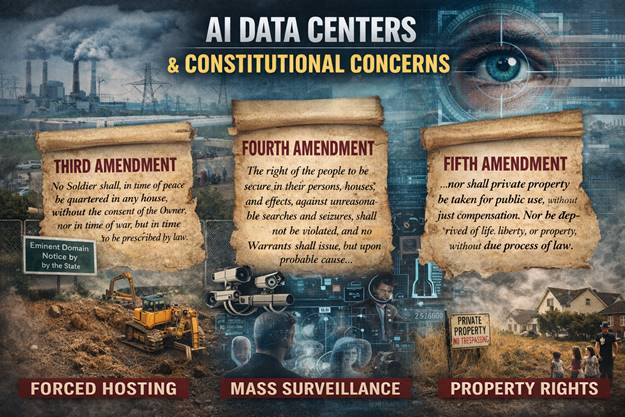
Third Amendment: Protection Against Compelled Occupation
The Third Amendment reflects a broader principle: citizens may not be compelled to host state-aligned power within their homes or land without consent.
Modern analogues include:
- Transmission corridors imposed through eminent domain
- Industrial substations embedded in residential or agricultural areas
- Zoning overrides to serve national technological objectives
When communities are effectively required to host continuous industrial operations for public-private initiatives, the spirit of the Third Amendment is implicated.
Fourth Amendment: Surveillance and Unreasonable Search
AI data centers form the physical backbone of mass data aggregation and algorithmic inference systems.
While the facilities themselves do not conduct searches, they enable:
- Large-scale data storage without individualized warrants
- Persistent behavioral inference
- Surveillance through metadata and pattern recognition
When infrastructure is knowingly built to support suspicionless monitoring, Fourth Amendment protections risk being bypassed in practice, if not explicitly violated in law.
Fifth Amendment: Takings and Due Process
The Fifth Amendment prohibits takings without just compensation and guarantees due process.
AI data centers can impose ongoing harms:
- Reduced property values
- Noise, heat, and air pollution
- Health impacts that diminish use and enjoyment of property
- Accelerated permitting that limits public participation
When approval processes allow private infrastructure to impose these burdens without compensation or meaningful procedural safeguards, serious constitutional concerns arise.
Consent, Legitimacy, and Governance
Preventing higher utility bills does not resolve these foundational issues. Economic mitigation cannot substitute for constitutional compliance.
If communities do not meaningfully consent to hosting AI data centers, the legitimacy of these projects is called into question. Infrastructure serving national objectives must operate within the limits of enumerated powers, individual rights, and due process.
Conclusion: Progress Within Constitutional Limits
AI data centers are permanent industrial installations with consequences that extend far beyond economics. They alter land, degrade air quality, strain water systems, and challenge constitutional boundaries.
The United States was established as a constitutional republic to restrain concentrated power and protect individual rights, particularly when national ambitions conflict with local liberty. Progress that depends on compelled land use, uncompensated harm, or expanded surveillance tests those limits.
The central question is not whether AI infrastructure can be built. It is whether it can be built consistent with the principles of a constitutional republic, where advancement does not come at the expense of property, health, and fundamental rights.

Your Tax Free Donations Are Appreciated and Help Fund our Volunteer Website
Disclaimer: We at Prepare for Change (PFC) bring you information that is not offered by the mainstream news, and therefore may seem controversial. The opinions, views, statements, and/or information we present are not necessarily promoted, endorsed, espoused, or agreed to by Prepare for Change, its leadership Council, members, those who work with PFC, or those who read its content. However, they are hopefully provocative. Please use discernment! Use logical thinking, your own intuition and your own connection with Source, Spirit and Natural Laws to help you determine what is true and what is not. By sharing information and seeding dialogue, it is our goal to raise consciousness and awareness of higher truths to free us from enslavement of the matrix in this material realm.






















Welcome to the Golden (c)age.
The be(a)st is yet to come.
We need to our keep our eye on the Ba'al.