EN
EN FR
FR

by Alex,
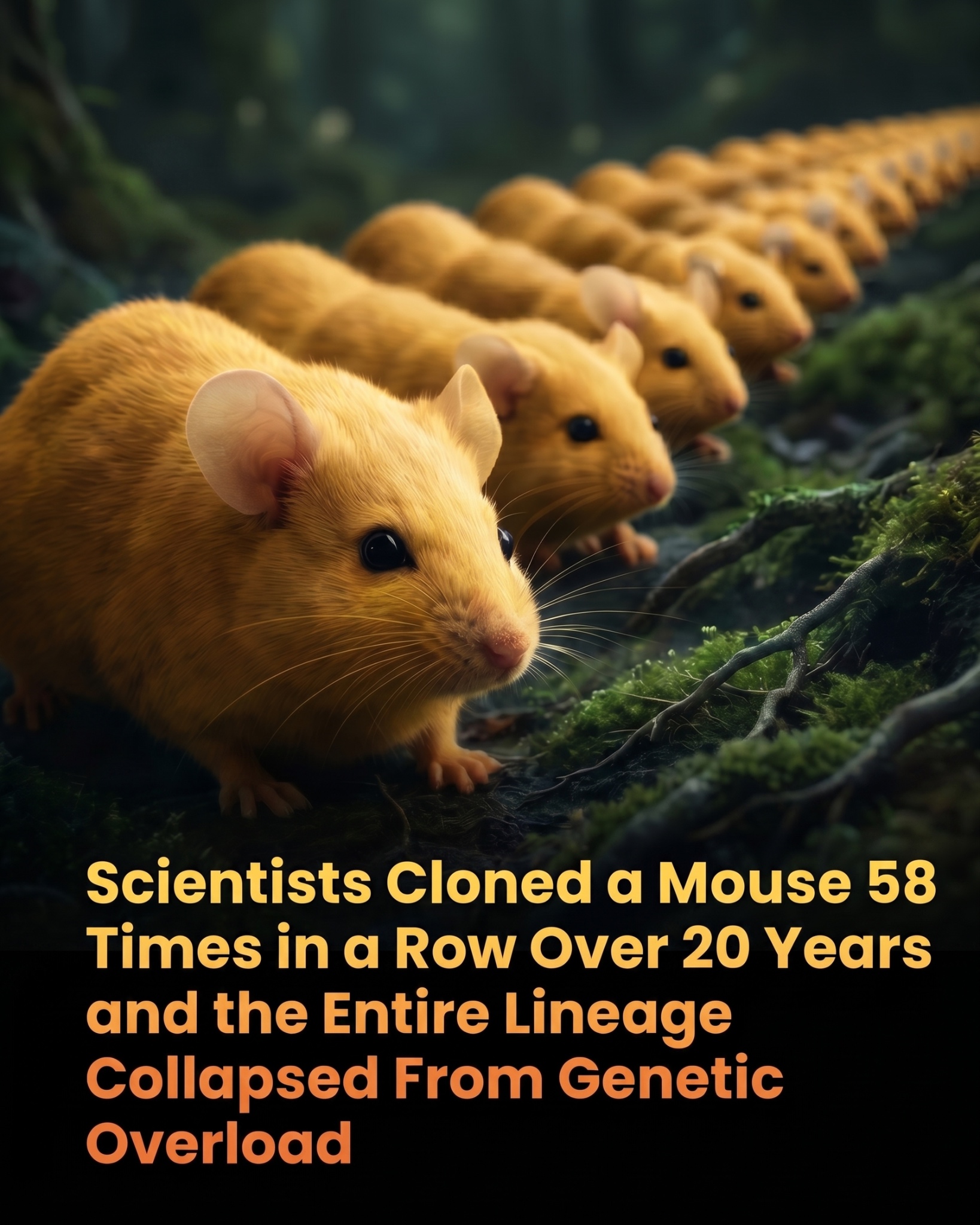
Researchers successfully cloned a single mouse and then repeatedly cloned its descendants for 58 generations over two decades, producing more than 1,200 animals from one original donor.
Yet the experiment ultimately ended in failure when the entire lineage collapsed due to accumulating genetic damage. This visual powerfully captures the central message of the study — that while cloning can produce healthy-looking individuals for many generations, it cannot sustain a viable lineage indefinitely in mammals.
The experiment, led by Teruhiko Wakayama and Sayaka Wakayama at the University of Yamanashi in Japan, began in 2005 using somatic cell nuclear transfer (the same technique that created Dolly the sheep).
Early generations of clones appeared normal, lived typical lifespans, and even showed slightly improved cloning success rates at first. However, subtle problems emerged after roughly the 25th–27th generation.
Cloning efficiency declined sharply, and by the 57th generation, the success rate had fallen to just 0.6%. All mice in the 58th generation died within a day of birth, despite showing no obvious physical abnormalities.
Whole-genome sequencing revealed the underlying cause: harmful mutations accumulated progressively with each round of cloning. Without the genetic shuffling provided by sexual reproduction, deleterious changes — including point mutations, chromosomal abnormalities, and loss of the X chromosome in some cases — could not be purged. By the later generations, the mutation load had become overwhelming, leading to what researchers described as a form of “mutational meltdown.”
This long-term study provides the clearest evidence yet that mammals cannot maintain a species through cloning alone. Sexual reproduction remains essential for resetting genetic errors and maintaining long-term viability. The findings carry important implications for cloning technology, regenerative medicine, and our understanding of genome stability.
Researchers successfully cloned a single mouse and then repeatedly cloned its descendants for 58 generations over two decades, producing more than 1,200 animals from one original donor.
Yet the experiment ultimately ended in failure when the entire lineage collapsed due to… pic.twitter.com/e8WEm1Eabw
— Massimo (@Rainmaker1973) April 15, 2026

Your Tax Free Donations Are Appreciated and Help Fund our Volunteer Website
Disclaimer: We at Prepare for Change (PFC) bring you information that is not offered by the mainstream news, and therefore may seem controversial. The opinions, views, statements, and/or information we present are not necessarily promoted, endorsed, espoused, or agreed to by Prepare for Change, its leadership Council, members, those who work with PFC, or those who read its content. However, they are hopefully provocative. Please use discernment! Use logical thinking, your own intuition and your own connection with Source, Spirit and Natural Laws to help you determine what is true and what is not. By sharing information and seeding dialogue, it is our goal to raise consciousness and awareness of higher truths to free us from enslavement of the matrix in this material realm.