EN
EN FR
FR

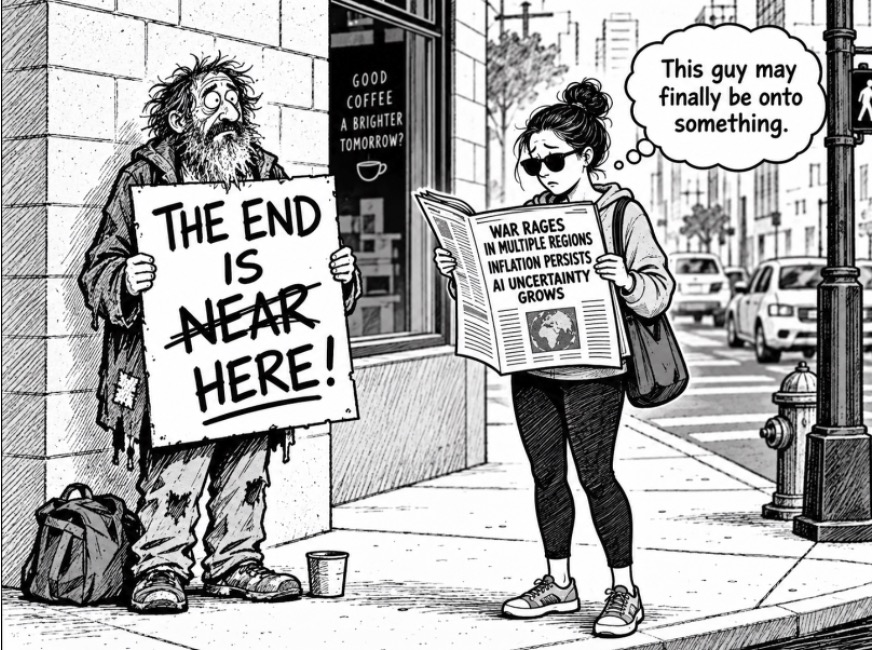
The End is Closer Than You Think!
The Irreverent Kat Carroll
Less Than 10 Minute Read

Did that get your attention?
Of course it did. Fear works.
A headline suggesting danger, catastrophe or some approaching “end” is far more likely to make us stop, look and click than good news, or one announcing that scientists are making remarkable advances in energy, medicine or technology.
By now, you know that I’m a glass half full, not half empty kind of thinker. I don’t buy into all the bunk and fear mongering.
And that is precisely what this article is about.
While our screens are filled with wars, rumors of wars, political conflict, economic anxiety and warnings about artificial intelligence, something very different is happening quietly in the background. Billions of dollars are being invested in technologies that could profoundly change how we produce energy, treat disease, communicate, work and live.
So perhaps the “end” really is closer than we think.
Just not necessarily the one the headline led you to imagine.
AI Fears
Fear and warnings of AI taking over and possibly destroying humanity have been the subject of science fiction and speculation for years. Even Rudolf Steiner warned more than a century ago about the potential spiritual consequences of increasingly mechanized technology, which he associated with what he called Ahrimanic forces.
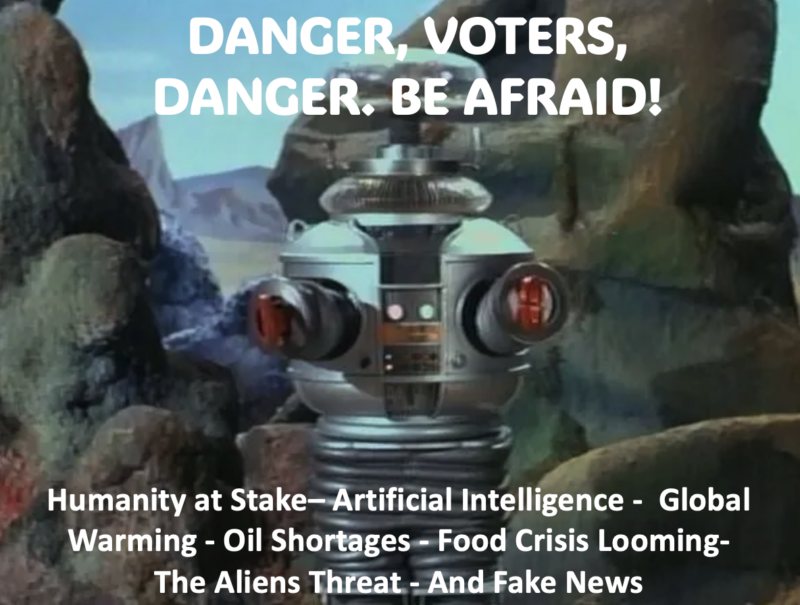 Some have gone on to call AI an existential risk.
Perhaps AI will become part of nearly everything—but more likely in ways that remain under human control and make life better.
If we’ve been warned, then it’s logical to believe we’ve been working on solutions to those concerns and fears. Science fiction began imagining safeguards decades ago, including Isaac Asimov’s famous Three Laws of Robotics.
We are already exploring AI-assisted medical care, environmental monitoring and new approaches to solving problems involving water, energy and climate. Robotics could take over dangerous, repetitive or physically exhausting work while creating entirely new kinds of jobs in engineering, manufacturing, medicine and technology.
There are risks, certainly, just as with any new or evolving technology. But there are possibilities too, and those possibilities don’t receive nearly the same attention as predictions of catastrophe.
And what will power all of this?
Fusion energy has been discussed for decades, often as something perpetually waiting somewhere over the horizon. Yet enormous private investments are now being made to bring commercial fusion closer to reality. If successful, fusion could provide vast amounts of low-carbon energy—something increasingly important as AI, robotics and data centers demand more electricity.
 Fusion has also been part of our science-fiction imagination for decades. Back to the Future gave us “Mr. Fusion,” while films such as Interstellar imagined fusion-powered spacecraft. The technology may still be developing, but the idea certainly isn’t new.
Of course there are more, but you get my point. It’s not a new concept.
Which brings us back to the question at the heart of this article:
What if we’re being shown the fear surrounding the transition more often than we’re being shown the transition itself, and the good that may follow?
And Why Now?
Mid-term… Election-season surprises, political theater, disinformation and unexpected crises are nothing new. And today, more people are willing to question whether fear and dramatic events are sometimes being used to divert their attention from other developments taking place—developments that may require an informed choice rather than a reaction to well-funded fear porn.
 This year’s midterm election spending is higher than usual. AdImpact now projects an extraordinary $11.6 billion in political advertising for the 2026 election cycle, which would make it the most expensive cycle on record, including presidential cycles. Broadcast television alone is projected at $5.6 billion, with another $2.7 billion going into connected TV.
So, if it feels as though political messaging is everywhere, there is a mea$urable rea$on.
I can only speculate on what will happen after the election should either party win. But Trump himself has promised $5,000 to every American adult if Republicans retain control of Congress. He has said increasing revenues would make that possible.
That makes me wonder what he expects to change after the midterms. Does he anticipate significantly greater government revenues from tariffs, changes in geopolitics, technological innovation—or some combination of factors we aren’t yet seeing?
Reporters have also asked when he expects the Iran war to end. On September 9, Trump said he expects it to end after the midterms.
Money clearly matters in elections—but 2024 offered an interesting reminder that money alone does not determine the outcome. Democrats outspent Republicans on political advertising overall, yet Republicans won the White House, took the Senate and retained the House.
That raises another question:
Is persuasion really about how much money is spent—or about whether the message connects with what people are already experiencing and whether they trust the people delivering it?
We won’t know unless—or until—it happens.
But until then, Promethean Action argues that “the Empire” is trying to manufacture an apocalypse before the midterms—AI panic, financial warfare, Ukraine manipulation, and Mideast war pressure. You can watch the video of this talk here.
Follow the Money
The connection between money, power and war goes back centuries.
During the Middle Ages, the Knights Templar developed a sophisticated financial network that allowed people to deposit wealth in one location and access equivalent funds somewhere else. They eventually provided financial services to kings and nobles and helped move money needed for military campaigns.
Centuries later, the Bank of England was founded in 1694 largely because the Crown needed money to finance its war with France. Private investors supplied £1.2 million to the government and were paid 8 percent interest. War needed money—and lending money to governments could generate a return.
The pattern continued into the modern era. The Federal Reserve was established in 1913 and began operating in 1914, just as World War I erupted in Europe. When America entered the war three years later, the Fed helped the Treasury sell Liberty Bonds and provided favorable lending conditions to support government borrowing.
 Wars are expensive. Someone has to finance them—and historically, war financing has created opportunities for banks, investors and industries to profit while giving governments access to the capital needed to fight them.
But when will the need for wars end?
And what if the financial system itself is now entering another transition?
Some people refer to the envisioned next generation of finance as a Quantum Financial System, or QFS—one incorporating AI, advanced digital networks and quantum-resistant security. There is no single officially launched global system by that name today. But technologies associated with the idea are already being developed.
The Bank for International Settlements and major central banks are testing quantum-safe payment systems, while other BIS projects are using AI and network analysis to detect fraud, money laundering and complex financial relationships that conventional systems can miss. If and when these technologies are adopted more broadly, they could make banking safer and some forms of financial crime much harder to hide.
So perhaps the important question isn’t whether something called “QFS” arrives tomorrow.
What happens when technology makes money easier to track, fraud harder to hide, and financial complexity increasingly transparent?
So, What Are We Missing?
While much of our attention is focused on wars, elections, political advertising and predictions of AI catastrophe, remarkable things are happening at the same time.
New gene therapies are treating diseases once considered untreatable. AI is accelerating medical and scientific research. Robotics is moving from novelty demonstrations into manufacturing and hazardous work. Billions are being invested in fusion and other new energy technologies. And increasingly sophisticated computer systems may make financial fraud and hidden transactions easier to identify.
None of these developments guarantees a better future and all technology can be used for good or evil. But it does suggest that the future being built may look very different from the future we’re being frightened into expecting.
So, perhaps the end really is closer than you think.
But maybe not the ending you were afraid of when you clicked on this article! 😉
May your glass always remain at least half full. Stay positive!

Additional Resources:
Existential risk from artificial intelligence
What Rudolf Steiner said about AI and the Emergence of Superintelligence
List of artificial intelligence films
The Evolution of Banking: From Temples to Digital Platforms
Dark Money Hit a Record High of $1.9 Billion in 2024 Federal Races
REPLAY: Ukraine, Mideast, and the Election: What They Don’t Want You to Know
Trump calls $5,000 payouts ‘easy’ to fit into federal budget

Your Tax Free Donations Are Appreciated and Help Fund our Volunteer Website
Disclaimer: We at Prepare for Change (PFC) bring you information that is not offered by the mainstream news, and therefore may seem controversial. The opinions, views, statements, and/or information we present are not necessarily promoted, endorsed, espoused, or agreed to by Prepare for Change, its leadership Council, members, those who work with PFC, or those who read its content. However, they are hopefully provocative. Please use discernment! Use logical thinking, your own intuition and your own connection with Source, Spirit and Natural Laws to help you determine what is true and what is not. By sharing information and seeding dialogue, it is our goal to raise consciousness and awareness of higher truths to free us from enslavement of the matrix in this material realm.