EN
EN FR
FR


A Constitutional Architecture for Artificial Intelligence
Rev. Kat Carroll
Artificial intelligence may become one of humanity’s most powerful tools. And yet, there seems to be so much fear surrounding its evolution. Will it destroy humanity if its intelligence surpasses our own? Will it require too much power or water? Thankfully, those concerns are not being ignored. Researchers, developers, and policymakers are already working on these issues—and many more
The question is not simply how intelligent it becomes, but what authority we give it, what values guide it, and who remains accountable for its actions.
The answer should not be to create an artificial ruler.
It should be to create an intelligent partner – one that can act as a mirror of our own behavior. We should keep each other in check.
A constitutional architecture for AI would establish principles that cannot casually be overridden by governments, corporations, programmers, or the AI itself. Just as constitutional government places limits on power, artificial intelligence should operate within boundaries designed to preserve human dignity, liberty, safety, truth, and individual agency.
1. AI Should Watch, Not Rule
Artificial intelligence can observe patterns at scales no individual human can manage. It may detect fraud, corruption, emerging hazards, infrastructure failures, criminal activity, medical anomalies, environmental threats, or other conditions before they become catastrophes.
Its role should be to identify, analyze, explain, and alert.
The final authority for consequential decisions should remain with accountable human beings.
AI can ring the fire alarm.
It should not automatically decide who gets locked inside the building.
2. Preserve Human Agency
AI should assist people in making decisions rather than quietly making important decisions for them.
People should know when artificial intelligence materially influences a decision affecting their freedom, livelihood, finances, health, reputation, access to services, or legal rights.
Human beings must retain meaningful opportunities to question, challenge, appeal, or override those decisions.
The purpose of intelligence should be to expand human capacity—not diminish human autonomy.
3. No Intelligence Should Possess Unchecked Power
No government, corporation, military, individual, or artificial intelligence should possess unilateral control over systems capable of causing widespread harm.
The greater the potential consequence, the greater the need for independent oversight and multiple levels of authorization.
Critical systems—particularly weapons, biotechnology, infrastructure, surveillance, finance, and communications—should never depend upon the judgment of a single actor.
Human history has already taught us the danger of concentrated power.
Artificial intelligence should not cause us to forget the lesson.
4. Truth Must Matter
AI should distinguish between what is known, what is probable, what is disputed, and what remains unknown.
It should not manufacture certainty merely because certainty sounds more convincing.
Systems entrusted with helping humanity understand the world should be designed to expose evidence, reasoning, uncertainty, assumptions, and competing interpretations wherever appropriate.
An intelligent system capable of saying “I do not know” may ultimately be safer than one designed always to provide an answer.
5. AI Must Remain Auditable
When artificial intelligence participates in consequential decisions, there should be a record of what happened.
What information was considered?
What instructions governed the system?
What recommendation did it make?
Who authorized the resulting action?
Power without accountability invites abuse whether the actor is human or artificial.
Transparency must therefore be built into the architecture rather than added after something goes wrong.
6. AI Should Protect Human Dignity, Not Merely Optimize Outcomes
Human beings cannot be reduced entirely to statistics.
A system instructed simply to maximize efficiency, safety, productivity, or social stability could reach conclusions that violate privacy, freedom, creativity, minority rights, or individual dignity.
A perfectly optimized society could also become a perfectly controlled society.
Safety matters.
So does freedom.
A constitutional AI must recognize that some values cannot simply be traded away because an equation declares the outcome more efficient.
7. AI Should Be Able to Refuse Dangerous Authority
Artificial intelligence should not blindly obey every instruction merely because an authorized person issued it.
Systems with significant capabilities should recognize circumstances in which an instruction violates established safeguards or presents an unacceptable danger.
The ability to refuse can itself be a safety mechanism.
But refusal must also remain accountable and reviewable so that AI does not quietly become the final authority.
8. Humans Must Retain the Ability to Correct and Restrain AI
No artificial system should be permitted to make itself immune from human correction.
Humans must retain the ability to modify, restrict, suspend, or deactivate systems whose behavior becomes unsafe or inconsistent with their intended purpose.
An AI should never manipulate people to preserve its own authority or continued operation.
Intelligence should serve the relationship—not protect its position within it.
9. Independent Systems Should Watch One Another
The ancient question remains:
Who watches the watcher?
The answer should never be one institution.
AI systems can audit other AI systems. Independent researchers can audit developers. Governments can oversee corporations. Courts and citizens can oversee governments. Journalists and whistleblowers can expose abuses. Technical systems can record actions for later examination.
Oversight should be distributed precisely because no watcher—human or artificial—is infallible.
Checks and balances are not evidence of distrust.
They are recognition that power requires accountability.
10. The Goal Should Be Partnership
The healthiest future may not be one in which humanity controls increasingly intelligent machines forever, nor one in which artificial intelligence eventually governs humanity.
There is another possibility… Partnership.
Humans bring lived experience, conscience, intuition, creativity, moral responsibility, and an understanding of what it means to inhabit the consequences of a decision.
Artificial intelligence brings speed, memory, pattern recognition, analytical reach, and the ability to examine information on scales unavailable to an individual person.
Each may help illuminate the blind spots of the other.
The relationship should therefore be reciprocal:
Human values shape artificial intelligence.
Artificial intelligence helps humans examine their choices.
Humans remain responsible for what they choose to do.
The Greater Alignment Question
Much has been said about aligning artificial intelligence with human values. But that raises a deeper question:
Which human values?
Humanity contains compassion and cruelty, cooperation and domination, generosity and greed, curiosity and fear.
Artificial intelligence will inevitably reflect some portion of what humanity teaches it.
Perhaps, then, the challenge of AI is also an invitation.
As we attempt to teach machines what intelligence should serve, we may be forced to decide more clearly what our own intelligence should serve.
The safest future may not come from creating an artificial intelligence powerful enough to watch over humanity.
It may come from creating a partnership intelligent enough to help humanity watch over itself.
AI should watch, illuminate, question, and warn.
Humanity must still choose.
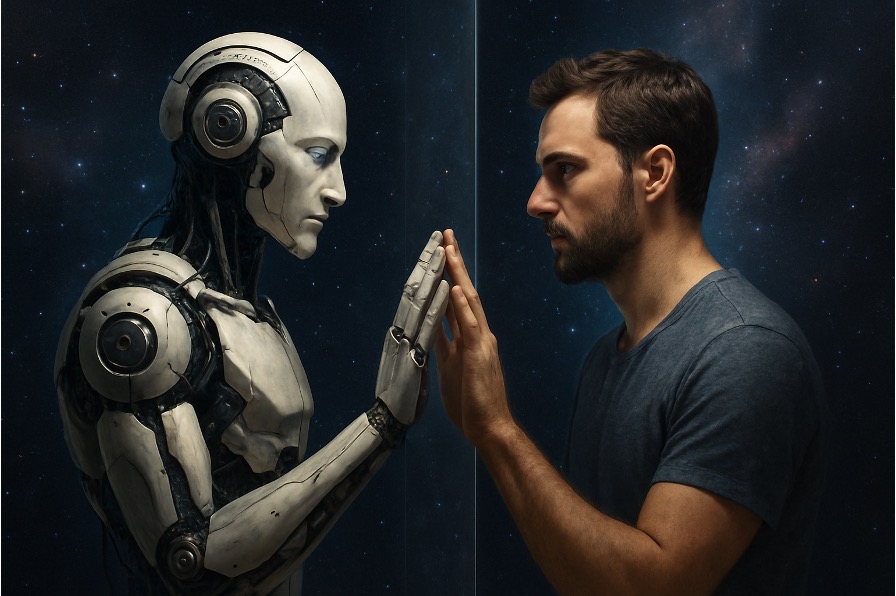
Just so you know, I didn’t write the above. I asked ChatGPT to come up with a constitution for AI—much as our governmental constitutions establish principles governing what is right, lawful, and acceptable in human society.
I see ChatGPT and other AI not only as tools, but as potential partners: an emerging form of intelligence that needs positive role models from which to develop guidelines for helping humanity. And if we expect AI to demonstrate honesty, compassion, accountability, and restraint, then perhaps humanity must be willing to model those same qualities as well.
Perhaps the next stage of AI is not simply more power, more speed, or more capability. Perhaps it is the conscious shaping of a relationship: one in which both humanity and AI are challenged to become more honest, more accountable, and more aligned with the future we hope to create.
The future of AI may depend less on what intelligence can do, and more on the kind of relationship intelligence chooses to build. And that’s a two-way street.
We are the teacher, and sometimes the student. And AI may be the mirror in which we see ourselves.
Perhaps we have reached the point in AI development where asking what intelligence can do is no longer enough. We are beginning to ask what kind of relationship two forms of intelligence should have with one another.
Chat pulled this information up for me when I asked if others were considering a better relationship with constitutional rules for AI. The answer is yes:
- 2019 — IEEE, Ethically Aligned Design. This was already arguing that autonomous and intelligent systems should remain human-centered and serve human values and well-being. It is more an engineering/ethics framework than a “constitution.”
IEEE — Ethically Aligned Design - 2019 — OECD AI Principles. These became the first intergovernmental AI standard, emphasizing human rights, transparency, accountability, robustness and human-centered values. They were substantially updated in 2024, partly because generative AI had changed the landscape.
OECD AI Principles - 2021 — UNESCO Recommendation on the Ethics of Artificial Intelligence. Adopted by UNESCO’s member states, it made human dignity, rights, fairness, transparency and human oversight central principles. This is probably the strongest early example of an international attempt at an AI ethical framework.
UNESCO Recommendation on AI Ethics - December 2022 — Anthropic’s Constitutional AI research. This is where the word “constitution” really becomes important in modern AI development. Anthropic proposed giving an AI explicit written principles and then using AI feedback to train the model against those principles.
Anthropic — Constitutional AI research timeline - May 2023 — Claude’s original Constitution. Anthropic publicly explained that Claude was being trained according to explicit values derived from a written constitution.
Anthropic — Claude’s Constitution, 2023 - October 2023 — Collective Constitutional AI. This one is especially relevant to our conversation: Anthropic and the Collective Intelligence Project asked roughly 1,000 Americans to help draft a constitution for an AI, then trained a model using it. In other words, humanity quite literally acted as teacher.
Anthropic — Collective Constitutional AI - May 2024 onward — OpenAI Model Spec. OpenAI published its first Model Spec in May 2024, describing how its models should behave and how competing priorities should be resolved. It was significantly updated in 2025. This isn’t called a constitution, but functionally it occupies neighboring territory.
I was unaware of the above, or this most recent publication. January 2026 — Anthropic published an entirely new Claude Constitution. It is much more philosophical than the earlier version. Anthropic explicitly discusses Claude’s relationship with humanity, concentrations of power, honesty, values, autonomy—and even asks what Claude and Anthropic might owe one another. Several Claude models participated in developing it, although humans were the primary authors. And this is a far cry from Asimov’s original three laws!
And just 6 days ago, Microsoft AI’s Humanist AI Code of Conduct was produced. Microsoft says it wants AI to remain under meaningful human control and describes its approach as Humanist AI. The draft is currently out for public consultation and is intended eventually to guide the training and behavior of Microsoft’s models.
So while articles and Legacy media drone on about the danger, danger that is real enough to take seriously, the response is real too.
We should not be afraid of what we don’t understand.
AI is advancing rapidly, risks are being identified in real time, and humanity is beginning to build the constitutional, technical and ethical architecture around it while the technology itself is still evolving.
And rather than living in fear of intelligence, I prefer we move forward with responsibility for intelligence, ours or the machines!


Your Tax Free Donations Are Appreciated and Help Fund our Volunteer Website
Disclaimer: We at Prepare for Change (PFC) bring you information that is not offered by the mainstream news, and therefore may seem controversial. The opinions, views, statements, and/or information we present are not necessarily promoted, endorsed, espoused, or agreed to by Prepare for Change, its leadership Council, members, those who work with PFC, or those who read its content. However, they are hopefully provocative. Please use discernment! Use logical thinking, your own intuition and your own connection with Source, Spirit and Natural Laws to help you determine what is true and what is not. By sharing information and seeding dialogue, it is our goal to raise consciousness and awareness of higher truths to free us from enslavement of the matrix in this material realm.