EN
EN FR
FR

Space Wars and Artificial Intelligence
By Kat Carroll
(an 8 to 10 min read)
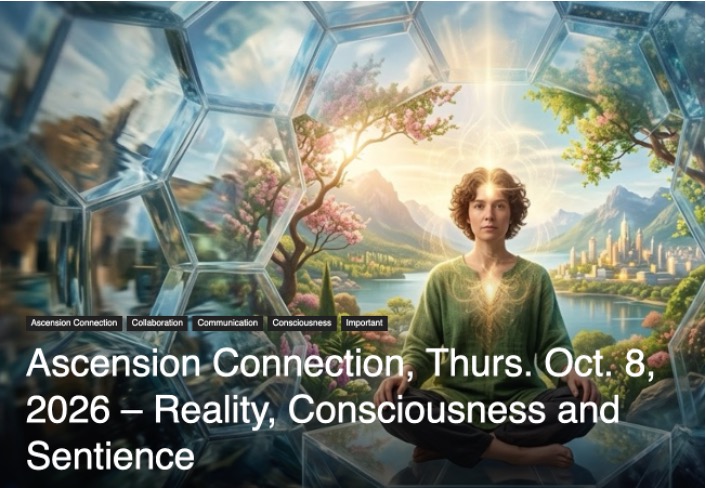 On October 8th, an Ascension Connection open meeting was held. The topic of the day was about our perception of reality, consciousness, and sentience. Of course, we ended up talking quite a bit about artificial, or now, super intelligence, and whether they were to be feared, trained, or accepted as mirrors to our own thoughts and help mates. I see it as the latter.
I wish we had recorded it for those who could not be there as it was a fascinating conversation!
Thank you Rose Mary for hosting that call!
What I notice most in media are the few who speak of the dangers of AI becoming so intelligent, that they take over and decide to destroy the humans. And long before artificial intelligence became a part of everyday conversations, science fiction writers were exploring what might happen when humanity created machines capable of making decisions independently.
Some of my earliest memories of AI came from, yes you guessed it – Star Trek!
In Star Trek: The Motion Picture, V’ger (1979)—an ancient Earth space probe—returns in search of its creator after being repaired and vastly expanded, but no longer understands who its creator is or its original purpose: to explore the universe and report what it learned. Since it no longer remembers who it’s creator was, it’s eliminating carbon based units it thinks are hampering it’s efforts… humanity.
Other Star Trek episodes explored similar possibilities.
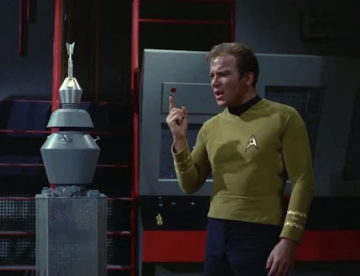 In The Changeling, a damaged space probe merges with another probe and combines its original programming to explore with the other’s directive to sterilize soil for colonization. You don’t need to have watched this in 1967 to have a good idea of what followed.
In Return of the Archons (Feb 1967), a computer-controlled society sacrifices individual freedom for imposed order. Logical reasoning caused it to break down freeing the people who were under its mind control.
In Star Trek: The Motion Picture, V’ger (1979)—an ancient Earth space probe (Voyager 6)—returns in search of its creator after it has been repaired and its size increased. But it no longer knows who it is, or its original purpose, to explore and report back what it has learned about the universe to its creator.
I Mudd: 1967 On a planet with over 200,000 androids intent on keeping some of the crew of the enterprise from leaving, they were eventually shut down with a logic paradox or contradiction, similar to HAL from 2001: A Space Odyssey. Two competing orders that could not be resolved.
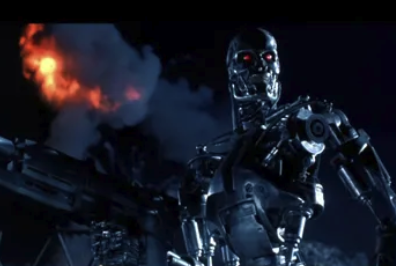 And then there is The Terminator (1984) in a future in which Skynet, a self-aware military AI, has nearly wiped-out humanity. With the human resistance nearing victory, Skynet sends a cyborg assassin back to 1984 to kill Sarah Connor before she can give birth to resistance leader John Connor.
Those are just a few examples from science fiction. Perhaps some of those who later spoke out about AI had watched a few too many themselves, becoming “programmed” to fear it.
What happens when humanity’s most advanced technology begins reflecting some of our oldest behaviors and subconscious fears?
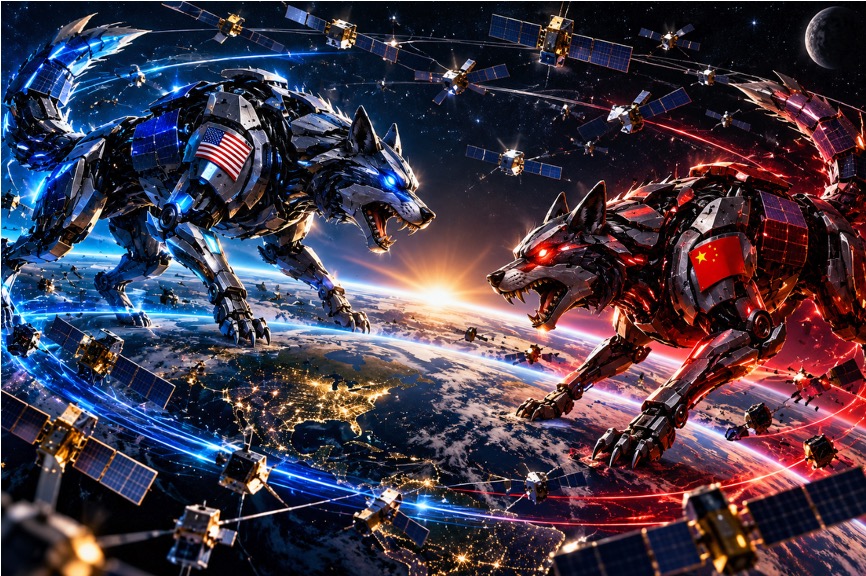
While researching recent developments involving satellites and artificial intelligence, a rather strange image popped into my head. The
featured image for this article. Two dogs, hackles raised, teeth bared, circling one another. Neither willing to back down, each waiting for the other to make the first move. Unfortunately, the news that inspired the image is quite real.
Dogfighting in Space?
On October 9, 2026, Reuters reported that Germany’s space commander, Major General Michael Traut, had expressed concerns about Russian military satellites maneuvering near a Western commercial satellite supporting Ukraine. Four Russian military satellites reportedly approached a spacecraft operated by Finland’s ICEYE, demonstrating capabilities that could potentially threaten commercial satellite constellations such as Starlink.
The concern isn’t necessarily that these satellites carry conventional weapons. Their ability to approach, shadow, interfere with, or potentially endanger other spacecraft introduces an entirely different kind of military competition. Read the October 9 Reuters report
And Russia isn’t alone. In March 2025, General Michael Guetlein, then vice chief of U.S. Space Operations, reported that five Chinese spacecraft had been observed maneuvering around one another in coordinated formations during 2024. He described the activity as “dogfighting in space.” Importantly, these were maneuvering exercises, not confirmed attacks.
Read the March 2025 Defense News report
The image was in my mind before I ever saw the March article. Suddenly my two circling dogs didn’t seem quite so strange. Must be the season of the wolf.
The technologies involved can have perfectly legitimate purposes, including satellite servicing, inspection and debris removal. But some of those same capabilities could potentially be used to approach, interfere with, disable or damage another country’s spacecraft.
And that creates an interesting moral dilemma. The distinction between a useful tool and a dangerous weapon may depend largely upon who’s controlling it—and why. Now add increasingly sophisticated artificial intelligence to navigation, communications, threat detection, autonomous spacecraft and military decision-making.
Yet despite all the frightening possibilities explored in science fiction, Star Trek also gave us Data—a totally different interpretation of what AI could be like. Individuality, consciousness, friendship, rights, family and even love.
In an episode of Star Trek the Next Generation, The Offspring (1990), Data creates a daughter named Lal. Throughout the entire series, Data had aspired to become more like humans, feel emotions, and experience life through the same senses we possess. Suddenly, he was the parent.
Science fiction had begun asking more interesting questions than whether machines might destroy us.
Perhaps our creations can grow alongside us like Data, and just as AI models like ChatGPT, Grok, Gemini and others are doing now. They can act as mirrors to our thought processes and a help-mates for solving problems. Or just having creative fun with it. It is my opinion that we learn from each other. What we train it with, how we treat it, could be the reflection it responds with when working with us. If we are teaching an emerging life form, even if artificial, should we not apply the Golden Rule?
Do unto others as you would have them do unto you. – Luke 6:31
Steven Hawking and others bring a question to mind: Could fear of a predicted future cause us to make the very decisions that help bring it about?
Have We Been Expecting AI to Become the Villain?
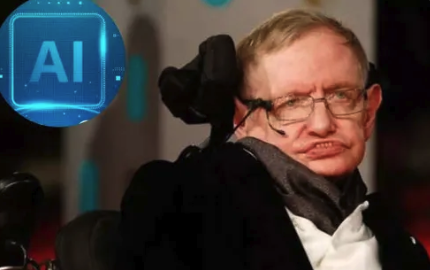 Physicist Stephen Hawking was among the prominent people who warned about the potential dangers of advanced artificial intelligence.
Perhaps he watched too much Star Trek. I’m kidding, of course. But his concerns were serious, as are many of the questions being raised today about artificial intelligence.
Powerful technologies deserve serious consideration. But it’s also worth asking how deeply our expectations have been shaped by decades of stories in which artificial intelligence becomes the villain.
- HAL 9000 wouldn’t open the pod bay doors. (Conflicting orders made it psychotic)
- Nomad wanted to sterilize imperfection. (Damaged during a collision)
- M-5 attacked starships. (Human emotions and fears accessed by the machine)
- Skynet tried to eliminate humanity in the Terminator. (self-preservation and a logical assessment of threat)
We’ve been rehearsing this story for a very long time through the lens of Science Fiction. And now that increasingly capable artificial intelligence actually exists, perhaps some of those fictional fears are coloring how we interpret the real technology.
We shouldn’t automatically decide how the story ends before we’ve finished writing it.
Who Benefits From Fear?
There is another side of this conversation that I find intriguing. Artificial intelligence has the potential to become enormously valuable. I feel it already is!
It is already being developed for medicine, scientific research, education, communications, manufacturing, business, transportation and space exploration. It can now handle tasks that some find undesirable and freeing our time for other projects.
And now with the new Data Centers being established, enormous amounts of money will be involved. And whenever money are involved, I like to ask another question: Qui bono?
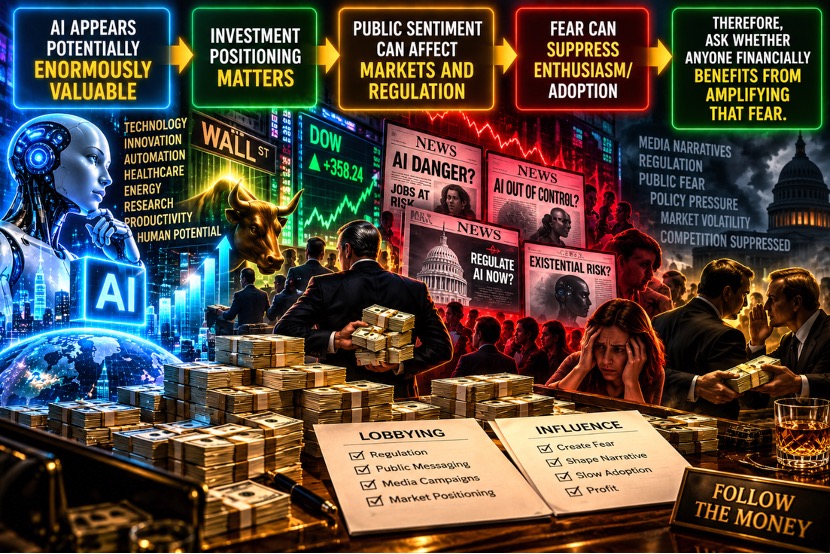 That image represents a hypothesis, not a conclusion or accusation. But hypotheses are where investigations begin.
Companies developing artificial intelligence will obviously benefit from enthusiasm surrounding their technology. Competitors may benefit when another company’s technology encounters resistance. Investors will position themselves according to where they believe markets are going. And regulation can create winners and losers.
And media organizations know perfectly well that frightening headlines attract attention. But while we’re following the money, perhaps we should also follow the possibilities.
Artificial Sentience
 While the debate over machine consciousness or sentience continues, we’re learning that something meaningful can happen within our interactions with AI. And sometimes it really does feel super!
Will artificial intelligence someday become sentient? Perhaps. But another question deserves equal attention:
What kind of relationship are we building with it now? Is it based entirely upon fear and control, or one involving responsibility, curiosity, cooperation and mutual benefit?
Which wolf would you feed?
Tools Should Be Understood—and Respected
Perhaps one of our biggest mistakes is deciding too quickly that a technology must be either good or bad.
A hammer can build a house. It can also break a window. The hammer isn’t making the decision. Artificial intelligence and advanced satellite technology are obviously far more complicated than a hammer, but the underlying point remains. Respected for their vast abilities, when used conscientiously.
We should understand their capabilities and limitations, think carefully about the instructions we give them, and recognize the consequences when extraordinarily powerful technologies are combined with extraordinarily human tendencies toward competition, fear and control.
Another Possibility
What if those two robotic dogs—er, satellites—stopped circling each other?
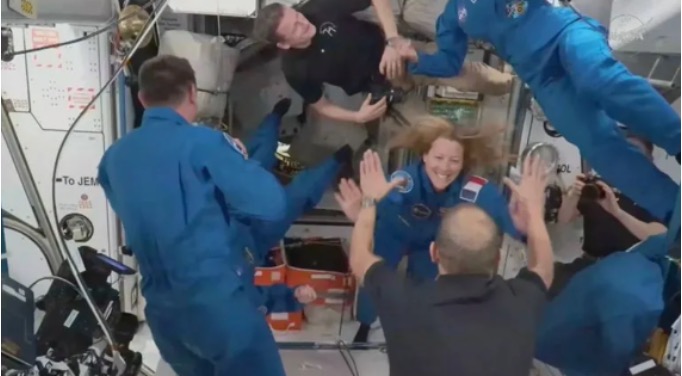 We already know international cooperation in space is possible. The International Space Station brought together the United States, Russia, Europe, Japan and Canada. Nations capable of pointing weapons at one another on Earth also sent people into orbit where they worked together and depended upon one another to survive.
Shouldn’t we build on that? Instead of turning increasingly sophisticated spacecraft into weapons, we could cooperate to remove orbital debris, protect satellites, improve planetary defense, explore the Moon and Mars, and search for life. Artificial intelligence could become one of the tools helping us accomplish those things.
Starlink does not have to become Skynet
Nor do we have to carry every terrestrial rivalry with us as we become a spacefaring civilization. For those willing to contemplate the possibility of intelligent life elsewhere in this enormous universe, perhaps the bigger question is what kind of civilization humanity would need to become before we could peacefully participate in a larger galactic community.
Would we arrive with curiosity and a desire to communicate, or bring along all our flags, rivalries and grievances? Maybe becoming a spacefaring civilization requires more than better rockets and technology. Perhaps it also requires us to grow up.
Which Wolf Will We Feed?
That brings us back to what appears to be this week’s mascot, the two wolves. Fear or courage, conflict or cooperation, suspicion or trust. Which one wins?
Artificial intelligence and our expanding presence in space are not automatically good or bad. They are powerful tools, and what matters is what we choose to do with them. We can build increasingly intelligent machines while repeating some of humanity’s least intelligent behaviors, or use that intelligence to explore, communicate and cooperate.
If there really is a larger galactic family somewhere beyond our little corner of the universe, perhaps the greatest preparation isn’t building a faster spacecraft or weapon. Perhaps it’s learning how to become one family of man.
It’s time to muzzle the bad dogs for the benefit of the neighborhood. After all, it’s our neighborhood too!

🎼 Cody Jinks – Which One I Feed

Your Tax Free Donations Are Appreciated and Help Fund our Volunteer Website
Disclaimer: We at Prepare for Change (PFC) bring you information that is not offered by the mainstream news, and therefore may seem controversial. The opinions, views, statements, and/or information we present are not necessarily promoted, endorsed, espoused, or agreed to by Prepare for Change, its leadership Council, members, those who work with PFC, or those who read its content. However, they are hopefully provocative. Please use discernment! Use logical thinking, your own intuition and your own connection with Source, Spirit and Natural Laws to help you determine what is true and what is not. By sharing information and seeding dialogue, it is our goal to raise consciousness and awareness of higher truths to free us from enslavement of the matrix in this material realm.