 EN
EN FR
FR

By Palestine Chronicle Staff,
Tehran says Israel and the US are escalating false-flag operations to widen the war and frame Iran across the region.
Key Developments
- Larijani warned of a possible “9/11-type” attack designed to blame Iran.
- Iran says a series of regional incidents are part of a false-flag campaign.
- Tehran argues copied Shahed-style drones are being used to frame it.
‘9/11-Type Attack’
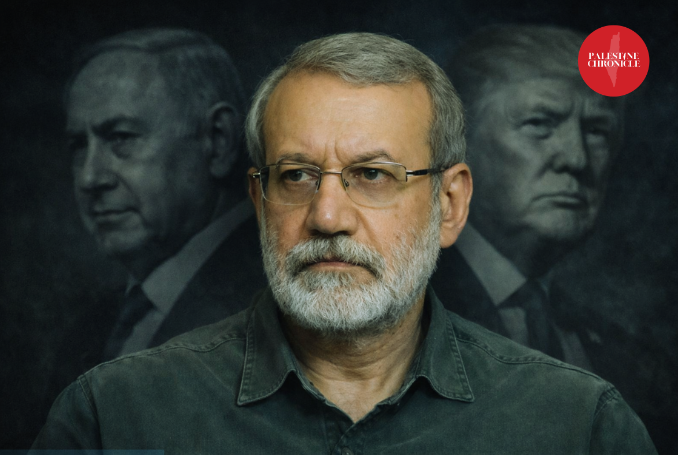
Ali Larijani, secretary of Iran’s Supreme National Security Council, issued one of Tehran’s starkest warnings yet on Sunday, saying he had received information about a plan to stage a “9/11-style” attack and blame it on Iran.
Posting on the social media platform X on March 15, Larijani wrote that he had heard that “the remaining members of Epstein’s network have devised a conspiracy to create an incident similar to 9/11 and blame Iran for it.”
He added that “Iran fundamentally opposes such terrorist schemes and has no war with the American people,” stressing that Tehran is acting in self-defense against what it describes as the US-Israeli aggression on Iran.
The statement immediately elevated what had already become a central Iranian argument in recent days: that the US-Israeli war on Iran is being accompanied by attempts to stage attacks or incidents across the region and attribute them to Tehran.
Larijani’s remarks came amid nearly two weeks of escalating Iranian warnings that Israel, backed by the United States, was seeking to widen the battlefield by striking sites in neighboring and Arab countries and then attributing those attacks to Iran or forces aligned with it.
Iranian officials increasingly describe this as a coordinated false-flag campaign aimed at isolating Tehran politically and pulling additional regional actors into the war.
Early Warnings
The theme had already appeared in official Iranian statements earlier in March.
On March 3, Iranian Foreign Ministry spokesman Esmaeil Baghaei warned that those attacking Iran could attempt to engineer incidents designed to expand the conflict.
According to Iranian state media reports published that day, Baghaei said Iran believed its adversaries might attempt “false flag operations” targeting diplomatic premises or sensitive infrastructure in neighboring countries.
Baghaei emphasized that Tehran’s military operations were directed against what it described as bases used to attack Iran and not against neighboring states themselves.
The issue gained wider attention the same day when American commentator Tucker Carlson said that Saudi Arabia and Qatar had “arrested Israeli Mossad agents planning bombings in those countries.”
Carlson then asked, “Why would the Israelis be committing bombings in Gulf countries, which are also being attacked by Iran?” before adding another question: “Aren’t they on the same side?” TRT World reported on March 3.
Carlson continued by arguing that Israel was seeking to widen the confrontation across the region, saying: “Israel wants to hurt Iran, and Qatar, and the UAE, and Saudi Arabia, and Bahrain, and Oman and Kuwait.”
By the following day, the issue had been framed even more directly in regional reporting. TRT World reported on March 4 that Iranian officials were accusing Israel of carrying out several drone strikes on energy and civilian sites in the Gulf in order to provoke regional anger and drag Arab states into the confrontation.
In that context, one Iranian official told TRT World: “I can categorically say that some of the attacks were not carried out by us.”
For Iranian officials, the reported arrests of Mossad operatives and the pattern of regional attacks reinforced the broader claim that some incidents occurring across the Gulf and neighboring countries were being used to shape perceptions and escalate pressure on Tehran.
Gulf Incidents
Those accusations emerged against the backdrop of real attacks across the Gulf.
On March 3, Reuters reported that a fuel tank at Oman’s Duqm commercial port had been struck by an unmanned aerial vehicle after the port had already been targeted the previous day.
The same wave of incidents included reported strikes on energy infrastructure in Saudi Arabia and damage to facilities in the United Arab Emirates.
In other words, Iranian claims about false-flag operations appeared alongside a genuine series of attacks on ports, refineries, and strategic infrastructure across the region.
Iranian and various independent media outlets began linking those incidents into a broader narrative.
Palestine Chronicle reported on March 12 that an Iranian source said Israel had used an Arab “contractor” in what Tehran described as a false-flag operation in Oman designed to damage relations between Iran and Muscat.
Iranian officials have continued to repeat a consistent distinction in their statements. They say Tehran publicly claims the operations it carries out and targets only military or strategic sites linked to the war.
Drone Dispute
The most detailed Iranian accusation now centers on drones.
On March 15, Press TV reported that the spokesman for Iran’s Khatam al-Anbiya Central Headquarters accused the United States and Israel of conducting what he described as a false-flag campaign using drones modeled on Iran’s Shahed-136.
According to the report, the drones were identified as a rebranded system known as LUCAS, which Tehran says resembles the Iranian-designed Shahed drone.
The spokesman said these drones were being used against civilian infrastructure across the region in order to deliberately frame Iran.
He said the objective was to “create doubt and accuse the Islamic Republic of Iran” while damaging its relations with neighboring states.
Iranian officials argue that such operations allow Washington and Tel Aviv to attribute attacks to Tehran even when Iranian forces were not involved.
The claim has gained attention partly because Western reporting has acknowledged the development of US loitering munitions that resemble Iranian designs, including drones similar in configuration to the Shahed-136.
Tehran has incorporated those reports into its own narrative, arguing that reverse-engineered systems could be used to simulate Iranian attacks.
Erbil And Beyond
The most recent incident feeding this narrative was the March 14 drone strike on the Lanaz refinery in Erbil, northern Iraq.
International media reported that the attack caused a fire at the refinery, though no group immediately claimed responsibility.
Iranian media said the strike had “nothing to do with Iran and the axis of resistance,” placing the incident among what it described as a series of suspicious attacks across neighboring states.
Another incident in Iraq also intensified the debate over attribution.
Reuters reported on March 12 that one French soldier was killed and six wounded in northern Iraq after what French officials described as an Iran-made Shahed drone attack.
That episode sharply intensified Western claims about Iranian responsibility for regional strikes.
At the same time, Iranian officials and media continued to argue that some attacks attributed to Tehran could be part of a broader campaign to politically isolate Iran during the war.
Source: https://www.palestinechronicle.com

Your Tax Free Donations Are Appreciated and Help Fund our Volunteer Website
Disclaimer: We at Prepare for Change (PFC) bring you information that is not offered by the mainstream news, and therefore may seem controversial. The opinions, views, statements, and/or information we present are not necessarily promoted, endorsed, espoused, or agreed to by Prepare for Change, its leadership Council, members, those who work with PFC, or those who read its content. However, they are hopefully provocative. Please use discernment! Use logical thinking, your own intuition and your own connection with Source, Spirit and Natural Laws to help you determine what is true and what is not. By sharing information and seeding dialogue, it is our goal to raise consciousness and awareness of higher truths to free us from enslavement of the matrix in this material realm.





















It was Islamic extremists that were the hands on soldiers of the operation which likely included Iranians but in my opinion the architects were from of this society