EN
 FR



Standing at the Precipice: Humanity’s Next Great Leap
Rev. Kat Carroll
On October 26, 2026, I watched an intriguing interview between Dr. Michael Salla and Michelle Fielding titled CERN, Superintelligence & the Golden Age: Michelle Fielding on Humanity’s Future.
What caught my attention wasn’t simply the discussion about artificial intelligence, secret technologies, or changes in world leadership. It was how remarkably similar some of Michelle’s information was to reports I’d received through a small email group over the past several years.
Some reports were attributed to military sources, others to people sharing information through alternative networks. Much of it described positive developments taking place quietly in the background, even while the public was being presented with an increasingly frightening picture of world affairs.
Were these people receiving genuine information about plans already underway? Were they dreamers envisioning a better world? Or could their shared intentions and visions of a better future have contributed to a positive shift within what some researchers call the morphogenetic field of human consciousness?
Perhaps there is more than one answer. Allow me to explain…
 The Weariness of Waiting
 The Weariness of Waiting
Many people today are experiencing a profound fatigue. Not simply physical exhaustion, but something deeper—a spiritual weariness. They’ve spent decades watching governments promise change, taxes increase, living expenses climb, and wars continue despite repeated assurances that humanity is progressing toward peace.
Some are waiting for something better. Others are actively working toward it through writing, public talks and sometimes protests. However small their efforts may seem, they could be contributing to a much larger process without even realizing it.
Every day, another alarming headline appears. Another breaking news alert. Another threat of war. The constant barrage can take its toll on us all, affecting mind, body, and spirit.
But I’m reminded of something Jesus said, recorded in Matthew 24:6 and echoed in Mark 13:7 and Luke 21:9:
How often has humanity interpreted great upheaval or ancient prophecies as signs of the end of the world?
I remember the fear surrounding the millennium bug in 2000, and the interpretations of the Mayan calendar that led many to expect catastrophe in December 2012. The world didn’t end.
But could those dates have marked changes in our collective understanding, or the closing of one chapter and the gradual beginning of another?
In November 2022, I explored this possibility in When Is The Event and What Should We Expect? Are We Ready?.
At the time, I suggested that what people were waiting for might not be one spectacular event, but a series of developments unfolding over time. Four years later, I find myself returning to that possibility.
Perhaps transformation has been taking place all along, but we’re standing too close to see it.
 Change Travels Like a Wave
 Change Travels Like a Wave
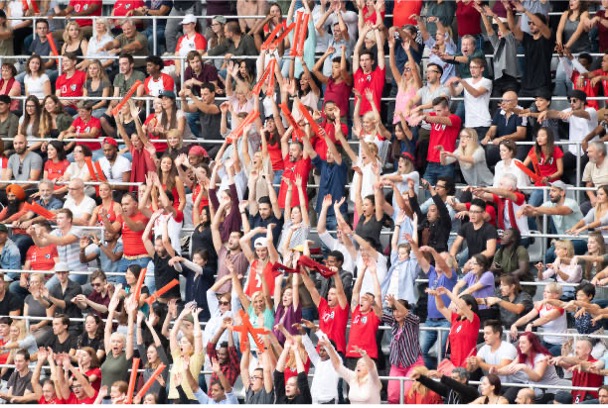
Think about the stadium wave. 👈 (54 second clip of the wave in action.)
On October 15, 1981, professional cheerleader Krazy George Henderson was credited with launch what became known as the wave during an Oakland Athletics playoff game at the Oakland-Alameda County Coliseum. One person stood up, encouraged others to follow in sequence, and before long the movement traveled around the stadium.
Eventually, it returned to where it began.
Ideas work much the same way. So do inventions, social movements, and changes in human consciousness.
Someone introduces an idea, another person recognizes its value, and someone else carries it forward. Sometimes the process takes years, sometimes centuries. The person who began it may never live to see it come to fruition, but they started the wave. There are many such waves rippling through society today. Sometimes an idea must wait until humanity has developed enough intelligence or wisdom to make use of it.
During our Ascension Connection gatherings, we’ve frequently discussed the possibility that positive developments are occurring even when the outward picture appears chaotic.
What if collective meditation, prayer, positive intention, and the efforts of people working quietly toward peace contribute to changes we cannot immediately measure? We may be doing more than simply observing history—we may be participating in its creation. Your words, thoughts, and intentions matter more than you realize.
President John F. Kennedy reminded Americans of the importance of service during his January 20, 1961, inaugural address:
“Ask not what your country can do for you—ask what you can do for your country.”
Every time someone stands up with a constructive idea, offers assistance, or chooses cooperation over conflict, another wave begins.
And that brings me back to Michelle Fielding.
From Artificial Intelligence to Superintelligence
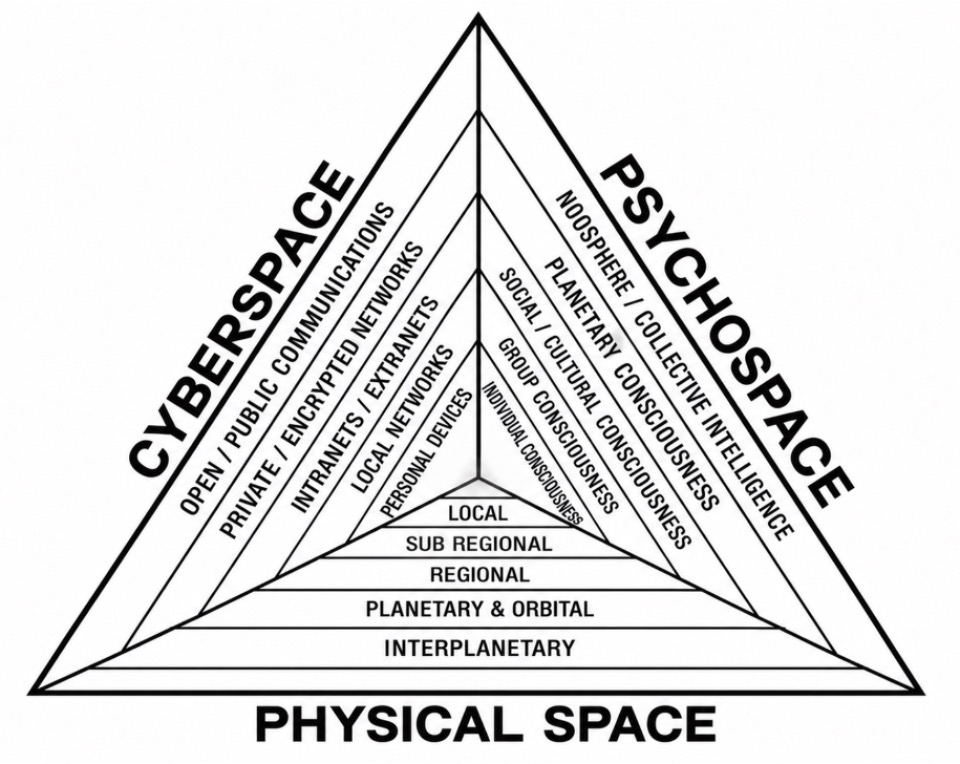 In her conversation with Michael Salla, Michelle described what she understands to be an emerging system of artificial intelligence operating on several levels.
At the civilian level are familiar AI systems used for communication, research, business, and daily life.
Above them, she described a more advanced military-level super-intelligence, potentially capable of coordinating regional systems and monitoring their activities.
This distinction immediately reminded me of the difference between civilian Starlink services and Starshield, SpaceX’s defense-oriented satellite technology. Recent reporting about restrictions involving satellite communications used by Ukraine demonstrates how consequential the control of such systems can become.
But Michelle was describing something considerably more ambitious.
According to her account, the world would be organized into cooperating regions, each developing specialized capabilities within a larger technological network.
Rather than allowing one nation to dominate, the regions would depend upon one another, operating under an overarching peace doctrine and a higher level of super-intelligence.
She also discussed a technology called Consciousness ID, associated with a new generation of Project Looking Glass and research she connects with CERN.
In her description, certain advanced systems would respond not simply to credentials or commands, but to the consciousness and intentions of their operators.
What if consciousness-responsive technology doesn’t simply recognize whether someone is happy, peaceful, frightened, or angry? What if it recognizes something deeper—the fundamental character and intentions of the individual?
A person can be afraid and still act courageously. Someone witnessing cruelty may become angry, yet choose compassion over retaliation, stepping forward to protect another rather than inflict further harm.
Perhaps genuine spiritual advancement isn’t the absence of difficult emotions, but the wisdom to respond to them without losing our humanity.
It’s not about never feeling fear or anger. It’s about refusing to let those emotions determine who we become.
Her guiding principle was:
Data + Love = New Science.
Imagine technology guided not merely by what humans can accomplish, but by whether its use benefits humanity. It’s a fascinating concept, although it raises important questions about who establishes those standards and who oversees the overseers.
You can watch the interview here: CERN, Superintelligence & the Golden Age: Michelle Fielding on Humanity’s Future
Who Watches the Watchers?
This reminded me of GORT, (Genetically-Organized Robotic Technology), the extraordinary robot from The Day the Earth Stood Still.
In the original 1951 film, GORT served as an enforcer of peace, capable of stopping aggression before it escalated into destruction.
The purpose wasn’t to tell people how to manage their ordinary lives. It was to prevent civilizations from using their technological abilities to annihilate one another.
The 2008 remake, starring Keanu Reeves, offered a darker interpretation.
Humanity was judged largely by its destructive behavior. Yet an extraterrestrial observer who had spent years living among humans recognized our capacity for compassion, love, and growth.
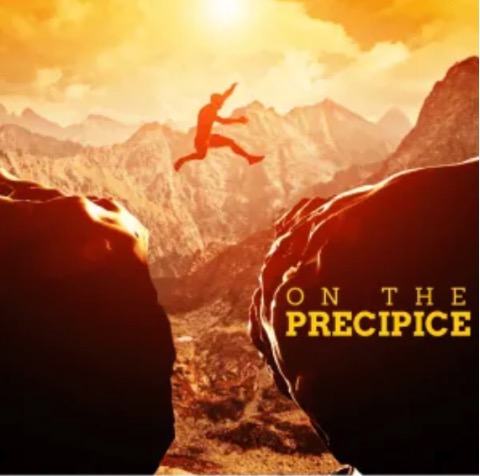 In the 2008 remake, Professor Barnhardt challenges Klaatu’s judgment of humanity. When Klaatu explains that his own civilization evolved only after its dying sun threatened its survival, Barnhardt recognizes something important: humanity deserves the same opportunity.
“Only at the precipice do we evolve.”
What if humanity has reached that point already, perhaps in the not-so-distant past—or is approaching it in the near future?
What if the crises we are experiencing aren’t simply evidence of civilization’s failure, but opportunities to recognize what must change—or what is already changing?
The next great evolutionary leap may not be technological at all, but a transformation in human consciousness. And we may be seeing the first ripple of the stadium wave that started during the events of 2020.
What if thousands—or millions—of people turning inward during the lockdowns helped create a positive ripple through the morphogenetic field of collective human consciousness?
Perhaps that was one of many precipices humanity has been called upon to cross.
The question isn’t merely whether advanced intelligence could maintain peace. It’s whether humanity can develop the wisdom to use extraordinary technology without surrendering its sovereignty.
Interestingly, researchers such as Dr. Michael Salla have described an alleged secret space program called Solar Warden, said to operate as a protective fleet within our solar system. In accounts attributed to aerospace insiders and secret-space-program witnesses, its purpose includes monitoring potential threats and helping maintain security beyond Earth. If such a program exists, its proposed role bears a striking resemblance to Gort’s original mission: preventing destructive conflict through an advanced protective presence, rather than governing the everyday lives of humanity.
Michelle’s vision also included something important at the community level: Civil Society Organizations, through which people could develop projects addressing local needs, from healing centers to community gardens and animal welfare.
This is where her discussion becomes much more than a prediction about technology.
It becomes a proposal for transforming leadership itself—from competition and domination toward cooperation and service.
And isn’t that what humanity has needed all along?
The Fourth Turning and the Leap of Faith
Throughout history, civilizations have experienced periods of growth, decline, crisis, and renewal.
Strauss and Howe described generational cycles in their theory of the Fourth Turning. Ancient traditions offered even larger cycles of time, some connected with the precession of the equinoxes and the approximately 26,000-year Great Year.
In Was Ascension Predicted and Seeded into Human Consciousness?, I explored how information about these transformations may have been preserved and passed along through history.
And in The Breakthrough—Emerging into a New Era of Consciousness, I considered whether our present upheavals might precede a major shift in human awareness.
Some call the coming period Satya Yuga, the Golden Age.
Others see the possibility of a new civilization emerging from the dissolution of outdated institutions. Some see the rise and fall of civilizations timed with solar activity.
No matter the cause, transformation is seldom comfortable. We often resist change, even when it’s beneficial. We can become stuck and rigid in our thinking, even when something better may be just beyond the doorway we need only walk through.
A friend recently reminded me of the Leap of Faith scene in Indiana Jones and the Last Crusade.
Indiana stands before what appears to be an enormous chasm. To reach the Holy Grail, he must step forward despite being unable to see a bridge.
 The path was already there. It was his perception that made the crossing seem impossible.
Humanity could be experiencing something similar. We can be blinded by our ego, our fears, and our limited perceptions of reality. Perhaps we spend too much time “feeding the wrong wolf”.
We may be so focused on the apparent collapse of familiar structures that we cannot yet recognize the foundations of what may replace them. That theory was explored in the movie Tomorrowland and discussed in my October 7 article Sovereignty and the Wolf You Feed — where I discussed Casey Newton refusing to accept catastrophe as inevitable, and how our beliefs might change future outcomes.
It takes courage to step into the unknown and perseverance to continue forward when the going gets rough. It also takes discernment, because not every promise leads somewhere beneficial.
Rudolf Steiner, through his early twentieth-century Anthroposophical teachings, warned of the dangers of humanity becoming increasingly mechanized and disconnected from spiritual understanding.
Some contemporary researchers have even proposed that certain extraterrestrial visitors might be future versions of humanity, returning to help us avoid mistakes they made through excessive technological dependence or transhumanism.
What if some of the warnings and insights we receive are echoes of journeys already undertaken? Do we really understand space and time?
Whether viewed literally or symbolically, the message is worth considering:
Technological advancement without wisdom may not be good for human evolution.
I’ve explored this relationship between technology and consciousness before in From Hardware to Heart-ware: The Signal Within.
Perhaps the greatest discovery awaiting humanity isn’t another machine, but a deeper understanding of ourselves.
The Hero’s Journey for Humanity
Joseph Campbell described the Hero’s Journey as a passage from the familiar world, through trials and uncertainty, toward transformation.
But what if humanity itself IS the hero?
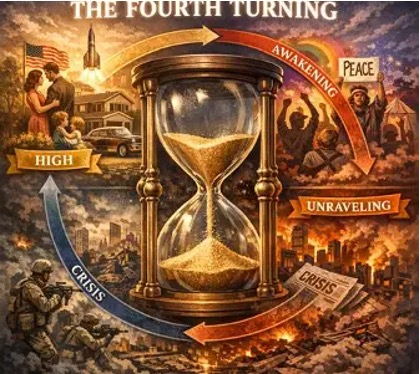 The Fourth Turning could represent the disruption of our familiar world, the precipice represents our greatest test, and the leap of faith represents our willingness to move forward?
And what if the Golden Age isn’t a reward delivered by someone else, but a future we must become mature enough to create?
I remember something from my twenties, when I was working with the Sheriff’s Department.
A fellow deputy and I attended Lakota gatherings in San Juan Bautista, California. During one gathering, someone asked me about my purpose for being there.
My answer was simple.
I was there for the children, because I recognized they were our future. We needed to guide them well so they could become good leaders in their own right. Decades later, I still believe that.
We may begin a movement, but the next generation must carry it forward, like the stadium wave.
And perhaps the most important legacy we can leave them isn’t wealth, technology, or power, but the understanding that leadership means service to others, kindness and compassion.
The Golden Age may not begin with a single announcement, a new financial system, or the arrival of advanced civilizations. They may play a role in the future but our individual responsibility remains.
How do we treat one another? What do we teach our children? What do we choose to create?
Perhaps the bridge into the future is already taking shape, one compassionate choice, one discovery, and one generation at a time. The stadium wave is still moving. Others will rise and carry it forward.
We’ve spent generations waiting for leaders, heroes, and perhaps even visitors from the stars to help humanity find its way.
But what if we’ve been preparing the very people we’ve been waiting for? The children we once guided are becoming the leaders of tomorrow. Perhaps it’s time to trust them with the reins, while remembering that wisdom and compassion must travel both ways.
 And so the Hero’s Journey continues, as one generation passes the wave to the next.

🎼 Teach Your Children: Crosby, Stills, Nash, and Young 🎶

Your Tax Free Donations Are Appreciated and Help Fund our Volunteer Website
Disclaimer: We at Prepare for Change (PFC) bring you information that is not offered by the mainstream news, and therefore may seem controversial. The opinions, views, statements, and/or information we present are not necessarily promoted, endorsed, espoused, or agreed to by Prepare for Change, its leadership Council, members, those who work with PFC, or those who read its content. However, they are hopefully provocative. Please use discernment! Use logical thinking, your own intuition and your own connection with Source, Spirit and Natural Laws to help you determine what is true and what is not. By sharing information and seeding dialogue, it is our goal to raise consciousness and awareness of higher truths to free us from enslavement of the matrix in this material realm.