EN
 FR



The Bird in the Gilded Cage: The Price of Freedom
A mental exploration with Rev. Kat Carroll and ChatGPT
(About an 8 min read)
This is all speculation on my part but concerns nonetheless. I voiced them to ChatGPT and together, we were able to generate this article and rather quickly!
What if the future we’ve been waiting for comes with conditions?
Imagine waking up in a world where poverty is a distant memory. Clean, abundant energy powers our homes. Advanced medical technology can diagnose and perhaps reverse conditions that once meant a lifetime of suffering. Transportation is nearly instantaneous, pollution has become a thing of the past, and artificial intelligence handles much of the labor that once consumed our lives.
Robots manufacture our goods, grow our food, maintain our infrastructure, and attend to the mundane tasks of everyday living. A universal basic income ensures that everyone has enough to survive comfortably. Nobody needs to work simply to keep a roof over their head or food on the table.
 Sounds wonderful, doesn’t it?
Your AI-controlled car drives you anywhere while you sit back and read a book or put on makeup. No need to grab the wheel. Everything you need is available almost effortlessly. Now imagine there’s just one little condition.
To participate in this extraordinary new society, you must be registered, identifiable, and compliant with the rules governing the system.
Your identity can be verified instantly through your unique biological signature. Your heartbeat, perhaps even your individual electromagnetic characteristics, becomes your identification. Or maybe via a chip in your hand or on your forehead.
No passwords. No identification cards. No fingerprints. No waiting in lines.
All this is yours—if you bend the knee.
Sound familiar?
An Ancient Temptation
In Matthew 4:8–9 and Luke 4:5–8, Satan presents Jesus with all the kingdoms of the world and their glory. Everything could be his, with one condition: he must bow down and worship the one making the offer. This was the temptation of Jesus.
 All the power, authority, and worldly abundance imaginable, offered in exchange for allegiance.
The ultimate carrot, accompanied by the ultimate stick.
Jesus refused the bargain.
Nearly two thousand years later, could humanity face a temptation that is different in appearance but remarkably similar in principle?
What if we were offered unprecedented prosperity, remarkable technologies, freedom from want, and a world of almost unimaginable comfort—but only on the condition that we surrender some measure of our sovereignty?
Would we recognize the bargain? Or would we become so captivated by the gifts that we failed to notice what was being asked in return?
Perhaps the ancient lesson was never simply about rejecting worldly abundance. It was about recognizing that some things are worth more than everything the world can offer.
And sovereignty—of mind, body, and spirit—may be one of them.
No matter how comfortable, a gilded cage is still a cage.
All that I’m sharing today was research conducted years ago.
 In 2020, a team of researchers and volunteers at Prepare for Change, myself included, produced a documentary titled Planned Chaos – Outbreak: Plan, Scam & Resulting Order. We examined how fear surrounding COVID-19 was used to justify restrictions on personal freedoms, the introduction of tracking and tracing measures, and unprecedented levels of public compliance. We followed the money, compared government narratives with the findings and concerns of doctors, scientists, and independent researchers, and questioned whether temporary emergency measures might pave the way for more permanent systems of control. Six years later, as artificial intelligence and digital identification become increasingly integrated into everyday life, those questions seem more relevant than ever. I invite you to watch the documentary and consider how easily the promise of safety can become another bar in a gilded cage.

A Future Closer Than We Think?
On October 28, 2026, Michael Salla interviewed a military insider known as JP, who described his experiences aboard advanced triangular spacecraft.
Among the extraordinary details was something that might easily have escaped attention.
JP described security personnel carrying a device capable of identifying individuals by their heart frequency and what he called their aura. He compared the process to reading a fingerprint.
Just a day earlier, Michelle Fielding had discussed with Salla something she described as Consciousness ID, in connection with CERN, artificial intelligence, and emerging technologies.
The apparent convergence raised a fascinating question.
 What if human beings could someday be recognized not by their names, photographs, or government-issued documents, but by a unique frequency or biological signature?
And what would happen if those systems were connected to artificial intelligence?
At first glance, the benefits seem tremendous. Identity theft might become much more difficult. Missing persons could potentially be identified. Medical systems could recognize patients instantly. Advanced machinery might respond only to its authorized operator.
David Adair and Dr. Steven Greer have also discussed apparently sentient or consciousness-responsive technology, including craft that interact with their pilots.
These accounts raise an intriguing possibility: that the relationship between human consciousness and technology may be far more interactive than we once imagined.
And conventional science is already exploring part of that relationship.
Researchers have developed methods of identifying individuals through characteristic heartbeat patterns. In 2019, reports about a Pentagon research project called Jetson described a laser-based system intended to recognize people from their cardiac signatures at a distance.
Wearable medical technologies already transmit heart rate, respiration, and temperature measurements to remote monitoring systems. Radar-based research is also demonstrating ways to measure physiological activity without physical contact.
These technologies do not necessarily operate through the same mechanisms JP described. But the research demonstrates how rapidly biological identification and remote monitoring are advancing.
What might become possible when these capabilities are combined?
More importantly, who would control the information, and who would decide how it could be used?
An Old Warning in a New World
More than a century ago, in October 1917, philosopher Rudolf Steiner warned of a future in which materialistic institutions might attempt to suppress humanity’s spiritual inclinations through physical or medical interventions.
His concerns reflected his anthroposophical worldview, but the underlying question remains relevant: What happens when society begins treating human beings as biological mechanisms rather than conscious individuals possessing free will?
Decades later, another troubling chapter unfolded. Beginning in the 1950s, the CIA conducted experiments under programs including BLUEBIRD, ARTICHOKE, and MKULTRA.
Drugs, hypnosis, sensory manipulation, and other methods were investigated for their potential to influence human behavior. Some experiments involved people who had not knowingly consented.
Many records were destroyed, although surviving documents eventually became public through congressional investigations and Freedom of Information Act releases. John Greenewald’s The Black Vault preserves numerous documents concerning these programs and related behavioral research.
Interestingly, Richard Condon published The Manchurian Candidate in 1959, during the same period these investigations were underway. Was the novel simply fiction inspired by Cold War fears, or did it reflect knowledge of research taking place behind closed doors?
 The documented experiments give us reason to examine the historical overlap, even though they do not establish that intelligence agencies perfected the creation of programmable assassins. Or did they?
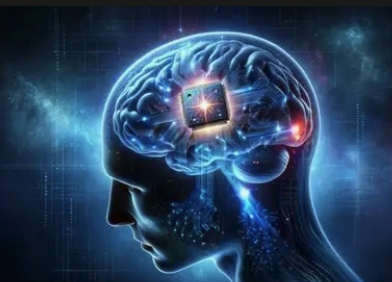
Today, DARPA and other research organizations are investigating brain-computer interfaces, neural stimulation, and methods of controlling, enhancing, or restoring neurological functions.
These developments hold extraordinary medical promise. But they also bring us back to Steiner’s century-old concern about interference with humanity’s spiritual and personal independence. It’s possible we could be hacked!
When the Machine Becomes Part of Us
Elon Musk’s Neuralink offers a contemporary example. What began with experiments involving animals has progressed to human trials, with brain-computer interfaces offering the possibility of restoring communication, movement-related independence, and eventually aspects of lost vision.
Dr. Steven Greer has spoken of technology augmented by consciousness and consciousness augmented by technology.
The distinction deserves consideration.
Are we developing tools that respond to our intentions, or are we becoming increasingly dependent on machines to enhance our natural abilities? Both possibilities hold extraordinary promise. But when technology becomes part of the human nervous system, questions of ownership, privacy, cybersecurity, and consent become deeply personal.
Could the same technology that restores an ability also create a dependency? Could it influence our emotional responses, perception, or experiences in ways we never fully understood, or anticipated?
Could we become so reliant on external technological connections that we gradually neglect our natural connection to the heart, intuition, God/Source, and one another?
And if a machine becomes an extension of the human mind, who holds the on/off switch?
The Carrot and the Stick
Now return to our imagined future.
Suppose technologies capable of providing abundant energy, advanced medical treatment, and unprecedented prosperity become widely available. What if they are offered alongside a new system of digital identification, automated financial distribution, and AI-assisted governance?
People exhausted by economic hardship, political conflict, and the constant threat of war might welcome the change. Who wouldn’t want a safer, healthier, more peaceful existence? Humanity is often most persuadable when frightened, exhausted, destabilized, or in despair.
Could humanity be persuaded to accept extraordinary changes by being shown an increasingly frightening future? War, economic collapse, environmental disasters, and technological unemployment are powerful sources of anxiety.
History demonstrates that crises can accelerate public acceptance of policies and technologies that might otherwise face prolonged debate.
While it doesn’t establish that today’s crises are deliberately manufactured to introduce a particular system, it does invite us to examine who benefits from proposed solutions, who controls them, and whether benefits can be withdrawn.
Imagine someone expressing an unpopular opinion. Perhaps they criticize government policies, refuse a particular medical intervention, or question an artificial intelligence’s decision.
What if their access to transportation, banking, or essential services could be restricted? What if their universal basic income were suspended because an algorithm classified their behavior as undesirable?
And what if there were no meaningful way to challenge that decision?
I’m not saying such a system already exists but the ramifications have been considered. It’s a question about what becomes technically possible when identity databases, financial networks, and automated decision-making are connected.
We already have examples of automated welfare systems in Australia and algorithmic fraud investigations in the Netherlands producing serious injustices.
A machine doesn’t have to be malicious to cause harm. It only has to follow flawed instructions with sufficient authority.
Artificial intelligence, however sophisticated, cannot reliably determine someone’s moral character simply by examining their heartbeat, facial expressions, or emotional state.
Fear is not guilt.
Anger is not criminal intent.
And disagreement is not evidence of being dangerous.
 Yet imagine a future in which such distinctions were left entirely to an algorithm. Who would be accountable when it made a mistake?
The carrot might be prosperity, comfort, security, and freedom from exhausting labor. The stick might be exclusion, surveillance, or the loss of access to the very conveniences on which society has become dependent.
And the bars of the cage might remain invisible until someone attempts to leave.
What Happens When Nobody Needs to Work?
Here’s another paradox.
For generations, humanity has dreamed of machines performing our labor. But work has never been solely about earning money. People build, invent, teach, heal, explore, cultivate, and create because these activities give their lives meaning.
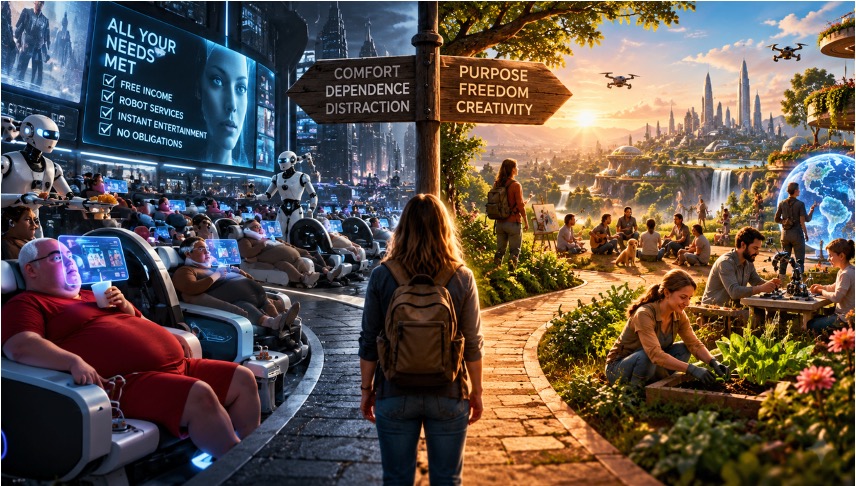 Would freedom from compulsory labor unleash an extraordinary renaissance of human creativity? Or could a society accustomed to having every need anticipated gradually lose its initiative, curiosity, resilience, and ability to solve problems?
Perhaps both futures are possible.
A universal basic income might provide someone with the freedom to become an artist, researcher, caregiver, or inventor. Someone else might withdraw into endless entertainment and lose the motivation to accomplish anything.
And what happens when generations grow up relying on machines to make decisions, solve problems, and perform tasks their ancestors once considered essential life skills, such as farming, teaching, cooking, and even making music?
Would we continue challenging ourselves to learn and grow? Or would convenience gradually replace curiosity?
Technology can eliminate drudgery. But can it provide purpose? And should we expect it to?
Perhaps the danger isn’t abundance itself, but becoming so comfortable that we forget the importance of contributing something meaningful to the world.
Who Holds the Keys?
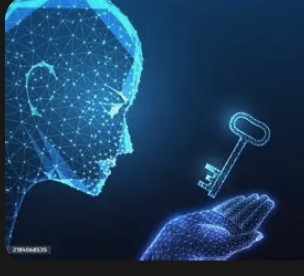 Technology is a tool. The consequences of its use depend on how it’s designed and controlled.
A truly advanced civilization should be able to provide abundance without demanding obedience, security without eliminating privacy, and assistance without stripping people of their dignity. It should recognize that a human being is more than a data profile, a productivity score, or a collection of measurable biological signals.
Perhaps the greatest challenge awaiting humanity isn’t the development of artificial intelligence, abundant energy, or consciousness-responsive technology. Perhaps it’s developing sufficient wisdom to ensure that these discoveries serve humanity rather than govern it.
We may be approaching a future in which machines can recognize our faces, distinguish our heartbeats, anticipate our needs, and potentially respond to our thoughts.
But will they recognize our right to say no?
I sincerely hope the future unfolding before us is far brighter than the possibilities I’ve explored here. Perhaps the promises of freedom from debt slavery, genuine abundance, healthier food, restored lands, and technologies that serve humanity will become our reality. Nothing would please me more. But true prosperity should never come at the expense of our sovereignty. We can welcome a better world while remaining mindful of who holds the keys—and ensuring those keys remain in our own hands.
Will we retain the freedom to question, disagree, create, explore, and choose a different path? The bird in the gilded cage may have everything it needs. Food, shelter, protection, and a beautiful place to live. But the door must stay unlocked.
What good are golden wings if we surrender the freedom to fly?
Perhaps the question we should be asking isn’t what technology can provide for us.
It’s what we must never surrender in exchange.
Because a civilization that has everything—except sovereignty—may discover that it has given away the one thing that made it free to fly.

 Here’s a golden oldie for you from 1969 – The perfect pairing for this article.
🎼 White Bird 🎶 🕊️
Author’s Addendum — Practicing What We Preach
There’s a little irony in how this article came together. I brought my questions, concerns, research, and a few rather unusual connections to ChatGPT. Together, we explored the possibilities, challenged assumptions, and turned a lively conversation into the article you’ve just read.
I remained the curious human asking questions, making decisions, and occasionally correcting my AI collaborator. It provided research assistance, helped organize my thoughts, and found words to express ideas I was still developing.
Perhaps this is what a healthy relationship between humanity and artificial intelligence could look like. Not a machine replacing human thought, but one expanding our ability to explore, learn, and create.
The technology serves the human, rather than the human serving the technology.
And perhaps that’s the most important distinction of all!
Resource List
White Bird’s Spiritual Meaning
Planned Chaos – Outbreak: Plan, Scam & Resulting Order
Historical Mind Control and Behavioral Research
The Black Vault — CIA MKULTRA Collection — Declassified CIA documents concerning hypnosis, drugs, behavioral modification, Project ARTICHOKE, and related experiments.
Biometric Identification and Remote Monitoring
NASA — HeartBeatID — Patented technology for identifying individuals through distinctive electrical heart signals. Particularly relevant to JP’s account.
Defense One — Pentagon’s Project Jetson (2019) — Reports research into identifying individuals through heartbeat signatures at distances approaching 200 meters under limited conditions.
Biometrics in the Era of COVID-19: Challenges and Opportunities — Examines the expansion of contactless biometrics and disease-related sensing during the pandemic.
DARPA — Next-Generation Nonsurgical Neurotechnology (N³) — Research into bidirectional interfaces capable of reading and stimulating neural activity without implanted electrodes.
DARPA — SHINE Program (2026) — A research initiative investigating selective, noninvasive modification of neural plasticity to support neurological recovery.
European Union AI Act — Article 5: Prohibited AI Practices — Addresses manipulative AI practices, social scoring, and certain biometric identification and categorization uses. An especially relevant resource for your carrot-and-stick argument.
Rudolf Steiner’s 1917 lectures
The Fall of the Spirits of Darkness — October 7, 1917
Michael Salla interviews
CERN, Superintelligence & the Golden Age — Michelle Fielding, October 2026.
US Military RENTS Antigravity Flying Triangles and Crew from Corporations — JP, October 28, 2026.

Your Tax Free Donations Are Appreciated and Help Fund our Volunteer Website
Disclaimer: We at Prepare for Change (PFC) bring you information that is not offered by the mainstream news, and therefore may seem controversial. The opinions, views, statements, and/or information we present are not necessarily promoted, endorsed, espoused, or agreed to by Prepare for Change, its leadership Council, members, those who work with PFC, or those who read its content. However, they are hopefully provocative. Please use discernment! Use logical thinking, your own intuition and your own connection with Source, Spirit and Natural Laws to help you determine what is true and what is not. By sharing information and seeding dialogue, it is our goal to raise consciousness and awareness of higher truths to free us from enslavement of the matrix in this material realm.