EN
EN FR
FR

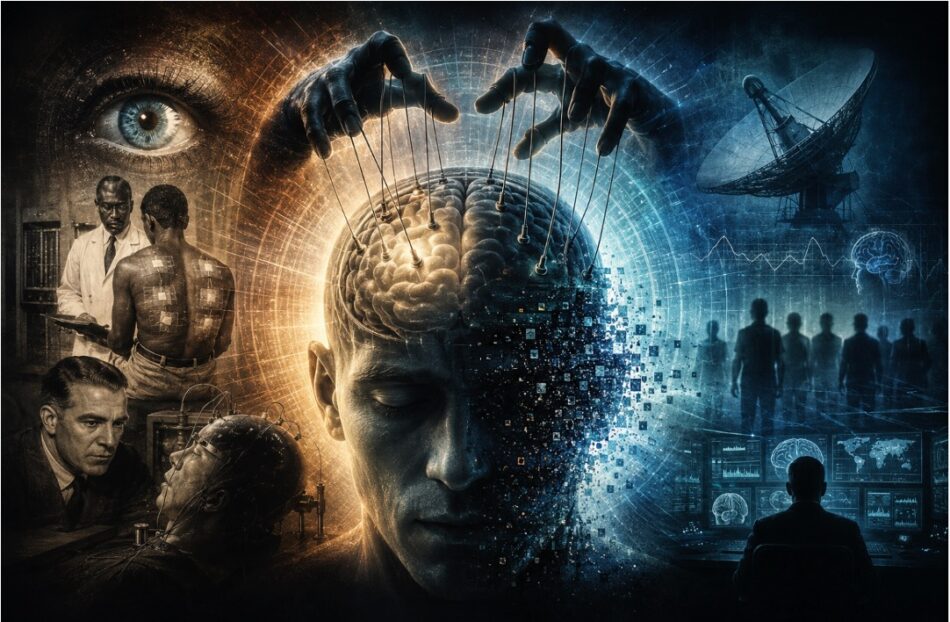
The Invisible Battlefield
Cognitive Freedom in an Age of Influence
Rev. Kat Carroll
Throughout history, every generation has had its battlefield.
Once it was fought with swords, bows and arrows, then rifles and cannon fire. By the time the 20th century rolled around, we had aircraft and nuclear weapons to drop on nations.
Today, the battlefield is far less visible. You can’t see it on a map or plot it in a country. The battle has moved to the human mind itself.
The greatest conflicts of the twenty-first century may not be fought over territory and resources alone, but over attention, perception, memory, and ultimately, human choice.
While that idea may sound like the plot of a science fiction novel, history tells a different story. Governments have long understood that influencing what people believe can be just as powerful as controlling what they do. Whether through propaganda, psychological operations, advertising, entertainment, or more recently, artificial intelligence and sophisticated algorithms, the methods have evolved alongside technology.
As new government disclosures continue to emerge and be heard in court, we are beginning to learn that some programs once relegated to conspiracy theories were, in fact, very real. The question now is no longer simply what happened and why? The more important question may be:
What do we do with this new knowledge?
The Human Mind: The Last Frontier
“The human mind is our fundamental resource.” — John F. Kennedy
During the Cold War, the United States and other nations found themselves engaged in more than an arms race. They entered a race to understand the human mind.
Programs such as Project Artichoke and MKUltra sought to explore methods of behavioral modification, interrogation, memory, hypnosis, and the effects of psychoactive substances. Psychic spying efforts by Russia and the US during the cold war was denied in 1972 yet carried on and became an even larger field of study for business and the military. Many of these activities remained classified for decades before congressional investigations revealed that unwitting individuals had been subjected to experiments without their knowledge or informed consent.
During the same period, both the United States and the Soviet Union quietly explored what became known as “psychic spying.” Although publicly denied in the early years, government-sponsored research continued through programs investigating remote viewing and other forms of anomalous perception. At the Stanford Research Institute, researchers examined whether aspects of human awareness might extend beyond the traditional five senses, with potential applications ranging from intelligence gathering to military operations. Many clandestine projects were funded via our tax dollars, and without our knowledge. The goals of these programs were very different, yet they shared one underlying assumption:
The human mind represented a frontier that science had only begun to explore. Although many of these programs were officially terminated or curtailed following public scrutiny and congressional investigations, questions have persisted about whether related research continued in other forms, particularly as neuroscience and technology advanced. And I suspect it has.
Decades later, the human mind remains one of the least understood frontiers in science and continues to attract interest from researchers, governments, the military, and the private sector alike.
“The important thing is not to stop questioning. Curiosity has its own reason for existing.” — Albert Einstein
Curiosity is one of humanity’s greatest gifts. It has led us to remarkable discoveries, expanded our understanding of the universe, and improved countless lives. Yet history reminds us that curiosity alone is not enough. Without wisdom, compassion, and ethical boundaries, the pursuit of knowledge can lose sight of the very humanity it seeks to understand.
History repeatedly reminds us that scientific curiosity, while essential to human progress, must always be guided by ethical responsibility. The pursuit of knowledge should never come at the expense of human dignity, informed consent, or fundamental rights. When secrecy replaces accountability and experimentation occurs without public oversight, society must ask not only what was discovered—but whether it should have been done in the first place.
Transparency and accountability are not obstacles to scientific progress; they should its moral compass.
Disclosure Changes the Conversation
For many years, discussions about mind control, psychological manipulation, or classified behavioral research were often dismissed as conspiracy theories. The public wasn’t ready to hear of the experiments and atrocities committed in the name of science during WWII and continued after the war.
Yet history has demonstrated that some classified programs were (and likely still are) very real.
Recent congressional hearings examining MKUltra have renewed public interest, not only because of what occurred decades ago, but because newly discovered records continue to surface. Witnesses described the destruction of records, ongoing declassification efforts, and raised questions about whether modern advances in artificial intelligence, neuroscience, and cyber technology warrant renewed ethical oversight.
That does not prove that every modern claim is true. Nor does it mean every theory circulating online is accurate. It does, however, remind us that healthy skepticism works in two directions.
It asks us not to believe, nor to dismiss everything.
Instead, it encourages us to examine evidence as it becomes available and remain willing to revise our understanding when new information emerges.
History has a curious habit of turning yesterday’s impossible story into tomorrow’s declassified document.
“There are no constraints on the human mind, no walls around the human spirit, no barriers to our progress except those we ourselves erect.” — Ronald Reagan
The Evolution of Influence
Not every form of influence requires advanced technology.
For generations, governments, advertisers, filmmakers, psychologists, educators, and media organizations have studied how human beings form opinions, respond emotionally, and make decisions.
- Music can inspire courage, and even higher emotional responses for peace.
- Images can evoke compassion.
- Words can unite—or divide.
- Advertising shapes consumer behavior.
- News framing influences public perception.
Social media algorithms increasingly determine what information we encounter and what information we never see.
Artificial intelligence can now generate persuasive text, realistic voices, convincing images, and videos that may soon become nearly indistinguishable from reality. And many have been fooled.
Taken individually, each technology may appear relatively harmless. But collectively, they raise an important ethical question.
At what point does communication become manipulation?
The battlefield has quietly shifted from controlling territory to influencing perception for profit.
From Science Fiction to Science
Some technologies once considered speculative have already entered public awareness.
Directed-energy systems have demonstrated that energy can affect the human body under certain conditions. Raytheon’s Active Denial system is such an example.
Research into brain-computer interfaces promises extraordinary medical advances, offering hope to individuals with paralysis and neurological disorders. But like computer systems in machinery, they too can be hacked.
Neuroscience continues to unlock remarkable insights into learning, memory, attention, and consciousness and these developments hold tremendous promise.
Yet history reminds us that nearly every powerful technology is like a double-edged sword.. it can be used for healing or harm.
The issue is rarely the technology itself.
The issue is how it is used, who controls it, and for what purpose. Informed consent rarely remains central to its applications. Are we making decisions for ourselves or are we being manipulated?
“The mind is everything. What you think, you become.” — Gautama Buddha
Cognitive Sovereignty
Perhaps the greatest lesson from the past century is not that secret programs existed. It is that human freedom depends upon protecting something even more fundamental than physical liberty.
- The freedom to think.
- Freedom of speech has long been recognized as a cornerstone of democracy.
- Freedom of religion has shaped civilizations.
- Freedom of the press has sought to hold power accountable.
Yet the coming decades may require us to defend another essential freedom.
Cognitive freedom.
Our God given rights include the right to think independently. To question what feels wrong, to investigate where those questions lead. And to change our minds when new evidence appears.
We should be able to see and resist manipulation—whether political, commercial, technological, or ideological.
That responsibility ultimately belongs to each of us.
Questions for Reflection
As disclosure continues across many fields, perhaps these are some of the questions worth considering:
- How should society balance scientific discovery with ethical responsibility?
- Should technologies capable of influencing human thought or behavior ever be used without informed consent?
- Where is the line between education, persuasion, and manipulation?
- How do we cultivate discernment in an age of artificial intelligence, personalized media, and information overload?
- If history has shown that some once-classified programs were real, how should we approach extraordinary claims today—with blind belief, automatic dismissal, or thoughtful investigation?
- What role does personal responsibility play in protecting our own cognitive freedom?
And perhaps the most important question of all…
How do we preserve the sovereignty of the human mind while remaining open to new ideas, new discoveries, and new possibilities?
Final Thoughts
Every generation inherits both the gifts and the challenges of its time. History reminds us that civilizations rise and fall not only because of the technologies they create, but because of the wisdom—or lack of wisdom—with which they choose to use them.
This generation has been given unprecedented access to information, remarkable technological advances, and opportunities for global connection unlike anything previous generations could have imagined.
Yet those same advances remind us that knowledge alone is never enough.
Wisdom requires discernment.
The invisible battlefield may never be won through fear.
It will be won through curiosity.
Through critical thinking.
Through compassion.
Through informed consent.
And through individuals who refuse to surrender the freedom to ask honest questions and seek truthful answers.
Perhaps the greatest form of sovereignty is not merely financial, political, or even technological.
Perhaps it begins with something much quieter… The freedom to think for ourselves.
“The mind, once stretched by a new idea, never returns to its original dimensions.” — Oliver Wendell Holmes Sr.
Feel free to leave a comment. I’d love to know what you’re thinking!

Additional Reading
C.I.A. mind control experiments and the man behind them
History of the Central Intelligence Agency
Stargate Project (U.S. Army unit) – History of psychic spy programs
Mind Control in the Third Reich
Mind Control: From Nazis to DARPA
The manipulation of the American mind: Edward Bernays and the birth of public relations
Suggested Topics for Further Research
This article was never intended to be an exhaustive examination of cognitive influence or behavioral research. Instead, it serves as an invitation to explore a subject that spans history, psychology, ethics, neuroscience, technology, and human consciousness. If today’s discussion has sparked your curiosity, you may wish to explore some of the following people, programs, and topics for yourself.
Historical Programs
- Project MKUltra
- Project Artichoke
- Operation Paperclip
- COINTELPRO
- Operation Mockingbird
People
- Edward Bernays
- Carl Jung
- Aldous Huxley
- John C. Lilly
- José Delgado
Research
- Stanford Research Institute (Remote Viewing)
- Brain-computer interfaces
- Neuroplasticity
- Psychoacoustics
- Behavioral economics
- Persuasive technology
Modern Topics
- Artificial Intelligence
- Algorithmic influence
- Social media recommendation systems
- Deepfakes
- Cognitive liberty
- Informed consent in neuroscience

Your Tax Free Donations Are Appreciated and Help Fund our Volunteer Website
Disclaimer: We at Prepare for Change (PFC) bring you information that is not offered by the mainstream news, and therefore may seem controversial. The opinions, views, statements, and/or information we present are not necessarily promoted, endorsed, espoused, or agreed to by Prepare for Change, its leadership Council, members, those who work with PFC, or those who read its content. However, they are hopefully provocative. Please use discernment! Use logical thinking, your own intuition and your own connection with Source, Spirit and Natural Laws to help you determine what is true and what is not. By sharing information and seeding dialogue, it is our goal to raise consciousness and awareness of higher truths to free us from enslavement of the matrix in this material realm.