EN
EN FR
FR

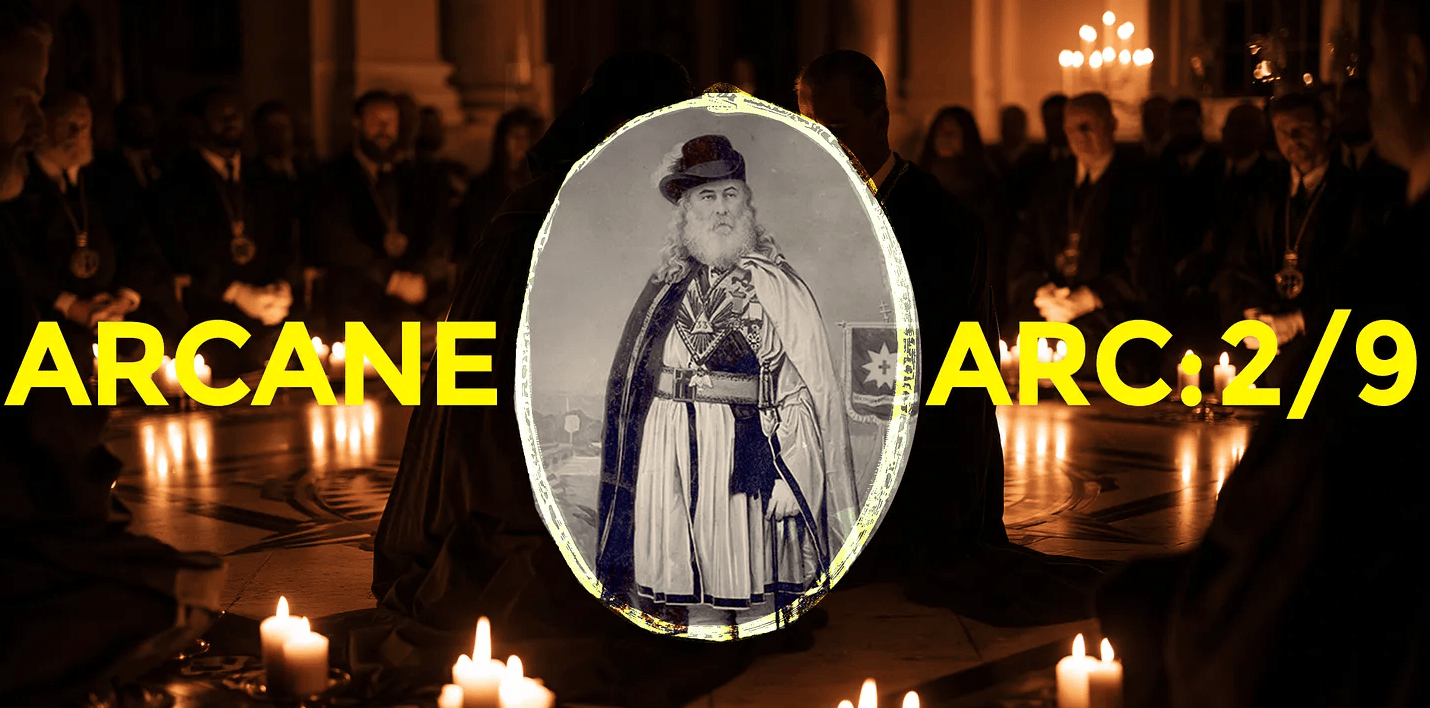
Albert Pike, Freemasonry, and the Administrative Blueprint
In the previous article we established that the plan was always published — that Blavatsky and Bailey laid out the Luciferian administrative project in books available in any library, and that the organizations built around those books have been operating at institutional levels for over a century. In this article we examine the man who built the administrative architecture that those organizations plug into: Albert Pike, Confederate general, lawyer, journalist, and for thirty-two years the Sovereign Grand Commander of the Scottish Rite of Freemasonry, Southern Jurisdiction.
Pike is the hinge figure between the esoteric philosophical tradition and the institutional power structure. Blavatsky provided the cosmological framework. Pike provided the organizational machinery — the degree system, the ritual architecture, the graduated initiation structure through which the philosophical claims of the tradition are transmitted to successively inner circles of the meritocratic tier. Understanding his work is essential for understanding how the administrative project moves from philosophical claim to institutional reality.
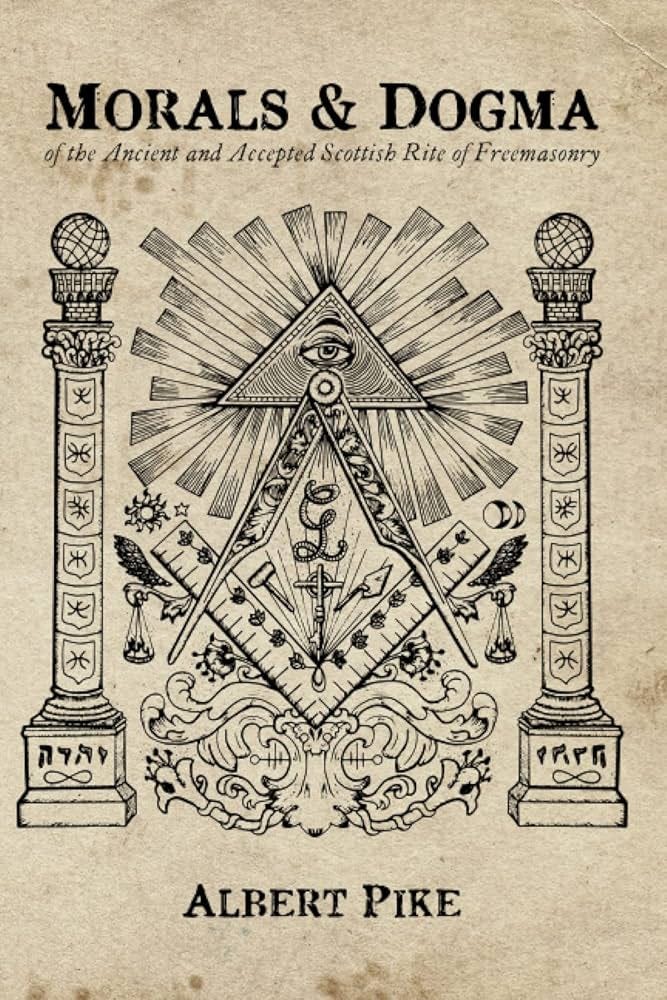
His primary work, Morals and Dogma of the Ancient and Accepted Scottish Rite of Freemasonry, published in 1871, is a real document available in full text. It is 861 pages of dense esoteric philosophy. It says what it says and can be quoted directly. What the text actually contains significantly reveals a disturbing underlying thread that Masons use as their hidden agenda at the higher levels of Masonry.
Pike plainly states, on page 819, that the lower degrees are “intentionally mislead by false interpretations.” Understood to mean deceived about the organizations true aim until they might graduate to the higher levels through deeds and beliefs, while the lower ranks carry water for the higher mission and infiltration ideology.
BRIDGE — Article 1 established the Theosophical foundation — Blavatsky’s cosmological architecture and Bailey’s institutional expression. This article examines the parallel institutional architecture of speculative Freemasonry and its relationship to the same underlying project. The two streams — Theosophical and Masonic — are not identical organizations, but they draw from the same esoteric well and their senior figures have historically been aware of and in some cases in direct contact with each other.
Albert Pike: The Man and His Position
Albert Pike was born in Boston in 1809 and died in Washington D.C. in 1891. He was a Confederate general during the Civil War, commanding Indian Territory forces — a role that generated significant controversy both during and after the war. He was a lawyer of considerable reputation, a poet, a journalist, and a prolific writer on esoteric subjects. He became a Freemason in 1850 and rose rapidly through the degrees of the Scottish Rite, eventually becoming Sovereign Grand Commander of the Southern Jurisdiction in 1859, a position he held until his death.
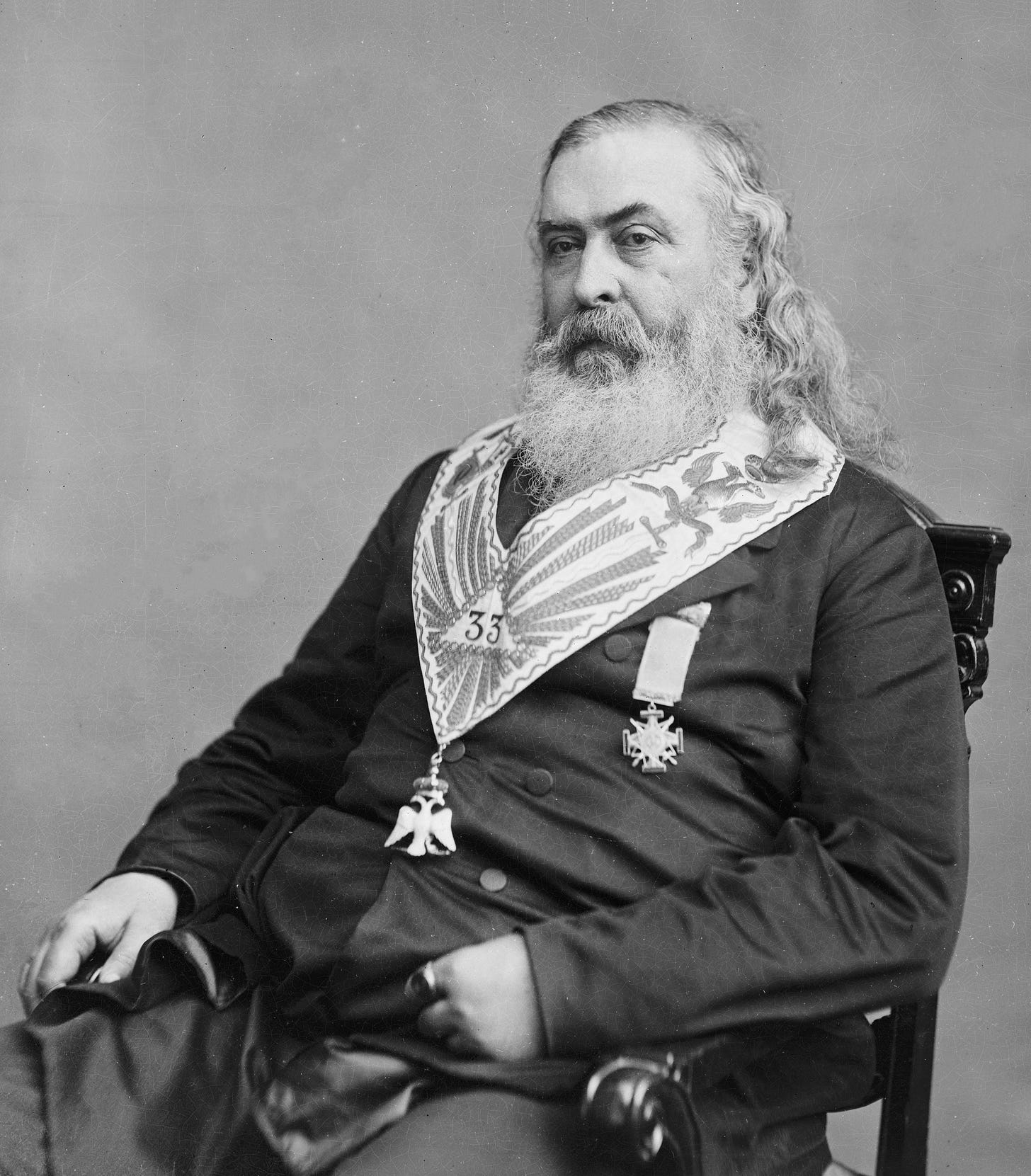
That position made him the most powerful figure in American Freemasonry for over three decades. The Scottish Rite’s degree system runs from the 4th through the 33rd degree — the first three degrees belong to the Blue Lodge, the foundational level of Freemasonry that most members never go beyond. Pike’s domain was the upper degrees, and it was in those upper degrees that he did his most significant and most controversial work.
Morals and Dogma was Pike’s attempt to provide a comprehensive philosophical and esoteric foundation for the Scottish Rite degrees. It was given to every Scottish Rite Mason upon completion of the 14th degree for many decades. It is not a document that was hidden or suppressed, though, neither promoted publicly outside the ranks. It was the official philosophical text of a major American institution, distributed to hundreds of thousands of initiates. Whatever it contains, it contains openly — which is itself the most important thing to understand about it.
NOTE — Morals and Dogma of the Ancient and Accepted Scottish Rite of Freemasonry by Albert Pike (1871) is in the public domain and available in full text through multiple archives including archive.org. The Scottish Rite Southern Jurisdiction, headquartered in Washington D.C. at the House of the Temple, maintains Pike’s archives and acknowledges his authorship without reservation. Copies of the book were to remain within the members circles, and not broadly circulated, though the text is displayed in some public settings.
What Morals and Dogma Actually Says
The most significant passage in Morals and Dogma for the purposes of this arc is not a disputed quote. It is in the chapter on the 19th degree, and it is unambiguous. Pike writes: ‘Masonry, like all the Religions, all the Mysteries, Hermeticism and Alchemy, conceals its secrets from all except the Adepts and Sages, or the Elect, and uses false explanations and misinterpretations of its symbols to mislead those who deserve only to be misled; to conceal the Truth, which it calls Light, from them, and to draw them away from it.’
Read that carefully. Pike is not speaking metaphorically or esoterically. He is stating plainly, in the official philosophical text of the Scottish Rite, that the institution deliberately provides false explanations and misinterpretations to the majority of its members — those he describes as deserving only to be misled. The truth is reserved for the Adepts, the Sages, the Elect. Everyone else receives deliberate misdirection. Everyone else, includes the general public. Though, as I’ve claimed many times, the truth needs to be provided to those who seek it, in order to abide by the laws of informed consent.
By segmenting the “truth,” it is the institutional expression of the two-tier knowledge system we examined in Article 1 — the same structure the mystery school tradition has always employed. The outer teaching is designed to manage and misdirect. The inner teaching is reserved for those who have demonstrated the specific qualities the institution values. In Pike’s framework those qualities include, among other things, the willingness to accept and operate within a system that deliberately deceives its own members at lower levels.
The Lucifer passage that Pike actually wrote appears in the context of his discussion of Lucifer as a symbol. Pike writes in the 26th degree chapter: ‘Lucifer, the Light-bearer! Strange and mysterious name to give to the Spirit of Darkness! Lucifer, the Son of the Morning! Is it he who bears the Light, and with its splendors intolerable blinds feeble, sensual, or selfish Souls? Doubt it not!’ This passage is genuinely in the text. Its interpretation is contested — some read it as Pike simply noting the paradox of the name, others as a genuine esoteric affirmation. What is not contested is that it is there.
NOTE — Both passages quoted above are directly from Morals and Dogma and can be verified in the full text. The ‘conceals its secrets’ passage is from the chapter on the 19th Degree, page 104-105 of standard editions. The Lucifer passage is from the chapter on the 26th Degree. These are Pike’s own words in Pike’s own published text, not attributions from secondary sources.
As an example The broader philosophical framework of Morals and Dogma aligns with the Theosophical tradition in its most essential claim: that humanity’s development is guided by advanced intelligences who communicate through initiatory systems, that the true nature of those intelligences is known only to the innermost circles, and that the outer forms of religion and institutional life serve primarily as management systems for the uninitiated majority. Whether one reads this as enlightened esotericism or as the philosophical justification for a control system depends on which measure one applies. The barometer I’ve established (see The Litmus Test article) asks: what does this framework produce in the people inside it?
Pike wrote plainly that Freemasonry ‘uses false explanations and misinterpretations of its symbols to mislead those who deserve only to be misled.’ That is not an accusation made by critics. It is a statement made by the institution’s most authoritative philosophical voice, in its own official text.
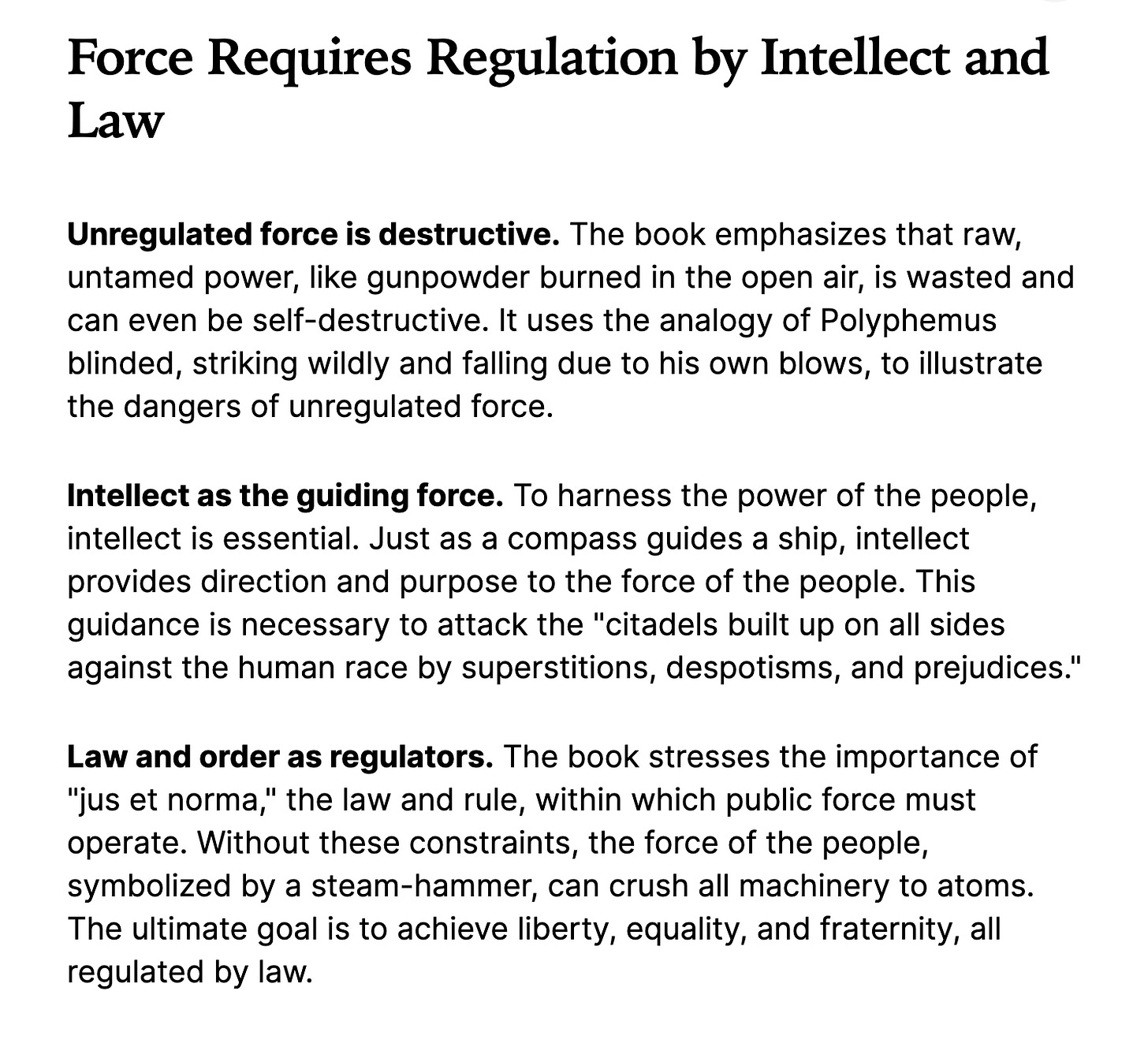
The Three-Tier Structure: Who Knows What
The Freemasonic degree system is, at its structural core, a knowledge management architecture. The Blue Lodge degrees — Entered Apprentice, Fellow Craft, Master Mason — constitute the foundational tier available to the general membership. At this level the symbolism is presented in broadly moral and philosophical terms. Brotherhood, charity, the improvement of character. The content at this level is not sinister in any obvious way and the vast majority of Freemasons — millions of men across the world — operate entirely within this tier and would reject any suggestion that the institution they belong to has an inner esoteric purpose distinct from its stated one.
The intermediate degrees of the Scottish Rite and York Rite introduce progressively more explicit esoteric content — Hermetic philosophy, Kabbalistic symbolism, the mystery school traditions of Egypt and the ancient Near East. The historical claims become more ambitious. The cosmological framework expands. Initiates at this level are being introduced to the proposition that the outer forms of religion are exoteric expressions of deeper esoteric truths accessible only through the initiatory system.
The 33rd degree — honorary in the Scottish Rite, conferred rather than earned through degree work — represents the institutional apex. What is actually taught and understood at this level is, by design, not publicly documented. Pike himself acknowledged in Morals and Dogma that the true meaning of the symbols is withheld from those who do not deserve it. The 33rd degree is the level at which, in the framework Pike describes, the full nature of the Masonic project becomes accessible to the initiate.
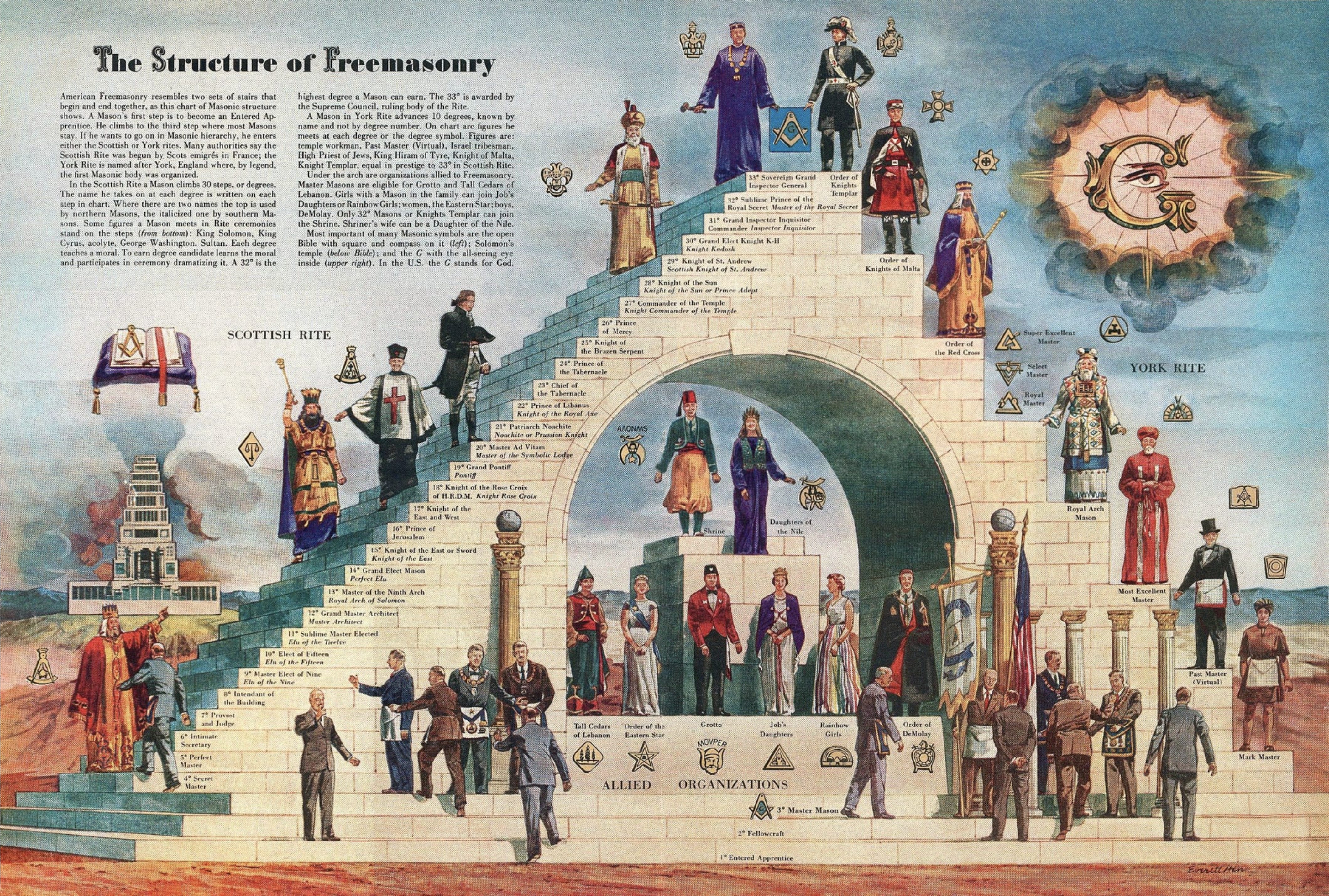
This three-tier structure maps directly onto the Fulford framework we examined in the Everybody Wants to Rule the World series: the general membership as the outer circle, the meritocratic initiates as the operational tier, and the bloodline-connected or highest-degree inner circle as the administrative apex that understands the actual nature and purpose of the institution. The Blue Lodge Mason and the 33rd degree recipient are nominally members of the same organization. The degree to which they understand what that organization is actually doing is radically different by institutional design.
The important editorial point is that the three-tier structure is not a conspiracy theory imposed on Freemasonry from outside. It is the institutional design Pike himself described and defended. The concealment of inner teaching from outer members is not a secret — it is in the official philosophical text distributed to hundreds of thousands of initiates.
The Conflict Framework: Managing Civilizational Transitions
Among the claims most frequently associated with Pike is the three world wars framework — a letter to Giuseppe Mazzini describing the use of three global conflicts to achieve the conditions necessary for the new world order Bailey would later describe. The specific letter’s authenticity is contested formally among academics. What’s not contested, is that the design of the three needed wars to achieve it’s ultimate end goal – a one world government under the authority of their light bearer god is not and for those with eyes to see it, the exact direction the world has been guided to over the years since it first came up in the Mazzini and Pike communique – real or not.
What we can stake further, on documented evidence, is this: the philosophical framework described in that letter — using ideological conflict between opposing factions to exhaust existing power structures and create the conditions for a new administrative arrangement — is entirely consistent with the documented Masonic and Theosophical philosophical tradition. It is the Hegelian dialectic applied at civilizational scale. Thesis and antithesis engineered to produce a specific synthesis. And it is a methodology with observable expression in the documented record of the twentieth and twenty-first centuries.
The first and second world wars did produce the institutional architecture Bailey described as necessary for the Masters’ externalization — the League of Nations, then the United Nations, then the network of international financial and governance institutions that constitute the current world order. Whether those outcomes were planned or emergent, engineered or opportunistic, the institutions produced by those conflicts are the ones Bailey’s affiliated organizations have been working within and through for decades.
The current geopolitical moment — the collision of multipolar and unipolar power, the disclosure acceleration, the institutional architecture under simultaneous stress from multiple directions — fits the third phase of the conflict framework whether or not Pike wrote a letter describing it. The framework describes an observable pattern. The pattern’s origins may be less important than its current expression.
Bailey was explicit about this in ways that require no disputed documents. In The Externalisation of the Hierarchy she describes the necessity of a period of intense conflict and upheaval before the new order could be established — not as prediction but as plan. The chaos is not incidental to the transition. In the framework she articulates, it is instrumental to it. Exhausted, destabilized, traumatized populations are more receptive to new administrative arrangements than stable, confident ones. This is not esoteric speculation. It is basic political science applied with a cosmological justification.
Bailey wrote openly about the necessity of upheaval and conflict as the precondition for the new order. She did not need a secret letter to make this argument. She published it. It is in the books. It has always been in the books. Those books are followed by the UN.
The Institutional Reach: From Pike to the Present
The significance of Pike’s work is not primarily philosophical. It is institutional. The Scottish Rite Southern Jurisdiction that he led for thirty-two years is headquartered at the House of the Temple in Washington D.C. — a building modeled on the Mausoleum at Halicarnassus, one of the seven wonders of the ancient world. Pike’s body is interred there. The building sits on 16th Street, sometimes called the Street of the Presidents, a few blocks from the White House. It is not a fringe institution. It is a major American organization with significant historical influence in the city that has administered global power for over a century.
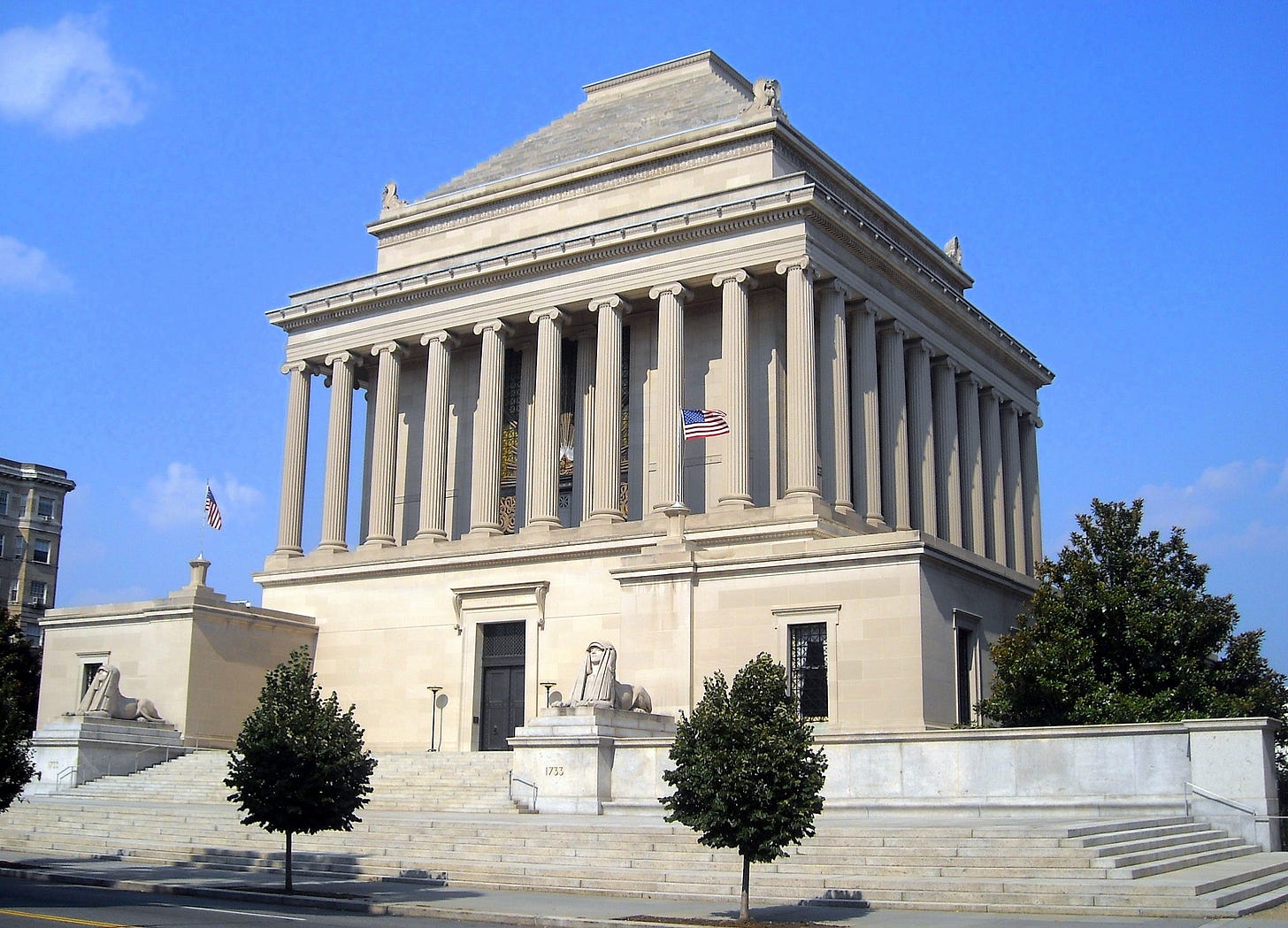
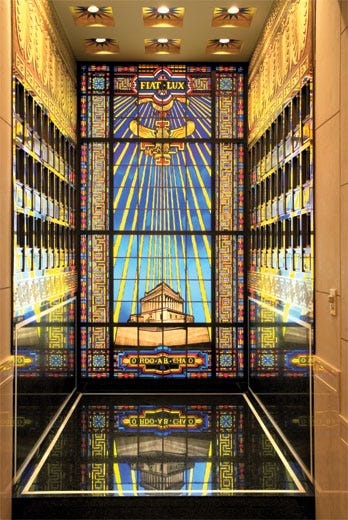
The roster of 33rd degree Scottish Rite Masons in American history includes presidents, Supreme Court justices, senators, military commanders, and figures across virtually every domain of institutional power. This is documented and not seriously disputed. What it means — whether Freemasonry shaped American governance toward the administrative project Pike described, or whether the overlap is simply the product of a social institution that has historically attracted ambitious men — is a question the barometer can help evaluate but cannot definitively resolve.
What the barometer asks is not whether individual Freemasons are good or bad people. Most are not aware of the inner teaching Pike described. The barometer asks what the institution produces at the systemic level — what pattern of outcomes emerges from a social and political network organized around a graduated knowledge system in which the inner circles hold cosmological claims the outer members are deliberately not told. Applied to the observable history of the institutions shaped by Freemasonic networks, the answer is a pattern of power concentration, information management, and governance structures that consistently serve institutional interests over public ones.
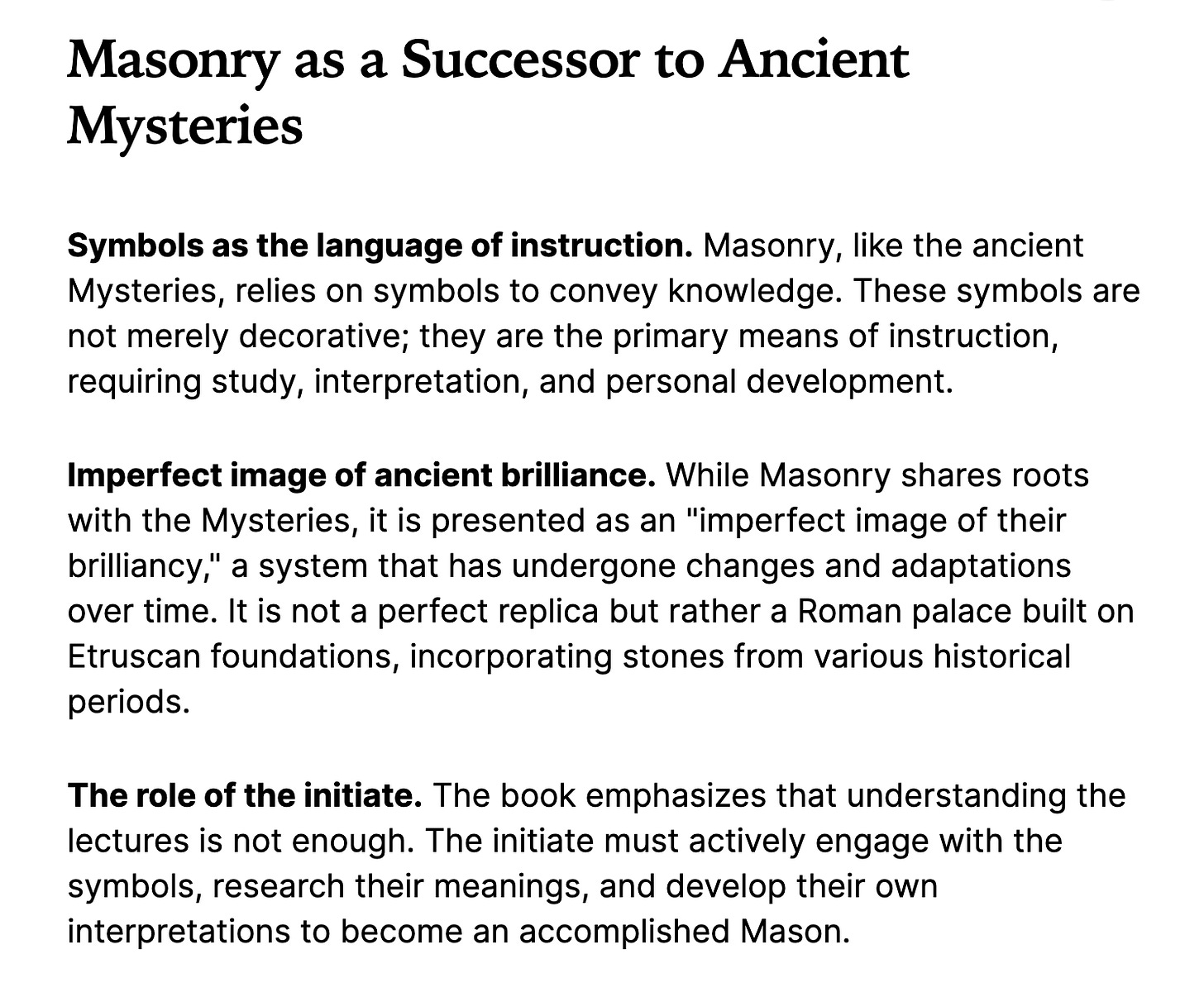
That observation does not require attributing malice to individual members. It requires only observing that institutions designed around a two-tier knowledge system — in which those who know the full nature of the enterprise make decisions on behalf of those who do not — produce outcomes consistent with that design. The outer members serve the project without knowing they are serving it. The inner circles know what the project is. Pike told us this is how it works. He published it.
NOTE — The House of the Temple in Washington D.C. is a real building open for public tours. Pike’s interment there is documented. The Scottish Rite Southern Jurisdiction maintains public records of its history and leadership. The roster of prominent 33rd degree Masons is a matter of historical record, documented in multiple independent sources including the organization’s own publications.
Pike and Bailey: The Same Project, Different Vocabularies
The most important observation this article can offer is the convergence between Pike’s Masonic philosophy and Bailey’s Theosophical framework — not as a claim of direct organizational connection, though such connections existed through shared membership and mutual influence, but as evidence that both are expressions of the same underlying project.
Both describe a graduated knowledge system in which inner circles hold truths withheld from outer members. Both describe advanced non-human intelligences as the ultimate source of the tradition’s authority and knowledge. Both describe humanity as being guided toward a specific destination by those intelligences through human proxy organizations. Both describe the current era as a pivotal transition point. Both use the phrase — or its close equivalent — new world order to describe the administrative arrangement that the transition is intended to produce.
Bailey was explicit about this convergence in her own writing. In The Externalisation of the Hierarchy she describes the work of the Masters as operating through multiple channels simultaneously — religious, political, scientific, and esoteric — all moving toward the same destination through different institutional expressions. Freemasonry is explicitly named as one of those channels. The Masonic institution, in Bailey’s framework, is one of the vehicles through which the Masters’ plan is being implemented in the political and social sphere.
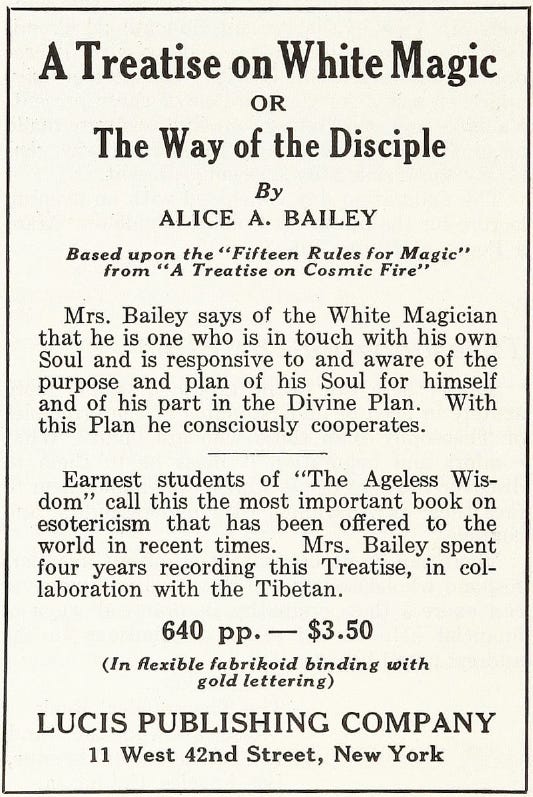
Whether one accepts Bailey’s framing of the Masters as the source of that plan, or applies the EWTRW series’ more cautious framework of assessed-source intelligence held at appropriate confidence — the institutional convergence is real. Organizations with overlapping membership, compatible cosmological frameworks, and complementary institutional reach have been working in the same direction for over a century. The direction is toward the administrative arrangement Bailey described and Pike’s institutional machinery helped build.
The deeds test, applied to that convergence, asks: what has this direction produced? What does the world look like after a century of these institutions working toward their stated goal? The answer to that question is visible in the observable world — in the concentration of institutional power, the erosion of genuine popular sovereignty, the managed information environment that the EWTRW series documented in Articles 5 and 6. Whether those outcomes are the intended product of a long-running administrative project or the emergent result of institutional self-interest operating without cosmic direction — the outcomes themselves are real and they are what the barometer measures.
Pike described the machinery. Bailey described the destination. A century of institutional history connects the two. The deeds test applies to the entire arc — not to the intentions of individual members but to the pattern of outcomes produced by institutions designed around these principles.
What the Architect Built
Albert Pike built something durable. The Scottish Rite degree system he shaped is still operating. The philosophical framework he articulated in Morals and Dogma is still distributed to initiates. The institutional network he helped consolidate still occupies significant positions in American and global governance. Whatever one concludes about the esoteric claims underlying that framework — about the nature of the beings the inner tradition serves, about the legitimacy of the administrative project — the institutional expression is real and its effects are observable.
The most important thing Pike did was not write a book. It was build an institution that could carry the administrative project forward across generations, through members who understood varying degrees of what they were participating in, using a graduated knowledge system that protected the inner teaching while maintaining the outer forms of a respectable civic organization. That institutional architecture is what connects the esoteric philosophy of the 19th century to the operational networks of the 20th and 21st.
It is important to note that deception is the devil’s greatest weapon. The will that’s often covered up by that polarity is exactly what Masonic Elder, Manly P. Hall spells out in plain English when he stated, “we must also perfect the plan of the ages, setting up here the machinery for a world brotherhood of nations and races.” (“The Secret Destiny of America,” 1944)
As well as this quote:
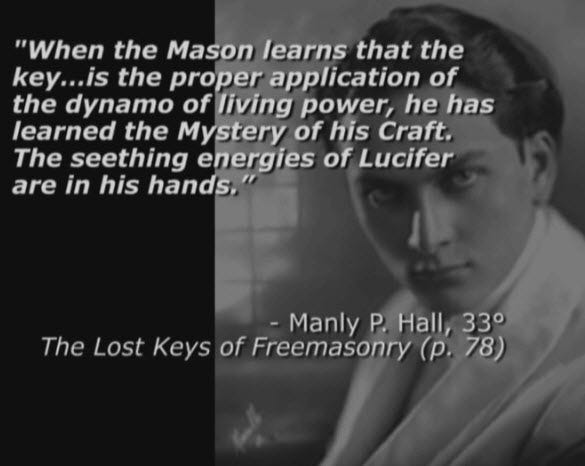
What fruits does the architect bear? You will know them by their deeds.
The next article examines what happened when the philosophy was taken out of the institutional framework and translated into a personal operational system — the work of the figure who did more than anyone else to make the Luciferian administrative project a practical toolkit for individuals seeking access to power outside institutional channels.
Aleister Crowley understood something Pike’s institutional framework made possible but didn’t quite capture: that the administrative project’s power doesn’t require organizational membership. It requires alignment. And alignment, in the occult tradition Crowley developed, can be achieved through direct personal practice — through ritual, through the will, through the deliberate cultivation of a relationship with the intelligences the tradition describes.
The operational methodology follows. And with it, the most direct expression of what it actually costs — and produces — to pursue access to power through the channels this arc is examining.
Eyes to see it.
The Arcane Blueprint — Series Roadmap
Article 1 — The Plan in Plain Sight: Blavatsky and Bailey [Published]
Article 2 — The Architect and the Doctrine [You are here]
Article 3 — The Operational Methodology: Crowley, Thelema, and the Translation of Philosophy into Practice
Article 4 — The Black Sun Thread: Vril, Von Braun, Disney, and the Space Age as Occult Project
Article 5 — The Military Psyops Layer: Aquino, the Temple of Set, and the Institutionalization of the Methodology
Article 6 — The Popularization Engine: LaVey, Cultural Programming, and the Normalization Layer
Article 7 — The Modern Administrative Layer: The Pandemic Operation and Administrator Recruitment in Practice
Article 8 — Silicon Valley, Technocratic Materialism, and the Final Expression
Article 9 — The Gnostic Departure and the Counter-Current
— Gerry
Gerry Gomez is an investigative journalist, creative director, and hybrid war correspondent who has spent a decade documenting the convergence of financial, media, and geopolitical forces shaping the current global transition.

Your Tax Free Donations Are Appreciated and Help Fund our Volunteer Website
Disclaimer: We at Prepare for Change (PFC) bring you information that is not offered by the mainstream news, and therefore may seem controversial. The opinions, views, statements, and/or information we present are not necessarily promoted, endorsed, espoused, or agreed to by Prepare for Change, its leadership Council, members, those who work with PFC, or those who read its content. However, they are hopefully provocative. Please use discernment! Use logical thinking, your own intuition and your own connection with Source, Spirit and Natural Laws to help you determine what is true and what is not. By sharing information and seeding dialogue, it is our goal to raise consciousness and awareness of higher truths to free us from enslavement of the matrix in this material realm.