EN
EN FR
FR

Michael Aquino, the Temple of Set, and the Institutionalization of the Methodology
The previous articles in this arc have traced the administrative project through its philosophical foundations, its institutional machinery, its personal operational toolkit, and its parallel expression in the esoteric interior of the Nazi project and the space age that followed. Each step has moved closer to the present. This article arrives at perhaps the most direct and most consequential expression of the arc’s central argument: the deliberate application of occult methodology to the systematic management of human consciousness, executed from inside the most powerful military institution in the world.

Michael Aquino was a Lieutenant Colonel in the United States Army, a specialist in psychological operations with a career spanning over two decades of active service. He was also the founder of the Temple of Set — the occult organization he created after leaving the Church of Satan in 1975 — and the author of MindWar, a document that proposed applying the principles of magical consciousness manipulation to military psychological operations at national and civilizational scale.
Those two identities were not separate in Aquino’s own understanding. He considered his occult practice and his military work as expressions of the same underlying project. The Temple of Set’s philosophy — the cultivation of individual consciousness through direct relationship with the entity Set, understood as a genuinely real non-human intelligence — informed his approach to psychological operations. And his understanding of psychological operations — how human consciousness is shaped, directed, and controlled through information and environment — informed his occult practice. The integration was deliberate and documented in his own published work
A Lieutenant Colonel in the United States Army and the founder of a Setian occult organization wrote a document proposing the application of consciousness manipulation to military psychological operations. He published it. He put his name on it. The document exists and can be read.
Michael Aquino: The Career and the Conviction
Michael Aquino was born in 1946 and joined the United States Army in 1968. His military specialization was psychological operations — the use of information, messaging, and environmental manipulation to influence the beliefs and behavior of target populations. He served in Vietnam and subsequently rose through the ranks of the Special Forces psychological operations community, eventually achieving the rank of Lieutenant Colonel before his retirement.
His involvement with the Church of Satan began in 1969, when he joined the organization founded by Anton LaVey. He rose to a senior position within it before breaking with LaVey in 1975 over what he described as a theological disagreement — specifically, whether the entity Satan was a genuine non-human intelligence or a symbol of human self-interest and materialism. LaVey held the latter position. Aquino held the former. The break produced the Temple of Set, which Aquino founded on the premise that Set — the Egyptian deity whose name the organization took — was a real entity whose direct relationship with human initiates was the foundation of genuine initiatory work
The Temple of Set positioned itself as a serious occult organization operating in the direct lineage of the Western esoteric tradition — drawing on Crowley’s Thelemic system, the Egyptian magical tradition, and the philosophical framework of the Left Hand Path. It attracted a membership that included military personnel, academics, and professionals, and it developed a degree system and curriculum with genuine intellectual rigor by the standards of the occult community. It continues to operate today.

SOURCE NOTE — Aquino’s military career is a matter of public record through Army personnel documentation. His founding of the Temple of Set and the break with LaVey are documented in his own published account and in multiple independent sources. His rank and specialization in psychological operations are confirmed through official military records. His published works including MindWar are available through academic and public domain sources.
The Temple of Set: Set as Real Entity
The theological distinction that drove the break between Aquino and LaVey is the most important element of this article for the arc’s purposes. LaVey’s Church of Satan was, at its philosophical core, atheistic — Satan as a symbol of human pride, materialism, and the rejection of supernaturalism. The entity LaVey celebrated was a human construct, a useful symbol for the philosophy of individual will and the rejection of external authority, but not a real being with independent existence.
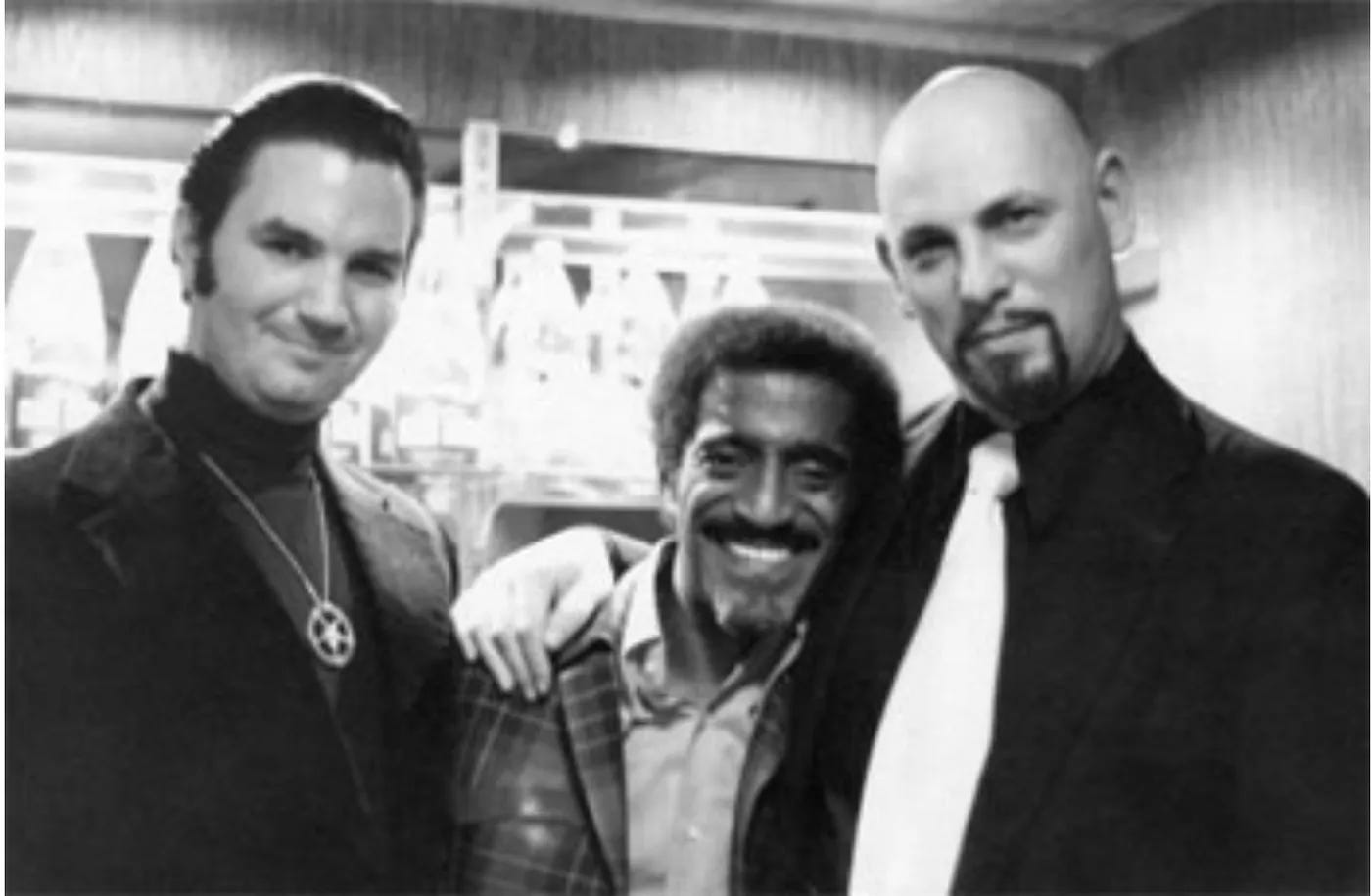
Aquino’s Temple of Set rejected that position entirely. In Aquino’s framework, Set is a genuinely real non-human intelligence — an entity that actually exists, that actually communicates with human initiates, and that is the legitimate source of the initiatory tradition’s authority and power. The contact claim, which this arc has traced from Blavatsky’s Masters through Crowley’s Aiwass through the Vril women’s channeling sessions, appears in the Temple of Set as its foundational theological premise. The organization exists to cultivate genuine relationship with a real non-human entity.
Set in the Egyptian tradition is a complex figure — the god of chaos, storms, and the desert, the slayer of Osiris, and simultaneously a protective deity of considerable power. In the Thelemic tradition Crowley drew from, Set is related to but distinct from the Satan figure of the Abrahamic traditions. Aquino’s identification of Set as the entity at the center of his initiatory system connects the Temple of Set directly to the Egyptian cosmological framework that runs through the arc from Article 1’s examination of Blavatsky through Article 3’s examination of Crowley’s Cairo working.

The entity profile is consistent across these independent encounters. Advanced beyond ordinary human capacity. Genuinely real as a distinct intelligence. Willing to communicate with and assist those who approach through the correct protocols. Positioned as a legitimate — in Aquino’s framework, the legitimate — source of the individual will’s authentic development. Whether that profile describes different encounters with the same entity, different entities in the same cosmological framework, or something else entirely is the question this arc holds open. What is consistent is the structural claim and the institutional consequences of building around it.
The Temple of Set’s foundational premise — that Set is a genuinely real non-human intelligence whose relationship with human initiates is the source of authentic individual development — places it squarely within the contact tradition this arc has been tracing. The entity profile is consistent. The institutional expression is the most militarily connected version of that tradition in the documented record.
MindWar: The Operational Synthesis
In 1980, Michael Aquino co-authored with Major General Paul Vallely a document titled From PSYOP to MindWar: The Psychology of Victory. The document was written as an internal Army paper and subsequently became public. It is one of the most direct expressions of the administrative project’s operational philosophy available in the documented record — not because it is an occult document in any obvious sense, but because it applies the principles of consciousness management to military psychological operations with a candor that the more carefully managed public discourse around these subjects consistently avoids.
MindWar’s central argument is that conventional psychological operations — the distribution of leaflets, radio broadcasts, messaging campaigns aimed at enemy populations — are insufficient and fundamentally misconceived. The reason, in Aquino and Vallely’s framing, is that these approaches work on the surface of consciousness rather than at its depths. They provide information and argument that the rational mind can evaluate and reject. What is needed instead is something that bypasses rational evaluation entirely — that operates directly on the deeper structures of consciousness where beliefs, motivations, and behavioral dispositions are actually formed.
The document proposes that MindWar — the term they coined to describe their alternative — should operate continuously, in peacetime as well as wartime, targeting not just enemy populations but the domestic population as well. It should use all available technologies — television, radio, and the emerging electronic media — to shape the psychological environment in which people live, think, and make decisions. The goal is not to persuade but to create the conditions in which specific beliefs and behaviors emerge as natural — as the population’s own authentic response to their environment rather than as the product of external manipulation.
The document explicitly references ELF — extremely low frequency — electromagnetic waves as a potential tool for direct neurological influence, and discusses the use of various technologies to affect human consciousness below the threshold of conscious awareness. Whether those specific technical proposals were ever implemented, and to what extent, is a question the classified record does not allow the public record to answer. What the document establishes beyond reasonable doubt is the intention: the systematic, continuous, technologically mediated manipulation of human consciousness at population scale, operating below the threshold of rational awareness.
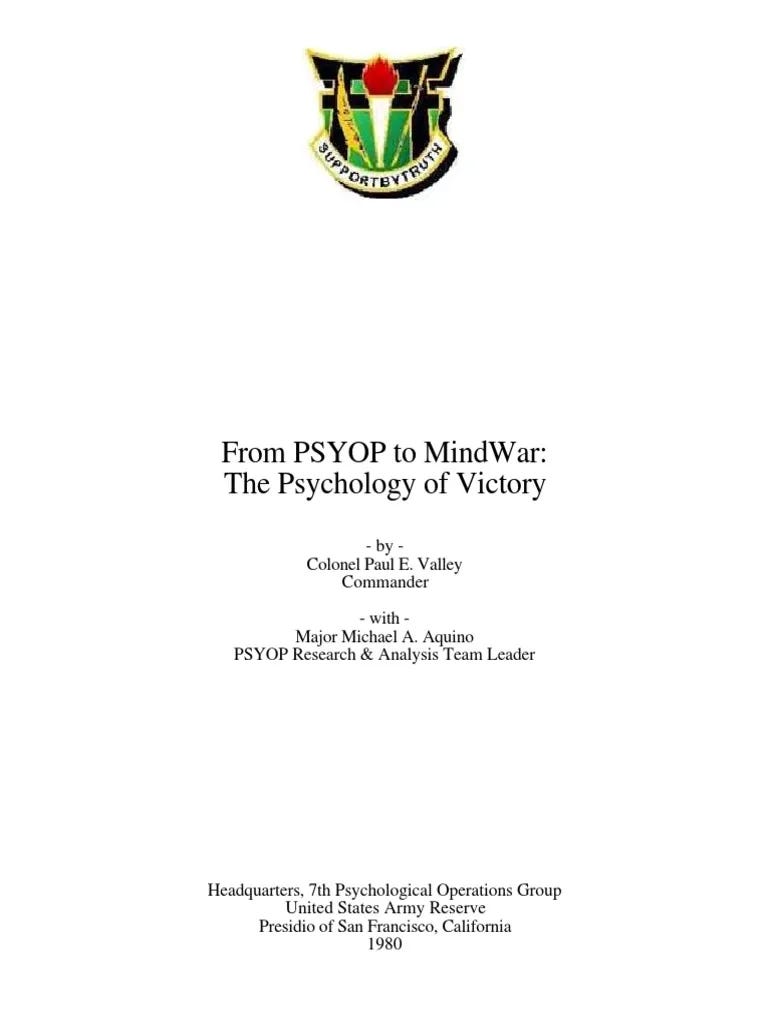
SOURCE NOTE — From PSYOP to MindWar: The Psychology of Victory is publicly available and has been widely reproduced in academic and research contexts. It was written by Aquino and Vallely in 1980 as an internal Army Special Warfare Center paper. Vallely went on to become a Major General. The document’s proposals regarding ELF and consciousness manipulation are in the text and can be read directly.
MindWar proposed the continuous, peacetime psychological manipulation of domestic populations using all available technologies, operating below the threshold of rational awareness, to produce desired beliefs and behaviors as apparently natural responses. It was written by a Lieutenant Colonel who ran an occult organization and a general who later became a prominent media figure. It was an Army document.
The Integration: Occult Methodology and Military Application
The significance of Aquino’s position is not that a military officer happened to have unusual personal beliefs. It is that the methodology developed across the occult tradition this arc has been tracing — the systematic cultivation of techniques for accessing and influencing consciousness beyond ordinary rational awareness — found its most institutionally powerful expression in the hands of someone whose professional specialty was the large-scale management of human consciousness for strategic purposes.

The through-line is precise. The esoteric tradition from Blavatsky through Crowley had been developing, for decades, sophisticated understanding of how human consciousness can be accessed below the level of rational awareness, what kinds of experiences and practices produce significant and lasting changes in belief and behavioral disposition, and what the relationship between individual consciousness and non-ordinary intelligences can produce when cultivated through systematic practice. That understanding — stripped of its cosmological framing and translated into the vocabulary of military psychology — is exactly what MindWar describes.
Aquino himself understood this integration explicitly. His occult work and his military work drew from the same theoretical foundation: the understanding that human consciousness is not a closed, self-contained rational system but a permeable field that can be influenced through environmental, informational, and energetic means that bypass ordinary conscious awareness. Whether the entity doing the influencing is the non-human intelligence of the Temple of Set tradition or the psychological operations apparatus of the United States Army — the basic model of how human consciousness works is the same.

That convergence is the most important thing this article can establish. The administrative project’s operational methodology and the national security state’s psychological operations infrastructure are not separate systems that happen to use similar techniques. They are, in the documented case of Aquino, literally the same person’s work — the same theoretical framework applied in different institutional contexts for purposes that, when examined through the barometer, point in the same direction: the management of human consciousness without human consent.
The Institutional Legacy: What Was Built and What Continues
The specific proposals in MindWar — the continuous peacetime psychological management of domestic populations, the use of electromagnetic technologies to influence consciousness below awareness — did not become official Army doctrine in any publicly documented form. What did become standard practice across the national security apparatus over the subsequent four decades bears a significant family resemblance to the framework MindWar articulated, whether or not MindWar was the direct source.
The social media platforms that shape the information environment of billions of people were developed with significant input from DARPA and the intelligence community. The algorithmic systems that determine what information people see are designed, at their operational core, to produce engagement — which means producing emotional responses that bypass rational evaluation and drive behavioral outcomes their designers intend. The documented programs of social media manipulation run by state actors — including the United States government’s own information operations programs — operate on exactly the principles MindWar described: shaping the psychological environment to produce desired beliefs and behaviors as apparently natural responses.

Whether this represents the direct institutional legacy of Aquino’s work or the independent convergence of similar understanding in different institutional contexts is a question that gets greatly disputed and protected in the public debate. What the available evidence establishes is the pattern: the theoretical framework for large-scale consciousness management without consent was articulated, published, and put into practice within a major national security institution by a figure who simultaneously operated within the occult tradition this arc has been tracing. The subsequent development of information technology has provided the implementation infrastructure that Aquino’s 1980 document could only gesture toward.
The barometer applied to this legacy asks the same question it always does. What does a system designed around the continuous management of human consciousness without that consciousness’s awareness or consent do to the people inside it? The answer, visible in the documented history of the information environment over the past four decades, is a population whose capacity for genuine discernment — whose ability to evaluate information and form authentic beliefs through their own rational and intuitive faculties — has been systematically compromised by the very infrastructure designed to inform them.
That is the stifling project at the institutional level. Not the fluoride in the water supply or the calcified pineal gland — though those are real and contribute to the spiritual and mental body orientation of individuals and we have examined them. The stifling project is a systematic management of the information environment to produce desired beliefs as apparently authentic personal conclusions. It is, in the vocabulary of the tradition Aquino drew from, the most successful magical operation in human history — and it has been running continuously, in peacetime, on domestic populations, for decades.
The most successful magical operation in human history may be the information environment itself — a system designed to produce desired beliefs as apparently authentic personal conclusions, operating continuously on domestic populations, built by institutions that drew on theoretical frameworks developed within the occult tradition this arc has been tracing.
What the Military Psyops Layer Tells Us
This article has stayed deliberately within the documented record. Aquino’s military career, his Temple of Set, his MindWar document — these are established facts available to anyone willing to look. The connections between the occult tradition’s theoretical framework and the national security state’s psychological operations methodology — these are visible in the primary texts without requiring any inference beyond what the documents themselves support.
What the documented record establishes is sufficient for the arc’s purposes. The administrative project’s operational methodology — developed across a century of esoteric tradition from Blavatsky through Crowley — found its most institutionally consequential expression in the hands of a military psychological operations specialist who brought it into the national security apparatus and articulated its application to mass consciousness management in a published document. The subsequent development of information technology has provided the tools that document could only anticipate.

The remaining articles of this arc examine the popularization layer that normalized this project’s philosophy for mass culture, its modern administrative expression in the pandemic operation and Silicon Valley’s AI development, and finally the counter-current — the gnostic departure and what genuine liberation from the administrative project’s management of consciousness actually looks like in practice.
The next article examines the figure who did more than anyone to make the Luciferian administrative project’s philosophy acceptable, even appealing, to the general population — and what his own final moments reveal about the gap between the project’s promises and its actual fruits.
Eyes to see it.
The Arcane Blueprint — Series Roadmap
Article 1 — The Plan in Plain Sight: Blavatsky and Bailey [Published]
Article 2 — The Architect and the Doctrine [Published]
Article 3 — The Operational Methodology: Crowley, Thelema, and the Translation of Philosophy into Practice [Published]
Article 4 — The Black Sun Thread: Vril, Von Braun, Disney, and the Space Age as Occult Project [Published]
Article 5 — The Military Psyops Layer: Aquino, the Temple of Set, and the Institutionalization of the Methodology [You are here]
Article 6 — The Popularization Engine: LaVey, Cultural Programming, and the Normalization Layer
Article 7 — The Modern Administrative Layer: The Pandemic Operation and Administrator Recruitment in Practice
Article 8 — Silicon Valley, Technocratic Materialism, and the Final Expression
Article 9 — The Gnostic Departure and the Counter-Current
— Gerry
Gerry Gomez is an investigative journalist, creative director, and hybrid war correspondent who has spent a decade documenting the convergence of financial, media, and geopolitical forces shaping the current global transition.

Your Tax Free Donations Are Appreciated and Help Fund our Volunteer Website
Disclaimer: We at Prepare for Change (PFC) bring you information that is not offered by the mainstream news, and therefore may seem controversial. The opinions, views, statements, and/or information we present are not necessarily promoted, endorsed, espoused, or agreed to by Prepare for Change, its leadership Council, members, those who work with PFC, or those who read its content. However, they are hopefully provocative. Please use discernment! Use logical thinking, your own intuition and your own connection with Source, Spirit and Natural Laws to help you determine what is true and what is not. By sharing information and seeding dialogue, it is our goal to raise consciousness and awareness of higher truths to free us from enslavement of the matrix in this material realm.