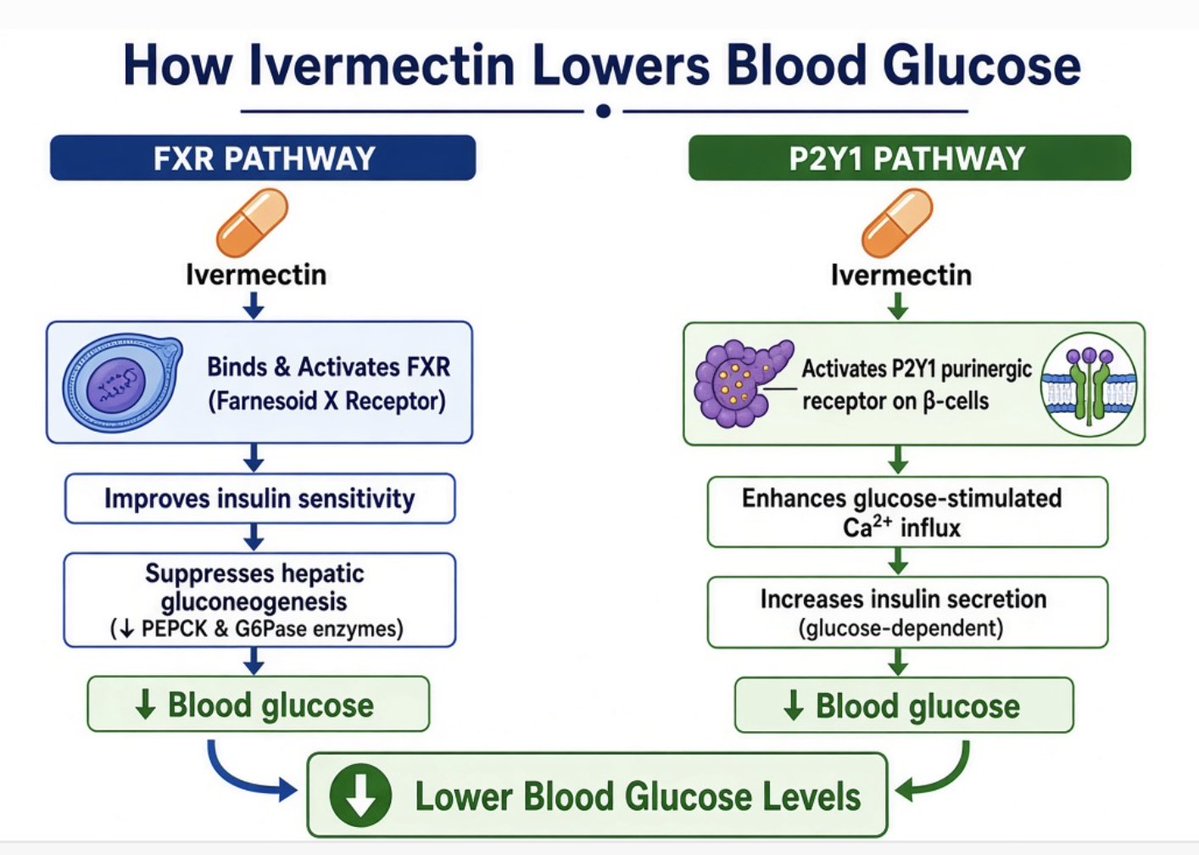
Except that longtime readers of this Substack were well aware of this most expected benefit of Ivermectin lowering blood glucose levels by acting as a direct agonist for the Farnesoid X Receptor (FXR) by suppressing hepatic gluconeogenesis and improving insulin sensitivity, leading to reduced serum glucose and cholesterol levels in diabetic mouse models.
We conclude that ivermectin is capable of regulating serum glucose and cholesterol levels by directly targeting FXR.
Wild-type (WT) and FXR−/− (knock-out (KO)) mice were fed with high-fat diet and i.p. injected with vehicle or ivermectin (1.3 mg kg−1) once a day for 14 days (n=6 per group for all data in this figure). The food intake were measured every second day. (a) Food intake. Kcal, kilocalories; BW, body weight. After 6 h of fasting, mice were weighed and the body weights were indicated as percentage (%) of the initial weight of mice (b). Serum was collected and the levels of serum glucose (c), insulin (d) and cholesterol (e) were determined. (f) Hepatic mRNA levels of metabolism-related genes were quantified by real-time PCR and normalized to actin. Values are the means±s.e.m. of six independent experiments. *P<0.05, **P<0.01 versus vehicle, Student’s t-test.
…Together, our results suggest that ivermectin as a novel FXR ligand may possess advantages over GW4064 in regulating glucose homeostasis.
Circadian disruption is widespread in our modern 24/7 society, leading to an increased prevalence of common diseases including type 2 diabetes. The authors conducted an unbiased screen for small-molecule compounds that can restore the attenuated insulin secretion from pancreatic β-cells caused by a disrupted circadian clock. They identified ivermectin and its clock-controlled target, the P2Y1 receptor, which regulate glucose-stimulated ca2+ influx and insulin secretion in β-cells. This discovery represents an important advance in our understanding of regulatory mechanisms of insulin secretion by cell-autonomous clocks in mouse and human β-cells and is of fundamental clinical importance in context of novel therapeutic targets for diabetes management.
Cancer cells are highly dependent on aerobic glycolysis — this is known as the Warburg effect: •Even in the presence of oxygen, they prefer to burn glucose for energy via glycolysis. •This produces lactic acid and fuels rapid cell growth.
To support this, cancer cells often overexpress glucose transporters (especially GLUT1) and have heightened glucose uptake.
Inhibits Microtubules •Fenbendazole binds β-tubulin, disrupting microtubule formation. •Microtubules are essential for: •Cell division •Intracellular transport — including moving glucose transporters to the cell membrane. •Result: GLUT1 transporters fail to reach the cell surface → glucose cannot enter the cancer cell efficiently.
Suppresses Glucose Uptake •Without access to glucose, the cancer cell experiences metabolic stress. •Deprived of fuel, it becomes more vulnerable to: •Apoptosis •Cell cycle arrest •AMPK activation
Disrupts Glycolysis Pathways •Fenbendazole also interferes with hexokinase, the first enzyme in glycolysis that phosphorylates glucose. •This further blocks energy production from sugar. •Cancer cells, which are inflexible and addicted to glucose, are hit hard.
While you may not be dealing with cancer this shows the mechanism of Fenbendazole and it’s ability to impact glucose
Ivermectin, a medication traditionally used to treat parasitic infections, has recently gained attention for its potential effects beyond its original purpose, particularly in diabetes management and metabolic processes. Understanding these connections could significantly impact diabetes treatment strategies.
Mechanisms Of Action
Ivermectin’s influence on metabolic processes, especially in diabetes, is a growing area of interest. At the molecular level, Ivermectin binds to specific ion channels, disrupting neurotransmission in parasitic organisms. Its implications in mammalian systems, particularly metabolic pathways, require further exploration.
Recent studies indicate Ivermectin may affect metabolic pathways by modulating nuclear receptors like the farnesoid X receptor (FXR), which is crucial in bile acid regulation, lipid metabolism, and glucose homeostasis. By modulating FXR activity, ivermectin might alter the expression of genes involved in glucose and lipid metabolism, influencing overall metabolic health.
The modulation of FXR by Ivermectin could impact insulin sensitivity and glucose uptake, affecting blood sugar regulation, a critical aspect of diabetes management. Preliminary in vitro studies suggest ivermectin alters gene expression related to glucose metabolism, indicating potential therapeutic avenues.
Farnesoid X Receptor And Metabolic Factors
The farnesoid X receptor (FXR) is integral in maintaining metabolic balance, primarily by regulating bile acid synthesis and transport, significantly influencing lipid and glucose metabolism. FXR activation impacts gene expression vital for energy homeostasis, making it crucial in studying metabolic disorders like diabetes.
Emerging evidence suggests FXR activation enhances insulin sensitivity and promotes glucose homeostasis by modulating genes involved in glucose and lipid metabolism. Studies show FXR agonists decrease hepatic glucose production, beneficial for type 2 diabetes management.
Ivermectin’s interaction with FXR introduces a potential mechanism for addressing metabolic dysregulation in diabetes. By influencing FXR activity, ivermectin could modulate metabolic pathways governing glucose and lipid metabolism, offering a novel therapeutic approach. While the precise nature of ivermectin’s influence on FXR is still being studied, initial findings are promising.
Effects In Animal Models
Research into ivermectin’s impact on metabolic processes in animal models offers intriguing insights. Rodent studies, particularly in mice and rats, have been instrumental in uncovering ivermectin’s effects on glucose regulation and insulin sensitivity, providing a clearer picture of its potential therapeutic applications.
In one study, ivermectin was administered to mice with metabolic syndrome, showing improved insulin sensitivity and reduced fasting glucose levels compared to control groups. These outcomes suggest ivermectin may benefit glucose homeostasis through its interaction with insulin signaling pathways.
Rat models further support these findings. In experiments where rats were fed a high-fat diet, ivermectin administration led to reduced body weight and improved lipid profiles, accompanied by enhanced glucose tolerance. These results highlight ivermectin’s potential as a modulator of metabolic health in conditions predisposing individuals to diabetes.
Observed Changes In Glucose Regulation
The exploration of ivermectin’s impact on glucose regulation reveals a potential role for this antiparasitic drug in metabolic health. Initial findings indicate ivermectin modulates pathways involved in glucose uptake and insulin sensitivity, key factors in maintaining glucose homeostasis.
Notably, in vitro experiments show an increase in glucose uptake in muscle cells exposed to ivermectin, suggesting enhanced cellular glucose absorption and reduced blood sugar levels. This aligns with diabetes treatment goals of improving cellular glucose utilization.
Animal studies bolster these findings, with ivermectin-treated models showing improved glucose tolerance characterized by more efficient glucose response and faster return to baseline levels. These consistent effects indicate ivermectin could benefit individuals with impaired glucose metabolism.
Interplay With Insulin Pathways
The connection between ivermectin and insulin pathways suggests a potential role in metabolic regulation. Insulin is crucial for managing blood glucose levels and regulating metabolism. Disruptions in insulin signaling are central to diabetes, particularly type 2, where insulin resistance leads to elevated blood sugar levels.
Research suggests ivermectin might enhance insulin signaling by improving phosphorylation of insulin receptor substrates, crucial for propagating insulin signals within cells. This could lead to improved activation of pathways like PI3K/Akt, vital for glucose uptake and metabolism, potentially improving insulin sensitivity.
There is speculation about ivermectin’s role in influencing insulin secretion from pancreatic beta cells. While direct evidence is limited, some hypothesize ivermectin might enhance these cells’ function, improving insulin release in response to glucose. This could benefit individuals with impaired insulin secretion, highlighting ivermectin’s multifaceted role in metabolic regulation. Further research is necessary to fully understand these mechanisms and their therapeutic implications.
Tocotrienol and Tocopherol forms (all 8) of Vitamin E (400-800mg per day, 7 days a week). A product called Gamma E by Life Extension or Perfect E are both great.
Bio-Available Curcumin (600mg per day, 2 pills per day 7 days a week). A product called Theracurmin HP by Integrative Therapeutics is bioavailable.
Fenbendazole (450mg, 7 days a week) or in the case of severe turbo cancers up to 1 gram — for MEGADOSE 1,350mg-2,000mg/day — for prophylaxis one 150mg tablet once or twice per week
Ivermectin (24mg, 7 days a week) or in the case of severe turbo cancers up to 1mg/kg/day — for MEGADOSE 120mg-200mg/day — for prophylaxis one 12mg tablet once or twice per week
Hydroxychloroquine (10mg/kg/day 7 days a week) – for prophylaxis one 200mg tablet once or twice per week
ImmunX immune support which also greatly increases the bioavailability of both FenbendazoleandHydroxychloroquine (2 capsules per day) —for prophylaxis 2 capsules per day
Removing sugars and carbohydrates (cancer food) from your diet and replacing table sugar with a zero glycemic index, zero calorie, keto friendly rare sugar like AlluX
Your Tax Free Donations Are Appreciated and Help Fund our Volunteer Website
Disclaimer: We at Prepare for Change (PFC) bring you information that is not offered by the mainstream news, and therefore may seem controversial. The opinions, views, statements, and/or information we present are not necessarily promoted, endorsed, espoused, or agreed to by Prepare for Change, its leadership Council, members, those who work with PFC, or those who read its content. However, they are hopefully provocative. Please use discernment! Use logical
thinking, your own intuition and your own connection with Source, Spirit and Natural Laws to help you determine what is true and what is not. By sharing information and seeding dialogue, it is our goal to raise consciousness and awareness of higher truths to free us from enslavement of the matrix in this material realm.
I'm glad you posted this. I had a conversation with my doctor on alternative treatments, including diet, exercise, and some of the oldest and preapproved medications. He gave me a line about it only being tested on animals. Why the heck would you test on animals if you did not anticipate a similar reaction in humans? I really wonder about the education our "physicians" receive. It certainly does not include logic!
Cookies
To make this site work properly, we sometimes place small data files called cookies on your device. Most big websites do this too.
Accept
Change Settings
Cookie Box Settings
Cookie Box Settings
Privacy settings
Decide which cookies you want to allow.You can change these settings at any time. However, this can result in some functions no longer being available. For information on deleting the cookies, please consult your browser’s help function.Learn more about the cookies we use.
With the slider, you can enable or disable different types of cookies:
This website will:
Remember which cookies group you accepted
This website won't:
Remember your login details
Essential: Remember your cookie permission setting
Essential: Allow session cookies
Essential: Gather information you input into a contact forms newsletter and other forms across all pages
Essential: Keep track of what you input in a shopping cart
Essential: Authenticate that you are logged into your user account
Essential: Remember language version you selected
Functionality: Remember social media settings
Functionality: Remember selected region and country
Analytics: Keep track of your visited pages and interaction taken
Analytics: Keep track about your location and region based on your IP number
Analytics: Keep track of the time spent on each page
Analytics: Increase the data quality of the statistics functions
Advertising: Tailor information and advertising to your interests based on e.g. the content you have visited before. (Currently we do not use targeting or targeting cookies.
Advertising: Gather personally identifiable information such as name and location
This website will:
Essential: Remember your cookie permission setting
Essential: Allow session cookies
Essential: Gather information you input into a contact forms, newsletter and other forms across all pages
Essential: Keep track of what you input in a shopping cart
Essential: Authenticate that you are logged into your user account
Essential: Remember language version you selected
This website won't:
Remember your login details
Functionality: Remember social media settings
Functionality: Remember selected region and country
Analytics: Keep track of your visited pages and interaction taken
Analytics: Keep track about your location and region based on your IP number
Analytics: Keep track of the time spent on each page
Analytics: Increase the data quality of the statistics functions
Advertising: Tailor information and advertising to your interests based on e.g. the content you have visited before. (Currently we do not use targeting or targeting cookies.
Advertising: Gather personally identifiable information such as name and location
This website will:
Essential: Remember your cookie permission setting
Essential: Allow session cookies
Essential: Gather information you input into a contact forms, newsletter and other forms across all pages
Essential: Keep track of what you input in a shopping cart
Essential: Authenticate that you are logged into your user account
Essential: Remember language version you selected
Functionality: Remember social media settings
Functionality: Remember selected region and country
This website won't:
Remember your login details
Analytics: Keep track of your visited pages and interaction taken
Analytics: Keep track about your location and region based on your IP number
Analytics: Keep track of the time spent on each page
Analytics: Increase the data quality of the statistics functions
Advertising: Tailor information and advertising to your interests based on e.g. the content you have visited before. (Currently we do not use targeting or targeting cookies.
Advertising: Gather personally identifiable information such as name and location
This website will:
Essential: Remember your cookie permission setting
Essential: Allow session cookies
Essential: Gather information you input into a contact forms, newsletter and other forms across all pages
Essential: Keep track of what you input in a shopping cart
Essential: Authenticate that you are logged into your user account
Essential: Remember language version you selected
Functionality: Remember social media settingsl Functionality: Remember selected region and country
Analytics: Keep track of your visited pages and interaction taken
Analytics: Keep track about your location and region based on your IP number
Analytics: Keep track of the time spent on each page
Analytics: Increase the data quality of the statistics functions
This website won't:
Remember your login details
Advertising: Use information for tailored advertising with third parties
Advertising: Allow you to connect to social sites
Advertising: Identify device you are using
Advertising: Gather personally identifiable information such as name and location
This website will:
Essential: Remember your cookie permission setting
Essential: Allow session cookies
Essential: Gather information you input into a contact forms, newsletter and other forms across all pages
Essential: Keep track of what you input in a shopping cart
Essential: Authenticate that you are logged into your user account
Essential: Remember language version you selected
Functionality: Remember social media settingsl Functionality: Remember selected region and country
Analytics: Keep track of your visited pages and interaction taken
Analytics: Keep track about your location and region based on your IP number
Analytics: Keep track of the time spent on each page
Analytics: Increase the data quality of the statistics functions
Advertising: Use information for tailored advertising with third parties
Advertising: Allow you to connect to social sitesl Advertising: Identify device you are using
Advertising: Gather personally identifiable information such as name and location
 EN
EN FR
FR





























I'm glad you posted this. I had a conversation with my doctor on alternative treatments, including diet, exercise, and some of the oldest and preapproved medications. He gave me a line about it only being tested on animals. Why the heck would you test on animals if you did not anticipate a similar reaction in humans? I really wonder about the education our "physicians" receive. It certainly does not include logic!