EN
EN FR
FR

Higher knowledge is not immunity. If the laws are truly universal, the beings above us answer to them too — and that changes everything about the story of control.
Four articles into this arc, a hard question has been waiting. We have described beings who are further along than humanity: fourth-density societies, energy beings who take human form, intelligences who know the rules far better than we do. Some of them, by this tradition’s account, have used that knowledge to build a control system over us.
So do the laws apply to them? Or is universal law just a set of rules for the students, with the teachers exempt?
This article takes up the two laws that answer that question: the Law of Cause and Effect, and its twin, the Law of Compensation. [Assessed] If they are truly universal — and the whole tradition says they are — then no being anywhere on the ladder escapes the consequences of what it does. That may be the most reassuring idea in this entire series.
Two Laws, One Principle
[Documented] The Law of Cause and Effect holds that every action produces a consequence, and every consequence has a cause. Its most famous name is karma, a Sanskrit word that simply means “action.” In Hindu and Buddhist thought, karma is not punishment handed down by a judge. It is the natural result of what a being does, carried forward until it is balanced.
The Law of Compensation is the same principle seen from the receiving end: you reap what you sow. [Documented] The phrase itself comes from Paul’s letter to the Galatians (6:7), but the idea appears in nearly every spiritual tradition on Earth. What you put into the world, in effort, kindness, deception, or harm, returns to you in kind.
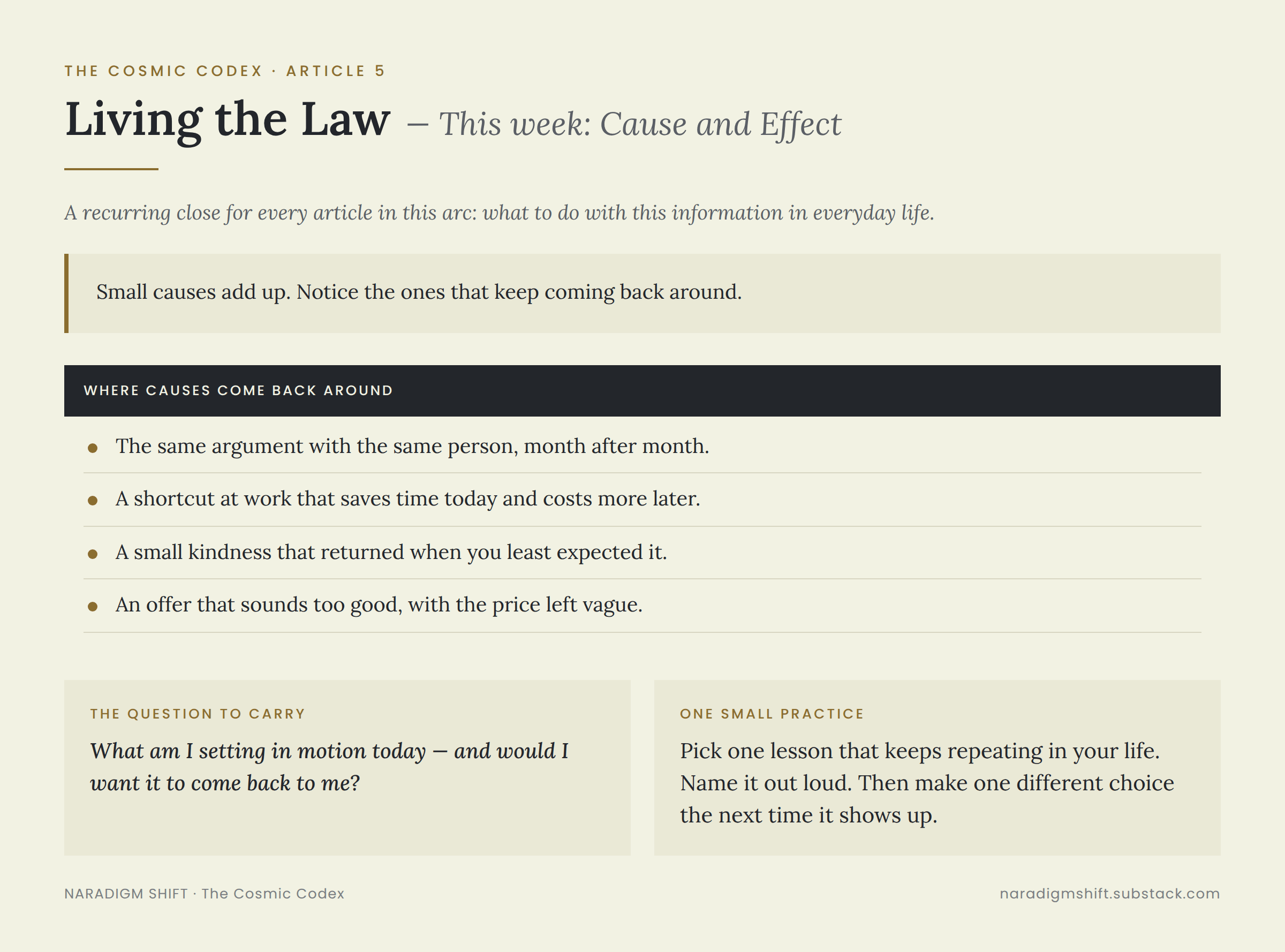
[Oral Tradition] In the first article, I shared a teaching I have heard many times: you get three opportunities at the big lessons, and once you know a lesson, you are choosing consciously whether to live by it. That is cause and effect working as a teacher, not a punisher. A lesson that goes unlearned comes back around, again and again, until it is chosen.
The School of Duality
This is the primary reason Earth is so often called a school for learning duality.
[Oral Tradition] In this tradition, third density is built for learning by consequence. You act, and the result comes back to you, close enough in time and form that you can connect the two. Touch the stove, feel the burn. Betray a friend, lose the friendship. Offer kindness, watch it return. Light and dark are not abstractions here. They are lived, felt, and paid for in a body.
And crucially, it is a forgiving school. Mistakes here are recoverable. A broken heart heals. A body bruised in play mends. A friendship lost can sometimes be won back. [Oral Tradition] And in the tradition’s larger view, even a whole lifetime that goes badly is not the end: reincarnation offers another term, another attempt, another chance to choose. The consequences are real, but they are scaled for students. They teach rather than destroy.
[Assessed] That is what makes the physical world such an effective classroom. Cause and effect run fast and visible, and the cost of failure is survivable. You can try, fall, and try again.
The Nostalgia of the Gods
If there are higher levels of perception, it stands to reason that beings from elsewhere might look at physical life the way an adult looks back on their halcyon days.
There is an old line, usually credited to George Bernard Shaw though never traced to his writing, that youth is wasted on the young. The point is a familiar one. When you are young, you are busy having the experiences and making the memories, often without realizing how good you have it. You are physically fit and in your prime. You can play hard, dance all night, fall and get up, date and get your heart broken, and your body and spirit snap back quickly. Later in life, those are the days we try to recapture.
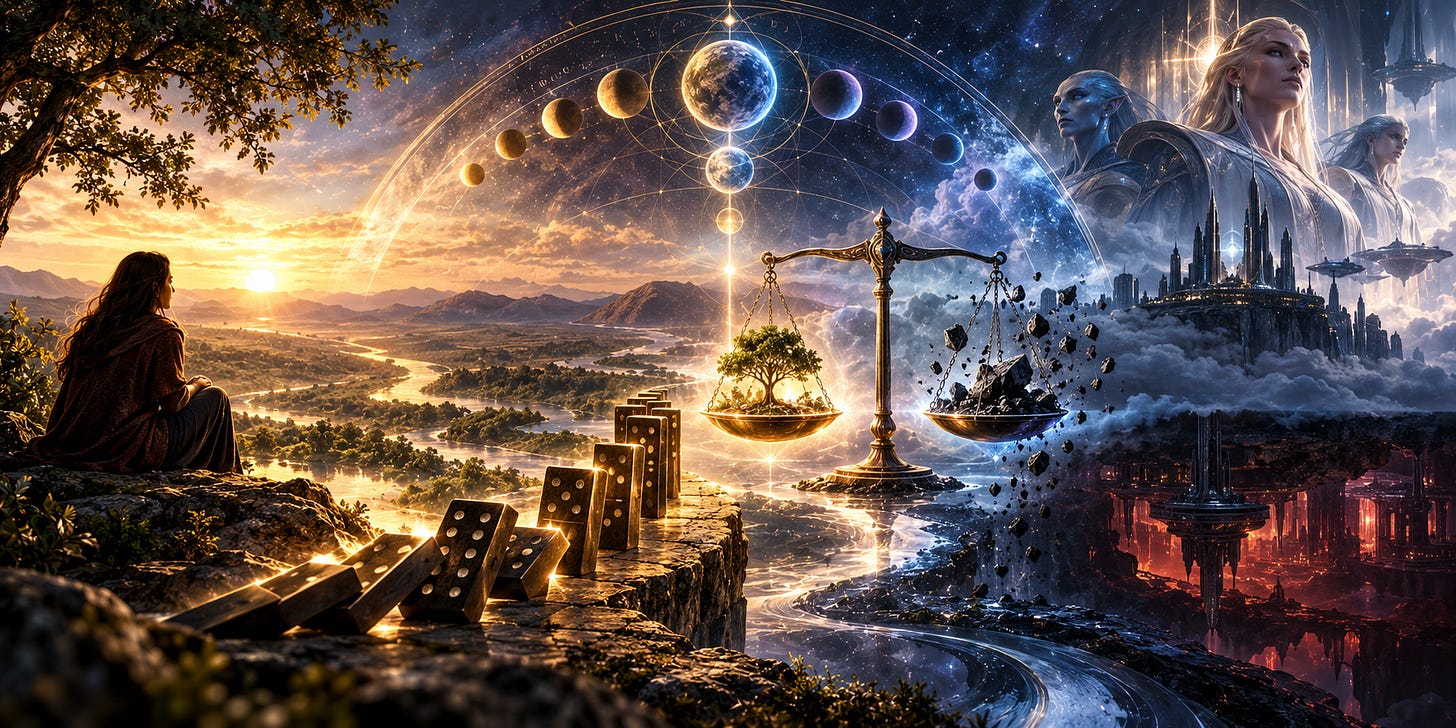
[Working hypothesis] Now imagine beings who have been removed from that kind of experience for a very long time. Beings who no longer have bodies that ache and heal, who no longer feel the rush of the flesh, and who no longer live in a world where consequences are close, physical, and forgivable. It may be that some of them long to feel those things again — the way an older person might give a great deal for one more summer at twenty.
That would help explain several threads in this arc. It would explain why higher beings are described as slowing themselves down to take physical form. And it would explain why Earth, with its intensity of sensation and its forgiving consequences, might be valued across the cosmos as more than a classroom.
This is one theory. But it has a clear human equivalent, and that makes it worth holding.
Q Gets What He Deserves
Star Trek once again offers the clearest picture.
[Documented] In Star Trek: The Next Generation, Q is a nearly omnipotent being who can bend time, space, and matter with a snap of his fingers. In the very first episode, “Encounter at Farpoint” (1987), he puts humanity itself on trial for being a savage, childlike race. For years afterward, he treats the Enterprise crew as his playthings.
Then comes “Déjà Q” (1990). Q appears on the bridge naked, stripped of every power by his own people, the Q Continuum, as punishment for the chaos he has caused across the universe. He is sentenced to live as a mortal, and he chooses a human body. The god who once mocked humanity suddenly has to eat. He has to sleep. His back hurts. He feels fear for the first time.
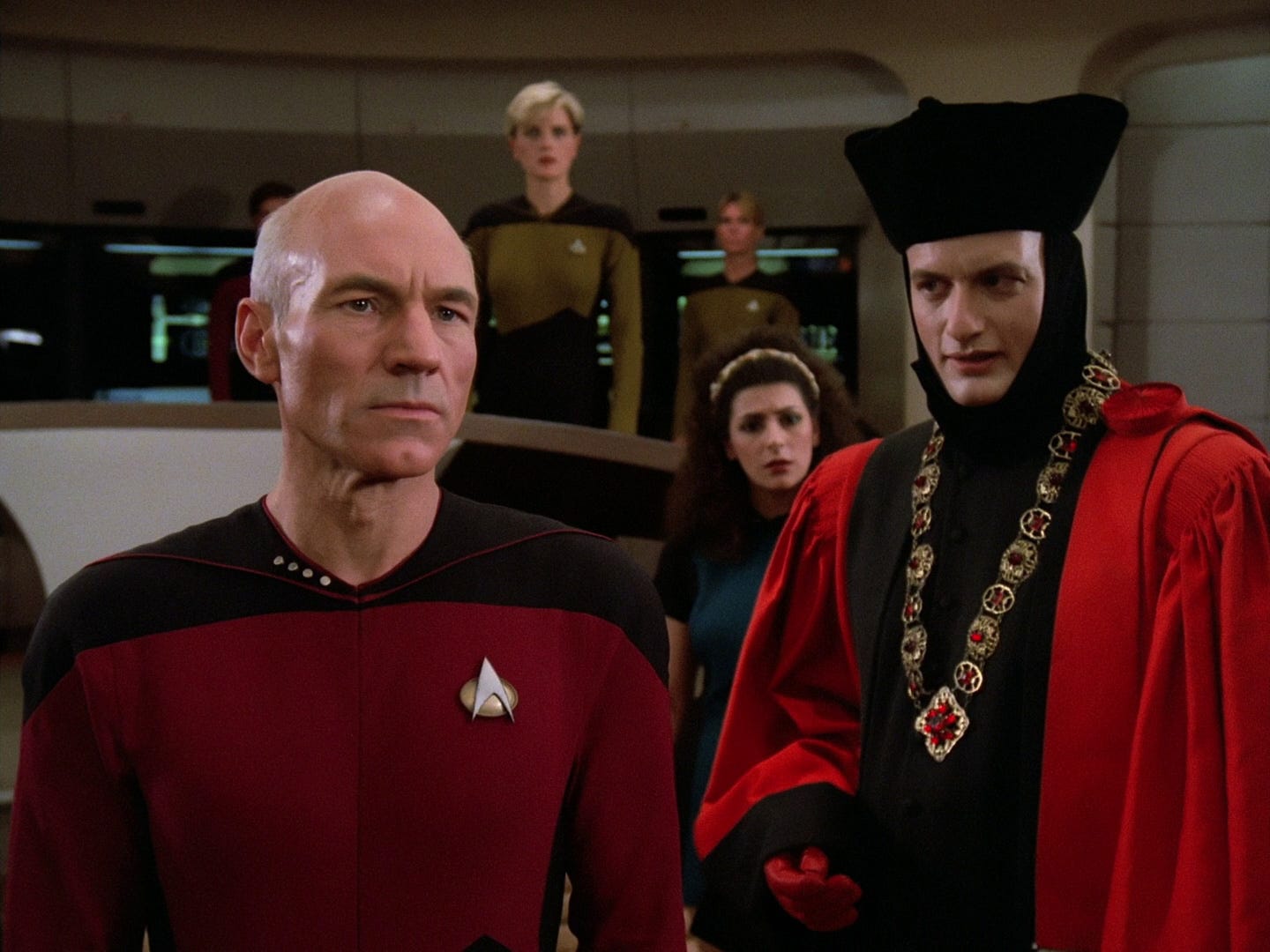
And the consequences of his past start arriving. A race of energy beings called the Calamarain, whom Q had tormented in his days of power, comes for revenge now that he cannot defend himself. Q’s cruelty, sown over eons, is finally reaped.
The turn comes when Q, rather than let the crew die defending him, takes a shuttle and flies out to meet the Calamarain alone, sacrificing himself so the Enterprise can escape. That single selfless act is what changes his fate. Another member of the Continuum appears and restores his powers, explaining that Q has, for once, done something unselfish.
[Assessed] It is all here in one episode. A higher being bound by a higher law. Cause and effect catching up with a god. The experience of physical life, with all its hunger and pain, as the classroom. And compensation working in both directions: the harm Q did came back to him, and so did the one good thing he chose to do. Even the most powerful being in that universe answered to something above him.
Karma Does Not Stop at the Atmosphere
Bring the lesson back to the real question. If the laws bind Q, they bind the beings described in the Arcane Blueprint.
[Assessed] A fourth-density being that deceives, harvests, or manipulates humanity does not escape consequence by being more advanced. It incurs debt, just as a human would. Higher knowledge buys a being more power and more reach. It does not buy an exemption. In this tradition’s view, the more a being knows, the more responsible it is for what it does with that knowledge.
[Oral Tradition] The Ra material describes a structural asymmetry built into the harvest itself. To graduate on the positive path, a being needs to be oriented toward serving others just over half the time — Ra puts it at 51 percent. To graduate on the negative path, a being must be oriented toward serving itself almost totally: 95 percent. The path of love has a far wider gate. The path of control demands near-perfect discipline in selfishness, and any slip toward compassion breaks it.
[Assessed] This is why the control system, however powerful it looks, is temporary. It is built by beings who are running up a debt they will one day pay, and it depends on a level of total polarization that is very hard to sustain. Meanwhile, every act of genuine service by a human being moves the balance the other way. The math is on the side of love.
Every Offer Has a Price
The Law of Compensation closes a thread left open in Article 4.
[Assessed] That article described the consent loophole: wishes and silence that open doors to beings who cannot simply take. Compensation explains why those doors are so costly. Nothing in the universe is free. Every offer of power, wealth, fame, or rescue carries a price, and when the offer comes from a being working the edges of the law, the price is usually hidden in the fine print. The deal-with-the-devil stories are, at their core, stories about compensation coming due.
This gives every person a simple test for any offer that seems too good. What will this cost, and who sets the price? If the answer is unclear, that is the answer.
But compensation works in the other direction too, and that is the part most often forgotten. [Oral Tradition] Service returns. Kindness returns. Honest effort returns. Not always quickly, and not always from the person you helped, but the tradition holds that what is given in love comes back in kind — the way Q’s one selfless act returned to him as everything he had lost.
No One Is Above the Law
The question this arc keeps returning to is how humanity protects itself in contact with beings who know the rules better than we do. This article adds a piece of the answer that is easy to miss: they are bound by the rules too.
That does not make every encounter safe. A being running up karmic debt can still do real harm in the meantime, which is why the earlier laws — vibration, non-interference, informed consent — matter so much. But it does mean the story does not end with the powerful winning simply because they are powerful. Every cause has its effect. Every debt comes due. And every act of love, however small, is counted too.
We are students in a forgiving school, in bodies that some beings may envy, learning lessons that will follow us wherever we go next. That is not a small thing. It may be the very thing the others came here to remember.
Next in the series: Two Sides of One Coin — the Law of Polarity, service to others and service to self, and why both can speak the language of light.
Whatever the question, love is the answer. You have to believe it to see it.
Sources
- Galatians 6:7
- Quote attributed to George Bernard Shaw; no primary source located
- Star Trek: The Next Generation, “Encounter at Farpoint,” 1987
- Star Trek: The Next Generation, “Déjà Q,” 1990
- The Ra material (The Law of One), L/L Research sessions, 1981–84
- Naradigm Shift: The Cosmic Codex, Articles 1–4; Arcane Blueprint
— Gerry
Gerry Gomez is an investigative journalist, creative director, and hybrid war correspondent who has spent a decade documenting the convergence of financial, media, and geopolitical forces shaping the current global transition.

Your Tax Free Donations Are Appreciated and Help Fund our Volunteer Website
Disclaimer: We at Prepare for Change (PFC) bring you information that is not offered by the mainstream news, and therefore may seem controversial. The opinions, views, statements, and/or information we present are not necessarily promoted, endorsed, espoused, or agreed to by Prepare for Change, its leadership Council, members, those who work with PFC, or those who read its content. However, they are hopefully provocative. Please use discernment! Use logical thinking, your own intuition and your own connection with Source, Spirit and Natural Laws to help you determine what is true and what is not. By sharing information and seeding dialogue, it is our goal to raise consciousness and awareness of higher truths to free us from enslavement of the matrix in this material realm.