EN
EN FR
FR


The Fourth Turning: Are We Breaking the Cycle?
Rev. Kat Carroll
About a 2-4 minute read
History has a peculiar habit of repeating itself. Empires rise and fall, civilizations flourish and collapse, and generations inherit problems that their ancestors either created or failed to resolve.
But what if humanity could recognize those patterns before history repeated itself? Could we consciously change the outcome?
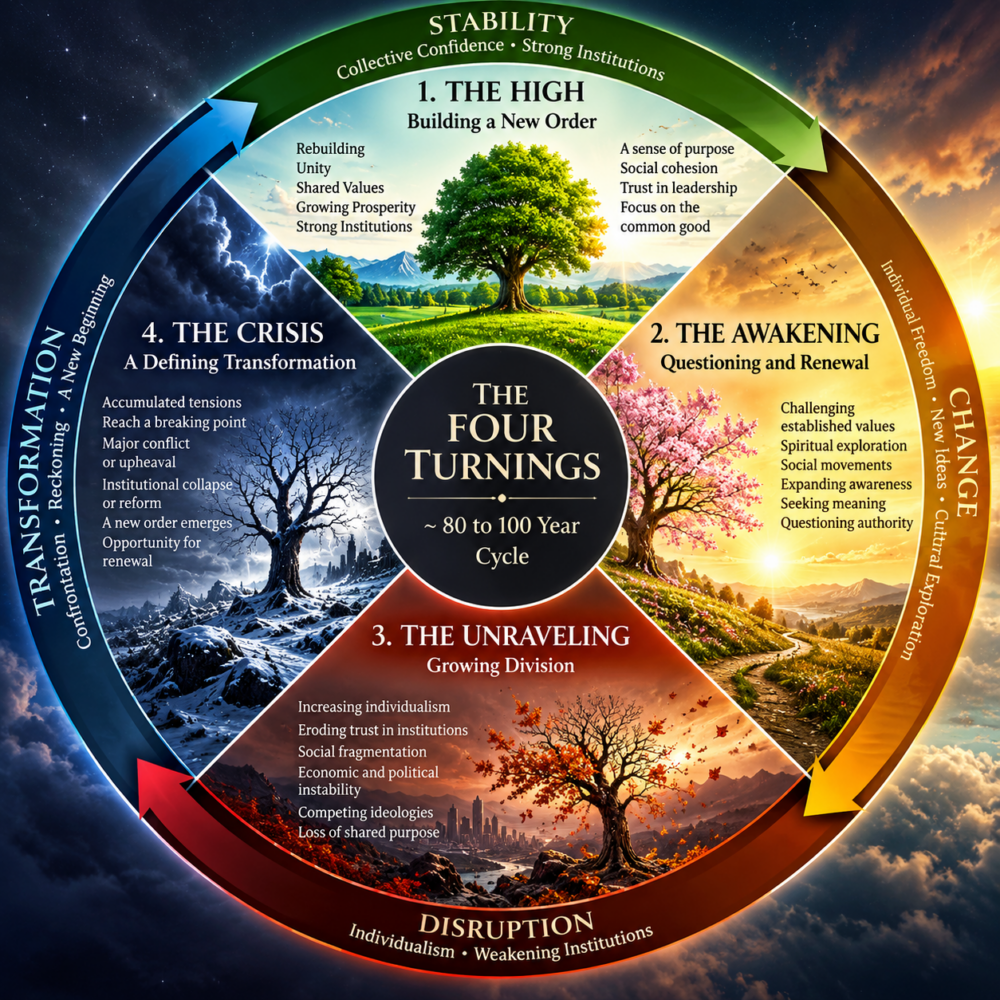
In their 1997 book The Fourth Turning, historians William Strauss and Neil Howe proposed that history moves through recurring generational cycles, each lasting approximately 80 to 100 years—roughly the span of a long human life.
Within each cycle are four distinct periods, which they called turnings.
The first, the High, represents a period of rebuilding, collective confidence, and strong institutions following a major crisis.
The second, the Awakening, emerges when people begin questioning established values and institutions, seeking greater individual freedom, meaning, and spiritual understanding.
The third, the Unraveling, brings increasing individualism, weakening institutional trust, and growing social divisions.
Finally comes the Crisis, when accumulated tensions reach a breaking point, forcing society to confront problems that can no longer be ignored.
According to the theory, the United States entered its current Fourth Turning with the financial crisis of 2008, followed by the H1N1 swine flu pandemic in 2009. But must every crisis culminate in war, economic collapse, or catastrophe? Could the upheavals we’ve already experienced represent part of the transformation?
Consider the pandemics, the expansion of emergency government powers, widespread social isolation, growing institutional distrust, and increasingly polarized societies.
Were these merely extraordinary events, or did they expose weaknesses in systems that had been accumulating for generations?
And what emerged from those experiences?
For some, isolation became an opportunity for reflection, meditation, prayer, independent research, and a reassessment of long-held beliefs. Others began asking difficult questions about authority, individual sovereignty, freedom of thought, and access to information.
Perhaps the most important question isn’t whether we’re living through another Fourth Turning. It’s whether humanity has become sufficiently aware of these repeating patterns to change the outcome this time.
Recognizing the Patterns of History
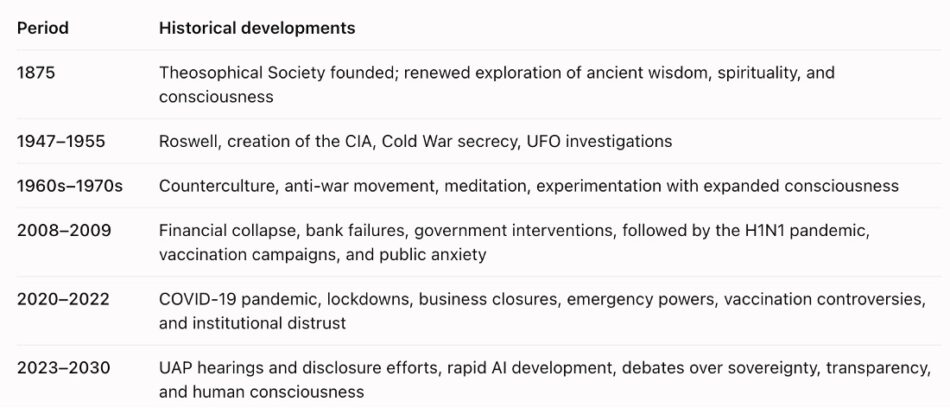
The 80-year cycles are approximate and there is generally more than one event taking place at about the same time. However, some events are larger in our memory.
Let’s examine some of those patterns:
I was born just eleven years after Roswell, during the Cold War, which wouldn’t end until 1991. Those of us from that era witnessed decades of political turmoil, social unrest, and uncertainty before many of those tensions began to ease. Yet, despite the turmoil, everyday life often felt simpler and safer, depending on where you lived. We rode our bikes after dark, left doors unlocked, and drank from garden hoses without giving it a second thought.
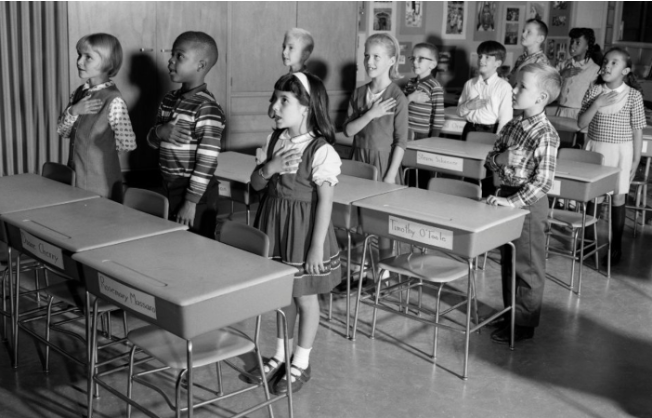 A strong sense of loyalty was forming. It was normal to pledge allegiance to the flag each morning in class. We watched the news coverage of astronauts in space and taking their first steps on the moon. It was an exciting time of growth and exploration.
What a strange dichotomy! We lived with the threat of nuclear war hanging over our heads, yet witnessed extraordinary achievements in science, exploration, and everyday life. Fear and optimism existed side by side, even during what Strauss and Howe called the High.
But as the Cold War continued, the assassination of President Kennedy and the Vietnam War began shaking that confidence. As government and powerful institutions increasingly influenced people’s freedoms, choices, and futures, many young people began questioning that authority and pushing back against a system they believed no longer represented their interests.
The counterculture movement of the 1960s became a visible expression of that discontent. San Francisco’s 1967 Summer of Love, followed by Woodstock in 1969, brought people together through music, anti-war demonstrations, spiritual exploration, and experimentation with alternative lifestyles and expanded states of consciousness.
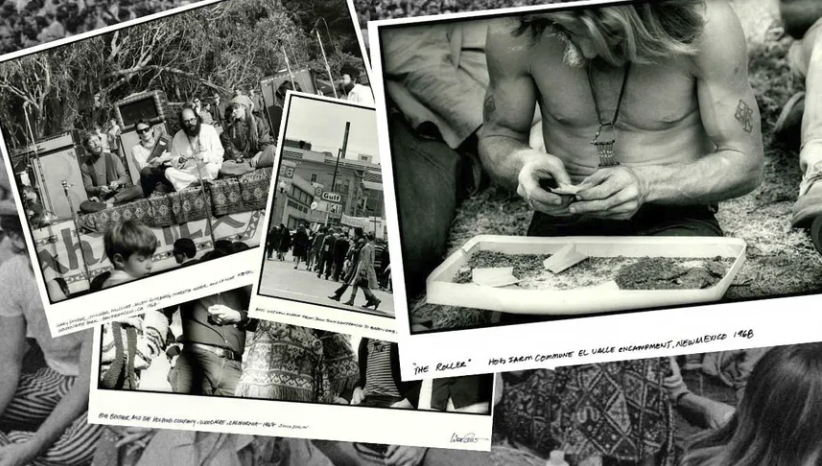
It wasn’t all peace and love. Drug abuse, overcrowding, and unsafe living conditions exposed the darker side of those experiments. Yet the movement also helped advance environmental awareness, community-based healthcare, social equality, and opposition to the military draft, which ended in 1973.
Looking back, I see something more significant than a cultural rebellion. It was an awakening, a movement away from established institutions and toward greater personal freedom, spiritual discovery, and exploration of human consciousness. That awakening appears to be growing and accelerating in the collective consciousness.
But consider what happened roughly half a century after 1973.
During the COVID pandemic, people weren’t gathering in parks or filling concert fields. They were isolated, separated from friends and family, and restricted in their daily activities. For some, that isolation became an invitation to look inward through meditation, prayer, independent research, and reflection.
The 1960s encouraged an outward exploration of freedom and consciousness. The 2020s, under very different circumstances, encouraged some people to explore those same questions from within.
Were these responses to extraordinary world events? Or could they be different expressions of an evolving collective consciousness?
Eighty Years of Secrecy: Is the Conversation Changing?
Another interesting historical pattern involves the secrecy surrounding UFOs, extraterrestrial life, and advanced technologies. Beginning with the modern UFO era in 1947, we’ve witnessed nearly eighty years of investigations, classified information, witness accounts, and growing demands for disclosure.
But when did the public conversation begin to change?
- 2017 – The New York Times revealed the Pentagon’s previously undisclosed Advanced Aerospace Threat Identification Program (AATIP), bringing renewed attention to military UFO investigations.
- 2018 – The GoFast Navy video, recorded in 2015, became public. It followed earlier releases of military footage showing unidentified aerial phenomena.
- 2019 – The U.S. Navy publicly acknowledged the authenticity of previously circulated Navy footage depicting unidentified aerial phenomena. Separately, Navy personnel recorded nighttime footage of an apparently triangular or pyramid-shaped object.
- April 2020 – The Department of Defense officially released three Navy videos recorded in 2004 and 2015, confirming their military origins while continuing to classify the observed phenomena as unidentified.
- 2021 – The Pentagon confirmed that the separate photographs and videos, including the 2019 footage of the apparent triangular object, had been taken by Navy personnel.
These acknowledgments marked a significant change in the official handling of the subject. Subsequently, congressional hearings, whistleblower testimony, documentaries, and further investigations brought longstanding questions about crash retrievals, advanced technologies, and withheld information into wider public discussion.
As we approach 2027, an eighty year turning after Roswell, it’s worth asking whether we’re witnessing more than a change in government transparency. Could our increasing willingness to question established narratives, challenge secrecy, and explore previously marginalized subjects reflect a broader shift in collective consciousness?
In his book Fractal Time, Gregg Braden explores the possibility that historical, personal, and even cosmic events follow repeating patterns influenced by earlier “seed events.” He suggests that recognizing these patterns can help us identify critical moments, or “choice points,” when conscious decisions may alter what happens next.
If Braden is correct, recognizing a recurring cycle doesn’t mean we’re destined to repeat it. Awareness gives us an opportunity to respond differently, interrupt destructive patterns, and consciously shape a better future.
The greatest change may not be happening in our institutions, technology, or governments, but within humanity itself. What if consciousness connects us all at a fundamental level, something the ancients understood and modern society has largely forgotten?
 If our thoughts, intentions, and actions influence the collective, as I believe they do, then each of us has a role in shaping what comes next. We don’t have to wait for another crisis or accept that history must repeat itself. Through awareness, cooperation, compassion, and a shared vision of a better world, perhaps we can consciously influence the direction of our future.
If the Fourth Turning represents a crisis followed by renewal, perhaps we’re closer to that renewal than we realize. Could 2027 mark the beginning of something wonderful for humanity? I certainly hope so!
The featured image represents the power we hold in our hands, our voices, and our written words.
History may repeat itself, but we don’t have to repeat the same mistakes. Perhaps it’s time to break the cycle and consciously build something better.
Perhaps recognizing a repeating pattern is the first step. Believing we can change it is the second. Choosing to act is the third. If you want to see this principle in action, then I suggest watching Tomorrowland.


Your Tax Free Donations Are Appreciated and Help Fund our Volunteer Website
Disclaimer: We at Prepare for Change (PFC) bring you information that is not offered by the mainstream news, and therefore may seem controversial. The opinions, views, statements, and/or information we present are not necessarily promoted, endorsed, espoused, or agreed to by Prepare for Change, its leadership Council, members, those who work with PFC, or those who read its content. However, they are hopefully provocative. Please use discernment! Use logical thinking, your own intuition and your own connection with Source, Spirit and Natural Laws to help you determine what is true and what is not. By sharing information and seeding dialogue, it is our goal to raise consciousness and awareness of higher truths to free us from enslavement of the matrix in this material realm.