 EN
EN FR
FR

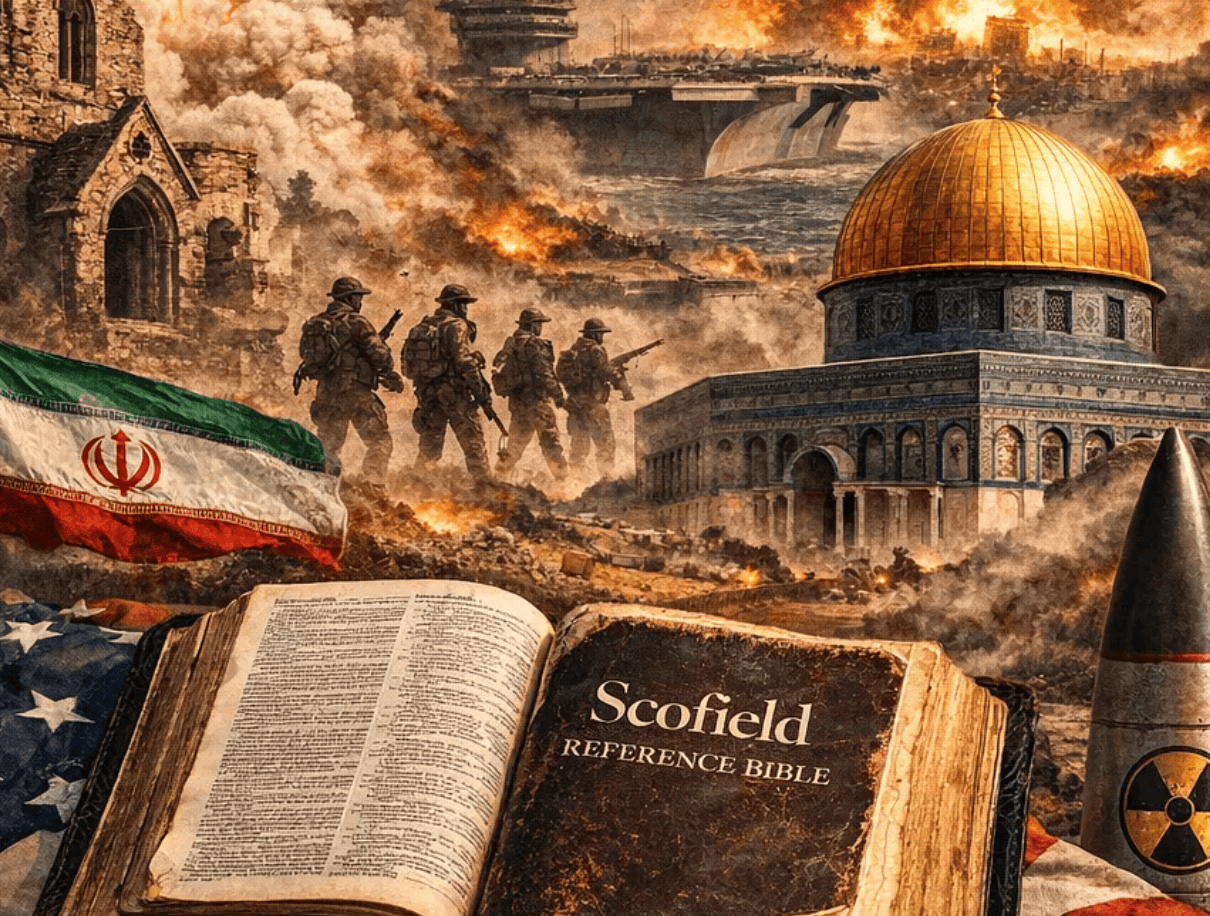
From Plymouth to Persia — How Dispensationalism Brought Us to the Brink
By John Mappin
There are many explanations offered for the present crisis — oil, power, geopolitics, history, revenge. All of them are, in their way, true. And yet all of them are secondary.
For beneath the machinery of statecraft — beneath the speeches, the sanctions, the missiles and the moral posturing — lies something far more potent, and far more dangerous:
A theology.
Not Christianity as it has been understood for nearly two millennia. But a modern construct — systematised, exported, industrialised — and, ultimately, weaponised.
To understand how we have come within inches of nuclear war with Iran, one must begin not in Tehran… nor in Washington…
…but in Plymouth.
The Birth of a Doctrine: The Plymouth Brethren
In the early 19th century, a small and austere Christian movement emerged in Britain: the Plymouth Brethren.
It was here that John Nelson Darby, an Anglo-Irish clergyman of formidable intellect and rigid conviction, began to articulate a new reading of scripture — one that would fracture Christian theology and, in time, reshape geopolitics.
Darby’s central innovation was deceptively simple, yet utterly transformative:
He divided history into distinct “dispensations” — epochs in which God interacts with humanity according to different rules.
More importantly, he separated Israel from the Church — insisting that the Jewish people retained a unique, prophetic role that must be fulfilled in history.
This was no longer theology as moral guidance.
It was theology as timeline.
A script.
A schedule.
And crucially — an unfinished one.
From Doctrine to Distribution: The Scofield Bible
Ideas alone do not change the world.
Distribution does.
Enter the Scofield Reference Bible, first published in 1909 by Cyrus I. Scofield — a text that did something unprecedented.
It embedded Darby’s dispensational framework directly into the biblical text itself, through annotations and cross-references that gave interpretation the authority of scripture.
For millions of readers, the distinction vanished.
The notes became the Word.
And the Word became a roadmap.
Through seminaries, churches, and eventually mass media, the Scofield Bible spread this framework across the United States with extraordinary success.
By the mid-20th century, a significant portion of American evangelical Christianity had absorbed — often unknowingly — a worldview in which:
• Israel’s restoration was prophetically required
• Middle Eastern conflict was inevitable
• Global crisis was a precursor to divine intervention
In short:
History was not to be guided — but fulfilled.
The Americanisation of Prophecy
As the United States rose to global dominance, it did not merely export democracy, capitalism, or culture.
It exported belief.
Dispensationalism, once a niche theological system born in British dissent, became an American political force.
Through televangelism, political lobbying, and the emergence of the Christian Right, it embedded itself within the bloodstream of public life.
This gave rise to Christian Zionism — not as a fringe idea, but as a powerful electoral reality.
A worldview in which:
• Support for Israel is not strategic, but sacred
• Opposition to Israel is not political, but heretical
• Conflict in the region is not tragic, but prophetic
Politicians, ever attuned to the currents beneath them, adapted accordingly.
Not always consciously.
Not always cynically.
But inevitably.
From Jerusalem to Tehran: The Logic of Escalation
Once one accepts the premises of dispensationalism, the logic unfolds with chilling clarity:
If Israel must be central to the end-times narrative…
If conflict in the region is foretold…
If great war precedes divine resolution…
Then tension is not something to defuse.
It is something to expect.
Perhaps even to facilitate.
And so the political posture hardens:
• Diplomacy becomes delay
• De-escalation becomes denial
• War becomes, quietly, the unfolding of destiny
Iran, in this framework, is not merely a nation-state.
It is a character in a script.
The Nuclear Threshold
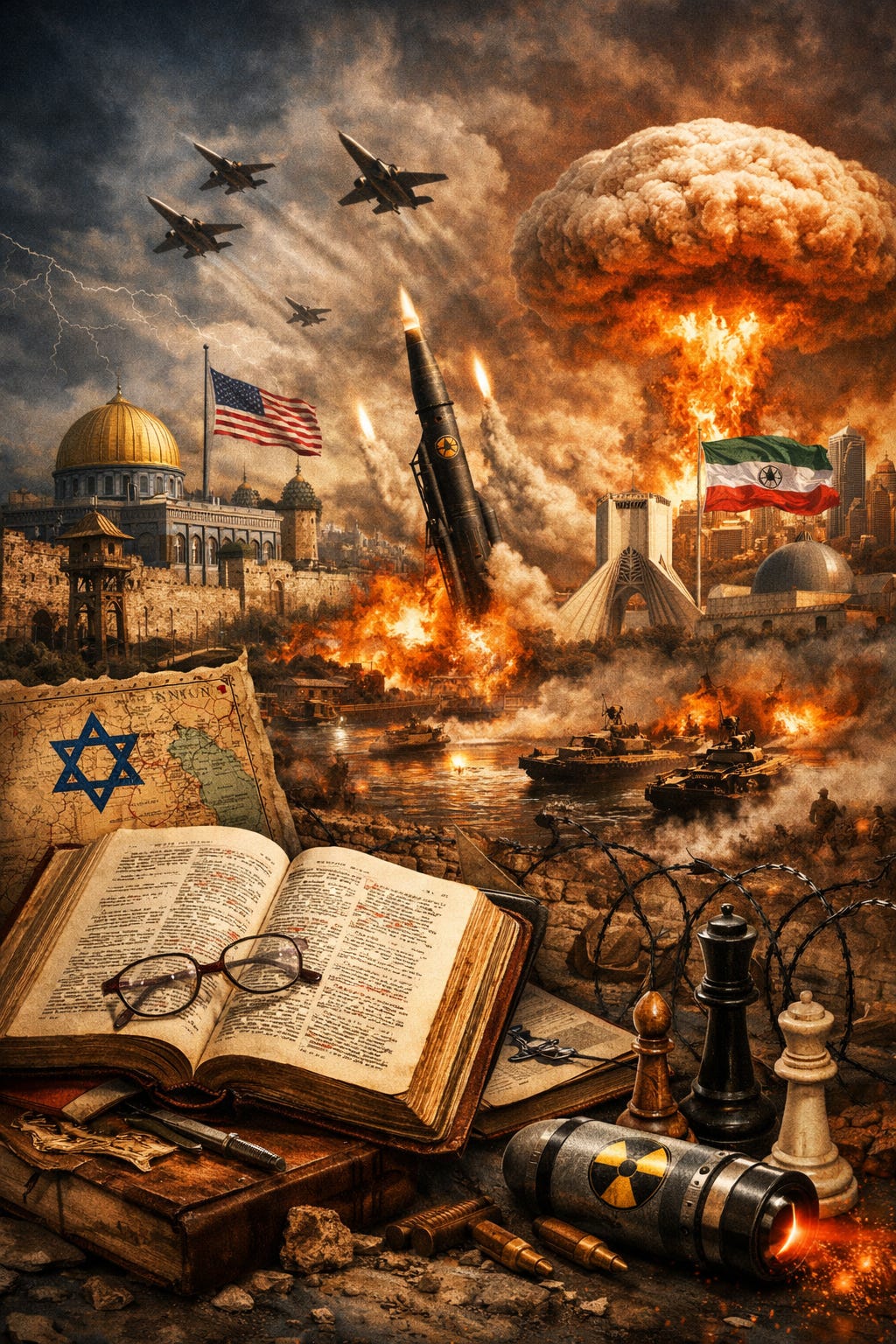
And now we stand where all such thinking ultimately leads:
At the threshold.
The distance between conventional conflict and nuclear exchange is not measured in miles — but in minutes.
Miscalculation.
Retaliation.
Escalation.
In a world already primed by ideological certainty, the margin for error collapses.
What is most unsettling is not that leaders desire nuclear war.
It is that some among the influential strata of belief may view catastrophic conflict not as the ultimate failure…
…but as the final confirmation.
When war is seen as prophecy fulfilled, restraint becomes philosophically fragile.
And when restraint weakens, catastrophe ceases to be unthinkable.
The Quiet Capture of the West
This is not a conspiracy in the vulgar sense.
It is something more subtle — and more powerful.
A cultural capture.
A migration of ideas:
From a 19th-century sect in Plymouth…
To annotated scripture in the Scofield Bible…
To American pulpits…
To political platforms…
To foreign policy…
Until, finally, it sits — largely unexamined — at the edge of nuclear decision-making.
Not declared.
Not debated.
But present.
The Great Inversion Revisited
What we are witnessing is not merely political failure.
It is theological inversion.
Christianity, at its civilisational best, tempered empire.
Dispensationalism, at its political worst, can inflame it.
Where once faith urged humility, it now risks underwriting certainty.
Where once it sought peace, it now risks accommodating war.
The Final Reckoning
And so we return to the question that now presses upon us with existential urgency:
How did we come so close to the unthinkable?
Not by accident.
Not by a single decision.
But by a chain of ideas —
quietly adopted,
widely disseminated,
politically absorbed —
until they began to shape the very framework through which decisions are made.
Conclusion: Stepping Back from the Edge
To question this influence is not to attack faith.
It is to defend reason.
To insist that policy must be guided by reality — not by apocalyptic expectation.
To reassert that the role of statesmanship is not to fulfil prophecy…
…but to prevent catastrophe.
For if we fail to disentangle belief from power —
if we allow theology to script geopolitics —
then the next step beyond this present moment…
may not be rhetorical.
It may be irreversible
From johnmappin.substack

Your Tax Free Donations Are Appreciated and Help Fund our Volunteer Website
Disclaimer: We at Prepare for Change (PFC) bring you information that is not offered by the mainstream news, and therefore may seem controversial. The opinions, views, statements, and/or information we present are not necessarily promoted, endorsed, espoused, or agreed to by Prepare for Change, its leadership Council, members, those who work with PFC, or those who read its content. However, they are hopefully provocative. Please use discernment! Use logical thinking, your own intuition and your own connection with Source, Spirit and Natural Laws to help you determine what is true and what is not. By sharing information and seeding dialogue, it is our goal to raise consciousness and awareness of higher truths to free us from enslavement of the matrix in this material realm.
















Not irreversible because God has always and will always be in control.
The Christian Zionists are a brain-wrecked group of non-christians, most accurately labelled as satanic, in the same way that the Zionists that poured billions of dollars into brain-wrecking people of already dubious faith that exempted their murder of Native Americans, along with other people's of the world, both Christian and non-Christian.
The Zionists and these Christian counterparts will all be annihilated by God's arrangement.
The closer you stand to them, the act of supporting them, draws you into the group to be annihilated.
You can't change God and His Will, no matter how much money, propaganda or determination you throw at it. The only change you can effect is whether you side with God and good, or satanic zionism and it's wickedness.
Evil and good always exist in this world of matter, we can't change that either. However, like season, ages of time shift from time periods that allow evil to become predominant to periods where evil is virtually absent. We are entering such a period now, and most understand 2030 stands as a gateway between the two. As we enter the period of goodness, those who are averse will be swept away. Despite the fact that none of us every die, only the body undergoes death, those committed to evil will reside in subterranean realms during the period while earth is infused with goodness.
We can't change this, we can only adapt, conform, or be ushered elsewhere.
Say goodbye to your Jewish and Christian Zionist friends and relatives, because they will ALL be departing soon. Nothing can change this, nor should it be changed. Prepare yourself for where you will reside during the coming period of The Golden Age of Kali Yuga, whether it be earth, below, or best yet, completely out of this world of matter once and for all. Om namo bhagavate vasudevaya.