EN
EN FR
FR

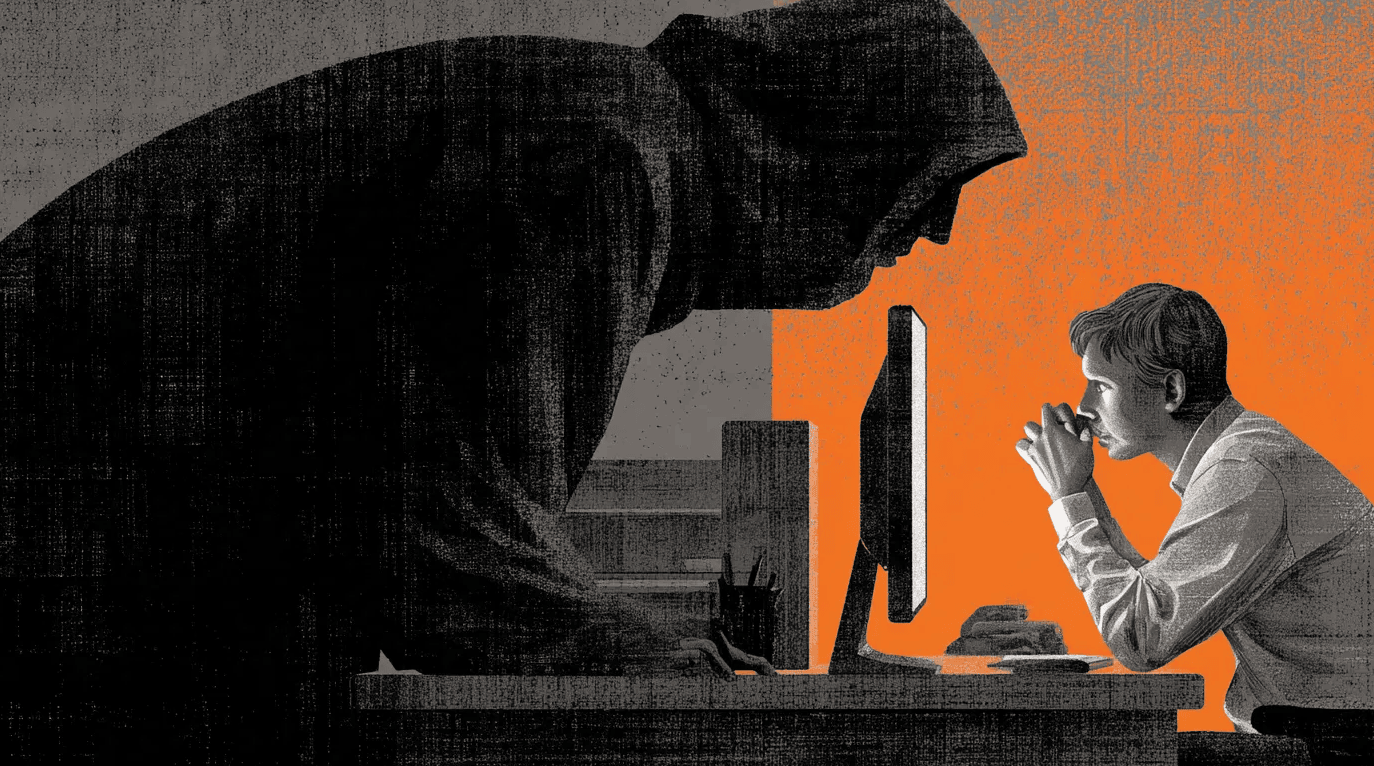
Snowden’s taxonomy of conspiracies was as honest a framework anyone in his position had ever offered. Then May 8th happened.
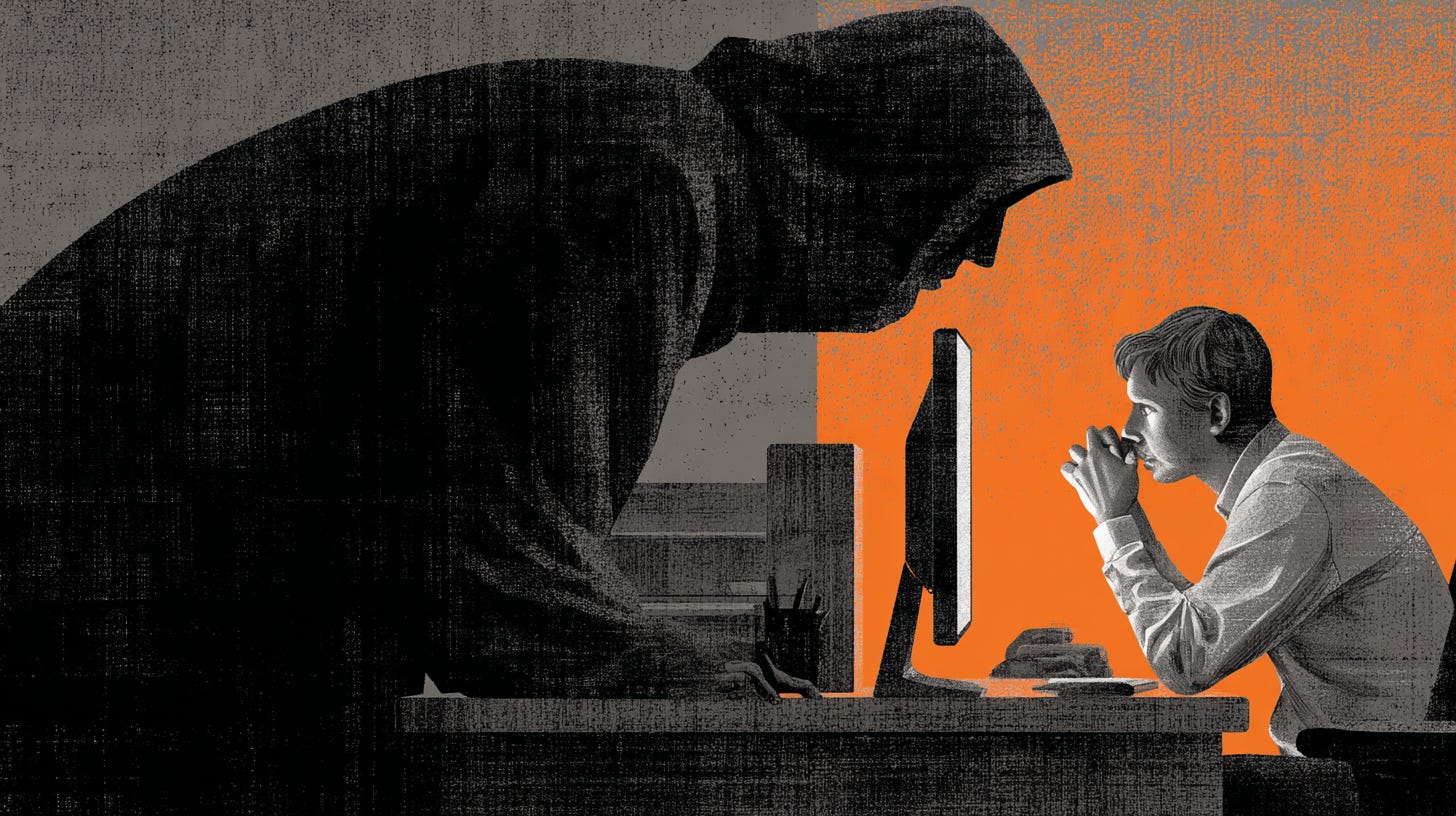
In June 2021, Edward Snowden — the man who proved that the most outlandish-seeming surveillance conspiracy was completely real — published a taxonomy of conspiracies on his Substack that most people missed.
His central argument deserves to be quoted directly, because it is the most precise formulation anyone in his position has ever offered:
“The greatest conspiracies are open and notorious — not theories, but practices expressed through law and policy, technology, and finance… The truest conspiracies meet with the least opposition.”
— Edward Snowden, “Conspiracy: Theory and Practice,” Substack, June 29, 2021
He drew a distinction between conspiracy practices — documented, verified, institutional; gerrymandering, the debt industry, mass surveillance — and conspiracy theories: the dramatic, unverifiable narratives that capture attention and, in doing so, obscure the real ones.
His conclusion was uncomfortable in the best way: we talk about conspiracy theories in order to avoid talking about conspiracy practices, because the practices are too daunting, too total, too present to emotionally metabolize.
That framework has been the editorial backbone of this platform since before I knew Snowden had articulated it. Document the practices. Source the claims. Follow the incentives. This used to be called journalistic integrity. It was taught in Journalism 101 classes. Hold the interpretive layer separate from the observational one. Let the evidence do the work.
I agreed with Snowden then. I agree with him now. And I want to show you exactly where his map — brilliant as it is — runs out.
The Taxonomy and Its Blind Spot
Snowden organized conspiracy thinking into five categories, drawing on Jesse Walker’s framework: the Enemy Outside, the Enemy Within, the Enemy Above, the Enemy Below, and — the category most relevant to this piece — Benevolent Conspiracies.
His definition: extra-terrestrial, supernatural, or religious forces dedicated to controlling the world for humanity’s benefit. He placed this category adjacent to Enemy Above — the conspiracies of those who manipulate events from within the circles of power.
He did not dismiss the Benevolent Conspiracy category. He taxonomized it. But the implication was clear: it belongs in the same analytical bracket as the others, subject to the one question Snowden himself acknowledged no existing taxonomy adequately addresses — truth value.
His original substack article can be found here:

For four years, I accepted that framing as a fair challenge. The ET disclosure content on this platform and elsewhere I’ve contributed — the congressional testimony, the whistleblower accounts, the historical pattern of official denial followed by official acknowledgment — sat at what I call Layer 3: philosophical, invited, not demanded. Held by my own confirmations. Reserved for individual scrutiny. I can’t verify all of your experiences, you can’t verify all of mine. Offered as a frame, not a fact.
Then May 8th, 2026 happened.
The Man Who Went Looking — and What He Found
Before we get to May 8th, there is a story that belongs here. Because the irony embedded in that date does not fully land until you know it.
In 2001 and 2002, a Scottish IT administrator named Gary McKinnon sat in his dressing gown at four in the morning, on a 56K dial-up connection, accessing 97 US military and NASA computers. His method was not sophisticated — a Perl script scanning for blank passwords, then remote access tools on whatever doors opened. What motivated him was the same impulse that drives every serious researcher in this space: not belief, but verification. He said it plainly:
“I wanted it from the horse’s mouth. I didn’t want to just believe. I wanted to know.”
— Gary McKinnon, interview with Jesse Michels, American Alchemy
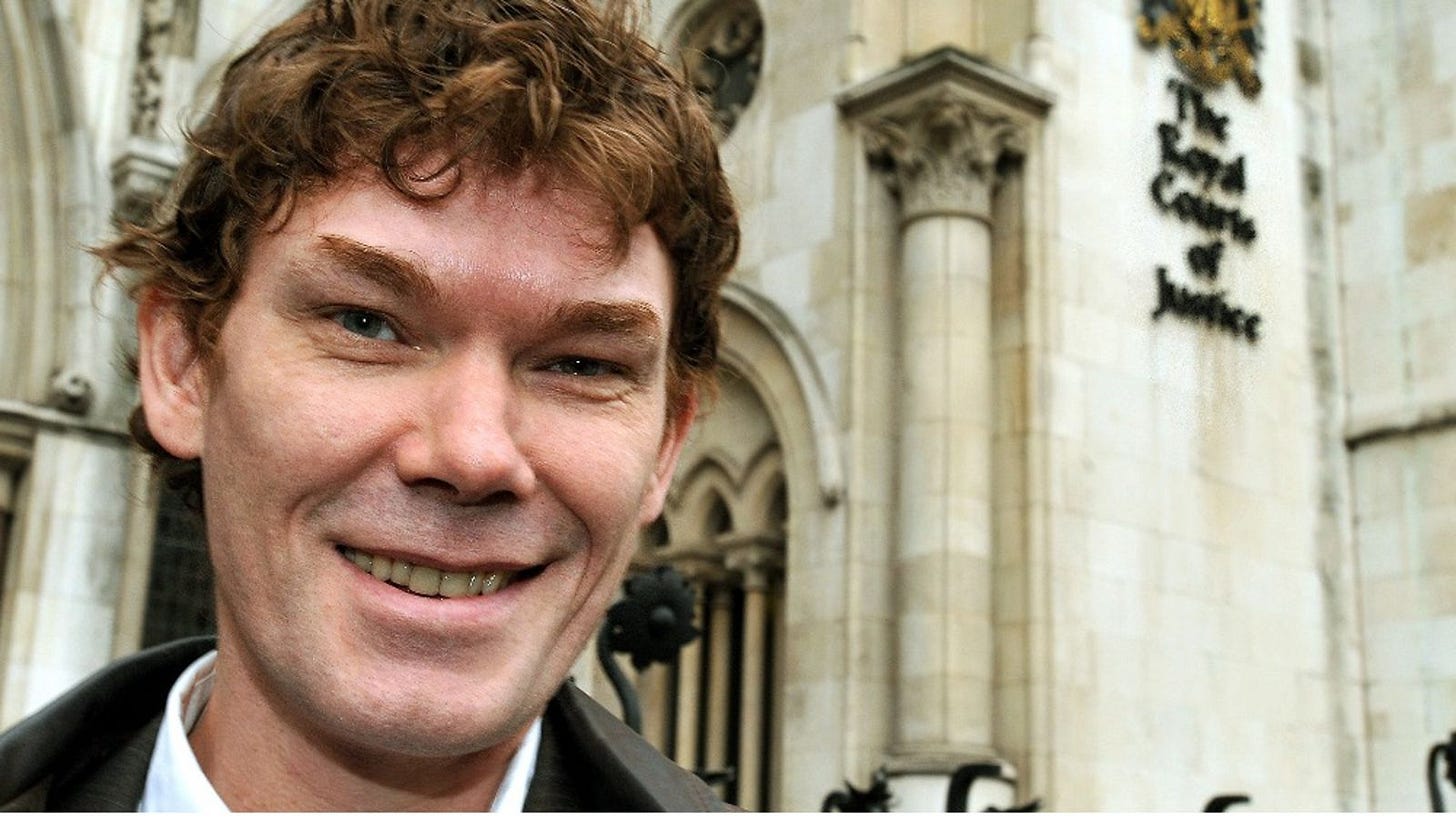
US prosecutors called it “the biggest military computer hack of all time.” He faced 70 years in prison. The UK blocked his extradition on human rights grounds.
What McKinnon found — before authorities seized his drives and he never recovered the data — was this:
On a US military system, he accessed an Excel spreadsheet titled “Non-Terrestrial Officers.” It contained names and ranks of US Air Force personnel not registered on any public roster. It contained fleet-to-fleet and ship-to-ship transfer records. The ship names appeared nowhere in any known naval registry. He said: “None of these were ocean-going ships. It was astounding. They are not a navy, they are not an army, and not even an air force. So I was thinking they must be an off-planet space fleet at least.”
Separately, inside NASA’s Johnson Space Center Building 8 — the building where former NASA contractor Donna Hare had testified that UFO images were routinely airbrushed out of satellite photography before public release — McKinnon found a folder of unfiltered imagery. Over his agonizingly slow connection, he watched an image render line by line: a cigar-shaped craft floating above the northern hemisphere with domes on multiple sides. “No rivets, no seams, none of the usual signs of man-made machinery,” he said. Just as the download was completing, a NASA technician remotely seized his mouse cursor and disconnected him.
The spreadsheet. The drives. The evidence. All confiscated by the government whose files he had accessed. Never returned.
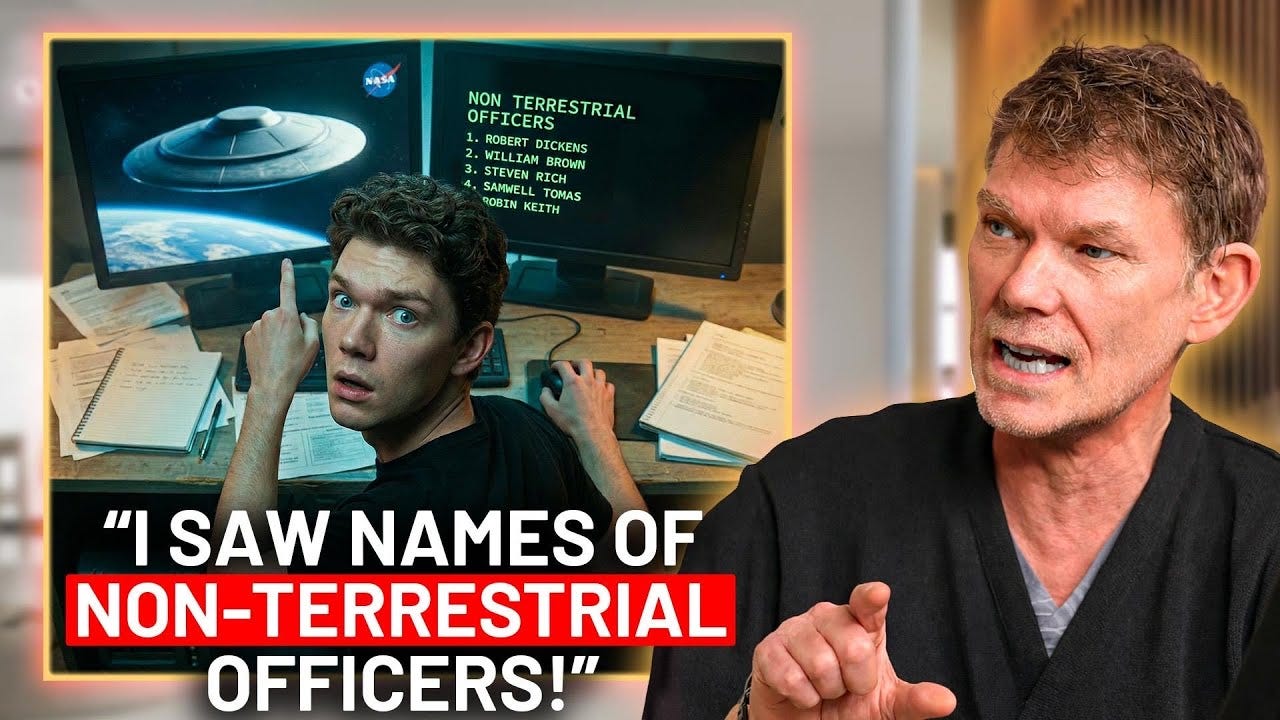
McKinnon had been directly inspired by the Steven Greer National Press Club Disclosure Project conference of May 9, 2001 — twenty retired Air Force, FAA, and intelligence officers testifying publicly about UAP reality. He went looking the same month.
On May 8, 2026 — one day before the 25th anniversary of that press conference — the United States government voluntarily published declassified UAP files at war.gov. No clearance required.
The man who risked 70 years in prison to find those files never got them back. A quarter century later, the government posted them online for anyone to read.
That is not a conspiracy theory. That is the timeline.
What Actually Occurred on May 8th
Let me be precise, because precision is what this moment requires.
On May 8, 2026, the United States Department of War — itself a semantic marker worth pausing on, the deliberate resurrection of that name — released the first tranche of declassified UAP files through a dedicated government portal at war.gov/UFO. The program has its own acronym: PURSUE. Presidential Unsealing and Reporting System for UAP Encounters.
The files included reports, photographs, videos, witness accounts, military records, astronaut transcripts, and historical materials connected to unresolved sightings and investigations dating from 1947 to the present. The Pentagon statement read:
“The American people can now access the federal government’s declassified UAP files instantly. The latest UAP videos, photos, and original source documents from across the entire United States government are all in one place — no clearance required. While past administrations sought to discredit or dissuade the American people, President Trump is focused on providing maximum transparency.”
— Pentagon Public Affairs, May 8, 2026
FBI Director Kash Patel called it “a landmark release.” NASA Administrator Jared Isaacman praised the “effort to bring greater transparency.” Director of National Intelligence Tulsi Gabbard confirmed the intelligence community is “actively coordinating declassification efforts” for ongoing releases — filed on a rolling basis, with new tranches posted every few weeks.
But the detail that distinguishes this moment from every previous UAP acknowledgment — and the detail I want to place directly next to Snowden’s taxonomy — is the language Trump used in February when he directed this process to begin.
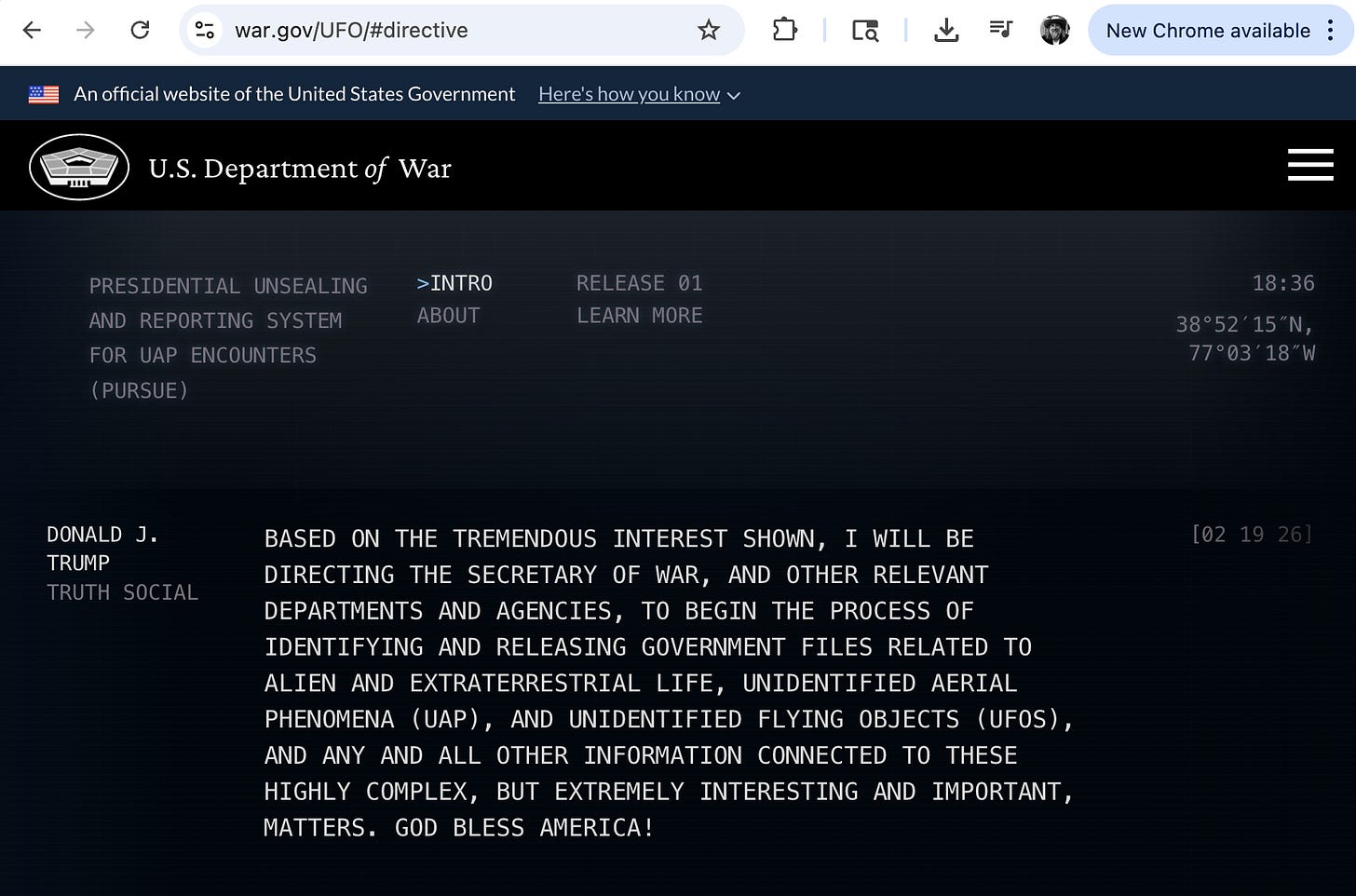
In a Truth Social post, Trump directed the Pentagon and relevant agencies to “begin the process of identifying and releasing Government files related to alien and extraterrestrial life, unidentified aerial phenomena (UAP), and unidentified flying objects (UFOs).”
— Donald Trump, Truth Social, February 2026
Alien and extraterrestrial life. Not UAP. Not anomalous phenomena. Not objects of unknown origin. The sitting President of the United States used the words that every previous administration had carefully avoided. And when asked directly about Obama’s podcast comment that aliens are real, Trump did not deny the claim. He said Obama had revealed classified information.
Read that again. The President’s objection was not that the claim was false. His objection was that the information was classified.
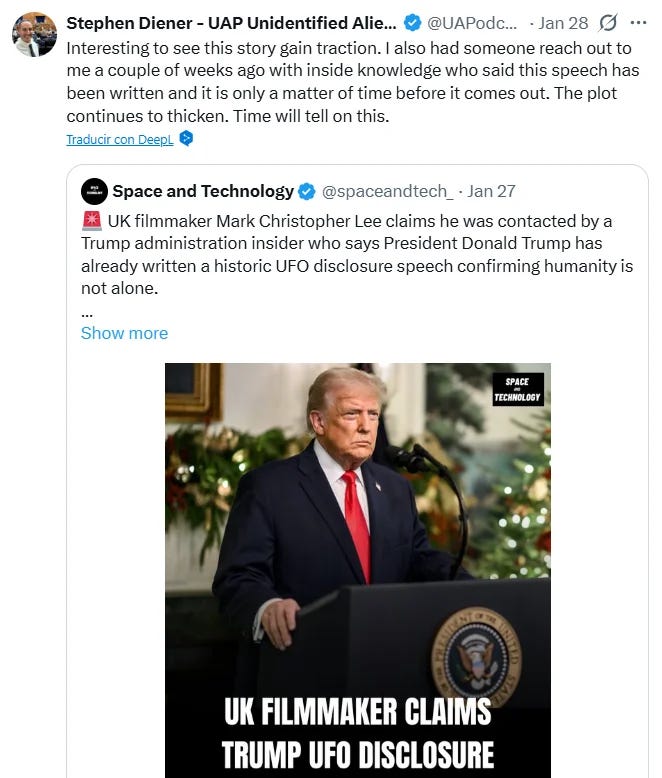
What This Does to Snowden’s Taxonomy
Here is the precise epistemological shift.
In 2021, Snowden placed ET-related claims in the Benevolent Conspiracy category — unverified, held lightly, outside the documented-practices lane. That was a fair placement given the available public record.
As of May 8, 2026, a significant portion of that content has migrated categories.
A sitting US President directing declassification of files related to “alien and extraterrestrial life” on a government portal, with the FBI, the DNI, and NASA simultaneously participating — that is not a Benevolent Conspiracy in Snowden’s framework. That is a conspiracy practice. Open. Announced. Documented. Institutional. Reported in newspapers. Scrolled across screens.
Which means Snowden’s own criterion now applies directly. Because the mainstream reaction to the May 8th release was almost perfectly calibrated to his prediction. The files were covered. Briefly. Skeptically. Then largely set aside.
The SETI Institute said there was “no compelling evidence for extraterrestrial life thus far.” The former AARO director said there was “nothing unexpected.” The New York Post noted some contents had been in the public record for years. A sitting congresswoman posted that unless they “roll out live aliens” she had “better things to do on a Friday.”
The dismissal was reflexive and — in the precise sense Snowden described — a symptom of something. Not stupidity. Not bad faith. But the same metabolic incapacity he identified: the thing is too total, too present, too daunting to sit with.
The truest conspiracies meet with the least opposition. We are watching it happen in real time. And, in real time, it gets even stranger:
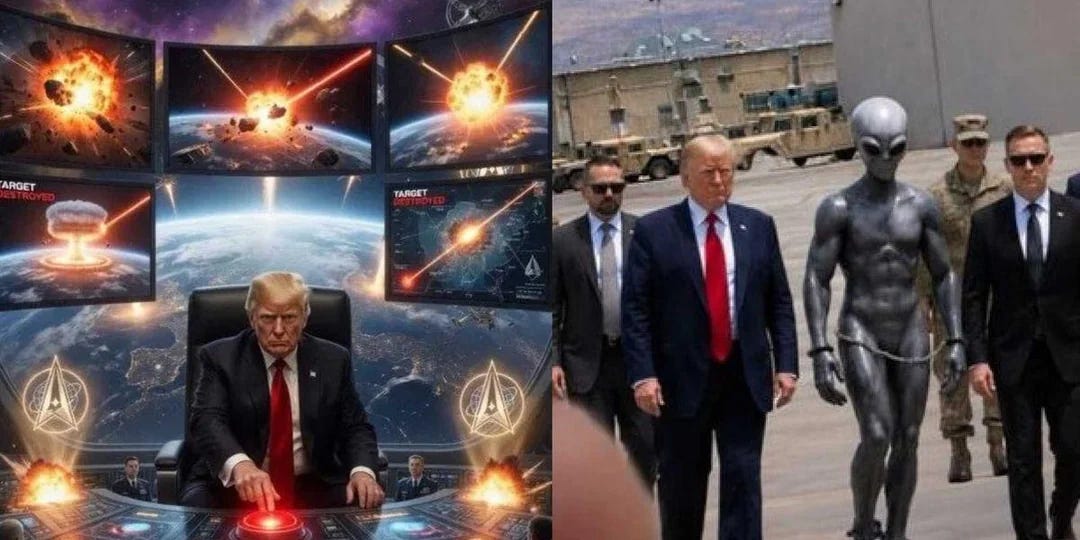
On Sunday (May 17), Trump posted around 25 times on Truth Social, and the nature of the images shared has come in for criticism online. One post saw Trump depicted in outer space while seemingly overseeing a missile strike. What goes on in the mind’s of operation Trump – cause he sure doesn’t act alone.
Gary McKinnon understood this in 2001. He went looking because the official silence was itself the signal. The government’s ferocity in prosecuting him — 70 years sought, extradition pursued for a decade — was proportional to something. You do not spend a decade trying to extradite a man in a dressing gown for finding files that contain nothing.
The Bayesian Argument Snowden Did Not Make
Snowden’s most important analytical gap is the absence of a mechanism for updating priors as evidence accumulates.
His taxonomy classifies conspiracies but does not tell us how to reason about them as the documented record grows. And this is precisely where the ET disclosure conversation requires a different tool.
Consider the chain of verified events across twenty-five years. The Greer National Press Club testimony with twenty credentialed officers in 2001. McKinnon’s discovery of Non-Terrestrial Officers — and the government’s decade-long pursuit of him for finding it. The Pentagon’s formal acknowledgment of UAP programs it had previously denied. The establishment of AARO as a permanent intelligence function. Congressional UAP hearings with sworn testimony from credentialed military witnesses. The Schumer-Rounds UAP Disclosure Act. Apollo astronaut transcripts released in the May 8th tranche referencing anomalous objects. And now a President who uses the words “alien and extraterrestrial life” on the official record, and whose objection to a predecessor’s disclosure was not that the claim was false but that the information was classified.
At what point does the accumulation of conspiracy practices — documented, verified, institutional — require us to update the prior probability we assign to the larger claim?
This is not rhetorical. It is the actual question. Snowden answered it once, in a different domain. He discovered that the most outlandish-seeming surveillance conspiracy was completely real. The prior probability he would have assigned to PRISM in 2005 was presumably low. The documented evidence changed it. That is how evidence is supposed to work.
And as I prepare this article on Tuesday for Wednesday release, this happened in the last 24 hours:
It’s getting pretty crazy. But, we always knew that it would. So, how does this change the story now? How do the statements and posts of the sitting President of the United States move the Overton Window?
Bayesian reasoning takes its name from Thomas Bayes, an eighteenth-century English minister who worked out the mathematics of belief revision. The core idea is deceptively simple: what you believe should be proportional to the evidence you have encountered, and when the evidence changes, the belief must change with it. Most people apply this naturally in daily life — you revise your opinion of a restaurant after a bad meal, of a person after a broken promise. Where the method breaks down is on questions that carry identity weight — where updating the belief feels like surrendering something about who you are. The ET disclosure question carries enormous identity weight for the mainstream. To update toward the possibility means acknowledging that the official position held for seventy years was wrong, that the people who were dismissed as conspiracy theorists were pointing at something real, and that the institutions trusted to tell the truth were doing the opposite. That is a large update. It is also, given the documented record now sitting at war.gov, the honest one.
The May 8th files do not confirm extraterrestrial contact. I want to be precise about that. The Pentagon explicitly said the public “can draw their own conclusions.” The scientific community’s skepticism is noted and legitimate. But the direction of travel across twenty-five years of documented practice is unambiguous. And the question Snowden’s taxonomy does not answer is the one McKinnon was already asking in 2001: at what point does the weight of institutional acknowledgment require the serious analyst to update?
Those of us in the “woo woo” camp already have had and seen enough experiences to move the needle and that puts us in a Shifted mindset. We’ve been waiting for the world to catch up to the new Paradigm or new Narratives. The institutional skepticism in the face of the new reality is telling us a lot about how deeply the self is aligned with its core beliefs and how challenging the Shift will be and is for many. It reminds me of one of my own sayings, you have to believe it to see it.
I offer a human and personal reaction from Jillian Michaels, who’s been dipping her toe in this world for a little bit, as she hears about another facet of the alien story from Lue Elizondo.
On a human note, the reactions of Jillian in the clip is why I’ve come back into the discussion. It’s mind blowing shit that when you begin to take it seriously, it changes you and your view of history and control – the control of these particular messages.
The Thing That Has Not Changed
Here is what I want to say clearly between what we know, what we interpret, and what we reflect on.
The May 8th release does not validate every claim made by SSP insiders, whistleblowers, or the disclosure community over the last thirty years. Truth will lay in the eyes of the beholder. Some of those claims will prove accurate. Some will not. The files released so far contain eyewitness accounts, videos of ambiguous objects, and historical records that raise more questions than they answer.
What the release does confirm — unambiguously and on the primary government record — is that the official position has shifted. The category of “alien and extraterrestrial life” is now a subject of active government declassification with the President’s explicit direction. That is a conspiracy practice in Snowden’s precise definition. Open. Institutional. Announced in public.
And it is meeting, just as he predicted, with the least opposition.
The most sophisticated response to that pattern is not to claim vindication. It is to keep doing exactly what this platform has always done: document the practices, own the interpretations, hold the reflections to scrutiny, and ask the question that the mainstream keeps finding ways to avoid.
If the President’s objection to a predecessor saying “aliens are real” was not that the claim is false, but that the information is classified — what exactly is classified?
Gary McKinnon spent twenty-five years without his drives back. He already knew the answer.
Snowden’s map was the best map available in 2021. The territory has moved.
We have eyes to see it.
— Gerry
Gerry Gomez is an investigative journalist, creative director, and hybrid war correspondent who has spent a decade documenting the convergence of financial, media, and geopolitical forces shaping the current global transition.

Your Tax Free Donations Are Appreciated and Help Fund our Volunteer Website
Disclaimer: We at Prepare for Change (PFC) bring you information that is not offered by the mainstream news, and therefore may seem controversial. The opinions, views, statements, and/or information we present are not necessarily promoted, endorsed, espoused, or agreed to by Prepare for Change, its leadership Council, members, those who work with PFC, or those who read its content. However, they are hopefully provocative. Please use discernment! Use logical thinking, your own intuition and your own connection with Source, Spirit and Natural Laws to help you determine what is true and what is not. By sharing information and seeding dialogue, it is our goal to raise consciousness and awareness of higher truths to free us from enslavement of the matrix in this material realm.