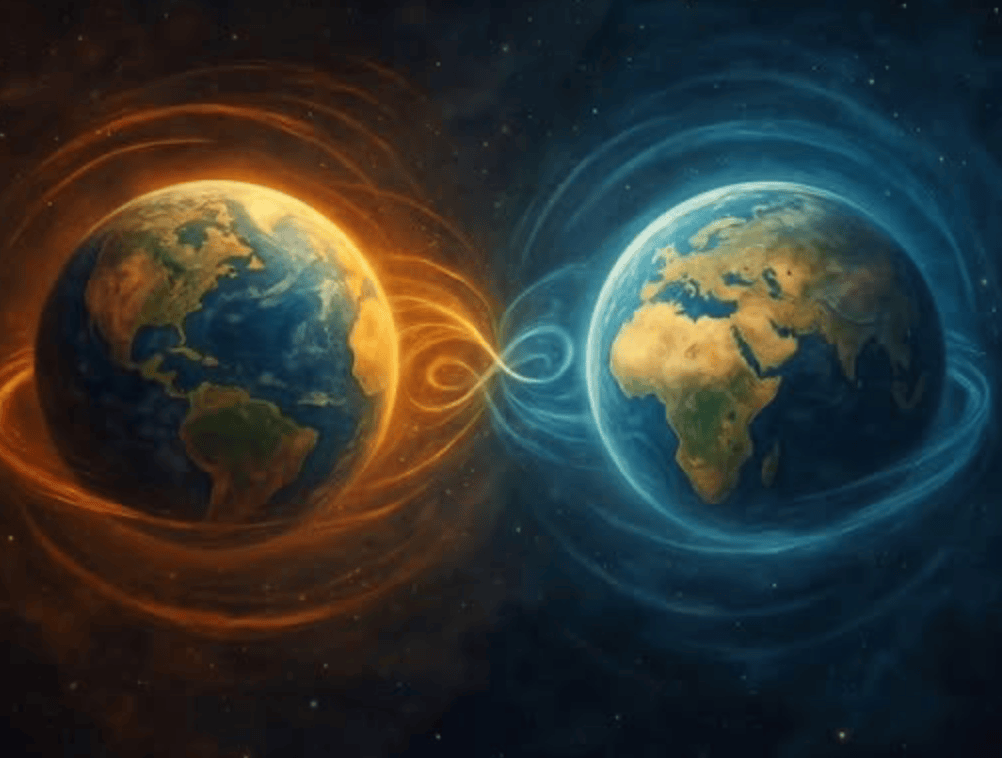
If you’ve spent any time in awakening spaces, you’ve probably heard people talk about “the splitting of worlds.” The way it’s sometimes described can sound like a literal timeline rupture — like some people are ascending into a new Earth while others are stuck in the old one. But the more I sit with it, the more I think the truer, more grounded version is also more useful: we’re witnessing a divergence in how people cope with change, how they make meaning, and how they relate to uncertainty.
In that sense, “the split” isn’t supernatural as much as it is psychological, cultural, and spiritual all at once. It’s what happens when pressure gets high enough that we can no longer pretend we share the same values, the same sense-making tools, or even the same definition of safety. We’re not necessarily living on different planets. We’re living in different interpretation layers of the same world.
Astrologically, the timing of this shift is almost too perfect to ignore. Pluto’s move into Aquarius signals a generational overhaul of technology, power, community, and identity — the deep, irreversible kind of transformation that doesn’t ask permission. It’s exposing where we’ve surrendered our sovereignty in the name of belonging, comfort, or survival… and where we’re ready to take it back.
Neptune preparing to move into Aries feels like another piece of the puzzle. The collective dream is shifting from diffuse spirituality and foggy ideals into something more embodied, courageous, and identity-driven. And with Uranus entering Gemini, the acceleration of information, communication, media, education, and networks of belonging is only going to get louder. This combination alone makes it understandable that so many people feel like reality itself is speeding up.
When I try to name what I’m seeing, I keep coming back to two broad patterns: hardening and integration. I don’t see these as moral categories. I see them as nervous-system strategies.
Hardening is what happens when change moves faster than our internal capacity can hold. It’s the instinct to tighten identity, simplify reality, and build walls. The drive underneath it is deeply human: protect what matters. But when hardening becomes a permanent state, it can turn into chronic fear, chronic conflict, and a kind of emotional exhaustion that looks like certainty but feels like suffering.
Integration is different. It’s what happens when someone decides to grow their inner capacity along with the chaos of the world. It doesn’t mean avoiding anger or grief. It doesn’t mean pretending everything is fine. It means strengthening discernment, learning how to regulate the nervous system, and choosing self-responsibility over reflex.
Some examples on how this might look like:
- Hardening signs: certainty addiction, us-vs-them narratives, identity armor, constant outrage, deep mistrust of anyone outside the tribe, nostalgia for a past that felt safer.
- Integration signs: nervous-system literacy, humility with truth, stronger boundaries without hatred, the ability to hold paradox, less performative identity, more embodied lived values.
And honestly, most of us will visit both states at different points. The question isn’t which camp you’re “in.” The question is what you’re practicing.
This is where AI enters the conversation in a way that feels unavoidable.
I don’t see AI as the villain. I see it as an amplifier. It’s changing the speed of culture, identity, and meaning — and that can be destabilizing. But it can also be liberating.
For some people, AI may become another tool of hardening: a way to confirm bias, outsource inner authority, or retreat into curated realities that feel safer than ambiguity. The risk isn’t AI existing. The risk is letting convenience replace discernment.
For others, AI becomes a tool of integration: a co-pilot for learning, creativity, clarity, structure, and self-expression. Used consciously, it doesn’t replace the human spirit. It supports it.
One of the most common fears I hear is that AI will take people’s jobs. And I don’t want to dismiss that anxiety. Change is real. The rules of work are changing.
But I also think this fear is built on an old story: that human worth equals human production.
Money is a currency that tracks value as society defines it. If society changes, the system that measures value will eventually change too. We are not becoming less valuable because machines can produce more. We are being invited to redefine value in more human ways.
A meaning-centered future would elevate things that can’t be automated into emptiness: care, wisdom, emotional intelligence, healing, creativity, community building, presence, integrity, and leadership. AI may destabilize certain job structures, but it also opens the door to something many humans have quietly craved for a long time: more time for life, more room for joy, and more freedom to define success on our own terms.
This might be one of the most hopeful parts of all of this.
For a long time, identity was anchored in productivity and status: what you do, what you own, where you rank. But as technology reshapes work, that scaffolding is cracking — and maybe it needs to.
I see more people asking questions that feel like an initiation:
Who am I beyond my job?
What do I value when no one is watching?
What kind of life feels aligned in my body — not just impressive on paper?
I’ve felt this shifting in my own life too. There was a time when success looked like productivity and achievement — the next role, the next milestone, the next measurable win. But lately, I’m less willing to live in systems that drain my energy just to earn permission to feel secure. I want work, community, and identity that feel aligned in my body — not just impressive on paper. And I don’t think I’m alone in that.
Meaning-centered identity is less about role and more about essence. Less about inherited scripts and more about conscious choice. It’s identity built on values, emotional maturity, purpose, relationship style, and integrity.
Astrologically, this fits the moment. Pluto in Aquarius pushes identity into collective evolution and technological transformation. Neptune in Aries asks for spiritual courage and self-definition. Uranus in Gemini accelerates experimentation with beliefs, voice, and belonging. Put together, it supports people choosing who they are and where they belong with more intention than ever before.
Humans have always co-created reality through family, culture, religion, and geography. The difference now is that more people are consciously choosing their reality-making circles.
This is why we’re seeing the rise of micro-communities that feel like mini civilizations: online first, then embodied — Substacks, group chats, local circles, retreats, mutual aid, creative collectives. Places where people don’t just consume meaning together… they live it.
And I think this is part of why life can begin to feel like it’s moving faster.
When you’re surrounded by people who share values, intentions, emotional safety, nervous-system regulation, and a mutual belief in possibility, your self-concept upgrades faster. Your actions align more naturally. The friction decreases. Momentum increases.
This is one grounded way to understand “faster manifestation” in the coming era. It’s not just mystical. It’s relational and psychological. Coherence is a multiplier.
So maybe “the split” isn’t about two worlds.
Maybe it’s about two ways of meeting the same world.
One by hardening into fear.
One by integrating into truth.
And the more people I meet who are choosing integration, the more I believe we’re not being asked to fear the future.
We’re being asked to participate in it — deliberately.
From Melissa Deal and True Node Co.
 EN
EN FR
FR