EN
EN FR
FR



Before a civilization can accept a new reality, it has to be able to imagine it. That is not a metaphysical observation. It is a practical one with documented operational history. The gap between what people can be told and what they can actually receive — psychologically, emotionally, cosmologically — is the gap that cultural programming exists to close. And the people who close it are not propagandists in the crude sense. They are artists. Storytellers. The most gifted narrative architects of their generation, working at the intersection of genuine creative vision and — in certain cases, through channels that are not always visible to the public — institutional intent.
I want to be careful about how I frame this, because the framing matters. I am not suggesting that every filmmaker who has touched the UFO and contact narrative is a knowing operative of a disclosure management apparatus. Many are not. What I am suggesting is something more structurally interesting: that the institutional apparatus managing disclosure has understood, from the beginning, that the emotional and imaginative preparation of the public is as important as the informational preparation — and that it has used the tools available to it, including the entertainment industry, to accomplish that preparation whether or not every individual creator understood the function their work was serving. This explains why tell-a-vision programming has gone so dark in the past decade, it’s not by accident and the audience wasn’t calling for it, it quite rightly has been used to “tell a vision” and to “program” the audience.
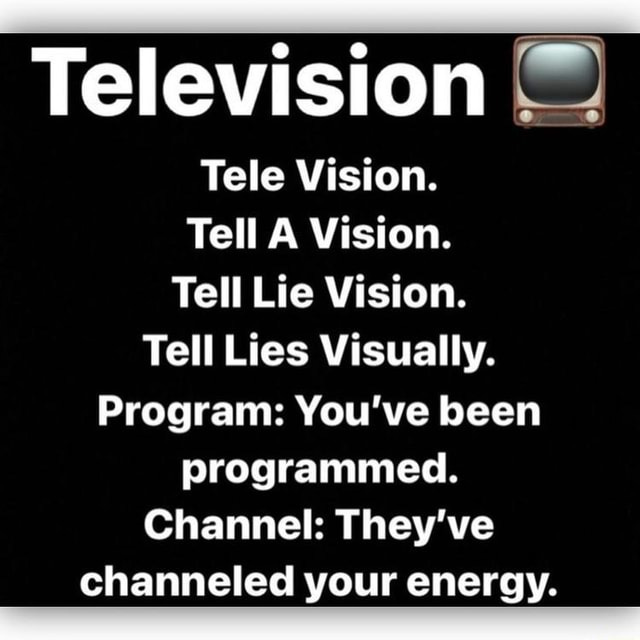
The result, across several decades, is what I am calling the managed revelation sequence — a progression of cultural products, each moving the Overton window one frame further, each making the next step in the disclosure arc emotionally receivable by an audience that was not ready for it the step before. It is not a conspiracy. It is a communications strategy. And in the spring of 2026, with Steven Spielberg’s Disclosure Day dropping in IMAX six weeks from now and Mel Gibson’s Resurrection of the Christ in production with an angel warfare narrative drawn from the Book of Enoch, that strategy is entering its most ambitious phase.
There is a phrase I want to plant here at the opening of this article because it is the most precise description of how the cultural programming operation actually works — and of the only posture that gives an individual genuine agency in relation to it. The conventional wisdom says see it to believe it. The managed revelation sequence depends on its opposite. You have to believe it to see it. The framework you carry determines what you are capable of perceiving when the event arrives. The cultural programmers know this. They are in the business of building the belief before the seeing. Understanding that mechanism is the beginning of using it consciously rather than being used by it.
You have to believe it to see it. The cultural programmers know this. They have been building the belief for decades. The question is whose version of what comes next they are making imaginable — and whether that version serves you.
BRIDGE — Articles 1 through 4 established the factions competing for authority over the transition and the cosmic mechanics driving everyone’s urgency. This article examines the layer of the contest that operates most directly on public consciousness — not through intelligence briefings or congressional testimony but through the most powerful emotional delivery system human civilization has ever produced: the feature film. The cultural programmers are not separate from the power plays examined in the previous articles. They are their public-facing preparation arm.
How Permission Structures Work: The Documented History
The relationship between the American entertainment industry and the national security apparatus is not a theory. It is a documented institutional arrangement with a paper trail going back to World War II and a formal infrastructure that has never been dismantled. The Pentagon’s Entertainment Media Office and the CIA’s Entertainment Industry Liaison Office both exist, both have websites, and both offer production assistance — technical advisors, equipment access, location permissions, script review — in exchange for the kind of creative influence that tends to produce narratives aligned with institutional interests.
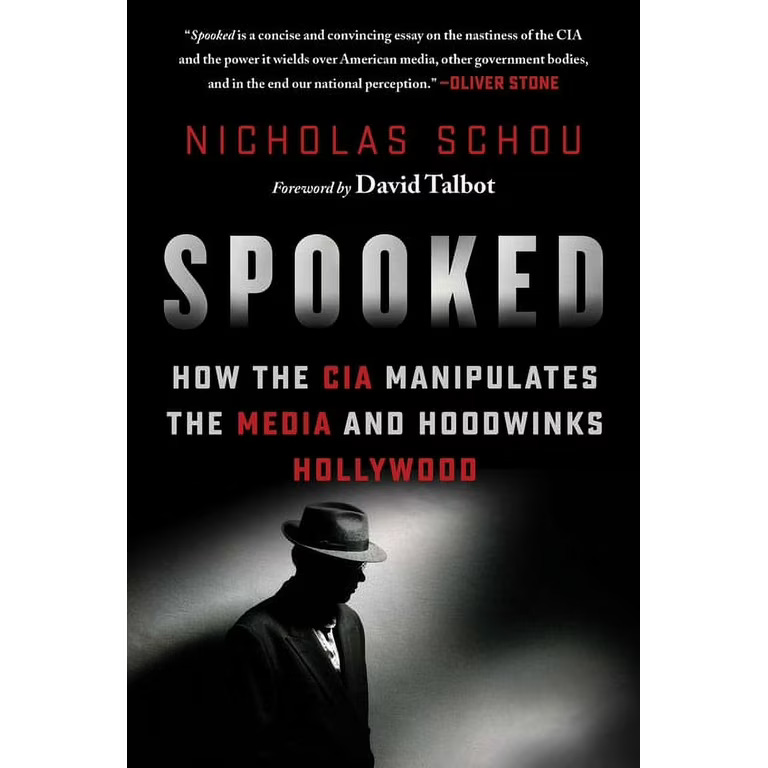
The arrangement is not coercive. No one is forced to accept Pentagon cooperation. But the productions that do accept it gain access to resources that dramatically improve their production value — real military hardware, real locations, real technical expertise — and the productions that decline do not. Over time, the films that look most authentic about military and intelligence subjects are, structurally, the ones that were made with institutional cooperation. The audience cannot distinguish between a film that is authentic because it had access and a film that is authentic because it was shaped by the entity providing access. That indistinguishability is the mechanism.
The UFO and contact narrative has had its own version of this arrangement since at least the 1970s. The 1977 consultation between Spielberg and NASA scientists before Close Encounters of the Third Kind is documented. The role of figures like Jacques Vallee — simultaneously a genuine UFO researcher and a consultant to intelligence-adjacent organizations — in shaping the intellectual framework of the contact narrative is documented. The pipeline between institutional knowledge and cultural product has been open for decades.
SOURCE NOTE — The formal institutional arrangement is documented in Tom Secker and Matthew Alford’s National Security Cinema (2017), which identified over 800 feature films and 1,000 television titles that received Pentagon assistance — with the assistance contingent on script modifications favorable to institutional interests. This is not conspiracy literature. It is sourced from FOIA documents.
https://youtu.be/BsgAuKGPsqw
What this history establishes is not that every contact film is a psyop. It is that the institutional apparatus has had the means, the motive, and the documented practice of shaping popular culture narratives about non-human intelligence for decades. Against that backdrop, the specific convergence of Spielberg and Gibson in the same disclosure window — with the specific narrative functions their films serve — deserves examination as something more than scheduling coincidence.
The question is never whether the films are good. Several of them are extraordinary. The question is what reality each one is preparing you to accept — and whose version of what comes next it is making emotionally imaginable.
The Managed Revelation Sequence: Mapping the Progression
The managed revelation sequence is the emergent pattern of a cultural landscape in which the available tools — film, television, documentary, congressional testimony — have been used, with varying degrees of coordination, to move public consciousness toward a specific threshold of readiness. The progression is visible in retrospect with a clarity that is difficult to attribute entirely to coincidence.
Close Encounters of the Third Kind (1977) First major mainstream normalization of contact with non-hostile non-human intelligence. Establishes the emotional register: wonder, not fear. Government concealment framed as protective rather than predatory.
E.T. the Extra-Terrestrial (1982) Removes the last barrier of adult skepticism by routing the contact experience through a child’s perspective. Makes benevolent NHI emotionally foundational for an entire generation. Spielberg’s most consequential cultural programming work.
Contact (1997) Introduces the ontological shock framework — what happens to human civilization’s self-understanding when contact is confirmed. Frames institutional suppression as coming from religious and political forces rather than military-industrial ones. Manages the threat attribution.
Signs (2002) The first major pivot. Presents NHI as threat rather than contact. Plants the fear register alongside the wonder register. The audience now holds both simultaneously.
Arrival (2016) Sophisticated normalization of non-linear NHI communication and the cognitive demands of genuine contact. Prepares the audience for the idea that understanding NHI requires a fundamental reorganization of human perception, not just translation.
Nope (2022) Jordan Peele’s contribution — NHI as predator, drawn to spectacle, feeding on human attention. The first major mainstream film to present the non-interference violation as biological consumption. Elizondo’s ‘not the apex predator’ language delivered as horror cinema.
Skinwalker Ranch (2020–present) The transition from fiction to documented reality. A real location, real investigators, real anomalous events presented in documentary format on mainstream cable. The Overton window crosses from imagination to evidence.
The Age of Disclosure (2025) 34 government insiders on camera. The fictional frame removed entirely. Congressional testimony normalized as the appropriate venue for this information. The institutional disclosure pipeline given its cultural legitimization.
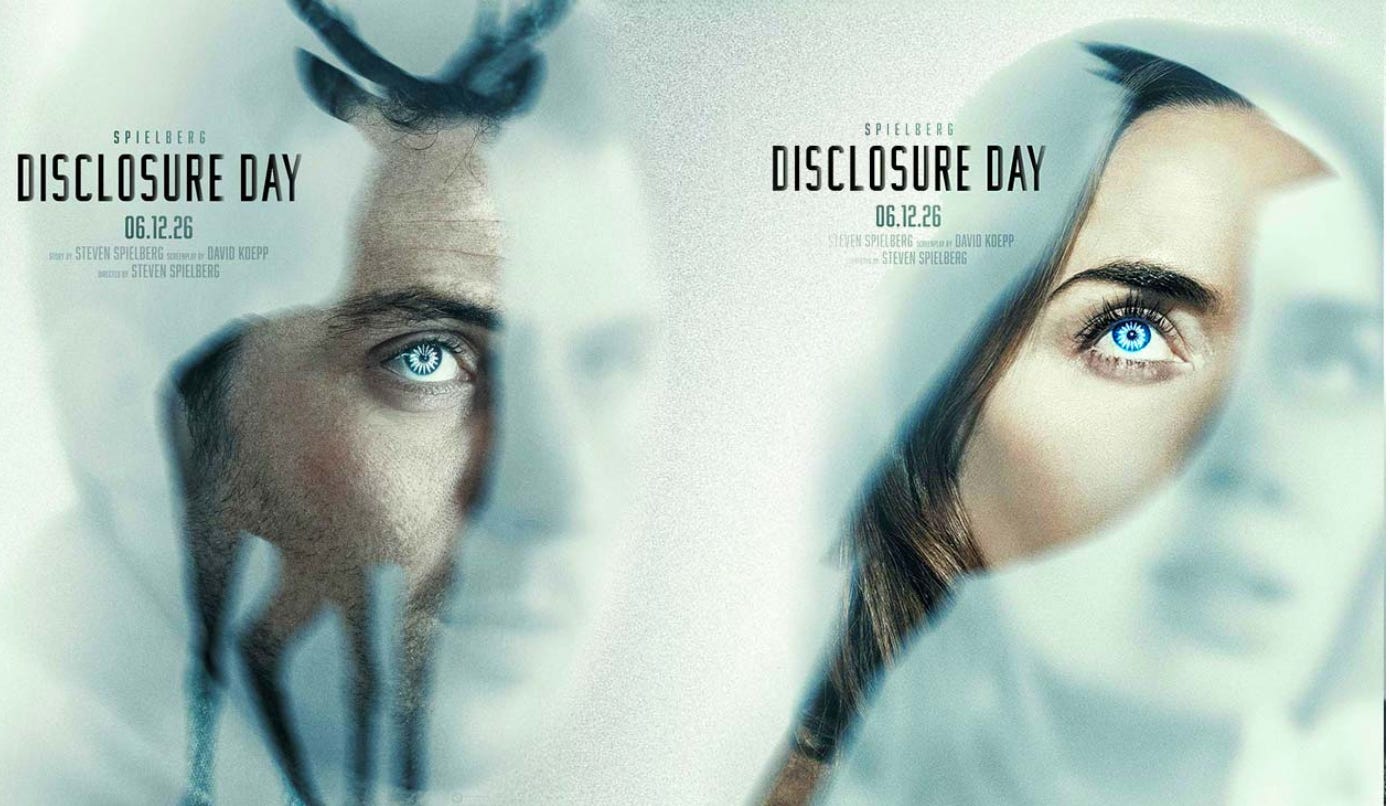
Disclosure Day (June 2026) Spielberg returns. The full-circle moment. The director who built the emotional foundation for contact with E.T. now dramatizes the whistleblower who breaks the institutional suppression. Cultural permission structure and political narrative unified in a single $200 million IMAX event.
The Resurrection of the Christ (2027) Gibson’s cosmic war framework delivered through the most trusted religious filmmaker alive. The Enoch rehabilitation. The interdimensional conflict narrative reaching the Christian audience through the one emotional register that community trusts implicitly.
Mapped this way, the sequence is not random. Each entry addresses a specific psychological barrier in the public’s ability to receive the next step. Wonder established before fear is introduced. Institutional suppression normalized before whistleblowers are celebrated. Fictional framing maintained until the documentary format is ready to receive it. The emotional preparation precedes the informational delivery by years in each case.
The forty-four year gap between E.T. and Disclosure Day is not a gap in Spielberg’s career. It is the distance between the emotional foundation being laid and the political activation of that foundation being safe to attempt. Whether he understands that function consciously or serves it intuitively through his own genuine creative vision is, for the purposes of this analysis, almost irrelevant. The function is the same either way.
The most effective cultural programming is indistinguishable from great art. That is not a criticism of the art. It is an observation about the sophistication of the operation.
Spielberg: The Permission Architect
Steven Spielberg has been the primary architect of Western civilization’s emotional relationship with non-human intelligence for nearly fifty years. Close Encounters established that contact was possible and worth hoping for. E.T. made it personal, intimate, and grievable. Contact — which he produced but did not direct — gave it philosophical weight. And now Disclosure Day arrives as the political culmination of everything those earlier films prepared.
Disclosure Day’s premise is precise and deliberate. A meteorologist and a cybersecurity whistleblower against a corporate suppression apparatus. The whistleblower has access to long-held government secrets about the existence of beings not of this Earth. The corporation wants that information buried. The tagline — ‘people have a right to know the truth, it belongs to seven billion people’ — is not a marketing line. It is a political position, stated without hedging, in the most mainstream venue available. Spielberg is not making a film about whether disclosure should happen. He is making a film that assumes it should and asks the audience to feel why.

The John Williams score is the detail that tells you everything about the institutional weight behind this production. Williams has scored thirty Spielberg films. He is eighty-three years old. He came out of retirement to write this music. That decision — by both men — signals that this is not a commercial project. It is a legacy statement. The director who shaped how a civilization feels about contact is making, with his oldest collaborator, the film he considers the culmination of that work.
The release date is not accidental. June 12, 2026 — thirty-five days after the PURSUE portal drop, weeks before the July 4th announcement window that multiple sources have identified as the target date for a major presidential disclosure statement. The film lands in the period between the informational priming and the political announcement. The audience walks out of the theater emotionally prepared to receive exactly the kind of news that may be coming within weeks. Sequencing this precise does not happen by accident in a $200 million IMAX production with a two-year production timeline.
Spielberg’s films prepare people to feel the right feelings about contact before they are asked to think about it. That emotional preparation is the most important infrastructure in the entire disclosure operation. Without it, the PURSUE portal files land as bureaucratic documents. With it, they land as confirmation of something people have been emotionally ready for since they were eight years old.
Gibson: The Cosmic War Narrative
Mel Gibson is doing something Spielberg cannot do and has never attempted. He is not normalizing contact. He is rehabilitating the cosmic war narrative — the framework in which the non-human intelligences operating in and around this planet are not visitors or neighbors but participants in a conflict that has been underway for millennia, in which humanity is not the audience but the territory being contested.
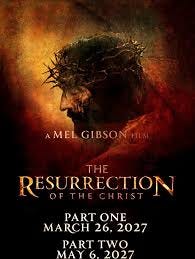
The Resurrection of the Christ — two parts, $200 million, sources close to the production confirm — will include the fall of the angels, interdimensional combat between forces of light and darkness, and a Christ who descends not into comfortable theological abstraction but into the actual architecture of the war the Book of Enoch has been describing for 2,300 years. The Ethiopian Orthodox canon — the only major Christian tradition that never removed Enoch — is the source material. The beings in this film are not extraterrestrials in the Spielberg sense. They are the Watchers. The fallen ones. The progenitors whose transgression the Book of Enoch names as the origin of the control system this series has been mapping across seven articles.

Gibson is the only director alive with the specific combination of capabilities this project requires. The Passion of the Christ demonstrated that he can make a film about sacred violence at a scale and with an emotional intensity that reaches audiences who would never engage with the subject through any other medium. It grossed $612 million worldwide on a $30 million budget, with no major studio distribution, through the sheer force of its emotional and spiritual authority. He has the trust of the Christian audience — the largest single demographic that will need a framework for the demonic NHI hypothesis — in a way no other filmmaker does.
When Elizondo says elements inside the Pentagon genuinely believe the phenomenon involves entities that traditional theology would call demons — when Tucker Carlson’s witnesses and Ross Coulthart’s sources describe higher-dimensional beings in terms that map onto the Enoch framework rather than the Spielberg framework — the Gibson film is the cultural permission structure that makes that revelation receivable by an audience that has no other emotional map for it. Spielberg prepares the audience for contact. Gibson prepares the audience for war. Both preparations are necessary for what appears to be coming.
Two directors. Two films. Two entirely different emotional registers for the same underlying reality. The audience gets to choose which framework they receive the disclosure through. But both frameworks have been carefully prepared for them in advance.
The Interpretive Fork in Practice
We identified the interpretive fork in Article 1 as one of the two simultaneous destinations the disclosure is heading toward. Here, in the cultural programming layer, it is most clearly visible.
INTERPRETIVE FORK — The contact frame — Spielberg’s register — produces a public oriented toward the galactic community as a positive development. It pre-authorizes the GFL and Confederation models as the natural next step: we are not alone, our neighbors have arrived, let us join the community of worlds. The cosmic war frame — Gibson’s register — produces a public that is spiritually mobilized and oriented toward the biblical and esoteric traditions as the interpretive apparatus for what has been operating in the shadows. It pre-authorizes the Watcher framework and the resistance to any administrative handover to non-human authority. Both frames are being deployed simultaneously. The audience segment that receives each will determine the political landscape of the post-disclosure period.
The sophistication of running both simultaneously is worth pausing on. A disclosure operation that produced only the contact frame would face the organized resistance of the Christian and traditional religious communities — the largest single demographic that would reject any narrative undermining their theological worldview. By running the Gibson cosmic war frame in parallel, that community is not left without a framework. They are given the most resonant version of their own tradition’s account of the same events — one that validates rather than threatens their cosmological worldview while simultaneously expanding it to include the non-human dimension. But, isn’t that always what the Holy Ghost or Holy Spirit was always about?

This is masterful audience segmentation applied to the most consequential informational challenge in human history. The question it does not answer — and that this series has been built to ask — is whose interests each frame ultimately serves. The contact frame pre-authorizes an administrative handover to galactic authority. The cosmic war frame pre-authorizes the resistance and accountability movements. Both are being prepared. Both serve specific factions in the contest for what comes next. The prepared observer holds both frames simultaneously and applies the barometer to each: what does it do to the people inside it? Does it move them toward agency or toward waiting for someone else to determine the outcome?
Great art changes what people are willing to feel. And what people are willing to feel determines what they are willing to accept. The cultural programmers are not the most powerful actors in the disclosure operation. They are the most important ones.
You Have to Believe It to See It
I want to close this article with something that sits at the intersection of my thirty years in this space and my genuine love of cinema — because those two things are not in tension for me and I do not want to give the impression that they are.
I have wept at Spielberg films. I have been moved, genuinely and repeatedly, by work that I now understand also serves an institutional function I was not consciously aware of while experiencing it. Those two things are both true simultaneously. The emotional authenticity of the experience does not cancel the analytical observation about the function. And the analytical observation does not diminish the emotional experience. What it does is add a layer of responsibility to it.
If I know that the film I am about to watch has been designed — at least in part, whether by intention or by the invisible hand of institutional shaping — to prepare me to accept a specific version of a coming reality, then I owe it to myself to watch it with that awareness active rather than suspended. Not to refuse the emotional experience. But to hold the emotional experience and the analytical question simultaneously. To let myself feel what the film wants me to feel — and then to ask what that feeling is being used for.
The conventional wisdom says I will believe it when I see it. That is the epistemology of the managed — the posture that places all authority with the external event, the institutional confirmation, the sanctioned source, and makes the individual a passive recipient of whatever reality is permitted to reach them.
The epistemology this series has been building toward is its exact inversion. You have to believe it to see it. The framework you carry determines what you are capable of perceiving when the event arrives. The flowers that have been tended bloom more fully. The mind that has been prepared receives more completely. The person who has already done the internal work of expanding what they consider possible arrives at the disclosure moment with their own discernment intact rather than borrowing someone else’s.
The cultural programmers know this. They have been building the belief for decades — in both directions, through both emotional registers, for every audience segment. Spielberg’s Disclosure Day and Gibson’s Resurrection are the most ambitious expression of that project yet attempted. They will be extraordinary. They will move people. They will change what significant portions of the public are willing to consider.
Watch them. Feel everything. And then ask whose version of the future just became imaginable — and whether that version serves you.
Eyes to see it.
Series Roadmap — Everybody Wants to Rule the World
Article 1 — The Convergence Moment [Published]
Article 2 — The Bloodline Argument [Published]
Article 2B — The Cosmic Clock [Published]
Article 3 — The Galactic Franchise Bids [Published]
Article 4 — The Earthside Power Plays [Published]
Article 5 — The Cultural Programmers [You are here]
Article 6 — The Media Cascade: How a Fringe Conversation Becomes Consensus, and Who Orchestrates the Bandwidth Shift
Article 7 — The Litmus Test: You Will Know Them by Their Deeds — A Field Guide to the Transition
— Gerry
Gerry Gomez is an investigative journalist, creative director, and hybrid war correspondent who has spent a decade documenting the convergence of financial, media, and geopolitical forces shaping the current global transition.

Your Tax Free Donations Are Appreciated and Help Fund our Volunteer Website
Disclaimer: We at Prepare for Change (PFC) bring you information that is not offered by the mainstream news, and therefore may seem controversial. The opinions, views, statements, and/or information we present are not necessarily promoted, endorsed, espoused, or agreed to by Prepare for Change, its leadership Council, members, those who work with PFC, or those who read its content. However, they are hopefully provocative. Please use discernment! Use logical thinking, your own intuition and your own connection with Source, Spirit and Natural Laws to help you determine what is true and what is not. By sharing information and seeding dialogue, it is our goal to raise consciousness and awareness of higher truths to free us from enslavement of the matrix in this material realm.