EN
EN FR
FR

There’s a scene in Robert Cialdini’s Influence where he describes a waiter named Vincent — the highest-earning server in an expensive restaurant, by a significant margin. Vincent’s secret wasn’t charm or efficiency. It was that he occasionally talked customers out of ordering something. He’d lean in conspiratorially, glance over his shoulder for the manager, and suggest a cheaper alternative. Customers trusted him completely after that. Because someone willing to argue against their own interests must be telling the truth.
The scene keeps coming back to me as I watch the Trump administration’s media campaign unfold.
Not because the administration is being honest. The opposite. But because the architecture of what they’re doing is, in a perverse way, equally sophisticated. They’re not banning anything. They’re not ordering anyone to do anything. They’re just creating enough ambient uncertainty — about where the line is, about what the cost of crossing it might be — that the industry regulates itself. And self-regulation, unlike imposed censorship, is invisible. You can’t protest something that nobody officially did.
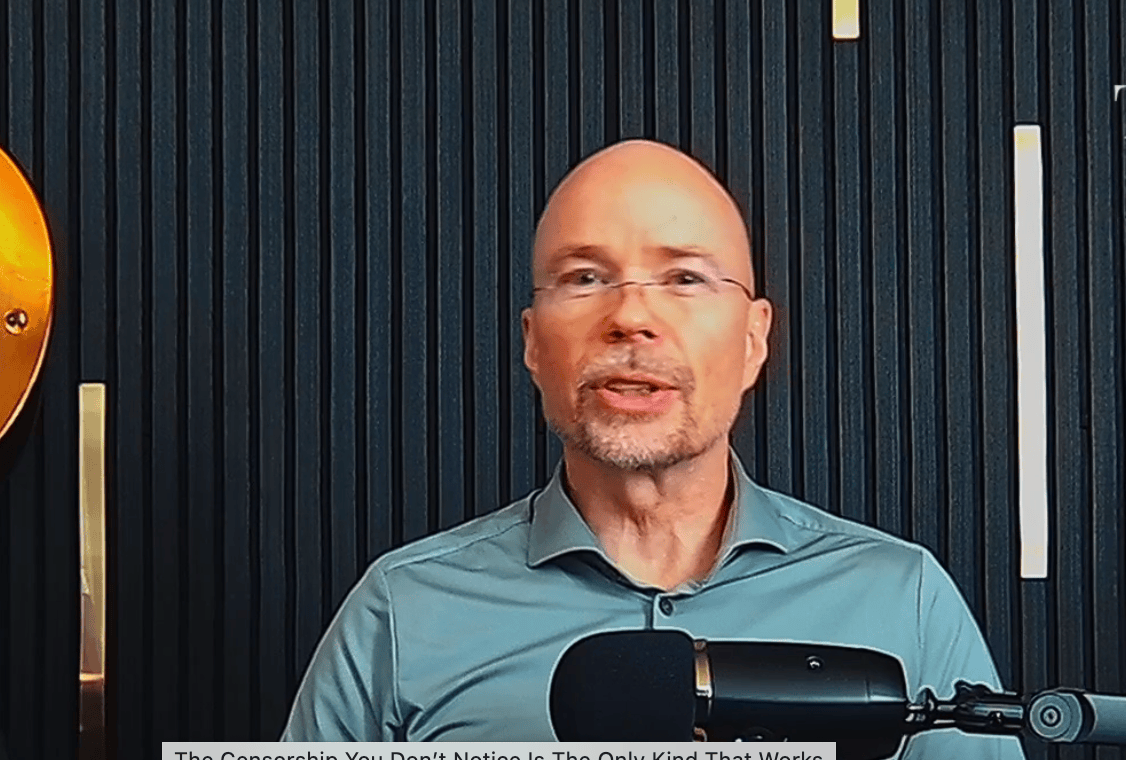
The video above goes into the mechanics of this in detail — the FCC threats, NSPM-7, NATO’s cognitive warfare doctrine, the EU’s FIMI framework, and the $111 billion media transaction that is quietly rearranging who controls what Americans watch and read. I’d encourage you to watch it. What I want to do here is go somewhere the video doesn’t.
The reason this works is older than politics.
Elisabeth Noelle-Neumann, a German political scientist, spent decades studying a phenomenon she called the spiral of silence. Her core finding: people don’t form opinions in isolation. They’re constantly scanning their social environment for signals about what views are safe to express. When they sense that a position is becoming minority or stigmatised — even if they personally hold it — they fall quiet. Not because they changed their mind. Because the social cost of speaking started to outweigh the benefit.
The spiral works in both directions simultaneously. The silent majority appears smaller than it is, which makes the vocal minority appear larger than it is, which makes more people go quiet, which amplifies the minority further. A feedback loop that can reshape public discourse without a single act of censorship.
This is what the chilling effect exploits at the institutional level. When the FCC chair implies a broadcaster’s license is at risk, he isn’t targeting that broadcaster alone. He’s sending a signal into the entire information ecosystem about what is and isn’t safe to produce. Every producer, every editor, every network executive does the math — not consciously, not in a meeting, but in the thousands of small decisions that constitute editorial culture. What angle is worth the fight? What story isn’t? The censorship happens in those micro-decisions, diffusely, invisibly, with no single author.
This, by the way, is why the administration’s critics keep making what I think is a tactical error. They focus on whether Carr’s threats are legally enforceable. The lawyers are right that they probably aren’t. But that’s like debating the structural integrity of a bully’s fist. The fist doesn’t need to land to change your behaviour. It just needs to exist.
Here’s the part that genuinely surprised me when I was researching the full piece.
The most effective historical examples of information control have almost never been the overtly brutal ones. Soviet censorship — the kind with gulags and disappeared journalists — produced a distinct pathology: everyone knew the official narrative was false, because the enforcement was visible enough to reveal the gap between what was said and what was real. The propaganda was so heavy-handed it became its own kind of transparency.
The subtler variants are far more dangerous, precisely because they leave no obvious gap. When journalists self-censor, the coverage that gets produced still looks like journalism. It has bylines and sources and the visual grammar of independent reporting. The absence — the story not pursued, the angle not taken, the question not asked — is structurally invisible. Nobody can point to it. Nobody can protest it. The reader has no way of knowing what they’re not reading.
This is what makes the Substack piece I published last week worth your time. It traces the policy infrastructure behind what looks, on the surface, like an angry president venting about bad press. What it actually documents is the simultaneous construction, across three distinct jurisdictions — the US executive branch, NATO, and the EU — of institutional frameworks that share a common logic: that information environments are security domains, that certain speech patterns constitute threats, and that state or state-adjacent bodies have both the legitimacy and the tools to respond. Not necessarily by removing content. By reclassifying it.
Go read it. The sources are all primary. Every claim is linked. And the picture it draws is considerably more unsettling than any individual news story from the past week — because it shows you the architecture rather than just the furniture.
One more thing, because it matters to this channel specifically.
Noelle-Neumann’s spiral of silence research contained a finding she herself found uncomfortable: the mechanism works even when people know about it. Awareness of the dynamic doesn’t automatically break it. What breaks it — her research suggested, and subsequent work has broadly confirmed — is visible dissent. When people see others expressing minority views publicly, the spiral slows. The perception of isolation is disrupted. Others feel the permission to speak.
This is, in a non-grandiose way, what independent media does. Not by having the biggest audience. But by being visible. By demonstrating that certain questions get asked, certain analyses get published, regardless of whether a regulator finds them convenient.
Which is why the algorithmic suppression of this kind of content isn’t incidental. It’s structural. A channel that used to pull a hundred thousand views and now pulls a few thousand isn’t just a business problem. It’s a data point in a larger pattern. The video explains that pattern. The full article documents it. I’d ask you to share both — not as a favour to me, but because visibility, right now, is doing actual work.
Accompanying video here: the-censorship-you-dont-notice

Your Tax Free Donations Are Appreciated and Help Fund our Volunteer Website
Disclaimer: We at Prepare for Change (PFC) bring you information that is not offered by the mainstream news, and therefore may seem controversial. The opinions, views, statements, and/or information we present are not necessarily promoted, endorsed, espoused, or agreed to by Prepare for Change, its leadership Council, members, those who work with PFC, or those who read its content. However, they are hopefully provocative. Please use discernment! Use logical thinking, your own intuition and your own connection with Source, Spirit and Natural Laws to help you determine what is true and what is not. By sharing information and seeding dialogue, it is our goal to raise consciousness and awareness of higher truths to free us from enslavement of the matrix in this material realm.